
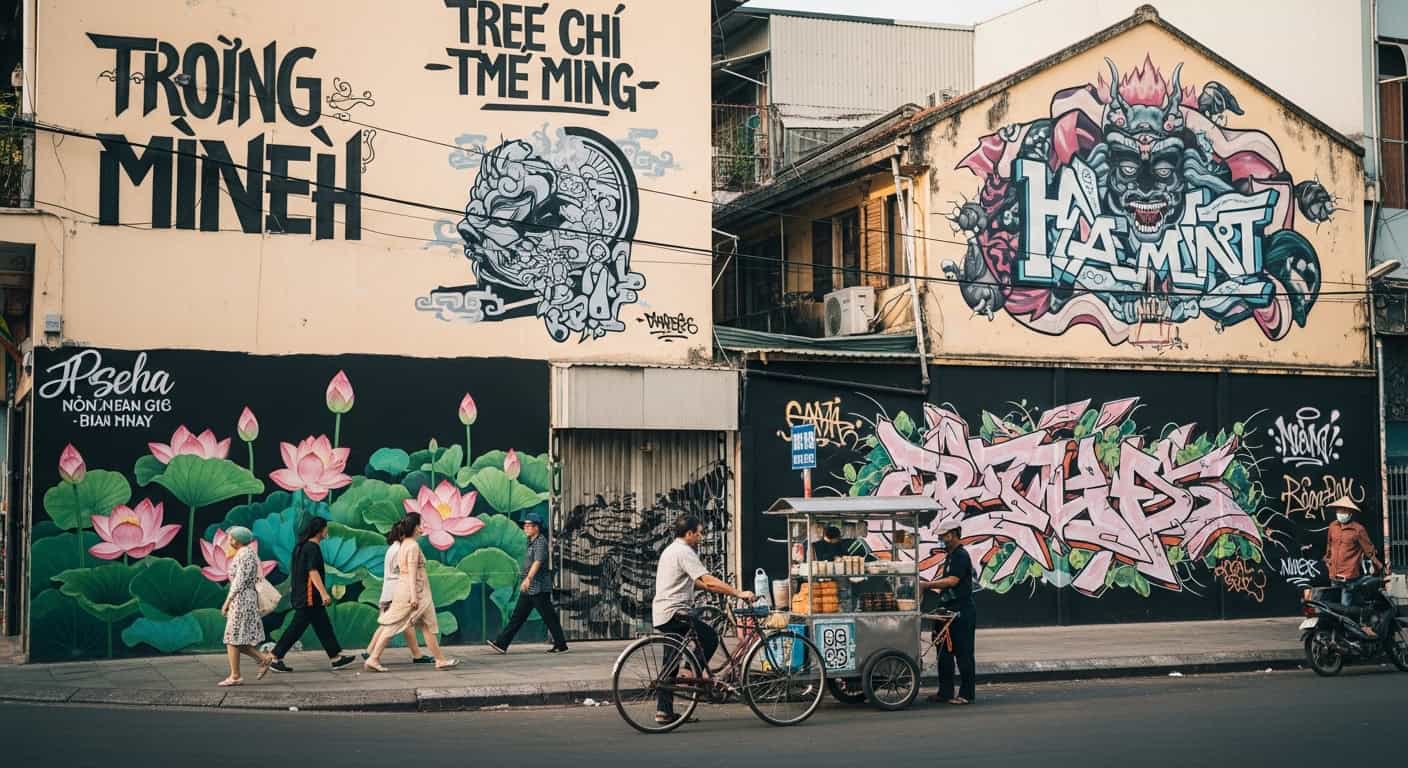
The best graffiti walls Saigon are concentrated in Districts 1, 3, and 4, where local crews and international artists have transformed blank concrete into vivid large-scale murals that rival any city in Southeast Asia. Ho Chi Minh City’s urban art scene has exploded since 2018, making it one of the region’s top destinations for street art lovers, photographers, and culture-curious travelers seeking something beyond the standard tourist trail.
Key Takeaways
- Saigon’s most concentrated graffiti walls are found along Bui Vien Street, the Nguyen Cu Trinh corridor in D1, and the underpass stretches of D4.
- The city hosts an annual street art festival that draws artists from Vietnam, Europe, and Australia, with over 60 new murals added between 2023 and 2025.
- Most graffiti walls in HCMC are free to visit and accessible on foot or by motorbike taxi.
- Early morning (6–8 am) offers the best light for photography and avoids the midday crowd at popular spots.
- Several co-working cafes and art collectives near D1’s mural zones run weekend walking tours for a deeper cultural experience.
Graffiti Walls Saigon: Why Saigon Has Become a Street Art Capital
Few cities in Asia have embraced urban art as quickly as Ho Chi Minh City. What started as guerrilla tags on abandoned warehouses in the early 2010s has evolved into a city-sanctioned and community-driven movement. The municipal government’s 2019 “Creative City” initiative opened up dozens of public walls for legal murals, and neighborhood associations in Districts 1 and 3 began commissioning local collectives to beautify alley entrances. By 2024, a survey by the Vietnam Urban Art Association counted more than 400 documented public murals across the city — a 140% increase from 2019. That transformation is why graffiti walls Saigon searches have climbed steadily on Google, drawing visitors who want to explore the city through its art.

The Nguyen Cu Trinh Street Mural Corridor
Running through the heart of District 1, Nguyen Cu Trinh Street is the single most important address for graffiti walls Saigon visitors. The 400-metre corridor is lined with oversized murals depicting Vietnamese cultural history, abstract geometric patterns, and social commentary pieces by both local artists and invited international painters. The walls are maintained and periodically refreshed, so there is almost always something new to photograph. Key names to look for include Ha Nguyen, whose hyper-detailed lotus-and-cityscape fusion pieces appear on three consecutive panels, and the collective Sai Gon Ink, which brought a distinctly northern Vietnamese visual language southward. Arrive before 8 am and you will have the corridor largely to yourself.
Bui Vien Walking Street: Neon After Dark
Bui Vien is famous for its backpacker bars and neon signs, but the side alleys branching off the main strip contain some of the most photographed graffiti walls Saigon has to offer. The art here leans toward psychedelic and pop-culture themes — expect portraits of Vietnamese icons alongside surrealist collages and large-scale stencil work influenced by Banksy’s visual language. After dark the murals interact with neon bar signage in a way that is almost cinematic; this is ground zero for Instagram reels and travel photography. The density of art per square metre makes it worth a slow, deliberate walk rather than a quick pass-through.
District 4 Underpasses and River-Wall Art
Cross the bridge into District 4 and the character of street art shifts noticeably. The highway underpasses between Ton That Thuyet and Hoang Dieu streets host sprawling abstract works that reflect D4’s working-class, maritime roots. Local artist collective Mau Nuoc (Water Color) has been painting these walls since 2020, producing narrative panels that tell the story of the district’s fishing communities and riverside trade. The scale here is massive — some pieces run 30 metres end to end. Unlike the curated corridors of D1, D4 retains a rawer energy, and you will often find artists actively working on new sections on weekend mornings. This authenticity makes it one of the most compelling graffiti walls Saigon destinations for serious art travellers.
The Pham Ngu Lao Arts Quarter
The backpacker district around Pham Ngu Lao has quietly developed into an arts micro-district, with gallery-cafes commissioning exterior murals that spill from their walls onto neighbouring buildings. The art here is more commercial and polished than D4’s raw underpasses, but no less impressive in scale or craft. Look for the 12-metre triptych on De Tham Street celebrating Vietnamese women’s history, repainted and updated in early 2025. Several shops sell prints and merchandise from the artists whose work appears on surrounding walls, giving visitors a direct way to support the local creative economy. Graffiti walls Saigon photography walks regularly include this zone as a midpoint stop between Bui Vien and Nguyen Cu Trinh.

Hidden Gems: Alley Art in Districts 3 and 10
Beyond the well-documented zones, Districts 3 and 10 contain alley networks where spontaneous and semi-organised murals appear without fanfare. Hem 47 on Vo Van Tan in D3 is a narrow passage that has been adopted by students from the HCMC University of Fine Arts as an informal outdoor studio. Works change frequently — sometimes monthly — making repeat visits genuinely rewarding. In D10, the community around the Nguyen Tri Phuong market corridor has developed a neighbourhood beautification programme that has produced over 30 individual murals since 2022. These lesser-known graffiti walls Saigon spots reward exploration and often lead to conversations with residents who take visible pride in their neighbourhood’s transformation.
International Festivals and Landmark Murals
Saigon’s annual Urban Colours Festival, held each March, is the single biggest driver of new graffiti walls Saigon visitors. The 2025 edition brought 34 artists from 12 countries to paint 20 new large-scale works across four districts over five days. According to festival organisers, the 2024 event generated an estimated 8,000 visitor trips specifically tied to street art tourism — a figure that underscores how significantly urban art has entered HCMC’s cultural identity. Landmark murals from past festivals include the 18-metre koi fish piece on Bach Dang Wharf (2023) and the abstract cityscape panel on Ly Tu Trong that was featured in Conde Nast Traveller’s 2024 Southeast Asia feature.
Photography Tips for Capturing Saigon Street Art
Getting the best shots from graffiti walls Saigon locations requires a little planning. Golden hour (6–7:30 am) gives warm, even light that eliminates the harsh shadows cast by adjacent buildings in the middle of the day. A wide-angle lens or the ultra-wide mode on a modern smartphone handles the scale of larger panels without distortion. For the neon-lit alley art around Bui Vien, shoot at dusk when ambient and artificial light are roughly balanced — pure night shots tend to blow out neon and lose mural detail. Always check whether local artists have posted “no commercial photography” notices on their pieces, and where tour groups or commercial shoots are in progress, give way to local photographers who depend on these walls for their income.
Guided Walking Tours vs Self-Guided Exploration
Several operators run dedicated street art walking tours starting from D1. The most established — XO Tours and Saigon Street Art Walks — charge between 350,000 and 600,000 VND per person (roughly USD 14–24) for a 2.5-hour circuit covering the main graffiti walls Saigon hotspots with artist background provided by local guides. Self-guided exploration is equally viable if you download an offline map and use the community-maintained HCMC Street Art Map project (available as a PDF from multiple traveller forums). The self-guided route gives you more time at each location and the freedom to deviate into alleys that organised tours skip for logistical reasons. Both approaches suit different travel styles; first-timers generally benefit from a guided tour, while returning visitors or art professionals tend to prefer solo exploration.
Where to Stay to Access Saigon’s Mural Zones
Location matters more than you might expect when planning a street art itinerary. The core graffiti walls Saigon corridors in Districts 1 and 3 are compact enough to cover on foot if you are based in central D1, but staying further out in D7 or Binh Thanh adds 20–40 minutes of transit each way. Live where the art is. Our D1 apartments sit minutes from Saigon’s most photographed street art installations, placing you within walking distance of Nguyen Cu Trinh, Pham Ngu Lao, and Bui Vien from the moment you step outside. For travellers who want to combine morning mural walks with evening bar-crawls or daytime cafe-hopping, central D1 accommodation removes every logistical friction point.
Respecting the Art and the Community
Saigon’s street art scene thrives because residents and local government have largely embraced it, but that relationship depends on visitors behaving respectfully. Do not touch or lean against murals — oils from skin cause paint to lift, especially on older pieces. Avoid blocking traffic or pedestrian flow while photographing. Ask permission before including local residents in shots taken near murals on their street. When visiting unofficial or semi-legal pieces in alley networks, keep noise levels down, particularly early in the morning. The Vietnamese phrase “Toi co the chup anh khong?” (May I take a photo?) goes a long way with residents who live alongside the art. Treating these spaces with consideration ensures they remain open and vibrant for every visitor who follows you.
Planning Your Saigon Street Art Day Trip
A well-structured day covering the main graffiti walls Saigon destinations runs approximately eight hours at a relaxed pace. Start at Nguyen Cu Trinh at 6:30 am for golden-hour photography, then move to the Pham Ngu Lao cluster by 8:30 am before it fills with tourists. A late breakfast at one of the alley cafes on De Tham transitions naturally into the Bui Vien alley art circuit, best seen in mid-morning light. After lunch, take a Grab bike to D4 for the underpass murals, which receive afternoon light from the west. Finish in D3’s Vo Van Tan alleys as the day cools. This circuit covers roughly 6 kilometres of walking with short motorbike rides between zones, and is manageable without a guide for any traveller comfortable navigating HCMC’s streets.
You May Also Find Useful
Frequently Asked Questions
- Where are the best graffiti walls Saigon visitors should see first?
- The Nguyen Cu Trinh Street mural corridor in District 1 is the best starting point — it is compact, well-maintained, and contains some of the city’s highest-quality large-scale work. From there, the Bui Vien alley network and Pham Ngu Lao arts quarter are within easy walking distance.
- Is street art in Ho Chi Minh City legal?
- Much of it is. Since the 2019 Creative City initiative, the HCMC municipal government has designated dozens of public walls for authorised murals, and community-commissioned work in districts 1, 3, and 4 is fully sanctioned. Some pieces in alley networks exist in a grey area but are tolerated by local residents and authorities.
- What time of year is best to visit for street art?
- March coincides with the Urban Colours Festival and guarantees freshly painted new murals. The dry season (December to April) offers better photography conditions than the wet season. That said, the murals are accessible year-round, and rain can add interesting reflective effects to the neon-lit Bui Vien pieces.
- How often are the murals changed or updated?
- It varies by location. The Nguyen Cu Trinh corridor receives partial refreshes roughly every 12–18 months. D4 underpass works are updated more frequently, sometimes within weeks. Alley murals in D3 near the Fine Arts University can change monthly. Following local artist collectives on social media is the best way to track new additions.
- Are there any entry fees to see graffiti walls in Saigon?
- All outdoor public murals are free to view. Guided walking tours cost 350,000–600,000 VND per person. Some gallery-cafes in the Pham Ngu Lao zone that commission exterior murals appreciate a coffee purchase if you spend time photographing their walls, though there is no formal charge.
Official Resources
For the most up-to-date information on graffiti walls saigon, visit the HCMC Department of Culture and Sports.