
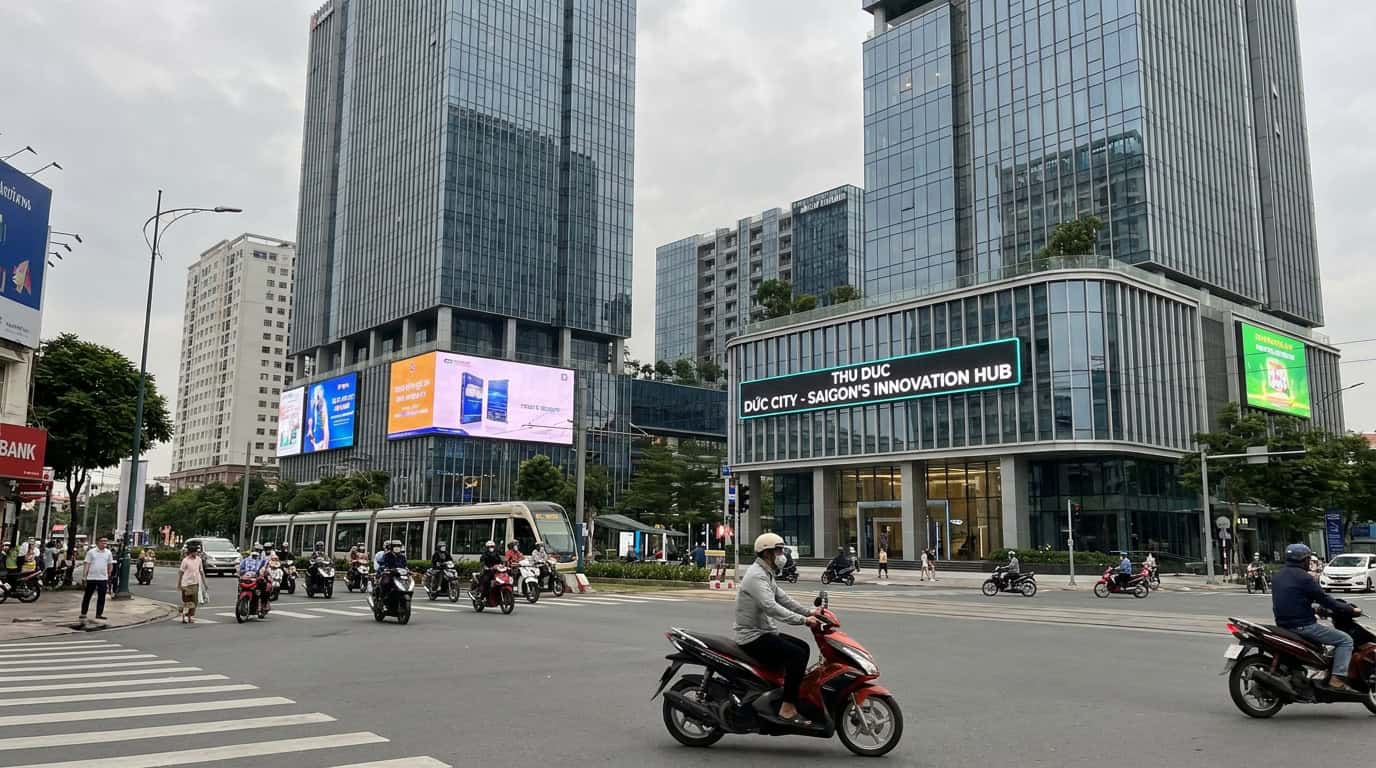
Thu Duc City Saigon is a city-within-a-city — a sprawling urban district formed in December 2020 by merging the former districts of Thu Duc, District 2, and District 9 into one administrative unit on the eastern edge of Ho Chi Minh City. It covers roughly 211 square kilometres, houses around one million residents, and represents the largest urban restructuring project Vietnam has attempted in decades. If you’re trying to figure out where it sits, how it works, and whether it matters to you as an expat or visitor, this guide covers everything.
Key Takeaways
- Thu Duc City was officially established on 1 January 2021 by merging Districts 2, 9, and Thu Duc — making it the first “city within a city” in Vietnam.
- According to the Ho Chi Minh City Department of Planning and Investment, Thu Duc City accounts for roughly 30% of the city’s GDP and hosts the majority of HCMC’s tech and innovation economy.
- The district is home to Saigon Hi-Tech Park, Vietnam’s largest technology zone, and the National University Village, which educates over 100,000 students annually.
- Property prices in Thu Duc have risen steeply since 2021, with premium riverside projects in Binh Thanh and Thu Thiem commanding prices comparable to District 1.
- Most expats working in HCMC’s central business district still live in Districts 1, 3, or Binh Thanh — Thu Duc suits those working in tech, education, or manufacturing.
What Is Thu Duc City and How Did It Come to Exist?
On 1 January 2021, Vietnam’s government formally merged three eastern districts of Ho Chi Minh City — District 2, District 9, and the old Thu Duc District — into a single administrative entity called Thu Duc City. According to the Ho Chi Minh City People’s Committee, the merger was designed to streamline governance, attract foreign investment, and create a unified development corridor stretching from the Thu Thiem New Urban Area in the south to the Saigon Hi-Tech Park in the north-east. The move was unprecedented: no other Vietnamese city had ever created a subordinate “city” within its own boundaries.

The rationale was straightforward. All three districts shared a common geography along the north-eastern bank of the Saigon River, and each had been developing independently in ways that duplicated infrastructure and fragmented planning. Merging them allowed a single authority to coordinate the metro extension, road upgrades, flood mitigation work, and investment zoning that the corridor needed. In practice, the transition has been gradual — many locals still refer to the component areas by their old district names, and administrative offices are still consolidating.
Where Exactly Is Thu Duc City Saigon on the Map?
Thu Duc City occupies the north-eastern quadrant of Ho Chi Minh City, bordered by the Saigon River to the west and south, Binh Duong Province to the north, and Dong Nai Province to the east. It’s separated from central Saigon by the river, which means getting to District 1 traditionally required crossing one of a handful of bridges — most commonly the Thu Thiem Tunnel, the Saigon Bridge, or the newer Thu Thiem 2 Bridge, which opened in April 2022.
The internal geography divides into three recognisable zones that locals still use:
- Former District 2 (south-west) — includes Thu Thiem New Urban Area, An Phu, Thao Dien, and the riverside luxury condo belt. This is the most internationally recognised part of Thu Duc City Saigon.
- Former Thu Duc District (north-west) — older residential neighbourhoods, Linh Dong, and sections of the National University Village. More affordable, predominantly Vietnamese residential.
- Former District 9 (east) — Saigon Hi-Tech Park, Long Binh industrial zones, newer suburban developments. The tech and manufacturing backbone.
The Thu Thiem New Urban Area: Thu Duc City Saigon’s Showpiece
Thu Thiem is the development everyone points to when they talk about Thu Duc City’s ambitions. Planned since the 1990s and built out aggressively from 2015 onwards, Thu Thiem sits directly across the river from District 1 — close enough that on a clear evening you can see the Bitexco Financial Tower from the embankment promenade. According to a 2024 report by CBRE Vietnam, grade-A office rents in Thu Thiem averaged USD 35–42 per square metre per month, approaching the upper range of District 1 rates.

The district hosts the Empire City mixed-use towers, the Sala urban development, and the proposed HCMC Financial Centre — a long-delayed project that, if completed, is intended to position Thu Thiem as a regional finance hub to rival Singapore’s Marina Bay at a fraction of the cost. The promenade along the Thu Thiem waterfront has become a legitimate weekend destination, drawing joggers, food trucks, and families from across the city.
Saigon Hi-Tech Park and the Tech Economy
In the former District 9, Saigon Hi-Tech Park (SHTP) is one of the reasons Thu Duc City matters economically. Established in 2002, it has grown into Vietnam’s largest technology and R&D zone, hosting companies including Intel, Samsung, Jabil, and Nidec. According to the Saigon Hi-Tech Park Management Board’s 2024 annual review, the park generated over USD 20 billion in export revenue that year — representing a significant share of HCMC’s total industrial output.
The park’s presence has shaped the surrounding neighbourhoods. Long Thanh My and Phuoc Long B wards have filled with engineer housing, international schools catering to Korean and Taiwanese expat families, and a cluster of Korean restaurants and convenience stores along National Highway 1A. If you’re working in tech manufacturing, SHTP puts you squarely in Thu Duc — not District 1.
The National University Village: Education Hub of HCMC
Straddling the former boundary between District 9 and old Thu Duc District, the National University Village (Lang Dai hoc Quoc Gia) clusters Vietnam National University HCMC’s constituent campuses alongside Ho Chi Minh City University of Technology, the University of Science, the University of Social Sciences and Humanities, and a dozen smaller institutions. Over 100,000 students study here, creating the kind of dense young population that sustains cheap food streets, motorbike repair shops, and late-night pho joints around the clock.
For expat academics or researchers, this zone offers affordable housing, proximity to English-language research communities, and direct bus links to the city centre. It isn’t glamorous, but it works.
Getting Around: Transport Links Into and Within Thu Duc City Saigon
Transport has historically been Thu Duc’s biggest limitation, and it remains a work in progress. The Saigon River crossings — Thu Thiem Tunnel, Thu Thiem 2 Bridge, Saigon Bridge, Binh Loi Bridge — funnel traffic and back up badly during rush hour. The ring roads (Hanoi Highway, National Highway 1A, Mai Chi Tho Avenue) carry heavy truck and commuter loads.
Metro Line 1, the Hanoi Highway metro running from Ben Thanh Station in District 1 to Suoi Tien in District 9, has been under construction since 2012 and reached operational testing in 2024. According to the Ho Chi Minh City Metro Management Authority, full passenger services were expected to begin commercial operations in late 2024, with the completed line covering 19.7 kilometres and 14 stations through the heart of Thu Duc City. When fully operational, it will cut the journey from the Saigon Hi-Tech Park area to District 1 from 40–60 minutes by car to around 25 minutes by rail.
Within Thu Duc, motorbike remains king. Grab is reliable throughout. Public buses link most wards but are slow. The absence of good east–west connectors within Thu Duc itself — running perpendicular to the Hanoi Highway spine — makes getting between former District 2 and former District 9 more awkward than the map suggests.
Where to Live in Thu Duc City: Neighbourhoods for Expats
The residential picture varies dramatically by sub-area. Former District 2 — particularly Thao Dien, An Phu, and the riverfront in Binh An — has been the default expat residential zone for HCMC for over a decade. Thao Dien specifically retains a village-within-a-city character: tree-lined lanes, independent cafes, international schools (ISSP, Saigon Pearl International, various bilingual options), and a weekend farmers’ market atmosphere. Rents here run from USD 800 for a basic two-bedroom apartment up to USD 3,000+ for a serviced villa.
Thu Thiem, by contrast, is newer and more corporate. The Sala and Metropole developments offer high-rise units with river views and full amenity packages, but the street-level commercial life remains thin — the neighbourhood hasn’t had time to develop the organic texture that makes Thao Dien liveable day-to-day.
Further east in former District 9, housing is cheaper but commutes to the centre are longer. This zone suits expats whose daily destination is SHTP or the university village, not Le Van Luong or Pasteur Street.
Thu Duc is the future; D1 is the now. Most expats choosing HCMC for work still base themselves in the centre — in Districts 1, 3, or Binh Thanh — because proximity to the CBD, the airport expressway, and the established food and social scene outweighs the space and value advantages that Thu Duc offers. That calculus shifts once Metro Line 1 is fully running.
Food, Nightlife, and What to Do in Thu Duc City Saigon
Thu Duc City Saigon doesn’t have the concentrated dining and nightlife strip that Bui Vien or the District 3 cafe quarter offers, but it has pockets of genuine quality. Thao Dien’s restaurant scene covers Japanese, Korean, Italian, French, and Vietnamese cuisines at a standard you’d expect in a well-funded expat neighbourhood. The Estella Place and Crescent Mall shopping centres (technically in former District 2) anchor a mid-market retail and dining circuit.
The Thu Thiem waterfront promenade has become one of the better evening walks in HCMC — the skyline view back across the river to District 1 is legitimately impressive after dark. Weekend markets operate seasonally. The Vincom Mega Mall Royal City equivalent for this side of the river is Vincom Mega Mall Thu Duc, which opened in 2022 and anchors the retail offer for the university and tech worker populations further north-east.
For outdoor activity, the Cat Lai mangrove area and the Rung Sac ecological zone are accessible from the eastern edges of Thu Duc. Neither is a major tourist draw, but both offer a respite from concrete that’s harder to find in central Saigon.
Property Investment in Thu Duc City: What the Numbers Show
Thu Duc City has attracted the majority of HCMC’s major residential development launches since 2021. According to a Q1 2025 market report by Savills Vietnam, primary apartment prices in Thu Duc’s Thu Thiem sub-area averaged VND 120–180 million per square metre (approximately USD 4,700–7,000/sqm), driven by landmark projects including Empire City and Lumiere Riverside. This places premium Thu Thiem product at price points that only five years ago would have been unimaginable outside of District 1.
The broader Thu Duc market — encompassing the former District 9 and Thu Duc District areas — remains more accessible, with mid-market launches averaging VND 45–70 million per square metre (approximately USD 1,750–2,750/sqm). Rental yields across Thu Duc average 4–5.5% gross annually, competitive with District 1 but with greater capital appreciation upside given the infrastructure pipeline.
The risk factors are real: infrastructure delivery delays, legal title complications on resale inventory, and the broader Vietnamese property market’s history of boom-bust cycles in suburban locations all require careful due diligence. Anyone considering property investment here should work with a licensed agent and verify title documentation independently.
How Thu Duc City Saigon Differs from the Rest of HCMC
Walking through Thu Duc feels different from walking through Districts 1 or 3. The scale is bigger: wider roads, taller buildings under construction, more planned-community geometry and less organic street-level chaos. There are fewer of the narrow alley networks (hem) that define life in central Saigon. The population skews younger — students, factory workers, tech professionals — compared to the mixed-age, mixed-income density of the old city.
The trade-off is that the spontaneous street life, the concentration of good independent restaurants at every price point, the walkability, and the sheer density of things happening within a 500-metre radius — all of that still belongs to the central districts. Thu Duc is well-planned in a way that central Saigon never was and never will be, but planning doesn’t automatically generate the texture that makes a neighbourhood feel alive. That takes decades. Thu Duc is still earning it.
Is Thu Duc City Worth Visiting as a Tourist?
Honestly, most short-stay tourists don’t need to visit Thu Duc City Saigon unless they have a specific reason. The Thu Thiem waterfront offers a good evening excursion — cross via the Thu Thiem 2 Bridge on a hired motorbike, walk the promenade, and return via the tunnel. The Thao Dien cafe scene warrants an afternoon if you’re interested in how HCMC’s international residential community has built a neighbourhood. The Suoi Tien amusement park at the far end of Metro Line 1 is a Vietnamese cultural spectacle worth a half-day if you’re curious.
For anyone staying longer than two weeks, Thu Duc’s food markets, the university area street food corridor on Vo Van Ngan, and the weekend activity at Vincom Mega Mall provide a useful counterpoint to the tourist-facing version of Saigon that District 1 presents.
You May Also Find Useful
- Vietnam Itinerary Planning: How to Build Your Own From a District 1 Base
- Best Free Things to Do in Saigon: 30 No-Cost Activities in District 1 and Beyond
- How to Get Around Vietnam on a Budget: Buses, Trains, and Open Tickets Explained
- Vietnam Food Culture: Eating Habits, Table Manners, and Food Etiquette Explained
Frequently Asked Questions
Is Thu Duc City the same as District 2 in Ho Chi Minh City?
No — but it contains what was District 2. Thu Duc City was created in January 2021 by merging the former Districts 2, 9, and Thu Duc into a single administrative unit. When people refer to Thao Dien, An Phu, or Thu Thiem, they’re describing neighbourhoods within the former District 2 area, which is now the south-western section of Thu Duc City.
How far is Thu Duc City from District 1 in Saigon?
The closest point of Thu Duc City — the Thu Thiem New Urban Area — is directly across the Saigon River from District 1, roughly 2–3 kilometres by road through the Thu Thiem Tunnel or Thu Thiem 2 Bridge. Thao Dien is about 8–12 kilometres from the Ben Thanh Market area, typically a 25–40 minute drive outside peak hours. Rush hour can double that.
Is Thu Duc City safe for expats and tourists?
Thu Duc City is generally safe by HCMC standards. The international neighbourhoods in former District 2 — particularly Thao Dien and An Phu — have low crime rates and a well-established expat support ecosystem. Standard urban precautions apply: watch for bag-snatching from passing motorbikes, secure valuables in crowded markets, and use licensed Grab transport after midnight.
What is Metro Line 1 and does it serve Thu Duc City Saigon?
Metro Line 1 is HCMC’s first urban rail line, running 19.7 kilometres from Ben Thanh Station in District 1 through Thu Duc City to Suoi Tien terminal in the former District 9. According to the Ho Chi Minh City Metro Management Authority, the line entered commercial operations in late 2024 after more than a decade of construction delays, and it directly serves key Thu Duc City stations including Thu Duc and Saigon Hi-Tech Park.
Should I live in Thu Duc City or District 1 as an expat in HCMC?
It depends on where you work. If your office or workplace is in District 1, 3, or Binh Thanh, living in central Saigon saves daily commute time and gives you walkable access to the CBD’s restaurants, co-working spaces, and nightlife. Thu Duc makes sense if you work at Saigon Hi-Tech Park, a university campus, or within Thu Duc City itself — or if you prioritise space and family amenities over urban convenience.
Official Resources
For the most up-to-date information on thu duc city saigon, visit the Vietnam Tourism Official Guide.