
Finding a quality tailor in Saigon for custom clothes is one of the best-kept secrets of living in Ho Chi Minh City. Whether you need a fitted suit for a business meeting, a silk ao dai for a special occasion, or a full wardrobe refresh at a fraction of Western prices, Saigon’s tailoring scene delivers remarkable craftsmanship with fast turnaround times. This guide covers the best tailor saigon custom clothes options across districts, what to expect from the process, and how to get results that actually fit.
Key Takeaways
- Saigon has dozens of skilled tailors concentrated in Districts 1, 3, and Tan Binh, with most offering 2–5 day turnaround on suits and dresses.
- Custom-made clothing in HCMC costs 70–85% less than equivalent made-to-measure garments in the US, UK, or Australia.
- Bring reference photos and fabric swatches when possible — tailors here work best with clear visual examples.
- Budget for at least two fittings: one after cutting and one before final hand-finishing for the best result.
- District 1 locations are most convenient for expats and short-stay visitors, with several tailors near Bui Vien and the central business district.
Why Saigon Is One of Asia’s Best Cities for Custom Tailoring
Vietnam has a long tradition of textile craftsmanship, and Ho Chi Minh City sits at the commercial heart of that industry. The country is one of the world’s top garment exporters — according to the Vietnam Textile and Apparel Association, Vietnam’s garment and textile exports reached approximately USD 44 billion in 2024, cementing its position as a global manufacturing hub. That industrial base translates directly to the quality of fabrics available at street-level tailor shops throughout Saigon.

For expats and travelers, this means access to tailors who work with imported Italian wool, Japanese cotton, and locally woven silk at prices that would be impossible in their home countries. The concentration of skilled labor, competitive pricing, and fast turnaround makes tailor saigon custom clothes a genuinely compelling reason to plan extra days in the city.
Best Areas to Find a Tailor in Saigon for Custom Clothes
Not all tailoring neighborhoods are equal. Knowing where to look saves time and ensures you land in a part of the city with the density of shops needed to compare options.
District 1: Most Convenient for Expats
The central business district has a cluster of well-regarded tailors on and around Nguyen Trai Street, Le Thanh Ton Street, and the alleys running off Dong Khoi. These shops cater heavily to foreign clients and are experienced with Western sizing and fit preferences. English communication is generally reliable. Prices are slightly higher than outlying areas but the convenience is hard to beat.
District 3: Mid-Range Quality with Local Pricing
A short Grab ride from D1, District 3 has several family-run tailoring shops that have operated for decades. These are often where Saigon residents go for ao dai, formal wear, and workwear. Prices are more competitive, but you may need a Vietnamese-speaking friend or Google Translate for detailed fittings.
Tan Binh District and Fabric Market
The Soai Kinh Lam fabric market in Tan Binh is where tailors themselves buy material. Visiting here before your fittings lets you select fabric directly and negotiate with tailors who operate adjacent to the market. This route takes more time but gives you maximum control over the finished product.
Top Tailor Shops in Saigon for Custom Clothes in 2025–2026
The following are consistently recommended options based on expat community feedback, Google reviews, and direct reports from long-term residents.
Yaly Couture (Branch in HCMC)
Originally from Hoi An, Yaly has expanded to Ho Chi Minh City and brings the same reputation for high-quality ao dai, suits, and dresses. Turnaround is typically 3–5 days. Pricing sits in the mid-to-upper range for Saigon but remains excellent value by international standards. Good English-speaking staff.
Kimmy Fashion
Located in District 1, Kimmy Fashion is popular with female expats looking for custom dresses, blazers, and trousers. The shop stocks a wide range of fabric samples and is experienced with copying garments brought in by clients. Fittings are efficient and the team is responsive to adjustments.
Bebe Tailor
A smaller operation near the backpacker district, Bebe Tailor handles both men’s and women’s garments with quick turnaround. Suits start around USD 120–150 using mid-range wool blends. Well-suited for travelers who have 48–72 hours in the city.
Dong Khoi Street Tailors
The stretch along and near Dong Khoi has several established shops that have serviced the expat community for years. Competition keeps prices honest and quality consistent. Worth walking the street and comparing fabric selections before committing.
What Does a Custom-Made Suit or Dress Cost in Saigon?
Pricing varies by fabric quality, shop location, and complexity of the garment, but the following ranges give a reliable baseline for 2025–2026.
- Men’s two-piece suit (wool blend): USD 150–350 depending on fabric origin and lining
- Women’s custom dress (cotton or linen): USD 50–120
- Ao dai (traditional Vietnamese dress): USD 80–200 for silk; USD 40–80 for synthetic
- Custom shirt or blouse: USD 25–60
- Trousers or skirt: USD 30–70
A custom suit or dress made in Saigon costs a fraction of home prices. Our D1 tenants have enough time to get fittings right — a typical stay of one to two weeks is more than sufficient for a full suit with two fittings and any alterations needed.
According to a 2024 consumer survey by Expatriate Lifestyle Magazine, expats in Southeast Asia who had clothing made-to-measure in Vietnam reported an average saving of 76% compared to equivalent garments purchased in their home countries.
How the Custom Tailoring Process Works in Saigon
For first-timers, the process can feel unfamiliar. Here is what to expect from start to finish when using a tailor in Saigon for custom clothes.
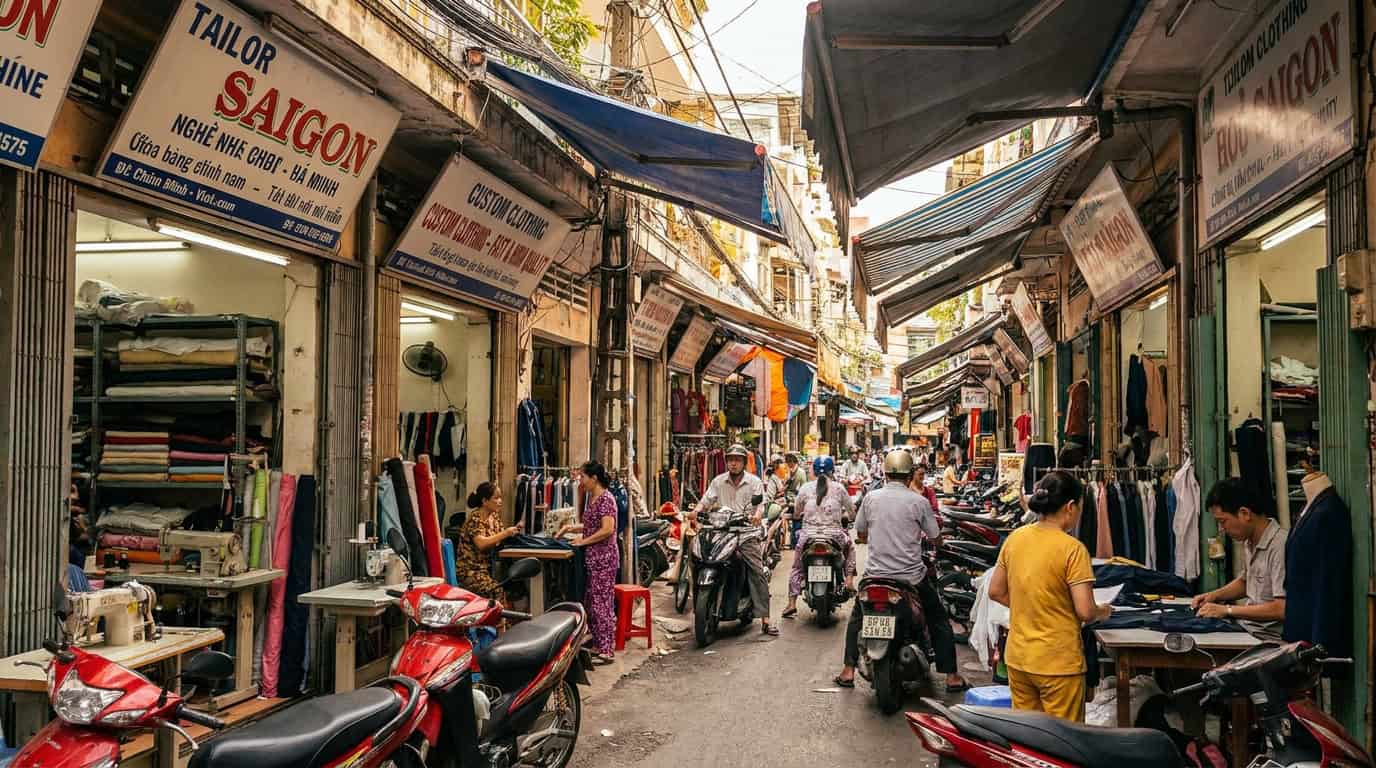
- Initial consultation: Bring reference photos from magazines, Pinterest, or photos of garments you already own and like. Describe the occasions you will wear the piece.
- Fabric selection: Most shops show you a book or wall of fabric swatches. Higher-end shops stock imported fabrics; budget shops use local mills. Feel the weight and ask about care requirements.
- Measurements: A full set of measurements is taken — typically 10–15 points for a suit. Tailors use their own sizing system, so previous measurements from other tailors are a starting reference, not a guarantee.
- First fitting (basted fitting): After 1–2 days, the garment is assembled loosely in the correct shape. This is where structural changes can be made: silhouette, shoulder placement, waist suppression.
- Final fitting: After adjustments, the garment is finished. This fitting is for minor tweaks — hem length, button placement, sleeve pitch.
- Pickup: Most tailors offer same-day or next-day pickup after the final fitting.
Tips for Getting the Best Results from Saigon Tailors
The tailoring process rewards clients who communicate clearly. These practical tips consistently produce better outcomes with tailor saigon custom clothes.
- Bring a reference garment: If you have a shirt or pair of trousers that fits perfectly, bring it along. Tailors can use it as a direct template, dramatically reducing fitting iterations.
- Be specific about fit preferences: Terms like “slim fit” mean different things to different people. Use photos and gesture on your body — point to where you want the jacket to button, how much break you want on trouser hems.
- Don’t rush fabric selection: Choosing the wrong fabric is the most common source of disappointment. Take time to feel weight, drape, and stretch.
- Build in time: Even shops that advertise 24-hour turnaround produce better results with 3–4 days. If you have a week or more, schedule the first fitting early to allow multiple rounds.
- Inspect seam allowances: Ask to see inside the garment before pickup. Generous seam allowances mean the piece can be adjusted later if your size changes.
Custom Ao Dai: Saigon’s Signature Garment
No guide to tailor saigon custom clothes would be complete without covering the ao dai. This traditional Vietnamese two-piece garment — a fitted tunic worn over wide-leg trousers — is experiencing a strong revival among both locals and visitors. Having one made to measure is a genuinely memorable experience and a practical souvenir that can be worn for formal occasions anywhere in the world.
Silk ao dai from reputable District 1 or District 3 tailors typically take 2–3 days and cost USD 100–200 for quality silk with hand-stitched details. Synthetic versions are available for USD 40–80 with faster turnaround. Many shops offer fitting consultations that include guidance on proper ao dai etiquette and styling.
Fabrics to Ask For — and Fabrics to Avoid
Fabric choice determines 70% of how a finished garment looks, drapes, and lasts. Understanding your options helps you navigate a typical tailor’s fabric book.
Best Fabrics for Suits
- Super 100s–120s wool: The standard for quality suits. Holds shape well, breathes reasonably in Saigon’s climate.
- Wool-linen blend: Lighter and more breathable — ideal for Saigon’s heat if you need to wear the suit regularly in Vietnam.
- Cotton twill: A good choice for casual suits or sports coats.
Best Fabrics for Dresses and Shirts
- Silk: Vietnam produces excellent quality silk at competitive prices. Best for formal wear and ao dai.
- Linen: Casual and breathable — perfect for the climate.
- Cotton poplin: Reliable for shirts and blouses; easy to care for.
Fabrics to Approach Carefully
Polyester blends are common in budget shops and produce noticeably cheaper-looking garments. Avoid any fabric described as “poly-wool” unless you are on a very tight budget. The savings are rarely worth the compromise in appearance and wearability in Saigon’s humidity.
How Long Does Custom Tailoring Take in Saigon?
Turnaround times vary by shop, current workload, and garment complexity. Here are realistic expectations for tailor saigon custom clothes turnaround in 2025–2026.
- Simple shirt or dress: 24–48 hours
- Two-piece suit with one fitting: 2–3 days
- Two-piece suit with two fittings: 4–6 days
- Ao dai: 2–4 days
- Full wardrobe order (5+ pieces): 7–14 days
Shops near tourist areas sometimes advertise overnight suits. These are possible but the quality of fit and construction is typically lower than when adequate time is allowed for multiple fittings. If your schedule allows, always opt for the longer timeline.
Tailoring for Business Travelers and Long-Stay Expats
Ho Chi Minh City attracts a large community of business travelers and long-term expats who leverage Saigon’s tailoring scene differently depending on their needs.
For business travelers staying 5–10 days, a single two-piece suit with two fittings is a realistic and valuable use of downtime. Many business visitors build tailoring appointments into their first and last days, using the stay itself as the fitting window.
For long-stay expats and residents, the calculus is even more favorable. Building relationships with one or two trusted tailors pays dividends over time — repeat clients often receive priority scheduling, better fabric access, and tailors who have learned their fit preferences and body proportions. Several tailors near the central business district and riverside developments maintain client records and measurement sheets for returning customers.
Living in District 1 is particularly advantageous for accessing quality tailoring quickly and repeatedly. The combination of central location, proximity to multiple tailor shops, and easy transport connections to the fabric market makes it the ideal base for building a custom wardrobe in Saigon.
You May Also Find Useful
- Rooftop Bar Ho Chi Minh City: Sky-High Cocktails with the Best City Views
- Coworking Spaces with Best Internet in Saigon: Where Remote Workers Get Fast Wi-Fi
- Coworking Cafe Saigon 2026: The Best Coffee Shops That Double as Serious Workspaces
- FV Hospital Saigon: Is It the Best International Hospital in HCMC?
Frequently Asked Questions
How much does a custom suit cost from a tailor in Saigon?
A custom two-piece suit using a mid-range wool blend typically costs USD 150–250 at established District 1 tailors. High-end shops using imported Italian or English wool charge USD 300–500. Budget operations in tourist-heavy areas may quote USD 100–130 but the fabric and construction quality is usually noticeably lower. For business or formal wear, investing in the mid-range is worthwhile.
How many days do I need in Saigon to get clothes made?
For a single garment with adequate fittings, plan for a minimum of 3–4 days. For a suit with two proper fittings, 5–6 days is ideal. Longer stays allow for more complex orders and higher-quality results. Rush orders (24–48 hours) are possible but sacrifice fitting quality. Most visitors find that 5–7 days in the city is the sweet spot for tailor saigon custom clothes without feeling rushed.
Can tailors in Saigon copy an existing garment?
Yes, and this is one of the most effective ways to work with Saigon tailors. Bring the garment you want replicated — a favorite blazer, a dress with the right silhouette, a shirt with ideal proportions — and tailors can use it as a direct pattern. Results are typically very close to the original. This approach eliminates most fitting uncertainty and is recommended for first-time clients.
Is it safe to pay a deposit before the garment is finished?
Deposits are standard practice at reputable tailor shops — typically 30–50% upfront. Stick to shops with verifiable reviews (Google Maps, TripAdvisor, expat forums) and physical shopfronts rather than pop-up or market stalls for large orders. Established shops rely on their reputation and returning customers, so they have strong incentives to deliver quality work. Always get a written receipt noting the agreed price, fabric, and delivery date.
What is the best fabric for a suit in Saigon’s climate?
For wearing in Vietnam’s heat and humidity, a lightweight wool (Super 100s or lighter) or a wool-linen blend performs best. These fabrics breathe better than heavier wools while still holding their shape professionally. For a suit destined for a cooler home climate, a heavier Super 120s wool is the better investment. Tell your tailor where and how often the suit will be worn — they will guide you to appropriate fabric weights from their stock.
Official Resources
For the most up-to-date information on tailor saigon custom clothes, visit the Vietnam Tourism Official Guide.