The best way to work from a Saigon cafe in 2026 is to stop relying on Google Maps reviews and start filtering by what actually matters for a productive session: upload speed above 20 Mbps, at least one power outlet per seat, and a noise level that lets you join a video call without muting every thirty seconds. Ho Chi Minh City has thousands of cafes, but the subset that reliably delivers on all three criteria is much smaller than you think — and it shifts by district, time of day, and even the weather. This guide covers everything a remote worker needs to know before pulling out a laptop in Saigon.
Key Takeaways
- Reliable Wi-Fi for remote work means testing upload, not just download — many Saigon cafes advertise fast internet but have asymmetric connections that choke video calls.
- District 1 cafe density is high, but noise floors in tourist-facing spots make focused work difficult between 10 AM and 2 PM on weekdays.
- Power outlet availability is the most common complaint among long-term remote workers — always scout before ordering.
- Co-working cafes in D3, Binh Thanh, and Thu Duc now rival purpose-built co-working spaces in terms of infrastructure at a fraction of the cost.
- Seasonal factors matter: Saigon’s rainy season (May–October) drives indoor foot traffic sharply upward, reducing seat availability at popular spots by early afternoon.
Why Working from a Saigon Cafe Requires a Different Checklist
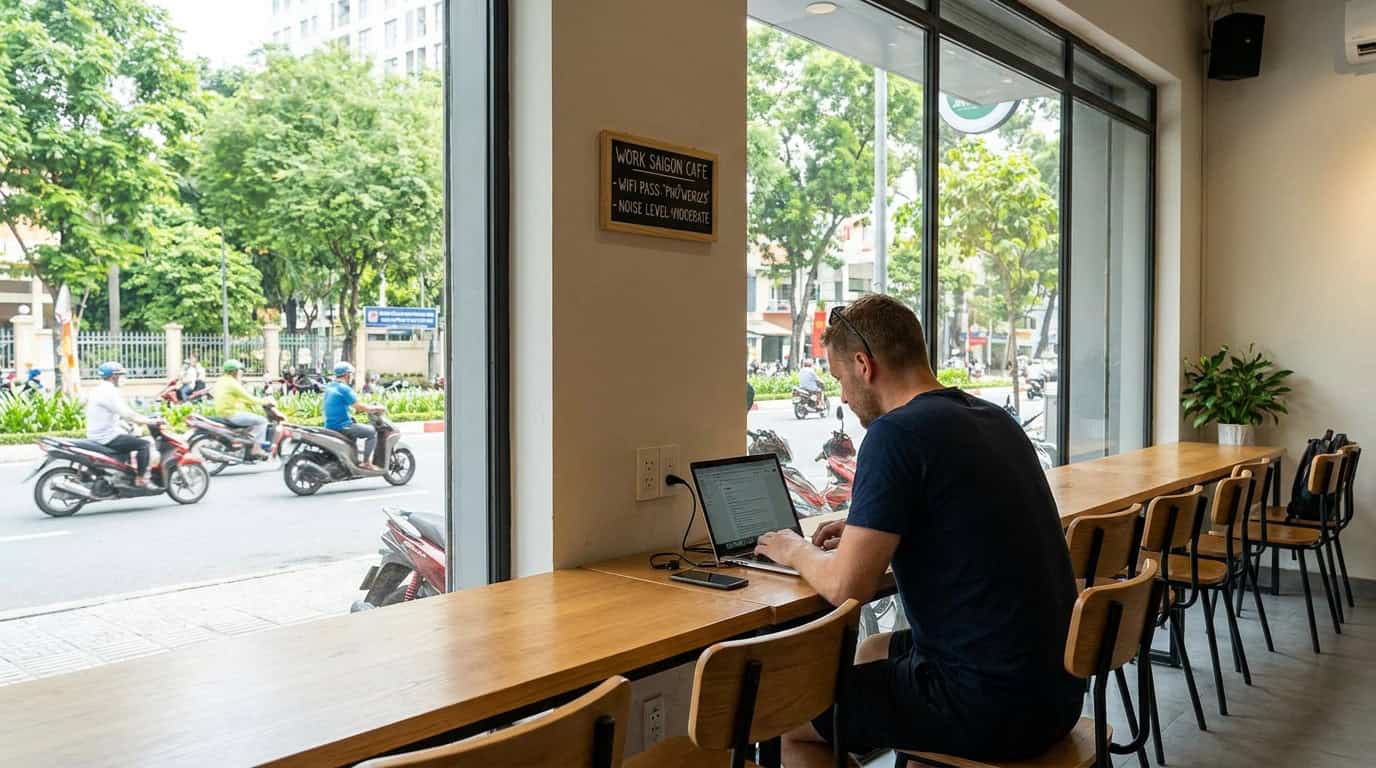
Working from a cafe in London or Berlin comes with certain baseline expectations — dependable Wi-Fi, reasonable noise, plentiful sockets. When you work from a Saigon cafe, the baseline shifts. Vietnam’s coffee culture is built around lingering, socializing, and the slow ritual of the drip filter, not necessarily around laptop productivity. That means the infrastructure varies wildly from one address to the next, and the same cafe can transform from a quiet morning workspace into a loud afternoon hangout within the span of two hours.
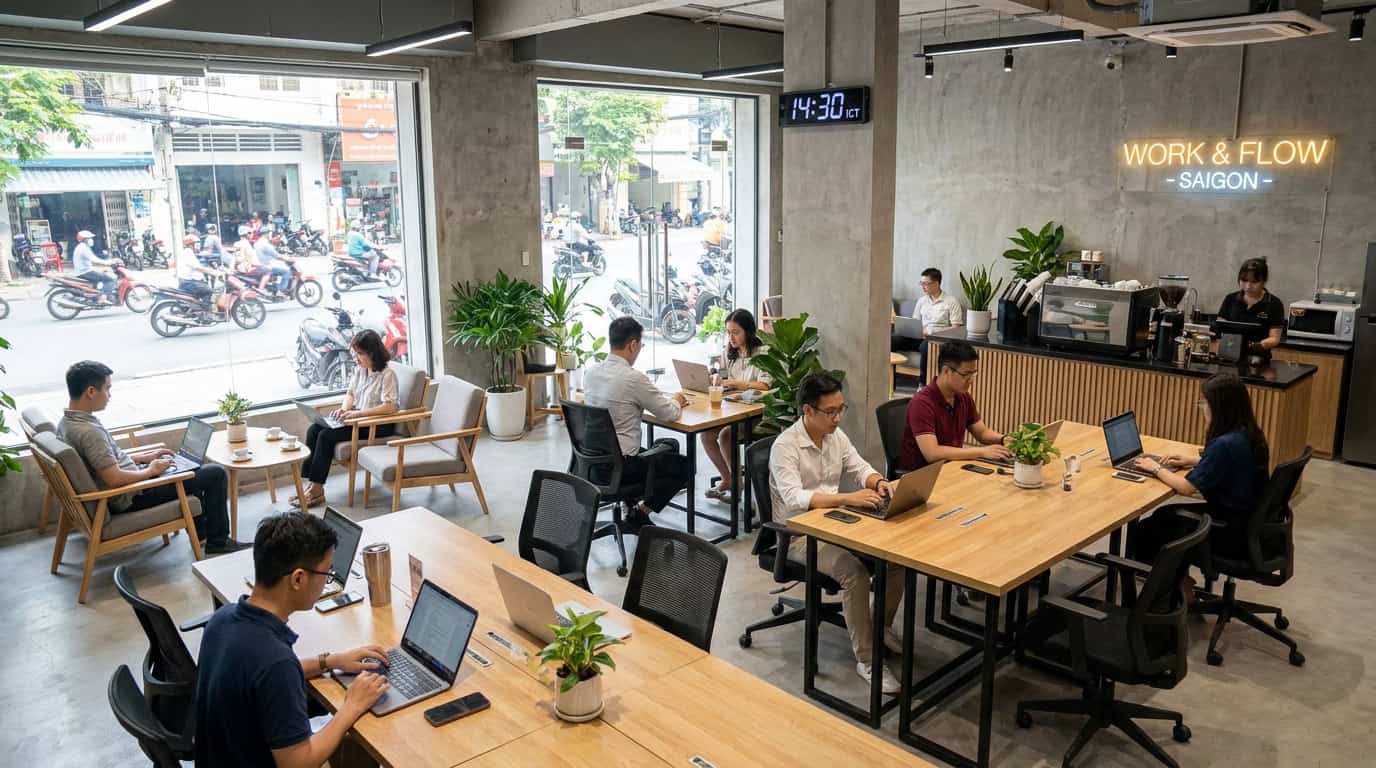
The savvy approach is to separate cafes into two mental categories: those that tolerate laptop workers and those that are genuinely built for them. The latter group has invested in commercial-grade routers, added power strips under tables, and often enforced a minimum spend or time limit to manage turnover. Once you learn to spot the difference, the city opens up in a completely new way.
Find your District 1 stay on the map
Live prices from Booking.com, Vrbo and more. Move the map or change dates to compare stays.
The Wi-Fi Reality Check: Speed, Stability, and Upload Rates
According to Ookla’s Speedtest Global Index (Q1 2026), Vietnam’s median fixed broadband download speed reached 112 Mbps, placing it among the top 30 globally — but that figure masks enormous variance at the last meter inside a cafe. A shared 100 Mbps line serving thirty devices simultaneously can drop usable upload bandwidth to under 3 Mbps per user, which is below the threshold for a stable 1080p video call.
Before you settle in, run a quick speed test at fast.com or speedtest.net. For comfortable remote work — email, Notion, Slack, occasional calls — you need at least 10 Mbps down and 5 Mbps up with a ping below 30 ms to local servers. For heavy video conferencing, aim for 20/10 Mbps. If the cafe uses a password-protected network segmented from the customer Wi-Fi (some co-working cafes do this), ask staff — they will often give you the faster SSID if you explain you are working.
Backup your connection with a local SIM. Viettel and Mobifone both offer 4G/5G data plans that run under 200,000 VND per month for 30 GB. When cafe Wi-Fi fails — and it will — a mobile hotspot saves the session.
Power Outlets: The Scarcest Resource in Saigon’s Cafe Scene
If Wi-Fi is the first filter, power availability is the second. Many of Saigon’s most photographed cafes — the rooftop terraces, the converted colonial villas, the brutalist-chic spaces in D1 — have deliberately minimized visible cabling for aesthetic reasons. The result is a beautiful room with three wall sockets shared among forty seats.
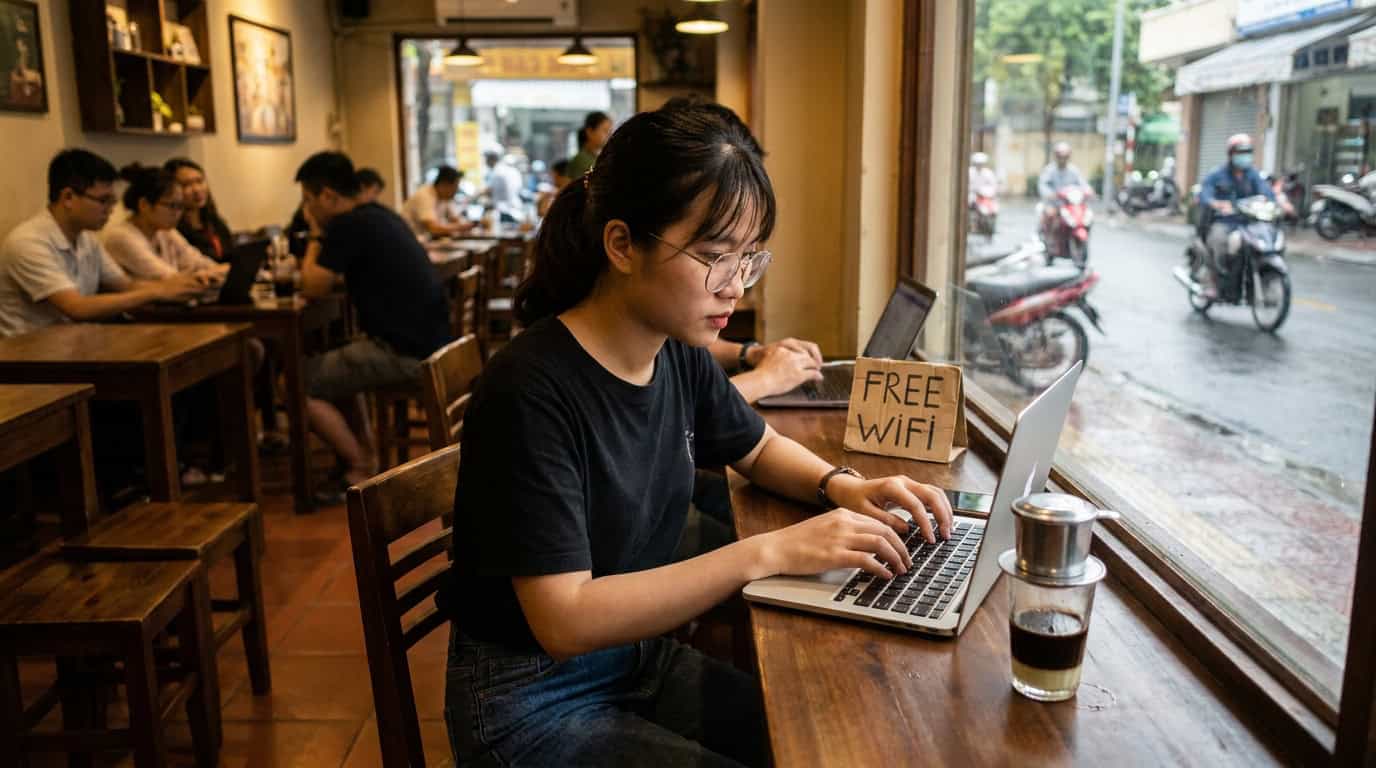
Practical rules that experienced remote workers use: arrive before 8:30 AM to claim a wall-adjacent seat; carry a compact power strip so a single outlet serves your laptop, phone, and earbuds simultaneously; and treat any cafe that has under-table cable trays as a premium find worth remembering. In District 1, a cluster of cafes along Nguyen Thi Minh Khai and the streets immediately behind Bui Vien has retrofitted power strips under bar counters specifically for the expat working crowd.
Cafes near universities — particularly around the University of Economics on Nguyen Dinh Chieu and RMIT on Nguyen Van Thanh — tend to have better power infrastructure because Vietnamese students have created the same demand for years. These spots are worth the ten-minute Grab ride from the tourist core.
Noise Levels by District and Time of Day
Saigon’s noise profile is not uniform. District 1’s Bui Vien strip is unusable for work around the clock. The quieter pockets of D1 — the lanes off Ton That Thiep, the cluster around 23 Tong Duc Thang — are workable until about 11 AM on weekdays, then get loud as lunch traffic builds. District 3 consistently offers lower ambient noise because its cafe culture skews local rather than tourist-facing. Binh Thanh, particularly the area around Dien Bien Phu near the roundabout, has a growing number of specialty coffee shops that function as de facto quiet co-working environments.
For video call-friendly silence, look for cafes with acoustic treatment — exposed concrete or brick walls actually amplify conversation noise, while soft furnishings, plants, and lower ceilings absorb it. Air conditioning units are a major noise source in Vietnamese cafes; position yourself away from the indoor unit, not underneath it.
Time-of-day strategy: the 7–10 AM window across every district is the most reliably quiet. The 2–4 PM window after the lunch rush clears is the second best. Avoid the 11 AM–1 PM rush and the post-school 3:30–5:30 PM surge near residential neighborhoods.
Best Districts to Work from a Saigon Cafe in 2026
District 1 (D1)
Still the most convenient district for anyone staying in the city center. The cafes that work for remote work in D1 are specific — long-stay residents share a vetted list on move-in day. The general principle is to stay one block off the main tourist corridors: the streets parallel to Dong Khoi, the alleys off Le Loi, and the lanes behind the Ben Thanh area that most visitors never explore. These spots have the same fast internet as their more famous neighbors but significantly lower noise ceilings.
District 3
The residential character of D3 keeps most cafes operating at a conversational volume. The density of specialty coffee shops along Vo Van Tan and the surrounding streets makes this the most consistent district for a full workday. Several cafes here have adopted a formal “working hours” policy — a minimum spend per two-hour block — which self-selects for serious workers and discourages casual drop-ins.
Binh Thanh and Thu Duc
Binh Thanh is a popular alternative to D1 for daily cafe working. Thu Duc (the merged mega-district covering former D2, D9, and Thu Duc) has seen a surge in co-working-style cafes near the tech corridor around Saigon Hi-Tech Park.
What to Order and Minimum Spend Etiquette
Vietnamese cafe culture is generous with seat time, but the economics of a 35,000 VND ca phe sua da do not support four hours of occupancy during peak hours. The unwritten rule that most long-term expats follow: order at least one item per 90 minutes, and if the cafe is filling up around you, either order again or quietly move on. This etiquette keeps you welcome at your favorite spots long-term.
Ca phe trung (egg coffee), ca phe cot dua (coconut coffee), and the classic sua da are all worth trying as you work from Saigon cafes — but if you need to avoid a sugar crash during a long session, most specialty coffee shops now offer standard espresso drinks at prices competitive with any Southeast Asian city (55,000–90,000 VND for a latte).
Safety, Security, and Laptop Theft Prevention
Laptop theft from cafes in Ho Chi Minh City is real but preventable with basic precautions. The most common scenario is a bag or laptop left unattended while the owner uses the restroom. Sit with your back to a wall when possible, use a laptop cable lock at high-traffic spots, and never leave your bag on a chair when stepping away. Ground-floor cafes near busy intersections carry slightly higher risk; upper-floor spaces or interior courtyards are naturally lower risk because bag snatchers on motorbikes cannot reach them.
VPN use is strongly recommended when working on public cafe Wi-Fi, particularly when accessing work systems or banking. Both Mullvad and ProtonVPN have reliable servers in Singapore and Japan with low latency from Saigon (30–60 ms).
Co-Working Cafes Versus Dedicated Co-Working Spaces
A dedicated co-working space like Toong, Dreamplex, or CirCO gives you guaranteed internet, guaranteed power, a professional meeting room, and often a business address for mail. The cost runs 300,000–600,000 VND per day or 3–6 million VND per month for a hot desk. A good co-working cafe runs 35,000–80,000 VND for drinks and gives you the same productive environment with more atmospheric charm and none of the commitment.
The decision usually comes down to call frequency and privacy needs. If you have three or more video calls per day, a dedicated space is worth the premium. If your workday is primarily asynchronous — writing, coding, design — a well-chosen cafe delivers an equivalent experience at a fraction of the cost. Many long-term residents split their week: two or three days at a co-working space for heavy-call days, the remainder at their trusted cafe rotation.
Seasonal Considerations: Rainy Season vs. Dry Season
Saigon’s rainy season runs roughly May through October, with afternoon downpours arriving with near-clockwork regularity between 2 PM and 5 PM. These rains push street-cafe patrons indoors, dramatically increasing seat competition at covered locations. During rainy season, arriving early is even more critical than usual — by 9 AM the better-known work-friendly spots are partially full.
The dry season (November through April) is gentler on seat availability and opens up the rooftop and semi-outdoor cafes that become impractical during monsoon months. Temperature-wise, Saigon is hot year-round (28–38°C), so air conditioning quality matters as much as Wi-Fi quality for a comfortable long session.
Building a Personal Cafe Rotation That Actually Works
The most productive remote workers in Saigon do not rely on a single spot. They maintain a rotation of three to five vetted cafes — at least one in each major district they frequent — and match the cafe to the task type. Heavy-focus writing or coding: the quietest spot in the rotation. Calls: the cafe with the most reliable upload speed and the least background noise. Creative work where some ambient buzz is helpful: the livelier spot with good coffee.
Building this rotation takes a few weeks of deliberate scouting when you first arrive. Test Wi-Fi, count outlets, observe the crowd at different times, and make notes. The investment pays off for your entire stay. When you work from a Saigon cafe consistently and strategically, the city becomes one of the most productive remote work environments in Southeast Asia — remarkably affordable, reliably caffeinated, and full of the low-level energy that many remote workers find genuinely motivating.
You May Also Find Useful
Frequently Asked Questions
Is it acceptable to work from a Saigon cafe for a full day?
In most cafes, a full-day session is not the norm unless the space specifically markets itself to laptop workers. The practical middle ground is two to three hours per visit with at least one drink order per 90-minute block. For genuine all-day work, a co-working space or a co-working cafe with a daily rate is a more respectful and comfortable choice.
How fast is the Wi-Fi when you work from a Saigon cafe?
Speed varies enormously. Well-equipped specialty cafes aimed at laptop workers typically deliver 30–80 Mbps download and 10–30 Mbps upload on a quiet morning. Busy tourist-area cafes can drop to 5 Mbps or below during peak hours regardless of what the router is theoretically capable of. Always test before settling in and have a mobile data backup.
Which districts are best for finding quiet work-friendly cafes?
District 3 is the most consistently quiet for focused work. Binh Thanh offers good infrastructure with less competition for seats. District 1 has excellent options but requires more careful selection — the best spots are deliberately off the main tourist strips. Avoid Bui Vien and Pham Ngu Lao for anything requiring concentration.
Do I need a VPN when working from a cafe in Saigon?
A VPN is strongly recommended for work purposes. Public Wi-Fi in cafes is unencrypted and shared, making it easy for other users on the same network to intercept traffic. A VPN also helps with accessing some work tools that may be geo-restricted. Mullvad, ProtonVPN, and ExpressVPN all have good performance from Vietnam.
What is the cheapest way to work from a Saigon cafe all week?
A daily spend of 70,000–120,000 VND (two drinks across a three-hour session) is realistic at most non-tourist cafes. That works out to roughly 350,000–600,000 VND per week — significantly less than any co-working day pass. The key is finding cafes where the work environment justifies the low cost, which requires upfront scouting time but pays off quickly.
Official Resources
For the most up-to-date information on work from saigon cafe, visit the Vietnam Tourism – Food and Drink.