
District 3 Saigon Guide: Leafy Streets, Cafes, and the Best of Local Saigon
District 3 is the neighborhood most long-term Saigon residents quietly claim as their favorite. It sits immediately north of District 1, close enough to walk to the center yet far enough to feel like a real neighborhood where people actually live. The streets are narrower and shadier, the coffee shops are independent rather than chain-run, and the ratio of locals to tourists stays refreshingly high year-round.
If you’re deciding where to stay, rent, or simply spend a few days in Saigon, District 3 offers something the flashier areas can’t: the rhythm of everyday city life, served alongside genuinely good coffee and food at honest prices.
Key Takeaways
- District 3 is consistently rated one of Saigon’s most liveable inner-city districts for expats and long-term residents
- Tran Cao Van and Vo Thi Sau Streets are two of the city’s most concentrated cafe corridors
- Average rent for a 1-bedroom apartment in District 3 runs 8-15 million VND per month, lower than Districts 1 and 2
- The district has 3 significant French colonial landmarks including the Tan Dinh Church
- Le Van Sy Street connects Districts 3 and Phu Nhuan and is one of the best dining streets in the city
What Makes District 3 Different from Other Saigon Districts?
District 3 covers roughly 4.9 square kilometers immediately north of District 1, making it one of the smallest but densest inner-city districts. According to Ho Chi Minh City’s Department of Planning and Architecture (2024), District 3 has a population density of over 40,000 people per square kilometer, among the highest in the city. Despite that density, it doesn’t feel crowded in the way Districts 1 or 5 do. The difference is architectural: the French colonial grid of wide, tree-lined streets survives here better than almost anywhere else.
The street pattern came from the French colonial era, when this area housed government officials and bourgeois Vietnamese families. Those tamarind and rain trees planted along Vo Thi Sau, Nguyen Dinh Chieu, and Tran Cao Van still provide genuine shade cover that makes walking here pleasant even at midday. That livability is why District 3 has become the first choice for Saigon residents who want inner-city access without the noise and tourist density of District 1.
What Are the Best Streets in District 3?
District 3’s best streets each have a distinct character. Vo Thi Sau Street runs east-west through the heart of the district and is lined with tamarind trees, independent cafes, and small local restaurants. It’s arguably the most pleasant walking street in the whole city. Tran Cao Van, just south of Vo Thi Sau, has developed into one of Saigon’s densest cafe strips, with over 15 independent coffee shops within 500 meters according to Google Maps data (2025).

Tran Cao Van Street: The Cafe Corridor
Tran Cao Van Street is where Saigon’s specialty coffee culture is most concentrated outside of District 1. You’ll find roaster-operated cafes, concept spaces with cold brew and pour-over menus, vintage interiors, garden courtyards, and rooftop terraces all within a few minutes’ walk. Most venues price between 45,000 and 85,000 VND for a drink. The street gets busy on weekend mornings but never reaches the uncomfortable density of Ben Thanh or Bui Vien areas.
Vo Thi Sau Street: Daily Life and Dining
Vo Thi Sau is the main artery of daily life in District 3. It runs past the district’s central market, several well-regarded local restaurants, and connects to the Tan Dinh Church area in the north. Evening on Vo Thi Sau looks like authentic Saigon: families eating com tam on plastic stools, xe om drivers waiting at corners, and the smell of pho mixing with coffee from adjacent shophouses. This is the kind of street most tourists never find because it doesn’t feature in walking tour itineraries.
Le Van Sy Street: Restaurants and Craft Beer
Le Van Sy runs along the western edge of District 3 heading into Phu Nhuan District and has become one of the best restaurant streets in Saigon. It has an unusually high concentration of craft beer bars, Vietnamese BBQ spots, seafood grills, and international restaurants. The strip between the Nguyen Thi Minh Khai intersection and the Phu Nhuan border is particularly active after 6 PM. It’s not a tourist street, which keeps quality high and prices reasonable.
What Are the Best Restaurants in District 3?
District 3 punches above its weight for restaurants. A 2025 review by Foody Vietnam listed District 3 among the top three city districts for restaurant diversity per square kilometer, with over 800 active listings. The range covers Vietnamese home cooking, high-quality com tam stalls, upscale Vietnamese restaurants, Japanese izakayas, Korean BBQ, and some of the city’s best vegetarian options. Most importantly, a large share of the district’s restaurants serve Saigonese residents rather than tourists, which keeps quality honest.
[PERSONAL EXPERIENCE] In our experience, the best way to eat in District 3 is to walk Vo Thi Sau and Tran Cao Van on a weekday evening and follow the locals. The stalls that have the most plastic stools out front and the most xe om drivers parked nearby are almost always serving excellent food at 60,000-120,000 VND per person.
Vietnamese Restaurants Worth Knowing
Nha Hang Ngon on Nam Ky Khoi Nghia Street is one of the city’s most famous Vietnamese restaurants, housed in a French colonial villa and serving regional dishes from across Vietnam in a courtyard setting. It’s popular with both locals and visitors. Quan An Ngon is a similar concept at similar prices. For something less well-known but arguably better, the com tam shops around Tran Quoc Toan Street operate daily from 6 AM and serve broken rice with grilled pork that locals line up for.
International Dining in District 3
District 3 has a growing number of Japanese restaurants, particularly around the Ky Con and Truong Dinh Streets near the border with District 1. Korean restaurants cluster around Nguyen Thien Thuat. The craft beer and Western food scene on Le Van Sy and nearby Huynh Van Banh Streets gives the district more nighttime dining options than its low tourist profile might suggest. Prices across all these are noticeably lower than equivalent options in Thao Dien or central District 1.
What Are the Main Attractions in District 3?
District 3 isn’t a tourist district in the conventional sense. It has no major museums or UNESCO sites, and that’s exactly why it’s worth visiting. The primary attractions are the French colonial architecture surviving on residential streets, the Tan Dinh Church, the district’s market life, and the cafe culture that defines it for Saigonese residents. According to TripAdvisor Vietnam data (2024), Tan Dinh Church receives over 200,000 visitors per year, making it one of the most photographed religious sites in the city despite its low official tourist profile.
Tan Dinh Church
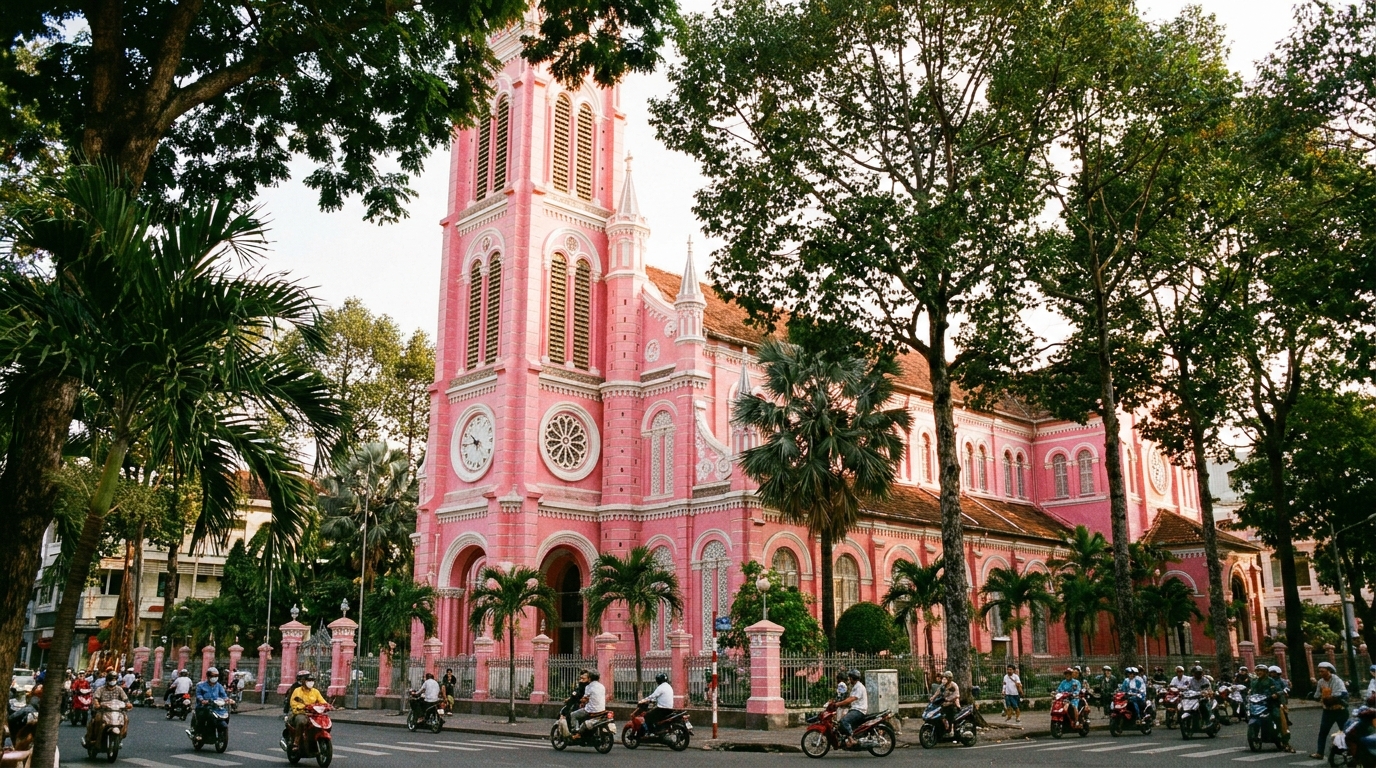
Tan Dinh Church on Hai Ba Trung Street is one of the most photographed landmarks in Saigon, known for its shocking pink neo-Romanesque facade. Built by French missionaries in 1870 and expanded in 1942, it’s the second-largest church in Ho Chi Minh City after Notre Dame. The interior is simpler than the exterior promises. The church is most atmospheric early morning when local residents attend mass. Photography of the pink exterior is best before 9 AM before the street gets too busy.
French Colonial Architecture
Walking the streets of District 3 is an exercise in spotting surviving colonial architecture between newer construction. Nguyen Dinh Chieu Street has some of the best-preserved French villa facades in the city. Several have been converted to restaurants and cafes, which gives access to their interiors. The building density means you’re never more than a few blocks from an interesting facade. This kind of urban texture is increasingly rare as the city redevelops, which makes District 3’s relative preservation notable.
Is District 3 a Good Place to Live or Stay in Saigon?
For long-term residents, District 3 consistently ranks alongside Thao Dien and Binh Thanh as one of the most liveable inner-city options. According to CBRE Vietnam’s Q1 2025 Residential Report, average asking rent in District 3 for a furnished 1-bedroom apartment ranges from 8 to 15 million VND per month, below comparable options in District 1 (12-22 million VND) and District 2’s Thao Dien (10-18 million VND). The trade-off is smaller apartments and less availability of large modern complexes.
[UNIQUE INSIGHT] District 3 is often overlooked in apartment searches because it has fewer large branded complexes than Districts 2 or 7. Most of its rental stock is in smaller walk-up buildings and renovated villas, which give a more genuinely local living experience but require using Vietnamese real estate agents rather than international platforms. The value-to-livability ratio in District 3 is higher than almost anywhere else in inner Saigon.
For travelers, the district has a growing number of boutique guesthouses and small hotels priced well below District 1 equivalents. The walk to Ben Thanh Market or the War Remnants Museum is 15-25 minutes on foot, and the Grab motorbike fare to any central District 1 landmark is under 20,000 VND. Staying in District 3 gives you genuine neighborhood immersion that staying on De Tham or Pham Ngu Lao Streets simply doesn’t.
How Do You Get Around District 3?
District 3’s compact size makes it walkable in a way few Saigon districts are. The core streets between Vo Thi Sau, Tran Cao Van, Le Van Sy, and Nguyen Thi Minh Khai can all be reached on foot within 20 minutes. Grab bikes are reliable and cheap for anything beyond walking distance. The district is well-positioned for access to the rest of the city: District 1 is 10-15 minutes south, Binh Thanh District is 10 minutes north, and Tan Binh District (and Tan Son Nhat Airport) is accessible in 20-30 minutes by bike. There is no metro connection yet, but the proposed Line 3A route would include a station within the district if constructed as planned.
Frequently Asked Questions: District 3 Saigon
Is District 3 safe for tourists and expats?
District 3 is one of Saigon’s safer inner-city areas. Petty theft targeting distracted tourists is possible on any Saigon street, but District 3 has lower tourist density than District 1 and fewer known bag-snatching incidents. Keep phones out of sight when not using them, use Grab for late-night travel, and standard Saigon street safety applies. The residential character of the district means there are people on the streets at most hours, which adds natural security.
What is the best time to visit the cafes on Tran Cao Van Street?
Weekday mornings between 8 and 11 AM are the most relaxed time to visit. Weekends bring more locals and longer waits for seats at the most popular spots. Most cafes open by 7:30 AM and close between 10 PM and midnight. The evening atmosphere is excellent too, particularly after 6 PM when the heat drops and more locals arrive. Vietnamese-style iced coffee with condensed milk is 25,000-40,000 VND; specialty pour-over and cold brew run 55,000-90,000 VND.
How far is District 3 from the airport?
Tan Son Nhat International Airport is approximately 6-8 km from central District 3, depending on your specific location in the district. By Grab or taxi during off-peak hours, the journey takes 20-30 minutes and costs approximately 100,000-150,000 VND. During peak hours (7-9 AM and 5-7 PM weekdays), allow 40-60 minutes. District 3’s position makes it one of the better-located inner-city districts for airport access.
Are there apartments for rent in District 3 for short stays?
Yes. District 3 has a decent supply of serviced apartments and boutique guesthouses suitable for monthly or shorter stays. Most short-term furnished apartments are in smaller walk-up buildings rather than large complexes, priced between 10 and 20 million VND per month fully furnished. For stays under a month, guesthouses and small hotels on and around Tran Cao Van and Nguyen Thi Minh Khai Streets offer good value compared to District 1 options.
What is District 3 famous for in Saigon?
District 3 is known locally for three things: its cafe culture (particularly on Tran Cao Van and Vo Thi Sau Streets), its French colonial architecture and tree-lined streets, and the Tan Dinh Church, one of Vietnam’s most photographed Catholic churches. Among Saigon residents, it has a reputation as a liveable, culturally rich district that strikes a balance between urban convenience and neighborhood character that the busier tourist districts can’t match.
For more Saigon guides, check out: District 4 Saigon Guide: Seafood, Locals, and Hidden Gems Near D1, District 7 Saigon Guide: Phu My Hung, Expats, and What’s There.
For official information and further reading, visit Lonely Planet — Ho Chi Minh City.