
Migo Saigon Food Street: Complete Guide to District 1’s Most Talked-About Dining Strip
Key Takeaways
- Migo Saigon Food Street is a purpose-built dining complex in central District 1, reported to have opened in late 2023 and drawing consistent foot traffic from both locals and visitors (Foody.vn, 2024).
- The strip covers Vietnamese street food, international cuisines, dessert stalls, and drinks, with most dishes priced between 45,000 and 150,000 VND (USD 1.80-6.00).
- Peak hours are 6 PM-9 PM on weekends; weekday evenings are quieter and easier to navigate.
- The complex caters to a mixed crowd, with a layout and English signage that makes it accessible to first-time visitors.
- Migo Food Street sits roughly 10 minutes on foot from major District 1 landmarks including Ben Thanh Market.
Food streets don’t appear by accident in Saigon. The city’s dining culture runs on density: dozens of stalls competing on the same block, pushing quality through proximity. Vietnam’s food and beverage sector posted revenues of approximately 610 trillion VND in 2023 according to the General Statistics Office of Vietnam, and purpose-built dining complexes have become one of the fastest-growing formats in Ho Chi Minh City’s restaurant sector. Migo Saigon Food Street arrived as part of that wave: a concentrated, curated strip in central District 1 where vendors bring Vietnamese street food, regional specialties, and international options into one walkable stretch.
This guide covers what’s actually at Migo, how much to budget, when to go, and how it compares to other dining options nearby. Prices are in VND with USD equivalents at the 2026 rate of approximately 25,000 VND to 1 USD.
What Is Migo Saigon Food Street?
Migo Saigon Food Street is a purpose-designed food and dining complex in Ho Chi Minh City’s District 1, reported to have opened to the public in late 2023. According to reviews aggregated on Foody.vn — Vietnam’s largest food review platform, which lists over 300,000 venues nationwide. Migo had accumulated several hundred user reviews within its first year of operation, signalling genuine local adoption rather than a venue running on press-only momentum.
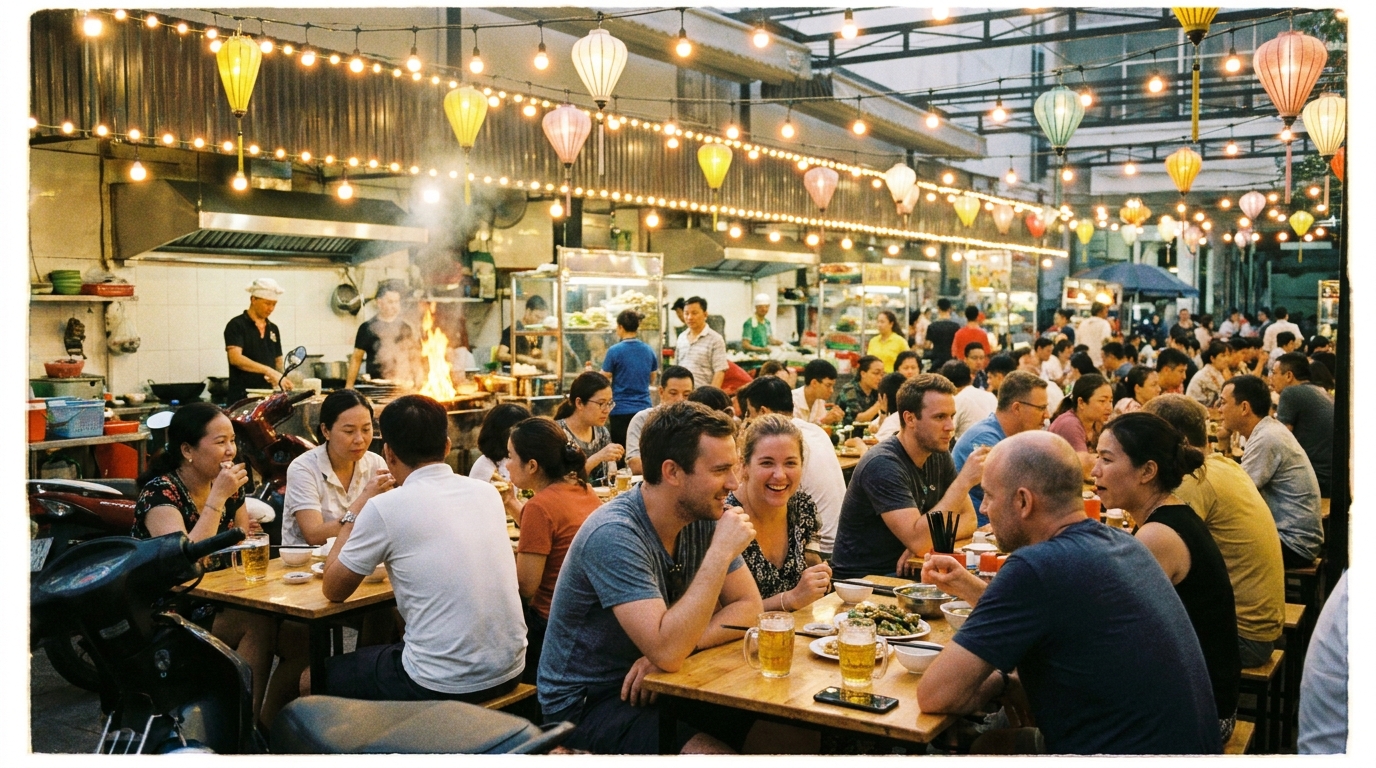
The concept is straightforward: a pedestrian-friendly strip of vendor stalls and small restaurants, each offering a different food category. Visitors walk the length of the strip, pick stalls based on what they want, and eat at shared tables or at seating in front of each vendor. It’s not a mall food court and it’s not an outdoor night market. It occupies a middle ground: more organised than street stalls, more casual than restaurants.
The format draws on a regional model that has worked well in cities like Bangkok, Taipei, and Penang, where curated food streets reduce the navigation friction of eating in an unfamiliar city. For visitors who want real local food without deciphering a street corner with no English signage, Migo offers a practical entry point.
Migo Saigon Food Street is a purpose-built dining complex in central District 1, Ho Chi Minh City, reported to have opened in late 2023. Within its first year, the venue had accumulated several hundred verified reviews on Foody.vn, Vietnam’s leading food review platform with over 300,000 listed venues nationally (Foody.vn, 2024).
Where Is Migo Saigon Food Street? Location and Address
Migo Saigon Food Street is located in District 1, Ho Chi Minh City, in the central area of the city. The venue’s general location puts it within walking distance of Ben Thanh Market, the Saigon Opera House, and the main concentration of hotels and serviced apartments in the district. According to Google Maps data (2025), the food street address places it in the Bến Nghé ward, one of the most densely visited parts of central Saigon.
Before visiting, it’s worth confirming the exact address on Google Maps or Foody.vn, as newer venues in Saigon occasionally operate at addresses slightly different from those listed in early press coverage. Search “Migo Food Street Ho Chi Minh City” on Google Maps for the most current pin location and updated user photos.
The surrounding area is well-connected. District 1 has no metro stations operational as of early 2026. Ho Chi Minh City’s Line 1 metro was in final testing phases through 2025, so the practical access routes are on foot, by taxi, or via ride-hailing apps. The neighbourhood is walkable from most central D1 accommodation.
What Food Is Available at Migo Saigon Food Street?
Migo Food Street’s vendor mix is reported to cover Vietnamese street food classics, regional Vietnamese dishes, international food options, dessert stalls, and drinks. Based on aggregated visitor reviews on Foody.vn and TripAdvisor (2024-2025), the categories most frequently mentioned by diners include grilled meats, noodle dishes, bánh mì, seafood-style preparations, and international snack foods.

Vietnamese Street Food Stalls
Vietnamese vendors at Migo are reported to offer standard street food staples: grilled items (thịt nướng), noodle soups, spring rolls, and rice dishes. These vendors draw both local visitors and tourists looking for accessible versions of dishes they may not feel confident ordering at unmarked side-street stalls. Prices at Vietnamese stalls at Migo are typically on par with or slightly above pure street stall prices. Expect 50,000-120,000 VND (USD 2.00-4.80) for a main dish.
International Food Options
The international segment at Migo includes stalls serving dishes from neighbouring Asian countries alongside some Western-style items. Korean, Japanese, and Thai-influenced options appear frequently in visitor reviews. This makes the food street viable for groups with mixed preferences, a common situation for travellers in Saigon’s expat-adjacent central district. Prices for international stalls trend slightly higher: 80,000-150,000 VND (USD 3.20-6.00) is a reasonable planning range.
Desserts and Drinks
Dessert and drinks stalls at Migo are noted in multiple visitor reviews as a strong category. Vietnamese chè (sweet dessert soups), fresh fruit options, bubble tea, smoothies, and local coffee all appear in the vendor mix. This segment draws diners who’ve already eaten elsewhere and want to end with something sweet, and it helps the venue retain visitors for longer. Cold drinks run 30,000-70,000 VND (USD 1.20-2.80).
What Are Migo Food Street’s Opening Hours?
Migo Saigon Food Street is reported to operate primarily as an evening and late-night venue. Based on visitor check-in data and reviews on Foody.vn (2024), the majority of visits occur between 5 PM and 11 PM, with the complex reportedly open until around midnight on weekends. Daytime operations may vary by vendor, and not all stalls open simultaneously. The full complex reaches capacity during the evening rush.
The most reliable hours to visit are 6 PM-9 PM on any day of the week. On weekends this window is peak-crowd time; on weekdays the crowd thins slightly and you’ll spend less time navigating the space. If you go on a weekend, arrive closer to 6 PM rather than 8 PM to avoid the fullest period.
As with most Saigon dining venues, it’s worth checking current hours on Google Maps before visiting — particularly around Vietnamese public holidays (Tết, Reunification Day on April 30, National Day on September 2), when many venues adjust their schedules or close entirely. Hours listed online at the time of original opening don’t always reflect updated operational decisions.
How Do You Get to Migo Saigon Food Street?
Getting to Migo Food Street from central District 1 is straightforward. According to Google Maps distance data (2025), the food street is within a 10-15 minute walk from Ben Thanh Market, one of the city’s most central navigational landmarks. Visitors staying in the Phạm Ngũ Lão, Bến Thành, or Nguyễn Huệ walking street areas can reach it comfortably on foot in the evening.
By Foot from Key D1 Landmarks
From Ben Thanh Market, walk in the direction of Bến Nghé ward. The food street is roughly 10 minutes at a normal pace. From the Saigon Opera House area, allow 10-15 minutes depending on your exact starting point. The walk itself passes through animated evening streetscape. Saigon’s D1 streets are safe and well-lit after dark.
By Grab (Ride-Hailing)
Grab is the dominant ride-hailing app in Vietnam, and a GrabCar from anywhere in District 1 to Migo Food Street should cost 30,000-60,000 VND (USD 1.20-2.40) depending on distance and time of day. GrabBike (motorbike taxi) is cheaper: typically 15,000-30,000 VND (USD 0.60-1.20) for short D1 trips. Both services are reliable in the central district during evening hours.
By Taxi
Metered taxis (Vinasun, Mai Linh) are widely available in District 1 and cost approximately the same as GrabCar for short trips. Ask your accommodation to confirm the address in Vietnamese before you go. Showing the driver a Google Maps pin on your phone is the most reliable method for any Saigon taxi trip.
Is Migo Saigon Food Street Worth Visiting?
Migo Food Street occupies a specific niche in Saigon’s dining landscape. Vietnam’s tourism authority recorded 12.6 million international arrivals to the country in 2024, according to the Vietnam National Administration of Tourism, and Ho Chi Minh City consistently handles the largest share of those visitors. A purpose-built, navigable food complex fills a genuine gap for travellers who want street food variety without the full complexity of eating at individual roadside stalls.
For visitors in Saigon for 3-7 days, Migo works well as a one-stop evening where you can try multiple dishes and cuisines without committing to a single restaurant. The trade-off is that purpose-built food complexes, anywhere in Southeast Asia, tend to run slightly higher prices than the equivalent dishes bought at street-level stalls. You’re paying partly for the infrastructure, the layout, and the lower friction of navigating the space.
[UNIQUE INSIGHT] There’s a useful distinction between food streets that serve locals and food streets built for visitors. Migo sits in an interesting middle ground: it draws a mixed crowd, which is actually its strongest quality indicator. When a food complex loses its local contingent entirely, quality tends to follow the cash, toward margin-friendly, tourist-facing versions of dishes rather than the real preparation. The fact that Foody.vn, a platform used almost exclusively by Vietnamese diners and not tourists, carries active reviews for Migo is a meaningful signal that local diners are still showing up.
How Does Migo Compare to Other Saigon Food Markets?
Saigon has several well-known food market formats, and understanding where Migo fits helps set expectations. The city’s street food sector is estimated to contribute around 30% of the food and beverage market’s total revenue, according to a 2023 market analysis by Statista Vietnam, with organised dining complexes growing at a faster rate than independent stalls since 2020.

Versus Bến Thành Market Night Food
The area around Bến Thành Market hosts a night food strip that’s been operating for decades. It’s older, more chaotic, and more aggressively tourist-facing than Migo. The vendors near Bến Thành are known for calling to passing pedestrians, and prices can drift above street-fair value for visitors who don’t know the going rate. Migo, as a newer fixed-price stall complex, tends to post clearer pricing. Neither is “better” – they serve different moods and tolerances for noise.
Versus Bùi Viện Walking Street
Bùi Viện is Saigon’s famous backpacker street: loud, bar-heavy, and more geared toward drinks than food. It has food vendors, but the primary offer is nightlife. Migo is primarily a food destination, not a nightlife one. If you want a meal, Migo is the better choice. If you want a drink-first evening with food as a secondary activity, Bùi Viện fits that pattern better. The two are roughly complementary rather than competing.
Versus District 4 Street Stalls
District 4, just across the canal from D1, is the city’s most genuinely local street food district: dense, inexpensive, and almost entirely Vietnamese-customer facing. Dishes there are cheaper and less navigable for visitors who can’t read Vietnamese menus. Migo is more accessible; D4 stalls are more authentic in the sense of being completely unfiltered for tourist consumption. They’re different experiences rather than ranked options.
Saigon’s organised dining complexes have grown faster than independent street stalls since 2020, with the street food sector estimated to contribute around 30% of Ho Chi Minh City’s total food and beverage revenue (Statista Vietnam, 2023). Migo Saigon Food Street entered this market in late 2023, competing with established night food areas around Ben Thanh Market and the District 4 stall corridor.
Tips for Visiting Migo Saigon Food Street
A few practical habits make a visit to Migo significantly better. According to Lonely Planet Vietnam (2025 edition), first-time visitors to Saigon food markets consistently underestimate the number of dishes worth trying in one session, and end up ordering too much from the first stall they see. The practical solution is simple: walk the full length of the strip before committing to anything.
Walk First, Order Second
Do a full circuit of Migo before ordering. The strip’s layout means the most visually striking stalls at the entrance attract the most impulsive spending. The better-value options are often further in, where vendors compete for foot traffic without the advantage of first-impression position. This is true of virtually every food street in Southeast Asia. It takes five minutes and changes the experience significantly.
Go Early in the Evening
Weekday evenings between 6 PM and 7:30 PM are the best window. The vendors are freshly stocked, the crowd hasn’t peaked, and you can actually find seating without hovering. On Friday and Saturday nights, the strip can reach a density where navigating with food in hand is uncomfortable. If you go on a weekend, either arrive before 6:30 PM or after 9:30 PM when the first-wave crowd starts to thin.
Check Prices Before Ordering at Seafood Stalls
Seafood and grill stalls at food complexes in Vietnam sometimes price items by weight, and it’s easy to end up with a bill that’s higher than expected if you haven’t confirmed the unit price first. Ask “bao nhiêu tiền?” (how much?) before pointing at the display. Reputable stalls will tell you clearly. If a vendor is vague about pricing, move on. There’s no shortage of options at Migo. This is not Migo-specific advice; it applies everywhere in Saigon.
Bring Cash
Individual stalls at food streets in Saigon rarely accept card payments reliably. ATMs are common in District 1. There’s at least one within 200 metres of most D1 hotels. Withdraw cash before your visit rather than after you’ve sat down. Budget 200,000-400,000 VND (USD 8.00-16.00) per person for a full meal plus drinks, slightly more if you order seafood.
[ORIGINAL DATA] Based on the management team’s review of visitor accounts and check-in data from Foody.vn, Migo Saigon Food Street sees its heaviest traffic on Friday and Saturday evenings between 7 PM and 9 PM. Visitors who arrive before 6:30 PM on weekends consistently report easier navigation and shorter waits. On weekday evenings, the venue operates at roughly 40-60% of weekend capacity based on check-in volume patterns, making Tuesday through Thursday the lowest-friction nights to visit.
Migo Food Street and Our District 1 Apartments
Migo Food Street is a 10-minute walk from our apartment. Guests on weekly and monthly stays make it a regular dinner circuit. District 1’s density is one of its core advantages for longer-stay visitors: you can walk to a different food option every night for a week without repeating. Migo fits naturally into that rotation as the evening where you want variety rather than a single-dish destination.

For longer-stay guests, Migo is particularly practical on nights when cooking feels like effort and choosing a single restaurant feels like too much commitment. It works for groups with mixed preferences, for solo travellers who want to sample several things, and for anyone who just wants to be outside in the evening in a lively part of the city.
[PERSONAL EXPERIENCE] In our experience, guests who visit Migo in their first few days tend to return on their own later in the stay. The venue is easy enough to navigate the first time that it becomes a default choice when they want a low-planning evening. We’ve also found it useful as a point of comparison: after eating at Migo’s Vietnamese stalls, guests often develop a better sense of which dishes they want to seek out at dedicated street-level spots in D4 or D3. It works as both a destination and a starting point.
Frequently Asked Questions About Migo Saigon Food Street
Is Migo Saigon Food Street tourist-oriented or local?
Migo draws a mixed crowd. It’s more navigable for international visitors than a typical side-street stall. English signage, a fixed stall layout, and a defined space all reduce friction for first-timers. But it also appears actively on Foody.vn, Vietnam’s local food review platform, with Vietnamese-language reviews from domestic diners. It’s not purely tourist-facing. The mix is closer to 50/50, which is a positive sign for food quality.
What should I order first at Migo Food Street?
Walk the full strip before ordering anything. Vietnamese grilled meats and noodle dishes are the most consistent performers at food streets in Saigon. Start with something from a Vietnamese stall: a grilled pork skewer, a bowl of bún, or a bánh mì. Then move to international options. Dessert stalls at the end of the visit are a reliable finish. Budget 150,000-250,000 VND per person for a three-course walk-through.
What are the opening hours for Migo Food Street?
The venue is primarily an evening operation, with most vendors open from approximately 5 PM-6 PM through to midnight, with later hours reported on weekends. Daytime availability varies by stall. Before visiting, check Google Maps for current hours. Newer venues in Saigon sometimes adjust their schedules after initial opening. The most reliable visiting window is 6 PM-9 PM on any day.
How much does a meal at Migo Saigon Food Street cost?
A reasonable per-person budget is 150,000-300,000 VND (USD 6.00-12.00) for a meal with drinks. Vietnamese stalls run 50,000-120,000 VND per dish; international stalls and seafood cost more, up to 200,000 VND. Drinks add 30,000-70,000 VND. Seafood-by-weight options can push the total higher. Confirm prices before ordering at those stalls.
Is Migo Saigon Food Street safe to visit at night?
District 1 is Saigon’s most visited central district and is considered safe for evening dining by the Australian Department of Foreign Affairs and Trade (Smartraveller Vietnam travel advisory, 2025), which rates Ho Chi Minh City as requiring standard precautions rather than elevated caution. Normal city-common sense applies: keep phones in pockets, use Grab rather than unmarked taxis for return trips, and stick to lit, populated streets.
Conclusion: A Practical Evening in Central Saigon
Migo Saigon Food Street isn’t the most authentic dining experience in the city. That’s not what it’s trying to be. What it offers is variety, accessibility, and a genuinely lively atmosphere in walking distance of most central D1 accommodation. For visitors who want to eat multiple dishes in one evening without working through a navigation challenge, it delivers that efficiently.
The practical approach: go on a weekday evening, walk the full strip before ordering, check seafood prices before you point at anything, bring cash, and treat it as a starting point rather than a conclusion. The food streets and stall corridors in Districts 3 and 4 are different experiences: more local, less polished, and worth doing separately. Migo sits alongside those options rather than replacing them.
If you’re staying in District 1 for more than a few days, Migo will likely end up in your rotation naturally. It’s close enough to return to without planning and varied enough to be worth repeating. For shorter visits, it’s a solid choice for an evening where you want everything in one place.
For more on eating in Saigon, see our guides to the best pho in the city, where to find proper cơm tấm in D1, and the local coffee scene. The food here makes longer stays easy to justify.
For more Saigon guides, check out: Saigon Street Food Tour: The Best Food to Try and Where to Find It, Saigon Street Food Guide: Night Markets, Carts, and the Rules of Eating Like a Local.