
Best Bánh Mì in Ho Chi Minh City: 12 Sandwiches That Will Change Your Lunch
Ho Chi Minh City’s Best banh mi ho chi minh city scene is one of the most exciting parts of expat life in Saigon. Vietnam sells an estimated 10 million bánh mì every single day, according to the Vietnam Culinary Culture Association (2023). In Ho Chi Minh City alone, a quick count of street carts on any given morning suggests hundreds of thousands of sandwiches change hands before 09:00. That’s not hyperbole — bánh mì is breakfast, lunch, and a late-night snack, all for somewhere between 25,000 and 65,000 VND (roughly $1-$2.60 USD). For a city this size, with this much culinary competition, the best ones are genuinely extraordinary.
This guide ranks 12 specific spots across the city, covers the history behind the sandwich, breaks down what separates a good one from a great one, and explains how to order with confidence even if you don’t speak Vietnamese.
Key Takeaways
- Vietnam produces an estimated 10 million bánh mì daily — Ho Chi Minh City accounts for a major share (Vietnam Culinary Culture Association, 2023).
- Prices range from 25,000 VND at street carts to 65,000 VND at premium shops, all under $3 USD.
- Bánh Mì Huynh Hoa in District 3 is the city’s most cited benchmark — queues form by 15:00 and it sells out before 20:00 most nights.
- The sandwich combines a French-era baguette technique with entirely Vietnamese fillings — a direct product of colonial culinary history.
- At least 4-5 distinct regional styles exist within the city, from classic thịt nguội to fish cake, meatball, and vegetarian versions.
Best Banh Mi Ho Chi Minh City: How Did Bánh Mì Become Vietnam’s National Sandwich?
The French colonial administration introduced wheat flour and baguette baking to Vietnam in the mid-19th century, concentrating bakeries first in Saigon and Hanoi, according to food historian Andrea Nguyen’s research published in “The Banh Mi Handbook” (2014). The Vietnamese baguette adapted quickly — shorter, lighter, with a thinner crust and airier crumb than its French ancestor. By the 1950s, street vendors were splitting those loaves and filling them with local ingredients that had no French counterpart at all.
The post-1954 migration from North to South Vietnam accelerated development. Northern vendors brought their own filling traditions; southern cooks added pork-fat richness, sweeter sauces, and heavier use of fresh herbs. By the 1960s, the sandwich was fully Vietnamese. It was cheap, portable, filling, and deeply flavored. Post-1975 Vietnamese diaspora communities carried it to the United States, Australia, and France, where it became a global food staple long before Western food media noticed.
CNN Travel named bánh mì one of the world’s 50 best foods in 2011, and the dish has maintained consistent international media attention ever since. The Michelin Guide Vietnam 2024 acknowledged several Saigon bánh mì stalls in its Bib Gourmand selections — remarkable for a dish that costs under $2.
What Makes a Great Bánh Mì? The Anatomy of the Perfect Sandwich
Culinary researchers at Vietnam’s Institute of Food Technology have identified bread texture as the single largest quality variable in bánh mì production — specifically, the ratio of crust crispness to interior softness that Vietnamese bakers achieve with lower-protein flour, a steam-injected bake cycle, and a very short shelf life after baking. A bánh mì that sat in a plastic bag for three hours is already a worse sandwich. The best shops bake every 90-120 minutes.
The Baguette
Vietnamese baguettes use lower-protein flour than European equivalents, producing a lighter, crispier crust with a cottony interior. They’re shorter — typically 25-35 cm. They should shatter audibly when you bite through the crust. If the bread is chewy, soft all the way through, or spongy, the bakery is cutting corners. A great baguette makes the filling irrelevant for the first bite.
The Essential Fillings
Classic thịt nguội (cold cut) bánh mì layers pâté spread directly onto both halves of the bread, followed by sliced Vietnamese cold cuts — typically chả lụa (steamed pork roll), chả bò (beef sausage), and sometimes thịt quay (roast pork). The fillings should be generous without collapsing the bread. Some shops add a smear of butter or mayonnaise under the pâté; this detail separates good from great.
The garnish is non-negotiable: pickled daikon and carrot (do chua) provide acidity to cut the fat, thin cucumber slices add freshness, fresh coriander (rau mùi) gives fragrance, and sliced bird’s eye chilli brings heat. Remove any of these and you have a different sandwich. Skip all of them and you just have meat in bread. The ratio matters — overcrowded garnish overwhelms; too little and the sandwich tastes flat.

What Are the Different Styles of Bánh Mì in Saigon?
A 2022 street food census conducted by the HCMC Department of Tourism identified at least 11 regional and filling-based variations of bánh mì sold commercially across the city. The major categories break down by protein — which determines not just flavor but also which neighborhoods you’ll find the best versions. Knowing which style you want before you approach a cart saves time and prevents confusion when the vendor gestures at a hand-written Vietnamese menu.
Bánh Mì Thịt Nguội (Cold Cut)
The classic. Pâté, chả lụa, chả bò, and garnish. This is what most tourist guides describe as “standard” bánh mì. It’s also the most technically demanding because there’s nowhere to hide — quality of bread, pâté freshness, and cold cut texture are fully exposed.
Bánh Mì Trứng (Egg)
A fried or scrambled egg replaces or supplements the cold cuts. Often made to order on a small gas burner at the cart. It’s hotter, softer, and slightly messier to eat. Breakfast crowds favor this version — it’s sold heavily between 06:00 and 09:00 and noticeably less common after midday.
Bánh Mì Chả Cá (Fish Cake)
Vietnamese fish cake — a bouncy, lightly seasoned steamed fish paste — replaces the pork cold cuts. Lighter in flavor than the thịt nguội version. Common in coastal-origin communities and in D4, which has a strong fishing-neighborhood heritage. A good chả cá version has more chilli and more herb to compensate for the milder protein.
Bánh Mì Xíu Mại (Pork Meatball)
Chinese-influenced pork meatballs in a light tomato-pork broth, served in or alongside the baguette. The Saigon version often involves dipping the bread directly into the broth. It’s messier, warmer, and more filling than dry versions. Distinctly a D5 Cholon specialty — the Chinese culinary influence on Vietnamese street food is obvious here.
Bánh Mì Chay (Vegetarian)
Mock meats, tofu, seasoned vegetables, and a mushroom-based pâté. Quality varies enormously. The best vegetarian versions are in neighborhoods near Buddhist temples. The worst are an afterthought. On the 1st and 15th of each lunar month, quan chay (vegetarian) options across the city improve dramatically as demand spikes.
The 12 Best Bánh Mì Spots in Ho Chi Minh City, Ranked
Vietnam’s Michelin Guide Bib Gourmand 2024 selections highlighted street food value across HCMC, with bánh mì vendors representing the city’s most price-competitive dining category. The 12 spots below were assessed on bread quality, filling balance, consistency, and value. Prices are current as of early 2026.
1. Bánh Mì Huynh Hoa — District 3
Address: 26 Lê Thị Riêng, Phạm Ngũ Lão Ward, District 1 (the original is associated with the Lê Thị Riêng address). Hours: 14:30-20:00 daily (sells out early most nights). Price: 40,000-55,000 VND ($1.60-$2.20 USD).
This is the benchmark. The bread is baked fresh every two hours. The pâté-to-meat ratio is more generous than almost any competitor. Fillings include three types of cold cut, pâté, butter, pickled vegetables, cucumber, coriander, and chilli. Queues form before 15:00 on weekends. Take a number, wait, eat immediately. The queue moves fast.
2. Bánh Mì 37 Nguyễn Trãi — District 1
Address: 37 Nguyễn Trãi, District 1. Hours: 06:00-21:00 daily. Price: 25,000-35,000 VND ($1.00-$1.40 USD).
Among the most central options for visitors staying in District 1. The bread is thinner-crusted than Huynh Hoa, but it’s consistently fresh and the fillings are honest. It’s a working-person’s bánh mì — fast, unfussy, and satisfying. A good benchmark for what a decent everyday version should taste like.
3. Bánh Mì Bà Hoa — Tân Bình District
Address: 53/11 Trần Mai Ninh, Tân Bình District. Hours: 06:30-19:00, closed Sundays. Price: 30,000-45,000 VND ($1.20-$1.80 USD).
A local institution with a four-decade history. Bà Hoa’s bread is slightly denser than standard — more filling per bite. The cold cuts are made in-house, which you can taste. The chilli sauce is homemade and noticeably better than the commercial sauces most vendors use. Worth the trip to Tân Bình if you’re spending time in that part of the city.
4. Bánh Mì Hòa Mã — District 3
Address: 53 Cao Thắng, District 3. Hours: 06:00-10:30 (breakfast only, closes when sold out). Price: 35,000-50,000 VND ($1.40-$2.00 USD).
Arguably the most historically significant spot on this list. Hòa Mã has been operating since the 1950s and is one of the few surviving breakfast-only bánh mì institutions from that era. Their signature is a bánh mì trứng — fried egg with cold cuts — made to order on a cast iron pan while you watch. It’s a slower, more ceremonial version of the quick street-cart experience.
5. Bánh Mì Tám Con Gà — Bình Thạnh District
Address: Multiple locations in Bình Thạnh. Hours: 07:00-20:00. Price: 30,000-40,000 VND ($1.20-$1.60 USD).
The “chicken bánh mì” specialist. Grilled chicken (gà nướng) replaces the cold cuts, with a marinade that includes lemongrass. Lighter and fresher-tasting than the pork versions. Popular with locals watching fat intake or just wanting a change from the standard. The bread-to-filling balance is well-managed.
6. Bánh Mì Xíu Mại Chợ Lớn — District 5
Address: Near Bình Tây Market, District 5. Hours: 06:00-11:00. Price: 25,000-35,000 VND ($1.00-$1.40 USD).
The D5 Cholon version of xíu mại bánh mì is the definitive one. Pork meatballs in tomato-pork broth, served with a short baguette for dipping. You’ll find multiple vendors near Bình Tây Market in the morning. The Chinese-Vietnamese culinary blend is obvious and delicious. Eat it there — it doesn’t travel well.
7. Bánh Mì Chả Cá D4 — District 4
Address: Various street vendors on Hoàng Diệu, District 4. Hours: 06:30-13:00. Price: 25,000-35,000 VND ($1.00-$1.40 USD).

District 4 fish cake bánh mì is a legitimate sub-genre. The chả cá here is made fresh each morning, and the vendors on Hoàng Diệu are a reliable cluster. Lighter than pork versions, slightly springy in texture, excellent with extra chilli. D4 is a 10-minute walk from D1 — easy to combine with a Saigon River waterfront walk.
8. Bánh Mì Phương (HCMC Branch)
Address: Multiple D1 locations. Hours: 07:00-22:00. Price: 35,000-55,000 VND ($1.40-$2.20 USD).
Bánh Mì Phượng is the most famous bánh mì name outside HCMC — it’s the Hội An original that Anthony Bourdain called “a symphony in a baguette” on No Reservations. The Ho Chi Minh City franchise locations don’t quite match the Hội An original (bread quality varies more), but they’re consistently better than average and reliably accessible for D1 visitors. Worth trying if you haven’t been to Hội An.
9. Bánh Mì Tý Lùn — Phú Nhuận District
Address: 195 Phan Đình Phùng, Phú Nhuận. Hours: 06:00-21:00. Price: 28,000-40,000 VND ($1.10-$1.60 USD).
A neighborhood staple with an unusually good pâté. The bread comes from a small local bakery that delivers three times daily — you can tell. The garnish ratio here is more herb-forward than most: extra coriander, less pickled vegetable. Good choice if you find heavily pickled versions too sour.
10. Bánh Mì Chay Tịnh Độ — District 10
Address: Near Long Vân Tự Pagoda area, District 10. Hours: 07:00-18:00. Price: 20,000-30,000 VND ($0.80-$1.20 USD).
The most consistent vegetarian option tested for this guide. The mock pâté is mushroom-based with lemongrass — it’s not trying to imitate pork, it tastes like its own thing. Available daily, with extra volume and lower prices on the 1st and 15th of each lunar month. Price point makes it accessible even against street-cart competition.
11. Bánh Mì Cô Ba Vũng Tàu — District 1
Address: 62 Lê Lợi, District 1. Hours: 06:30-20:00. Price: 30,000-45,000 VND ($1.20-$1.80 USD).
Named after a Vũng Tàu-origin cold cut style, this D1 shop brings a coastal southeastern flavor profile to the city. The chả lụa here is slightly denser and more seasoned than standard Saigon versions. Good location for Ben Thanh Market visitors wanting a quick lunch before or after the market.
12. Street Cart Outside Bến Thành Market
Address: Northwest corner of Bến Thành Market, District 1. Hours: 06:00-14:00. Price: 25,000-35,000 VND ($1.00-$1.40 USD).
No formal name, two carts, rotating staff, consistent quality since at least 2018 based on local accounts. Tourists walk past them to go into the market. Locals stop and eat standing. This is the version closest to the original street experience — no seating, no menu, just point at what you want and eat it immediately. At 25,000 VND it’s one of the cheapest reliable versions in D1.
How Does Saigon’s Bánh Mì Compare to Hội An’s Famous Version?
Bánh Mì Phượng in Hội An is arguably the most internationally famous single bánh mì vendor in Vietnam, drawing a significant share of the 3.5 million tourists who visited Hội An in 2023 according to the Vietnam National Administration of Tourism (VNAT, 2023). Anthony Bourdain’s 2009 description on No Reservations created a lasting media mythology around the Hội An style. The comparison with Saigon’s best versions is worth making directly.
Hội An bánh mì tends toward a drier, more herb-heavy style with thicker pâté and less pickled vegetable. The bread in Hội An is often slightly denser and chewier. Saigon’s best versions are generally more generous in cold cut quantity, have a lighter (crispier) bread, and use more butter. Neither is definitively superior. They represent different regional preferences. If you’ve eaten Hội An bánh mì and found it revelatory, Saigon’s Huynh Hoa will feel familiar but more richly assembled.
How to Order Bánh Mì in Ho Chi Minh City Without Speaking Vietnamese
Vietnam’s tourism sector recorded 18 million international arrivals in 2024, according to VNAT (2024), and most visitors successfully navigate street food markets without Vietnamese language skills. Bánh mì ordering is among the most accessible street food transactions in the city because the fillings are visible, the transaction is fast, and vendors at tourist-adjacent carts have handled thousands of non-Vietnamese orders.

The simplest approach: point at what you want, hold up fingers for quantity. “Bánh mì thịt” (say: “bahn mee tit”) covers the classic cold cut version. “Không cay” (say: “khong kai”) means “not spicy” if you want to skip the chilli. “Thêm hành” (say: “tem hun”) means “more spring onion.” Most vendors in D1 and D3 understand a thumbs-up or thumbs-down for each ingredient as it goes in. The transaction typically takes under two minutes.
Payment is cash only at virtually all street carts and most small shops. Have small bills — 20,000 and 50,000 VND notes. Vendors rarely have change for 500,000 VND notes at 06:30 in the morning. Note that cards are sometimes accepted at premium named vendors like Huynh Hoa, but don’t count on it.
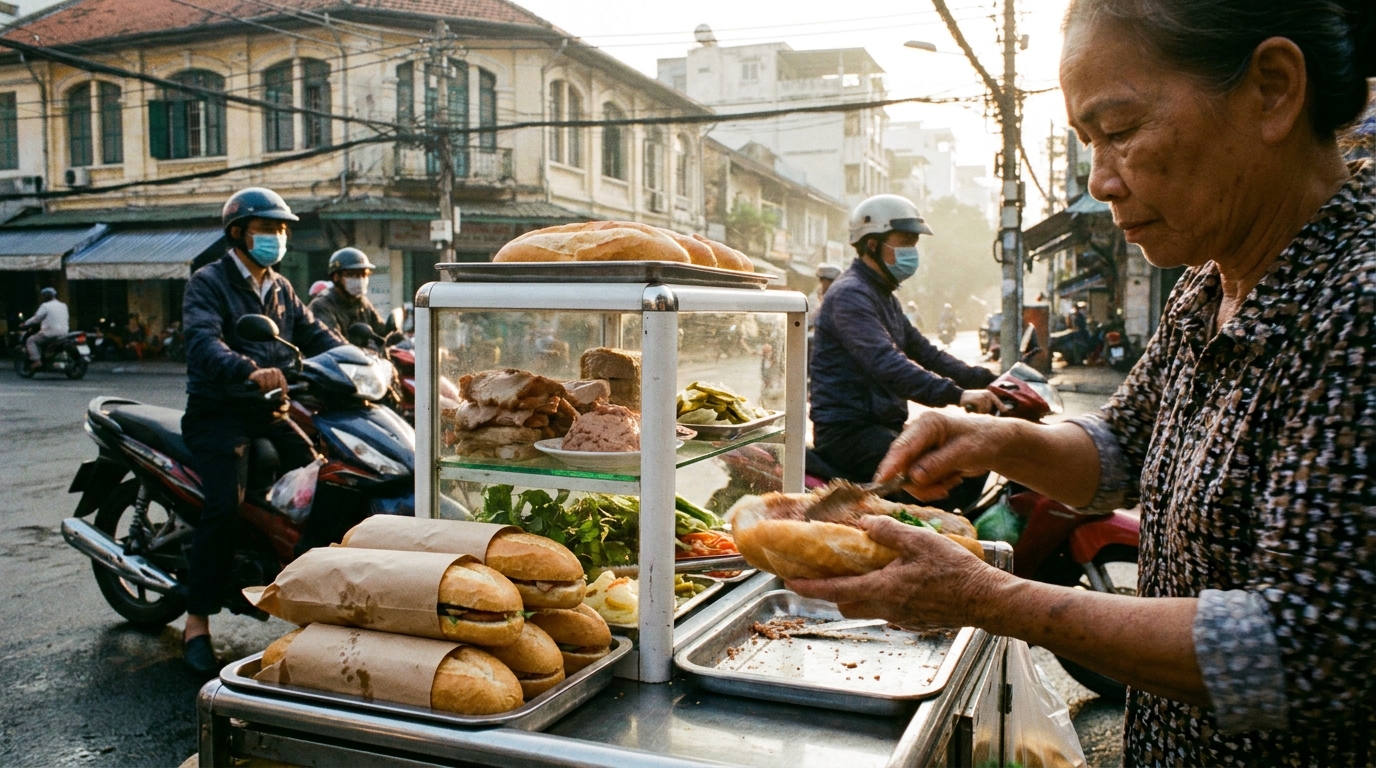
Bánh mì carts operate from 06:00 outside many serviced apartment buildings in District 1 — guests on longer stays tend to become regulars within their first week. The ritual of a 25,000 VND breakfast from the cart downstairs is one of those small daily anchors that makes an extended Saigon stay feel genuinely local rather than tourist-adjacent.
What Time Should You Go for the Best Bánh Mì?
Bread freshness peaks in two daily windows, based on most Saigon bakeries’ production schedules documented by the HCMC Bakers’ Association (2022): 05:30-09:00 and 13:30-16:30. Street carts and small shops receive their first delivery around 05:30-06:00, meaning the morning rush window features the freshest bread of the day. The second freshness window in the early afternoon explains why Huynh Hoa, which opens at 14:30, consistently has excellent bread despite starting mid-afternoon.
Avoid the 11:30-13:30 lunch rush at popular shops unless you don’t mind waiting. It’s also the period when bread sitting in display cases since morning starts to lose its crust. If you visit Huynh Hoa, arriving at 14:30-15:00 on a weekday gets you fresher bread and shorter queues than the 17:00-19:00 peak. Weekend queues at Huynh Hoa are unpredictable — add 20-30 minutes to any estimate.
Frequently Asked Questions
What is the most famous bánh mì in Ho Chi Minh City?
Bánh Mì Huynh Hoa on Lê Thị Riêng is the most consistently cited benchmark by both local food media and international guides including CNN Travel and the Michelin Guide Vietnam 2024. It opens at 14:30, sells out by 19:00-20:00 most nights, and prices range from 40,000-55,000 VND (about $1.60-$2.20 USD). Queues are real but move quickly.
How much does a bánh mì cost in Ho Chi Minh City?
Street cart versions run 25,000-35,000 VND ($1.00-$1.40 USD). Named shops and premium vendors charge 40,000-65,000 VND ($1.60-$2.60 USD). Even at the upper end, bánh mì remains among the most affordable restaurant-quality street foods in any major Southeast Asian city, according to HCMC food cost surveys (2025).
Is bánh mì available 24 hours in Saigon?
Not commonly 24 hours, but it’s available across an unusually wide window. Most street carts start around 06:00. Some breakfast-only spots like Hòa Mã close by 10:30. Named shops typically run 14:00-20:00. A smaller number of vendors operate past midnight near Bùi Viện Street and in Bình Thạnh for late-night demand.
What is the difference between northern and southern-style bánh mì?
Saigon’s southern-style version uses more butter, more cold cuts, and a larger variety of garnishes. Northern versions (Hà Nội and nearby cities) tend to be smaller, use more chả lụa relative to other cuts, and have less garnish. CNN Travel (2023) described the Saigon version as “more maximalist” — a reasonable summary. Neither is objectively better; they reflect regional preference.
Are there good vegetarian bánh mì options in Ho Chi Minh City?
Yes, though quality varies. The best vegetarian (chay) versions are near Buddhist temples in Districts 3, 5, and 10. Mock pâté made from mushrooms or tofu is the key quality indicator — avoid versions that simply leave out meat with no substitute. On the 1st and 15th of the lunar month, vegetarian bánh mì options increase citywide as Buddhist dietary observance drives demand. Prices typically run 20,000-30,000 VND.
The Bottom Line
Bánh mì is one of those foods that rewards genuine curiosity. There’s a version for every hour, budget, and protein preference — from the 06:00 cart serving egg bánh mì to workers heading to the market, to Huynh Hoa’s afternoon queue of regulars, to the xíu mại vendors in D5 who’ve been dipping baguettes in pork-tomato broth since the 1970s. The sandwich connects colonial history, Vietnamese adaptability, and a deeply practical approach to delicious cheap food.
The 12 spots on this list cover the city’s main districts and styles. Start with Huynh Hoa to set your benchmark. Then work outward by neighborhood. The gap between a 25,000 VND cart version and a 55,000 VND named-shop version is real but not enormous — the best carts beat mediocre shops consistently. Pay attention to the bread. Everything follows from there.
Planning an extended stay in Ho Chi Minh City? Our District 1 serviced apartments put you within walking distance of several spots on this list and minutes from the city’s best morning food streets.
For more Saigon guides, check out: Best Restaurants in Ho Chi Minh City: From Street Food to Fine Dining, Best Phở in Ho Chi Minh City: Bowl-by-Bowl Ranked from District 1.
For official information and further reading, visit TripAdvisor — Ho Chi Minh City Restaurants.