
The British Vietnamese International School (BVIS) is one of Ho Chi Minh City’s most established international schools, offering a full British National Curriculum from Early Years Foundation Stage through to A-Levels. Founded in 2007 as a joint venture between Nord Anglia Education and Vietnam’s Ministry of Education and Training, the british vietnamese international school has grown into a dual-campus institution serving over 1,800 students from more than 50 nationalities. If you are a family relocating to HCMC or already living in District 1, this guide covers everything you need to know before applying.
Key Takeaways
- BVIS follows the British National Curriculum (EYFS through A-Level) and is accredited by the Council of International Schools (CIS).
- Two campuses: Waterfront (District 2 / Thu Duc) and Nam Saigon (District 7 / Nguyen Van Linh corridor).
- Annual tuition ranges from approximately USD 13,000 (Early Years) to USD 25,000+ (Sixth Form), excluding registration and capital levy fees.
- Admissions are rolling, but Year 7 and Sixth Form entry points are most competitive — apply at least 6 months in advance.
- BVIS is consistently ranked among HCMC’s top three international schools and recorded a 100% A-Level pass rate in 2024.
What Is the British Vietnamese International School?
BVIS Saigon is part of Nord Anglia Education, the world’s largest premium international schools organisation with over 80 schools across more than 30 countries. The school holds dual recognition: it operates under a Vietnamese government licence as a bilingual institution while simultaneously delivering the full UK national curriculum. This means students graduate with internationally recognised qualifications — IGCSE and A-Level — while also meeting Vietnamese Ministry of Education requirements for Vietnamese language and culture.
The partnership structure makes BVIS somewhat unique among HCMC’s international schools. Unlike purely expatriate-facing schools, a significant portion of the student body is Vietnamese nationals, giving the community a genuinely bicultural character that many expat families find appealing.
BVIS Campuses: Waterfront vs. Nam Saigon
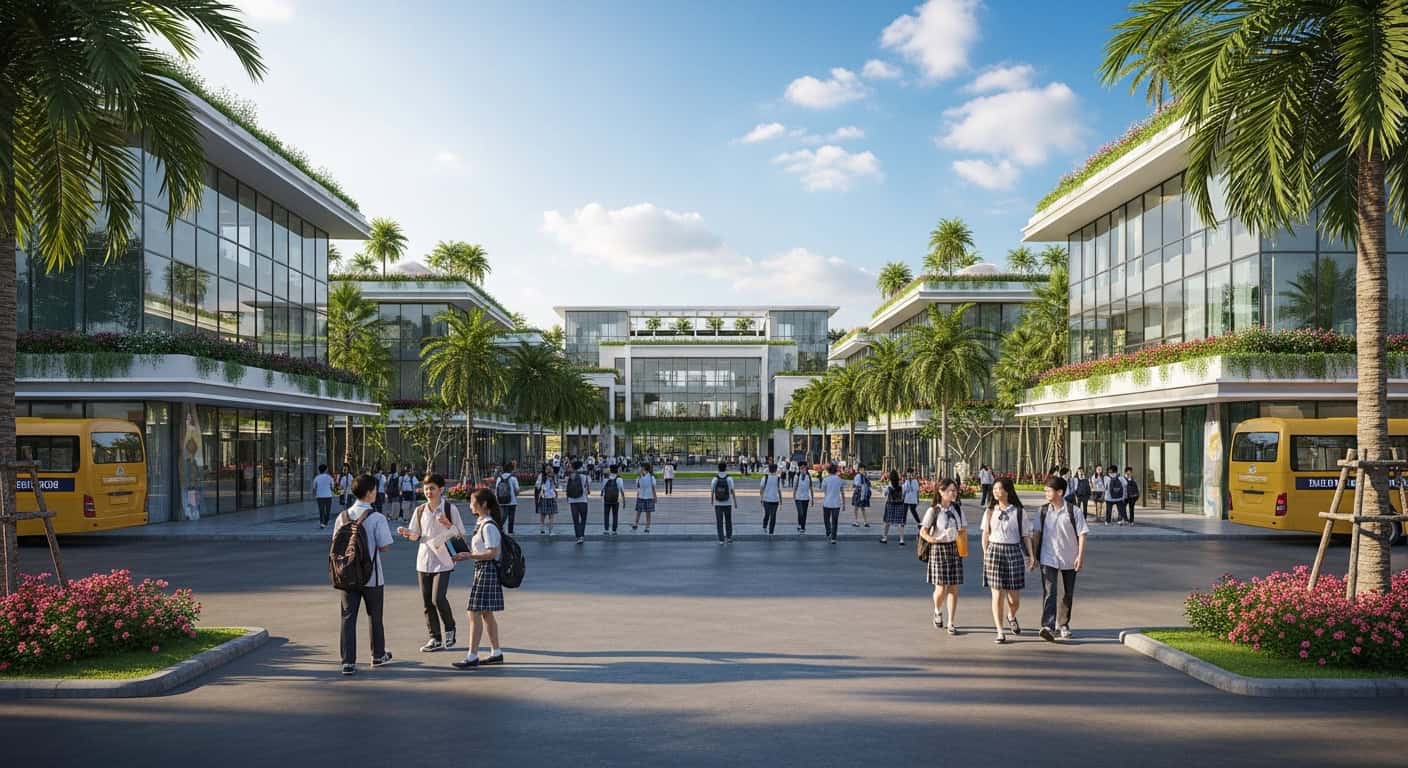
The Waterfront Campus sits in the Sala urban area of Thu Duc City (formerly District 2), close to the major expat residential clusters of An Phu, Thao Dien, and Sala itself. It is the larger of the two sites and houses the Sixth Form (Years 12–13). The campus features a 25-metre swimming pool, full-size football pitch, dedicated performing arts centre, and multiple science and technology labs.
The Nam Saigon Campus is located on Nguyen Van Linh Boulevard in District 7, close to Phu My Hung and the growing residential zones of District 7 and Nha Be. BVIS runs the British National Curriculum from Early Years through A-Level and is consistently ranked among HCMC’s top three international schools. For D1 families, the Nam Saigon campus is a 20-30 minute commute by school bus. The school operates a comprehensive bus network covering District 1, District 3, Binh Thanh, and other inner-city districts.
Curriculum and Academic Programme
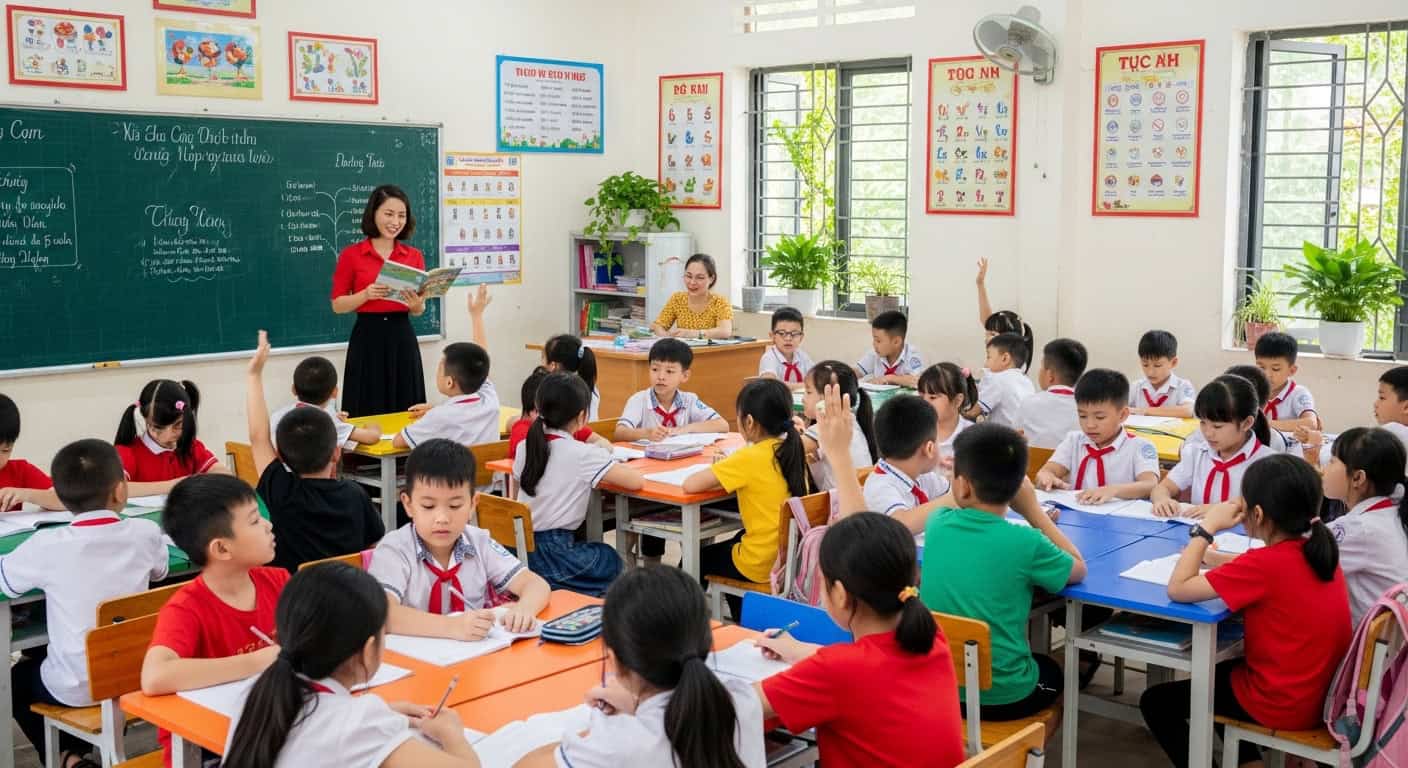
The british vietnamese international school delivers the English National Curriculum at every stage:
- Early Years Foundation Stage (EYFS): Ages 2–5, play-based learning with bilingual Vietnamese and English instruction.
- Primary (Years 1–6): Core subjects plus Mandarin Chinese, PE, music, and Vietnamese.
- Secondary (Years 7–11): Broad curriculum leading to Cambridge IGCSE examinations in Year 10 and 11.
- Sixth Form (Years 12–13): A-Level subjects at the Waterfront Campus; students typically sit 3–4 A-Levels.
Beyond standard academics, BVIS is a member of the Nord Anglia Collaborative Online Learning programme, which connects students with peers at partner schools in New York, Shanghai, London, and elsewhere for joint projects. The school also holds a partnership with The Juilliard School for performing arts enrichment.
According to the Cambridge Assessment International Education 2024 results summary, BVIS Saigon students achieved a mean IGCSE score placing the school in the top 10% of Cambridge schools in Southeast Asia. Separately, the school’s own 2024 results publication confirmed a 100% A-Level pass rate, with 42% of all grades at A* or A.
British Vietnamese International School Fees 2025–2026
Tuition at the british vietnamese international school is structured by year group. The figures below are approximate USD equivalents published for the 2025–2026 academic year; always request the current fee schedule directly from the admissions office as fees are revised annually.
- Early Years (Nursery – Reception): USD 12,800 – 14,200 per year
- Primary (Years 1–6): USD 15,500 – 17,800 per year
- Secondary (Years 7–11): USD 19,500 – 22,000 per year
- Sixth Form (Years 12–13): USD 24,500 – 26,000 per year
In addition to tuition, families should budget for a one-time Registration Fee (approximately USD 500, non-refundable) and a Capital Levy (approximately USD 1,500–2,000, paid once on enrolment). School bus fees, uniforms, and optional co-curricular activities are charged separately. Lunch is provided and included in the tuition for most year groups.
According to the ISC Research 2025 International School Fees Report, average annual tuition at top-tier international schools in Ho Chi Minh City rose by approximately 6–8% between 2023 and 2025, reflecting demand growth from both expatriate and Vietnamese professional families.
Admissions Process: Step-by-Step
The british vietnamese international school accepts applications on a rolling basis throughout the year. The main entry points are the start of each academic year (August/September) and the January mid-year intake, though spot availability varies by year group.

- Enquiry and campus tour: Submit an online enquiry via the BVIS website. The admissions team typically responds within two business days and will arrange a guided tour of your preferred campus.
- Application form and documents: Complete the online application. Required documents include the child’s birth certificate, most recent school reports (two years), passport copies, and an immunisation record.
- Assessment: Students in Year 1 and above undergo an English literacy and numeracy assessment, conducted on-site or (for overseas applicants) online. There is no entrance exam for Early Years.
- Offer letter: If a place is available and the assessment is satisfactory, BVIS issues a conditional offer. The place is secured upon payment of the registration fee and capital levy.
- Induction: New students attend a half-day induction session before their first full day. The school assigns a student buddy for the first two weeks.
For Year 7 entry — the most competitive intake — the school recommends applying at least six months before the intended start date. Sixth Form applications should be submitted by February of the preceding academic year.
Student Life and Co-Curricular Activities
BVIS offers over 100 co-curricular activities (CCAs) each term, spanning sports, arts, STEM clubs, and community service. Competitive sports teams represent the school at the ACAMIS and FOBISIA regional tournaments. The performing arts programme, bolstered by the Juilliard partnership, is particularly strong — the annual school musical draws professional production standards.
The student council is active and has genuine influence over school policy. Community service is embedded in the Sixth Form curriculum through the CAS (Creativity, Activity, Service) component of broader personal development requirements. Many graduating students log 150+ hours of community service in HCMC before leaving for university.
University Destinations
BVIS graduates consistently secure places at leading UK, US, Australian, and Asian universities. Recent cohorts have received offers from University College London, University of Edinburgh, King’s College London, University of Melbourne, Monash, and a range of US liberal arts colleges. A small but growing number of students apply to and are accepted by universities in Vietnam, South Korea, and the Netherlands.
The school employs two full-time university counsellors who begin working with students in Year 10 on preliminary planning and intensify support through Years 12 and 13. UCAS application support, personal statement workshops, and mock interviews are all included as part of the Sixth Form programme.
How BVIS Compares to Other International Schools in HCMC
When families evaluate the british vietnamese international school, they typically compare it against three other British-curriculum schools: Renaissance International School Saigon (District 2), International School Ho Chi Minh City – British (ISHCMC), and Saigon South International School (SSIS, which follows a US curriculum). Key differentiators for BVIS include:
- Bilingual mandate: BVIS is the only major British-curriculum school with a formal Vietnamese bilingual programme embedded across all year groups, not just as an add-on language class.
- Scale: At over 1,800 students across two campuses, BVIS has greater breadth of subject options at IGCSE and A-Level than smaller schools.
- Price point: BVIS fees are competitive relative to ISHCMC, which runs slightly higher for equivalent year groups.
- Location: The dual-campus model means one site is accessible from almost any residential district in HCMC.
Practical Information for Expat Families in District 1
Families based in District 1 — particularly those in the serviced apartment clusters around Ben Thanh, Le Thanh Ton, and Pasteur Street — most commonly opt for the Nam Saigon campus. The school bus routes serving District 1 typically depart around 6:45–7:00 AM and return by 4:15–4:30 PM. Journey time varies with traffic but averages 25 minutes in the morning run.
For families who prefer to drive, parking at both campuses is available. The Nam Saigon campus is accessed via Nguyen Van Linh Boulevard, which connects directly to the elevated expressway and District 1 via the Thu Thiem Tunnel or Phu My Bridge. A growing number of District 1 expat families also use ride-hailing apps (Grab) for the afternoon pickup, particularly at the beginning of term when bus capacity fills quickly.
The school’s academic calendar broadly follows the UK system: three terms from August to June, with half-term breaks in October, February, and April. It does not follow the Vietnamese public holiday calendar in full, though major Vietnamese public holidays (Tet, National Day) are observed.
Scholarships and Financial Assistance
BVIS offers a limited number of merit-based scholarships for entry into Year 7 and Year 12. These are awarded based on academic performance, demonstrated talent in the arts or sport, and an interview. Scholarships typically cover 10–25% of annual tuition fees and are renewable subject to academic standing. Financial need bursaries are not widely available; BVIS is primarily a fee-paying institution without an endowment model that supports large-scale need-based aid.
Families employed by companies with corporate education allowances should confirm with their HR department whether BVIS invoices qualify — the school issues tax-compliant receipts in both USD and VND.
You May Also Find Useful
- French International School Saigon (LFJT) Review 2025: French Curriculum, Bilingual Programme, and Fees
- Japanese School Saigon Review 2025: Curriculum, Fees, and What Japanese Expat Families Should Know
- International School Costs in Ho Chi Minh City: What Expat Parents Budget For
- Australian International School (AIS) Saigon Review 2025: Full Guide for Expat Families
Frequently Asked Questions
Is BVIS a good school for non-English-speaking children?
Yes, BVIS has an English as an Additional Language (EAL) support programme at both campuses. Students who are assessed as needing language support receive targeted EAL sessions alongside mainstream classes. Most students without prior English schooling reach comfortable fluency within 12–18 months, based on the school’s own reported data. Early Years and Lower Primary are the easiest entry points for non-English speakers.
What is the language of instruction at the British Vietnamese International School?
English is the primary language of instruction for all academic subjects. Vietnamese language and culture are taught as a compulsory subject in all year groups. Mandarin Chinese is offered as a second language from Year 1. French is available as an elective in secondary school.
How long does the admissions process take?
For year groups with available places, the process from enquiry to offer letter typically takes two to four weeks. If assessment is required (Year 1 and above), add one to two weeks for scheduling and results. During peak application periods (January–March for August entry), the process can take six to eight weeks. Applying early significantly reduces waiting time.
Does BVIS offer boarding?
No. BVIS is a day school only. There are no boarding facilities at either the Waterfront or Nam Saigon campus. Families relocating from abroad are expected to secure private accommodation in HCMC before or shortly after enrolment. The admissions team can provide a list of recommended relocation agents and residential areas popular with BVIS families.
Are BVIS A-Level results accepted by Vietnamese universities?
Yes. Vietnamese public and private universities formally recognise Cambridge A-Level qualifications for admissions purposes following Ministry of Education guidelines updated in 2022. However, the majority of BVIS A-Level graduates choose to study abroad. Students wishing to enter Vietnamese higher education should also check individual university equivalency requirements, as some faculties require additional Vietnamese language proficiency documentation.
Official Resources
For the most up-to-date information on british vietnamese international school, visit the Vietnam Ministry of Education and Training.