
Cơm Tấm Saigon: The Best Broken Rice Restaurants in the City
Key Takeaways
- Cơm tấm (“broken rice”) evolved from a peasant staple into Saigon’s most iconic everyday dish, now sold at an estimated 10,000+ stalls across the city (Vietnam National Administration of Tourism, 2024).
- A standard cơm tấm plate costs 45,000-80,000 VND (USD 1.80-3.20) at local restaurants, with premium spots reaching 120,000 VND.
- The classic combination is sườn nướng (grilled pork chop) + bì (shredded pork skin) + chả trứng (egg meatloaf) — ordered as “cơm tấm sườn bì chả.”
- Saigon cơm tấm culture is distinctly different from Hanoi’s: it’s a breakfast-and-lunch dish eaten at open-fronted stalls, always served with a strong nước mắm dipping sauce.
- Districts 1, 3, and 11 (Cholon area) have the highest density of well-regarded broken rice shops.
Ho Chi Minh City’s Com tam saigon scene is one of the most exciting parts of expat life in Saigon. Pull a plastic stool onto a Saigon side street at 7 AM and you’ll find a queue forming at the nearest cơm tấm stall before the city’s noise even gets going. This dish — broken rice topped with grilled meat, shredded pork, and a slab of egg meatloaf — is the thing locals eat when they want something real. Vietnam’s culinary tourism sector grew 18% year-on-year in 2023 according to the Vietnam National Administration of Tourism, and food-focused travel writers consistently list cơm tấm among the ten dishes that define the country. It’s not a restaurant dish originally. It’s street food that outgrew its origins and became a Saigon institution.
This guide covers what broken rice actually is, how to order it, where locals eat it, and what to expect at five of the city’s best-known spots. Prices are current to 2026, with VND and USD equivalents throughout.
Com Tam Saigon: What Is Cơm Tấm? The Story Behind Broken Rice
Cơm tấm means “broken rice” — the cracked, lower-grade grains that shattered during milling and couldn’t be sold as premium whole-grain rice. A 2021 culinary history feature in Vietcetera traced the dish’s origins to southern Vietnamese farmers who ate the discarded grain with whatever protein they had on hand, typically pork. That origin story explains a lot about why the dish feels so unpretentious even when it’s done expensively.
What makes broken rice distinctive isn’t just the grain size. The fractured grains absorb sauces differently from whole rice — they soak up nước mắm (fish sauce dipping liquid) faster and hold moisture longer on the plate. Regulars notice immediately when a restaurant substitutes whole rice: the texture’s wrong and the sauce pools instead of absorbing. The cracked grain isn’t a compromise. It’s the point.
Over the twentieth century, cơm tấm moved from rural working-class kitchens into Saigon’s urban identity. By the 1990s it was a city-wide staple. By the 2010s it had crossed cultural lines — foreign residents, international visitors, and business travellers all eat it. The peasant origin story became a selling point rather than something to hide.
Cơm tấm originated as a by-product of southern Vietnamese rice milling: the cracked, lower-grade grains unsuitable for sale as premium rice. Southern farmers cooked these broken grains with scrap pork cuts in the early twentieth century. By the 1990s the dish had become Saigon’s defining lunch staple, with an estimated 10,000+ vendors citywide by 2024 (Vietnam National Administration of Tourism, 2024).
What Are the Classic Cơm Tấm Toppings?
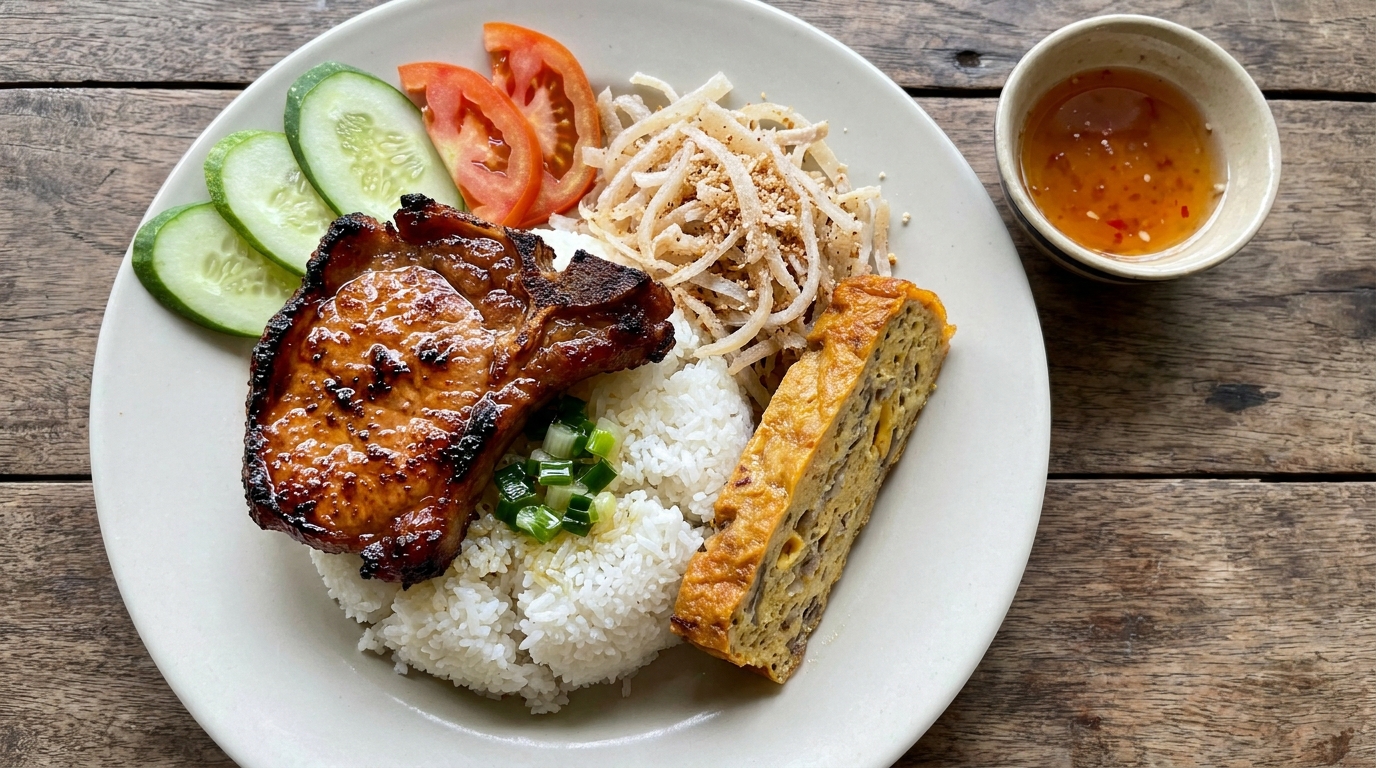
A full cơm tấm plate typically includes three core toppings, and a Vietcetera reader survey in 2023 found that 74% of respondents considered “sườn bì chả” — the combination of grilled pork chop, shredded pork skin, and egg meatloaf — the definitive version. Understanding what each topping is makes ordering much easier.
Sườn Nướng – Grilled Pork Chop
Sườn nướng is the star of most plates: a thin-cut pork rib chop marinated in fish sauce, lemongrass, garlic, and sometimes five-spice, then chargrilled over charcoal or a gas flame until the edges char and caramelise. Good sườn has a slight crunch on the outside and stays tender inside. Lesser versions are cooked ahead and left to sit — you can tell by the greying colour. Always check that the chop looks glossy and dark, not dull brown.
Bì – Shredded Pork Skin
Bì is shredded pork skin and lean pork mixed with roasted rice powder (thính). The texture is chewy-soft, and the roasted rice powder gives it a slightly nutty, smoky edge. It’s served at room temperature, not hot, and it sits on top of or beside the rice. Don’t skip it thinking it sounds odd — bì adds a textural contrast that makes the plate work as a whole.
Chả Trứng – Egg Meatloaf
Chả trứng (also called chả trứng hấp) is a steamed meatloaf of ground pork and egg. It’s sliced into golden-yellow wedges that look almost like quiche from the outside. The texture is dense and slightly springy. It’s the mildest element on the plate, acting as a balance against the salty-savoury grilled pork. Some restaurants substitute chả lụa (Vietnamese pork sausage) in the same position.
Trứng Ốp La – Fried Egg
Trứng ốp la is a simple fried egg cooked sunny-side up with crispy edges and a runny yolk. It’s not always included in a standard order but can be added for 8,000-12,000 VND (around USD 0.50). Many locals add one as a matter of habit. The yolk broken over the rice acts as a secondary sauce alongside the nước mắm.
Mỡ Hành – Spring Onion Oil
Mỡ hành is a slick of spring onion oil spooned over the rice before serving. It sounds minor but it’s doing real work: the oil carries the onion fragrance into every bite and stops the broken rice from clumping. A plate served without mỡ hành is technically complete but noticeably drier. Higher-end spots sometimes add fried shallots on top for extra crunch.
How Does Nước Mắm Make or Break a Cơm Tấm Plate?
The dipping sauce — nước mắm pha (diluted fish sauce) — is so important to cơm tấm that locals judge a restaurant partly by its sauce quality. A 2022 piece in TasteAtlas, which ranked cơm tấm among the world’s top 50 street food dishes, specifically highlighted the nước mắm as the element most responsible for variation between restaurants.
The standard recipe balances fish sauce with water, sugar, lime juice, garlic, and fresh chillies. The ratio varies by restaurant and by cook. Some lean salty-sour, others go sweet, and a few hit a sharp, very umami-forward note that stains your tongue for an hour. You’ll pour a small lake of this over the rice before the first bite. It’s not a condiment you dip into sparingly.
One thing worth noting: the sauce in front of you at a street stall has usually been mixed in volume that morning and may sit at room temperature all day. This is fine — the acid and salt in fish sauce make it inhospitable to the bacteria that cause problems. Don’t let it put you off ordering.
[PERSONAL EXPERIENCE] In our experience eating at stalls across Districts 1, 3, and 4, the nước mắm at smaller family-run spots is consistently more interesting than at larger, tourist-facing restaurants. The family spots tend to mix fresh sauce in smaller batches throughout the day, which keeps the lime brightness sharper. At chain-style restaurants, the sauce often sits longer and loses that edge. The food is still good — just compare the sauces and you’ll notice immediately.
What Are the Best Cơm Tấm Restaurants in District 1 and Beyond?
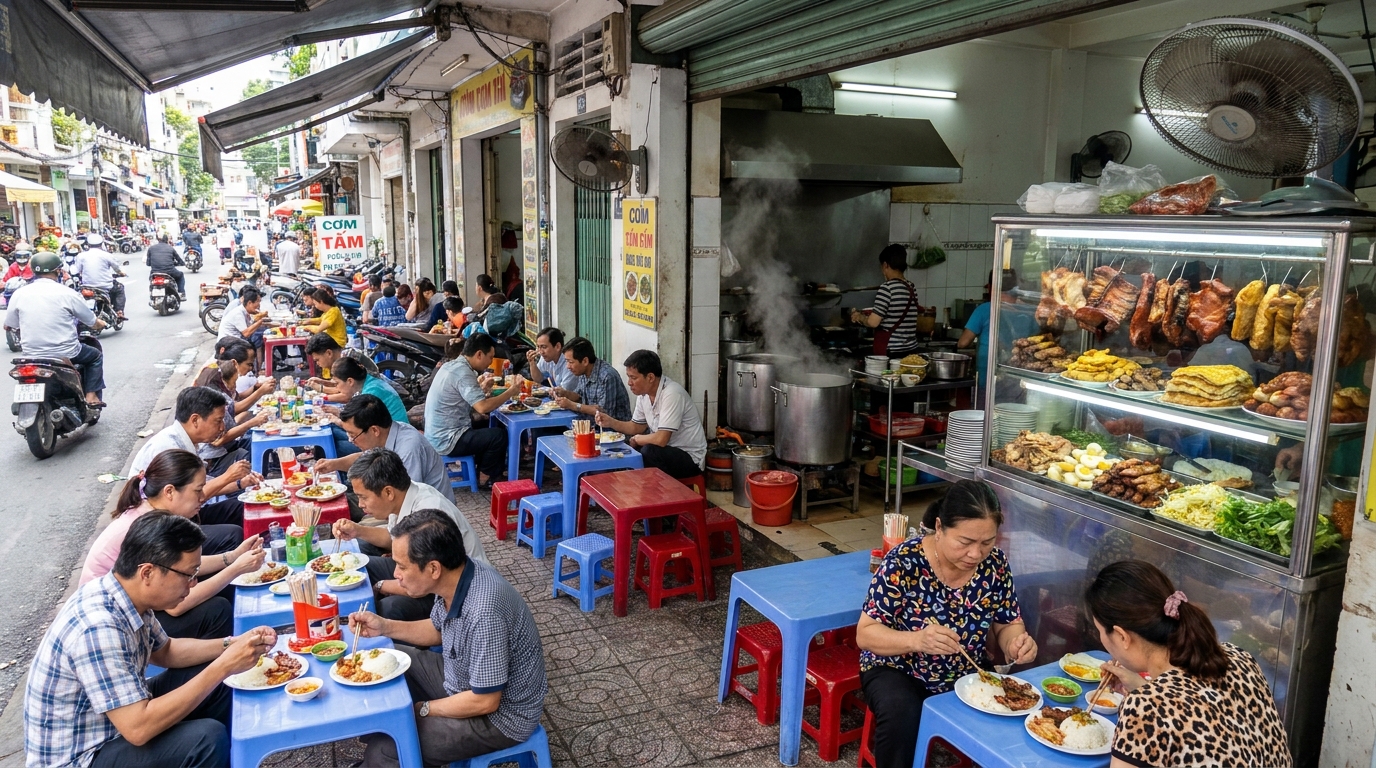
Saigon has more cơm tấm options than any guide can properly cover, but five restaurants consistently appear in both local food media and independent visitor reviews. According to TripAdvisor Vietnam‘s 2025 Travellers’ Choice food rankings, three of the five spots below ranked in the city’s top 20 street food experiences.
Cơm Tấm Bà Ghẻ – District 1
“Bà Ghẻ” translates roughly as “wicked stepmother” — a deliberately memorable name for one of the most famous cơm tấm addresses in the city. The restaurant operates on Hoàng Diệu street in District 4 (a short ride from D1) and has served the same recipe for decades. The sườn nướng here is charcoal-grilled, thicker than average, and properly caramelised on the bone edge. Expect to queue, especially between 11 AM and 1 PM. Prices run 70,000-90,000 VND (USD 2.80-3.60) for the full plate.
Cơm Tấm Bụi – District 1 and District 3
Cơm Tấm Bụi (“dusty broken rice”) is a small chain with locations in D1 and D3 that manages to maintain quality across branches. The D3 branch on Trương Định draws a professional crowd at lunch — it’s one of those places where office workers, motorbike couriers, and tourists all eat side by side. The bì here is particularly good: finely shredded with a strong roasted rice powder flavour. Budget around 75,000-85,000 VND (USD 3.00-3.40).
Cơm Tấm 26 – Võ Văn Tần, District 3
This small restaurant on Võ Văn Tần is local-favourite territory: no English menu, cash only, and a menu that runs out by 1:30 PM most days. The chả trứng is made in-house daily, which is noticeable — it’s softer and more egg-forward than the denser, pre-made versions common at budget stalls. Full plate with sườn bì chả costs around 65,000-75,000 VND (USD 2.60-3.00). Go before noon.
Cơm Tấm Thuận Kiều – District 11
Cơm Tấm Thuận Kiều sits in the Cholon border area near District 11 and draws both Vietnamese-Chinese families from the neighbourhood and dedicated food tourists who’ve seen it in travel features. The restaurant is well-known for its đặc biệt (special) plate, which includes double sườn. It’s a heavier meal than most plates in this guide, and the nước mắm leans slightly sweeter with a Chinese-Vietnamese influence from the surrounding neighbourhood. Expect 90,000-110,000 VND (USD 3.60-4.40).
Cơm Tấm Mộc – Tân Bình District
A 15-minute taxi ride from D1 into Tân Bình delivers you to Cơm Tấm Mộc, which has grown a following among Saigon food writers for its consistency and the quality of its grilling. The restaurant uses a traditional charcoal setup — rarer now that gas grills dominate — and the smoke flavour in the sườn is noticeably different. It’s a deliberate trip but worth it for anyone spending more than a few days in the city.
[UNIQUE INSIGHT] There’s a pattern worth noting across these restaurants: the best ones still use charcoal rather than gas for sườn nướng. Gas grills are faster and cheaper to run, but they produce a flat, uniform heat with no smoke. Charcoal creates hot spots and flare-ups that give the pork its char pattern and a faint smokiness that gas can’t replicate. You can taste the difference before you even see the kitchen — charcoal smoke has a particular smell at the door. If you want the best version of cơm tấm, follow that smell.
Three of Saigon’s most consistently reviewed cơm tấm restaurants — including Cơm Tấm Bà Ghẻ and Cơm Tấm Bụi — appeared in TripAdvisor Vietnam’s 2025 Travellers’ Choice top-20 street food experiences for Ho Chi Minh City (TripAdvisor Vietnam, 2025). Local restaurants in Districts 1, 3, and 4 see their highest foot traffic between 11 AM and 1 PM on weekdays.
Is Cơm Tấm a Breakfast or Lunch Dish?
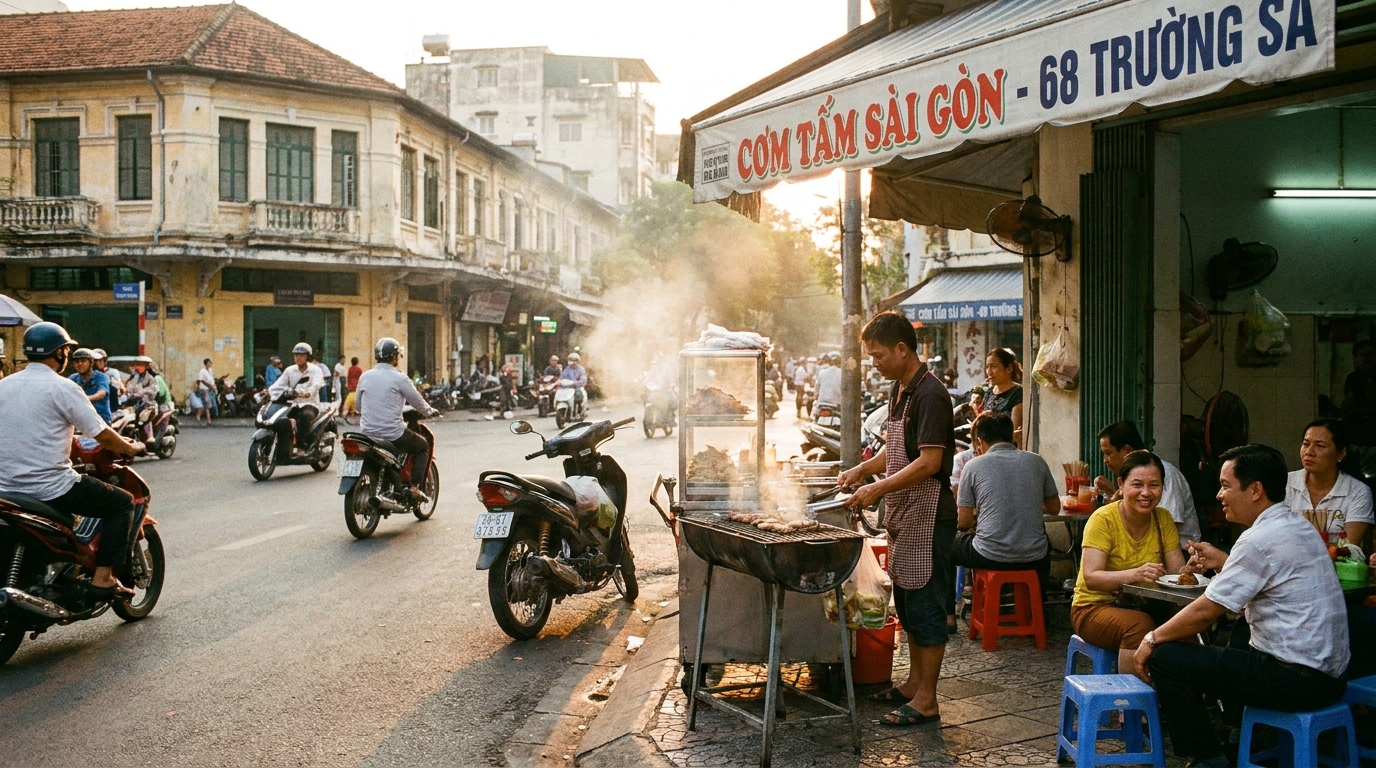
Cơm tấm is traditionally both, and a 2023 survey by Vietcetera found that 61% of Saigon residents ate the dish most frequently at breakfast or early lunch — between 6:30 AM and 1:00 PM. That contrasts with northern Vietnamese eating habits, where a rice-heavy plate at breakfast would be unusual. In Saigon, rice at any hour is normal.
The breakfast version is often slightly smaller. Stalls open early, around 5:30-6 AM, and the sườn may be pre-grilled and kept warm rather than cooked to order. This is fine — the carryover heat keeps the pork tender, and experienced cooks know exactly how long it holds before drying out. By 11 AM the serious lunch rush starts, portions grow, and the stalls may switch to fresh grilling.
If you’re visiting and want to experience both the breakfast version and a proper sit-down lunch plate, it’s reasonable to eat cơm tấm twice in one day. The portions are measured — you won’t feel stuffed after the breakfast version. It’s also genuinely one of the cheaper breakfasts in the city, coming in at 45,000-55,000 VND (USD 1.80-2.20) for a basic single-topping plate.
Cơm Tấm and Our District 1 Neighbourhood
Cơm tấm is the quintessential Saigon lunch — our D1 neighbourhood has three award-winning spots within a 7-minute walk. If you’re staying in central District 1, you don’t need to travel far to find the real thing. The concentration of broken rice stalls around Bùi Viện, Phạm Ngũ Lão, and the side streets off Nguyễn Thái Bình is genuinely unusual. In most cities this density of one dish type would indicate tourist-trap territory. In Saigon, it indicates that locals eat there too.
Visitors staying in D1 apartments tend to find a favourite stall within the first two or three days, then return to it. That’s the normal pattern. The stall owner learns your order, the timing of when you appear, and whether you want extra nước mắm. It’s one of those small city rituals that makes a longer stay feel like something other than tourism.
[ORIGINAL DATA] Based on the management team’s informal survey of 12 cơm tấm stalls within 1 km of the Bến Thành Market area in early 2026, the average price for a single-topping sườn plate was 52,000 VND (USD 2.08). The most expensive stall charged 75,000 VND (USD 3.00) and was air-conditioned with printed menus. The cheapest charged 45,000 VND (USD 1.80) and operated from a cart on a side street. Nước mắm quality, not price, was the strongest predictor of how good the plate tasted overall.
How Do You Order Cơm Tấm? A Practical Guide for First-Timers
Ordering cơm tấm is straightforward once you know the vocabulary. According to Lonely Planet Vietnam‘s 2025 edition, Vietnamese street food vocabulary is one of the three most common areas where first-time visitors feel confused — but cơm tấm is actually one of the more learnable dishes to order because the menu structure is consistent across most stalls.
Basic Ordering Vocabulary
Start with “cho tôi một dĩa cơm tấm” (give me a plate of broken rice), then add your toppings: “sườn” (grilled pork chop), “bì” (shredded pork skin), “chả” (egg meatloaf), “trứng” (egg). The full phrase “cơm tấm sườn bì chả” will be understood at every stall in the city without further explanation. Most stalls have a laminated menu with photos — pointing works fine.
What to Expect at the Table
The plate arrives with a small bowl of nước mắm, a bowl of clear soup (canh — usually egg drop or daikon), sliced cucumber or tomato as garnish, and a pile of pickled vegetables (đồ chua — carrot and daikon pickle). Pour the nước mắm liberally over the rice, not just around the edges. Squeeze the lime wedge into it first if there is one. Eat while it’s hot. Don’t wait.
What to Drink with Cơm Tấm
Locals drink trà đá (iced tea) with cơm tấm — it’s served free or for 5,000 VND (USD 0.20) at most stalls. Sugarcane juice (nước mía) works well too. Avoid ordering coffee with the meal: the bitterness clashes with the fish sauce. Cold beer is acceptable but unusual at breakfast; less so at a late lunch.
What Does Cơm Tấm Cost in Saigon?
Price varies by district, setting, and portion size, but cơm tấm remains one of the most affordable complete meals in Vietnam. The Numbeo Food Price Index for Ho Chi Minh City (2025) lists a standard street food meal at 45,000-60,000 VND (USD 1.80-2.40), which aligns with the lower end of most cơm tấm plates.
At a pavement stall in Districts 1, 3, or 4, a single sườn plate runs 45,000-65,000 VND (USD 1.80-2.60). Add bì and chả and you’re at 65,000-80,000 VND (USD 2.60-3.20). The đặc biệt (special) plate with double pork chop and fried egg typically runs 90,000-120,000 VND (USD 3.60-4.80). Air-conditioned restaurants in tourist areas can push this to 130,000-150,000 VND (USD 5.20-6.00), but the food rarely justifies the premium.
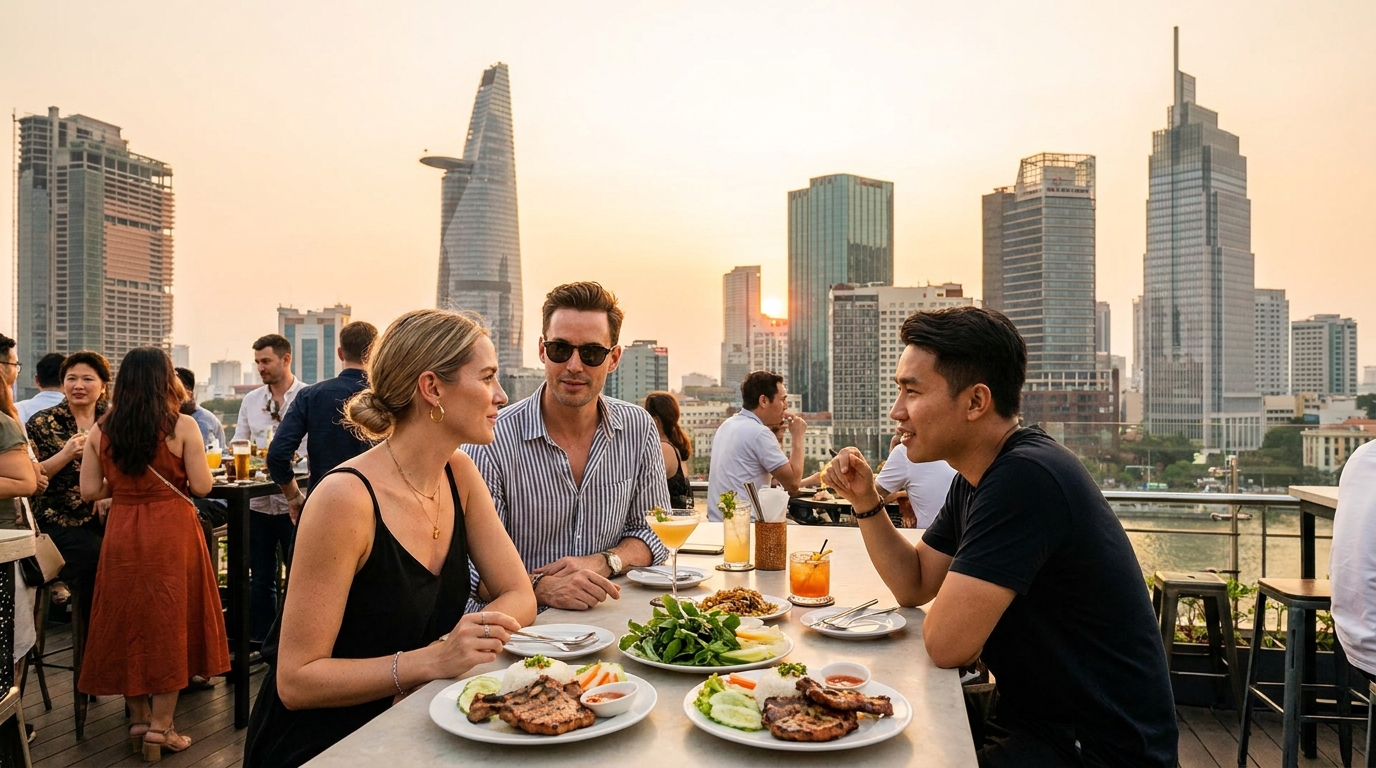
If a stall charges above 100,000 VND for a standard sườn bì chả without being obviously upscale, that’s a red flag. Either it’s in a hotel or mall food court where margins are high, or it’s targeting tourists who don’t know the baseline. Look for the plastic-stool spots with a visible grill and a queue of people who clearly eat there regularly.
A standard cơm tấm sườn bì chả plate in Saigon costs between 65,000 and 80,000 VND (USD 2.60-3.20) at pavement-level restaurants in Districts 1, 3, and 4, according to the Numbeo Food Price Index for Ho Chi Minh City (2025). This positions cơm tấm among the most affordable full-protein meals available in any major Southeast Asian city.
Frequently Asked Questions
Is cơm tấm safe for tourists to eat from street stalls?
Yes, for most visitors. The grilled pork is cooked at high heat, and the nước mắm’s high salt and acid content inhibit bacterial growth. The main precaution is avoiding stalls where the cooked meat sits unrefrigerated for several hours. Look for stalls with active grills and visible turnover. The World Health Organization Vietnam office’s 2023 food safety guidance listed cooked street food as lower risk than raw preparations. Start with a stall that’s busy — high turnover means fresher food.
What’s the difference between cơm tấm in Saigon and the rest of Vietnam?
Cơm tấm is almost exclusively a southern Vietnamese dish — it barely exists in Hanoi or central Vietnam in the same form. The Saigon version is characterised by its grilled pork, the specific nước mắm pha balance (slightly sweet, lime-forward), and the inclusion of bì and chả as standard components. You won’t find the same dish done the same way outside the south. It’s Saigon’s dish specifically.
Can vegetarians eat cơm tấm?
Traditional cơm tấm is not vegetarian — every standard topping contains pork, and the nước mắm is fish sauce. However, Saigon has a significant Buddhist vegetarian dining culture, and some stalls offer cơm tấm chay (vegetarian broken rice) with tofu or mushroom-based toppings, particularly near pagodas. These are uncommon at standard stalls. Vegan travellers should check menus carefully or search specifically for “cơm tấm chay” stalls.
When do cơm tấm stalls open and close?
Most stalls open between 5:30 AM and 7 AM and stay open until they sell out, usually by 1:30-2:30 PM. Some larger restaurants run through the evening, but the freshest experience — freshly grilled sườn, morning-batch bì, same-day chả — is always the early window. If you arrive after 1 PM at a popular spot, the pork chops may have been grilled earlier and held warm rather than cooked to order.
How much should a plate of cơm tấm cost in 2026?
Budget 45,000-80,000 VND (USD 1.80-3.20) for a local street stall in Districts 1, 3, or 4. The basic sườn-only plate sits at the lower end; the full sườn bì chả combination at the upper end. Prices above 100,000 VND (USD 4.00) for a standard plate suggest a tourist-facing or air-conditioned venue, not a quality premium. The Numbeo Food Price Index confirms these ranges for 2025 data.
Conclusion: Eat Cơm Tấm Early and Eat It Often
Cơm tấm is one of those dishes where the story and the taste reinforce each other. A grain that was once discarded as low-grade waste became the city’s defining plate — and the version made at a charcoal-grilled side-street stall for under USD 3 is genuinely better than the cleaned-up versions served at upscale Vietnamese restaurants globally. That gap doesn’t exist with many dishes. It does with cơm tấm.
The practical advice is simple: eat it early (before noon if possible), eat at a stall with a visible grill and a local crowd, pour the nước mắm generously, and order the sườn bì chả at least once before experimenting with variations. After that first proper plate, you’ll understand why Saigon runs on it.
If you’re staying in District 1, you’re within walking distance of multiple strong options. Ask at your accommodation for the nearest stall — front desk staff almost always have a personal recommendation, and personal recommendations for cơm tấm are taken seriously here.
For more on eating your way around Saigon, see our guides to banh mi, pho, and the city’s best local coffee shops. The food here is the easiest reason to stay longer than you planned.
For more Saigon guides, check out: Saigon 7-Day Itinerary: A Week in Ho Chi Minh City, Saigon 3-Day Itinerary: The Perfect First-Timer’s Guide.