
Fine Arts Museum Saigon: Collections, Hours, and What to Expect
A visit to Fine arts museum saigon is a highlight for both first-time visitors and long-term residents exploring Ho Chi Minh City’s history. 
The Fine Arts Museum Saigon sits in one of the most beautiful colonial buildings in Ho Chi Minh City, yet most visitors walk straight past it on the way to Ben Thanh Market. That’s a mistake. The museum holds over 20,000 artworks spanning Vietnamese history from the bronze age to the present day, all housed in a 1929 Chinese-French building that’s worth the entry fee on its own.
Entry costs just 30,000 VND (around $1.20), making it one of the cheapest cultural experiences in District 1. You’ll spend 60 to 90 minutes here comfortably, and you’ll come away with a better understanding of Vietnamese visual culture than most organised city tours provide.
Key Takeaways
- Entry fee: 30,000 VND (~$1.20), Tue-Sun 09:00-17:00, closed Mondays
- The 1929 Chinese-French colonial building is itself a highlight — original mosaic floor tiles still intact
- Three floors: decorative arts and sculpture (ground), revolutionary and modern art (second), lacquerware and ceramics (third)
- Vietnamese lacquer paintings, including works by master Nguyen Gia Tri, are the collection’s strongest pieces
- Only 7 minutes on foot from Ben Thanh Market at 97B Pho Duc Chinh Street, District 1
What Is the Fine Arts Museum Saigon?
The Fine Arts Museum Saigon (Bao Tang My Thuat) opened in 1992 and now holds over 20,000 pieces across three floors, according to the museum’s own collection records. It covers Vietnamese art from ancient Cham and Khmer objects through French colonial-era paintings, wartime propaganda posters, and contemporary Vietnamese sculpture. The building predates the collection by more than 60 years.
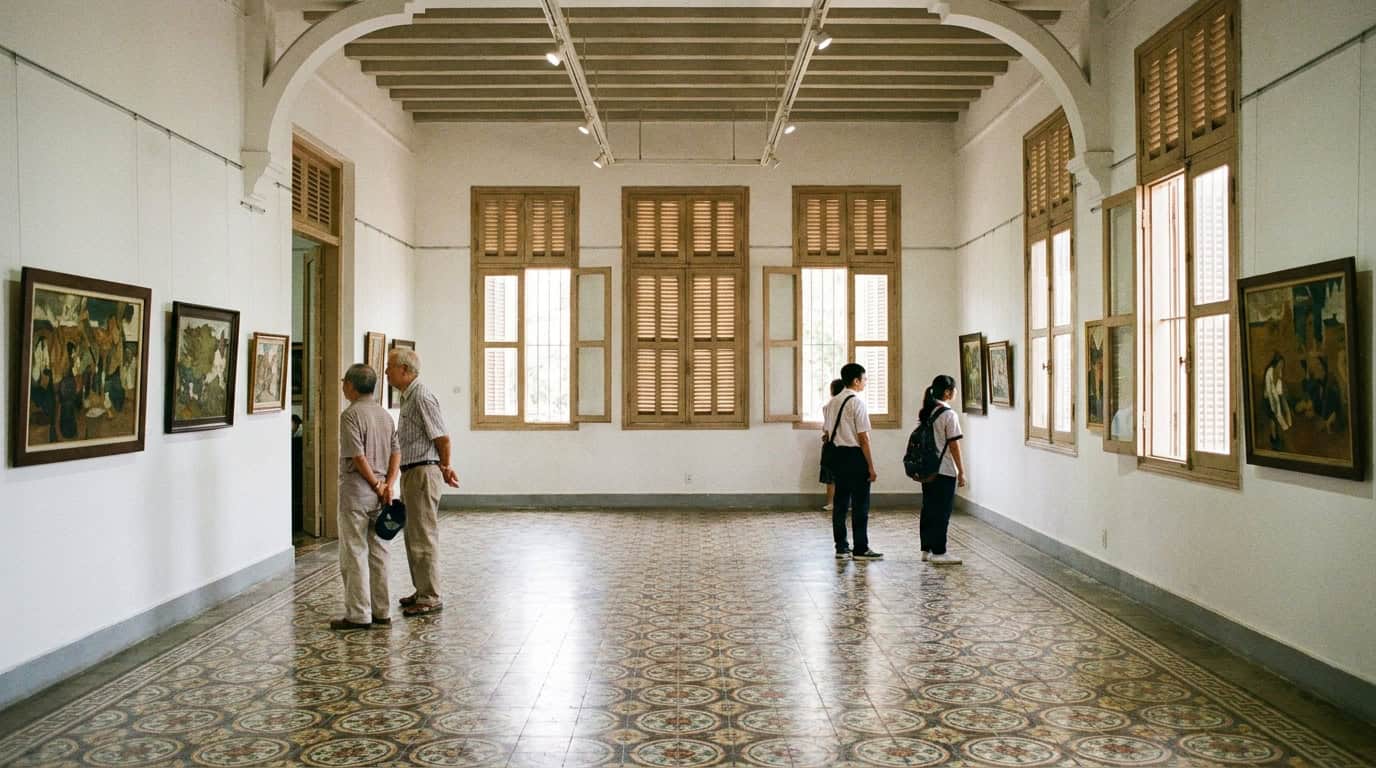
The museum occupies the former residence of a wealthy Chinese merchant, built in 1929. Architects blended French neoclassical structure with Chinese decorative elements: ornate yellow plasterwork, lotus-motif ironwork balconies, and original encaustic cement floor tiles that have survived almost a century of foot traffic. Walking the corridors feels genuinely different from modern museum buildings.
Three wings spread across the main building, connected by open-air galleries and a central courtyard. A separate annex building at the back hosts temporary exhibitions, which rotate every six to eight weeks. The permanent collection stays on the three floors of the main villa.

What Are the Three Floors of the Fine Arts Museum?
A 2023 visitor survey published by Vietnam National Administration of Tourism found that most international visitors to the Fine Arts Museum Saigon spend under 30 minutes inside — less than half the time the collection actually warrants. Knowing what’s on each floor before you arrive changes that significantly.
Ground Floor: Ancient Objects and Sculpture
The ground floor focuses on three-dimensional works: Cham sculpture, Khmer stone carvings, and bronze objects from the Dong Son culture (roughly 500 BCE to 200 CE). These pieces represent the pre-Vietnamese cultures that shaped the Mekong Delta region. Context boards are in Vietnamese and English, though the English translations are occasionally approximate.
Don’t miss the courtyard off the ground floor. It’s free to enter even without a museum ticket, and it gives you the best view of the building’s Chinese-style ceramic roof tiles and the interior ironwork staircases. Several vendors sell lacquerware and art prints here.
Second Floor: Revolutionary and Modern Vietnamese Art
The second floor is where the museum becomes genuinely compelling. This floor covers Vietnamese art from the French colonial period through the American War era and into the 1980s. Revolutionary propaganda paintings hang alongside French-influenced oil paintings from the Indochina Fine Arts School (Ecole des Beaux-Arts de l’Indochine), which operated in Hanoi from 1925 to 1945.
The wartime propaganda collection is particularly strong. Lacquer, silk, and oil works show rice farmers, armed women fighters, and abstract representations of the Ho Chi Minh Trail. These pieces read very differently when you understand they were made as functional communications tools, not gallery art.
[PERSONAL EXPERIENCE] The second floor gets genuinely interesting when you stop treating the propaganda works as curiosities and start reading them as documents. The technique is consistently high. Several pieces show clear influence from Soviet socialist realism, while others feel closer to French poster art — the blending reflects the complicated cultural moment they came from.
Third Floor: Lacquerware and Ceramics
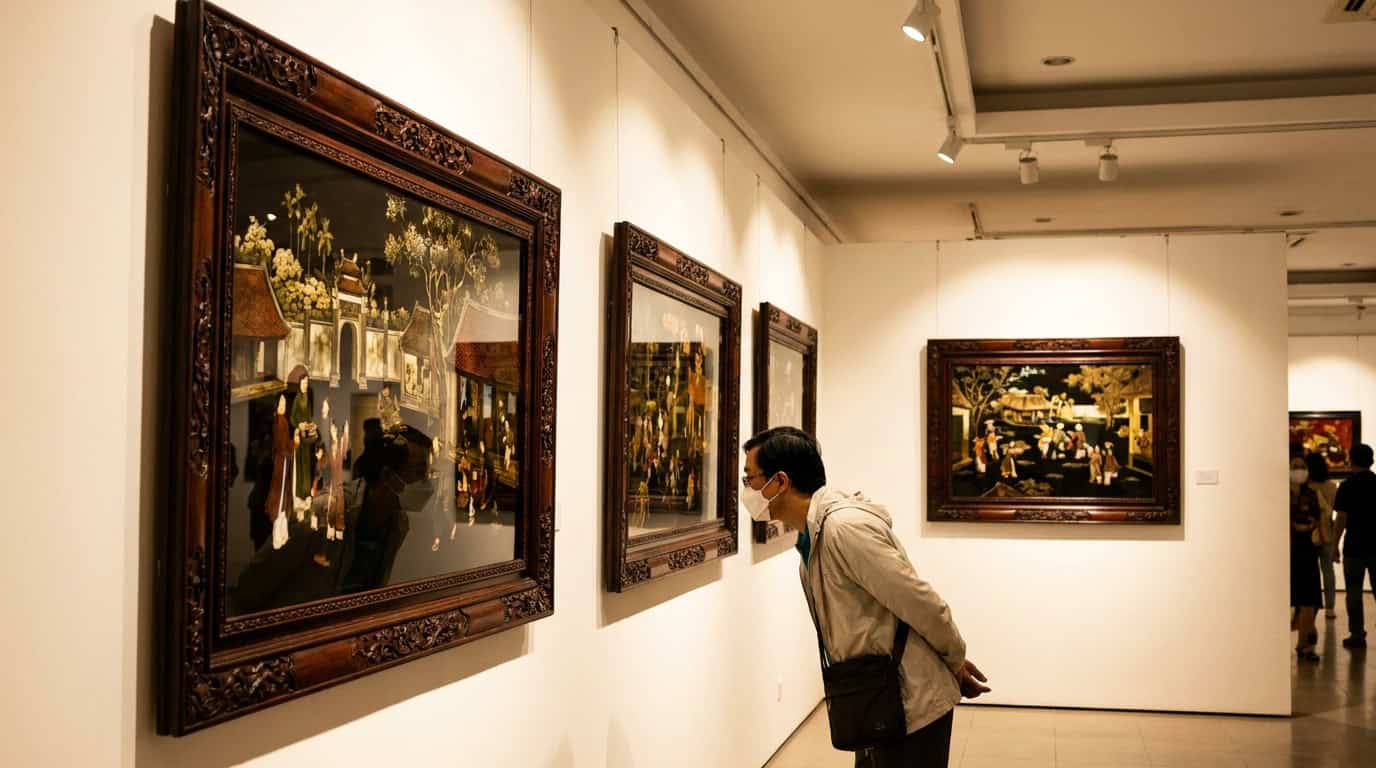
The third floor houses the collection’s most technically accomplished works. Vietnamese lacquerware (son mai) requires 15 to 30 layers of sap from the Rhus succedanea tree, with each layer dried and sanded before the next is applied. The final pieces have a depth and luminosity that photographs cannot capture accurately. This is one of the few places in Saigon where you can see major lacquerware works in person.
Works by Nguyen Gia Tri (1908-1993), widely considered the master of Vietnamese lacquer painting, are among the most significant in the collection. His large-scale panels depicting village life and mythological scenes demonstrate the full range of the medium. Ceramics from Bien Hoa (late colonial period) and blue-and-white wares from Bat Trang complete the floor.
Is the Building Worth Seeing Even Without the Art?
Yes. The Fine Arts Museum Saigon occupies a 1929 Chinese-French colonial building at 97B Pho Duc Chinh that architectural historians consider one of the best-preserved examples of this hybrid style in Southeast Asia, according to a 2022 survey by the Saigon Architecture Preservation Society. The original mosaic floor tiles, cast-iron balustrades, and carved wooden shutters survive almost completely intact.
The building’s yellow facade with white trim follows French neoclassical proportions — symmetrical bays, arched windows, projecting balconies. But the decorative elements are distinctly Chinese: lotus flowers in the ironwork, cloud-motif plaster reliefs, and a central doorway flanked by ceramic guardian figures. The fusion reflects the Chinese merchant community that commissioned it.
Photographers get the best exterior light between 08:00 and 10:00, when the morning sun hits the yellow facade directly. The interior courtyard is shaded all morning, making it good for detail shots of the ironwork and tile floors at any hour.
How Do You Get to the Fine Arts Museum Saigon?
The Fine Arts Museum is at 97B Pho Duc Chinh Street, District 1, a 7-minute walk from Ben Thanh Market. Vietnam’s Grab ride-hailing app, which handles over 3 million rides per day across Southeast Asia according to Grab’s 2024 annual report, will bring you here from anywhere in District 1 for under 30,000 VND. Walking from Dong Khoi Street takes about 12 minutes.
The street address can confuse GPS apps slightly. Pho Duc Chinh runs parallel to the Ben Thanh Market area, one block west of Ham Nghi Boulevard. Look for the yellow building — you can’t miss it once you’re on the right street. The entrance is on the ground floor, set back from the pavement through an iron gate.
There’s no dedicated parking for tourists arriving by car. Motorbike parking is available on the pavement outside for around 5,000 VND. Most visitors arrive on foot or by Grab from nearby District 1 hotels.
Practical Tips for Visiting the Fine Arts Museum Saigon
A 2024 TripAdvisor analysis of HCMC museum reviews found that the most common complaint among international visitors to the Fine Arts Museum was confusion about which parts of the building were open. The annex building’s opening hours sometimes differ from the main villa, and signage inside is inconsistent. Asking at the ground-floor ticket desk before you start saves backtracking.
Photography Rules
Photography is permitted throughout the permanent collection without flash. Video is also allowed. Commercial photography requires advance written permission from the museum administration. Some temporary exhibitions in the annex building restrict photography — look for signage at the annex entrance. Your phone camera handles the low-light third-floor galleries better than most compact cameras.
Audio Guides and Tours
The museum does not offer a formal audio guide as of 2026. English-language labels are present on most permanent collection items, but their depth varies significantly. Several tour companies offer private guided visits that include the Fine Arts Museum as part of a broader District 1 cultural walk. These typically cost 300,000 to 500,000 VND per person and last three to four hours total.
[UNIQUE INSIGHT] The museum’s ground-floor courtyard is technically free to enter and functions as a small art market most mornings. Local artists sell lacquerware prints, silk paintings, and oil-on-canvas works here directly. Quality varies widely, but a few vendors consistently show genuinely skilled pieces. Worth five minutes even if you don’t buy.
Combining With Nearby Sights
The Fine Arts Museum pairs well with Ben Thanh Market (7-minute walk), the Mariamman Hindu Temple (10-minute walk), and the Bitexco Financial Tower observation deck (12-minute walk). A half-day cultural route starting at the Fine Arts Museum, walking south to the temple, then east to Dong Khoi Street covers the main District 1 highlights without needing transport.
If you are doing this as a day out from elsewhere, Booking.com and Agoda show what is available to stay in Ho Chi Minh City on the nights around it.
Frequently Asked Questions
How much does it cost to visit the Fine Arts Museum Saigon?
Entry to the Fine Arts Museum Saigon costs 30,000 VND (approximately $1.20) for all visitors — there is no separate foreigner price. This makes it one of the cheapest museums in Ho Chi Minh City. The ground-floor courtyard and art market can be accessed free without purchasing a ticket. Camera fees are not charged separately.
What are the best artworks at the Fine Arts Museum Saigon?
The strongest pieces are the Vietnamese lacquer paintings on the third floor, particularly large-scale works by Nguyen Gia Tri (1908-1993), widely considered the master of the son mai lacquer technique. The second-floor wartime propaganda collection is historically significant. On the ground floor, Dong Son bronze drums (circa 500 BCE) are among the most technically impressive objects in the museum.
Is the Fine Arts Museum Saigon building itself worth seeing?
Yes, unambiguously. The 1929 Chinese-French colonial building at 97B Pho Duc Chinh is one of the best-preserved of its type in Southeast Asia. The yellow facade with ornate white ironwork balconies photographs exceptionally well. Inside, original encaustic cement mosaic floor tiles, wooden-louvred shutters, and cast-iron balustrades survive almost completely intact after nearly 100 years.
What are the Fine Arts Museum Saigon opening hours?
The Fine Arts Museum Saigon is open Tuesday through Sunday, 09:00 to 17:00. It is closed on Mondays. The best time to visit is before 11:00, when tour groups are less likely to be present and morning light through the shuttered windows is at its best. The last entry is accepted at 16:30.
How far is the Fine Arts Museum from Ben Thanh Market?
The Fine Arts Museum Saigon is a 7-minute walk from Ben Thanh Market. The museum address is 97B Pho Duc Chinh Street, District 1. Walk west from Ben Thanh Market along Le Loi Boulevard, then turn right onto Pho Duc Chinh. The yellow colonial building is visible from the corner. Grab motorbike from Ben Thanh takes around 3 minutes and costs 15,000-20,000 VND.
Planning to make Saigon your base?
For more Saigon guides, check out: History Museum Saigon: What’s Inside and Why It’s Worth Your Time, War Remnants Museum Saigon: What to Expect, Tips, and How to Prepare.
For official information and further reading, visit Vietnam Tourism — Ho Chi Minh City.