
Lonely Planet Vietnam: What It Gets Right and What Locals Would Change
The Lonely Planet Vietnam guide remains one of the most-read travel references for first-time and returning visitors alike, and for good reason — it covers a genuinely complex country with impressive breadth. But after living in Ho Chi Minh City for years, there are things the guide nails and a few things where local knowledge fills the gaps. This article breaks down both honestly, so you can use Lonely Planet Vietnam as the solid starting point it is while knowing where to supplement it.
Key Takeaways
- Lonely Planet Vietnam is strongest on historical context, northern trekking, and coastal destinations like Ha Long Bay and Hoi An.
- Its Ho Chi Minh City coverage has improved but still skews toward backpacker hubs rather than the neighborhoods where expatriates and long-stay visitors actually live.
- Locals would update the food sections more frequently — the street food scene in HCMC changes faster than a print cycle allows.
- Transport information, especially for inner-city HCMC, needs real-time supplementing with apps like Grab.
- For accommodation, the guide’s District 1 focus is well-founded — it remains the most practical base for first-time visitors to Saigon.
What Lonely Planet Vietnam Actually Covers
The current edition of Lonely Planet Vietnam runs to nearly 700 pages across the country’s three regions: the north centered on Hanoi and Sapa, the central coast anchored by Hue, Da Nang, and Hoi An, and the south dominated by Ho Chi Minh City and the Mekong Delta. It is organized geographically, which suits the way most travelers move through the country — overland from north to south or the reverse.
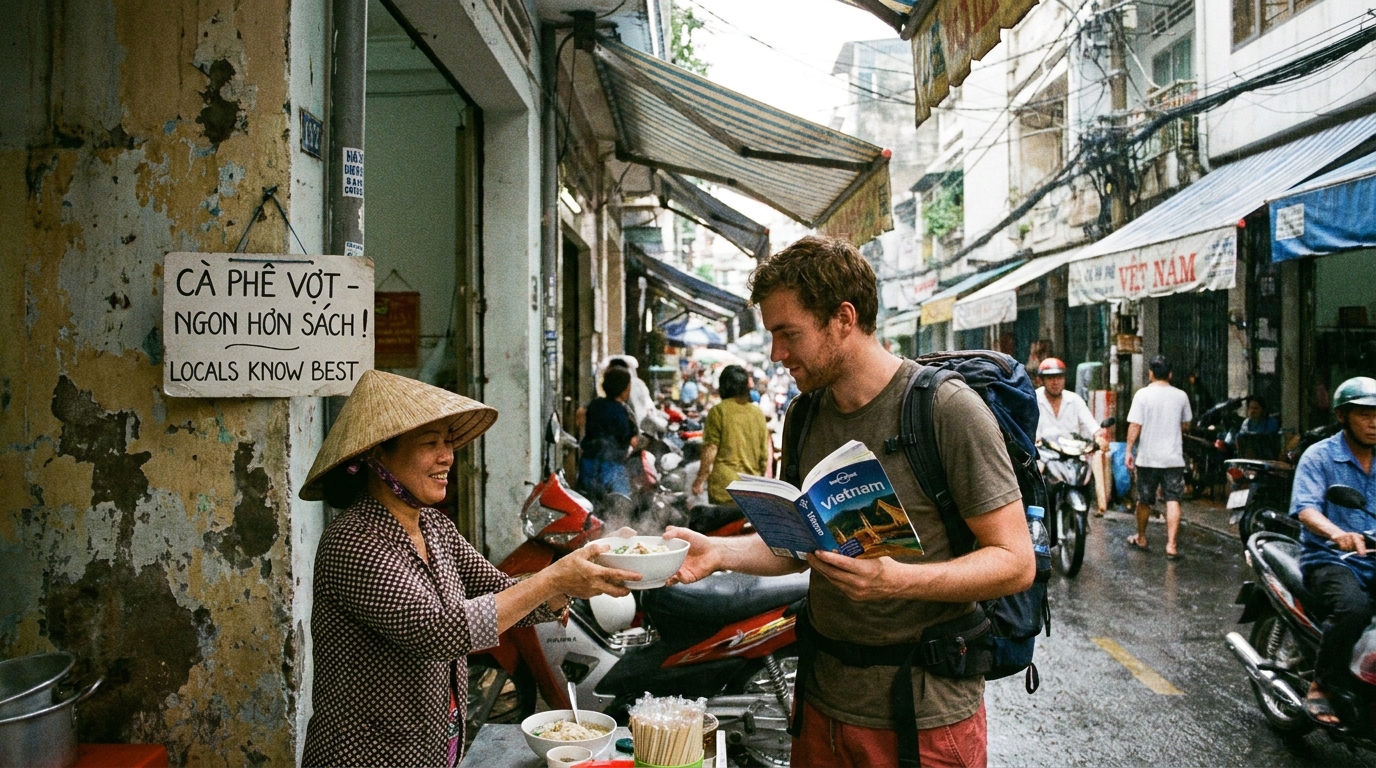
Each city chapter includes a curated selection of sights, restaurants, accommodation, and transport options. The contextual introductions — history, culture, local customs — are generally well-researched and hold up over time better than the restaurant listings do. If you want to understand why Hue matters as the former imperial capital before you walk its citadel, Lonely Planet Vietnam gives you that foundation efficiently.
Where Lonely Planet Vietnam Gets It Right
Experienced travelers sometimes dismiss guidebooks, but the Lonely Planet Vietnam team earns its keep in several areas that genuinely help visitors plan.
Historical and Cultural Context
The war history sections — covering the American War, the French colonial period, and Vietnam’s longer arc of resistance against Chinese, Mongol, and regional powers — are unusually detailed for a mainstream travel guide. The Cu Chi Tunnels write-up, for instance, explains the strategic logic of the tunnel network, not just the tourist experience of crawling through it. That kind of context changes how you engage with a site.
Northern Trekking and Minority Cultures
Sapa, Ha Giang, and the surrounding highlands receive thorough coverage in Lonely Planet Vietnam, including practical advice on hiring local guides, the ethics of homestays with ethnic minority communities, and route difficulty. This is an area where independent research is genuinely hard to aggregate, and the guide does the heavy lifting well.
Coastal and Island Destinations
Ha Long Bay, Phu Quoc, Con Dao, and the Hoi An Ancient Town are all covered in enough detail that a traveler could plan meaningful itineraries from the guide alone. The Ha Long Bay section in particular is useful for navigating the tour-boat ecosystem — warning readers away from the cheapest overnight options and explaining the difference between Ha Long, Bai Tu Long, and Lan Ha Bays.
Where Local Knowledge Fills the Gaps in Ho Chi Minh City
This is where a Saigon resident’s perspective diverges most sharply from what Lonely Planet Vietnam offers. The HCMC chapter is not bad — it has improved substantially across recent editions — but it still reflects a particular kind of visitor experience rather than the city locals navigate.

The Food Scene Moves Too Fast for Print
HCMC’s street food and restaurant landscape turns over at a pace that makes any printed guide partially outdated by publication. Banh mi stalls close, new pho spots open under elevated highways, a District 3 rooftop that was buzzing two years ago is now a parking structure. The guide’s restaurant recommendations are worth cross-referencing with Google Maps reviews filtered to the last six months rather than treating them as current picks.
What Lonely Planet Vietnam does well here is give you the categories — banh xeo, bun bo Hue, com tam, hu tieu — and approximate price expectations. That framework is durable even when specific addresses aren’t.
Neighborhood Coverage Beyond the Tourist Triangle
The guide concentrates HCMC coverage on District 1, Pham Ngu Lao backpacker area, and a few District 3 highlights. This is understandable for a first visit, but it leaves out the texture of districts where the city actually lives: the ceramic workshops of Binh Duong just north of the city, the creative studios clustering in District 4, the Vietnamese-Chinese heritage of Cho Lon in District 5, the emerging cafe and gallery scene in Thu Duc City.
Lonely Planet recommends staying in D1 for good reason — our apartments offer the quality the guides assume. District 1 genuinely is the most navigable base, especially for visitors arriving without Vietnamese language skills, and being well-located there means you can day-trip into every other district without losing practical efficiency.
Transport: What the Guide Misses in 2026
The Lonely Planet Vietnam transport sections were written for an era before Grab dominated urban Vietnam the way it now does. The guide discusses metered taxis and xe om (motorbike taxis), which still exist, but for most visitors the practical reality is that Grab handles 90 percent of inner-city HCMC transport at predictable prices. The guide’s warnings about taxi meter fraud, while not wrong, are less critical now than they were five years ago.
More significant is the metro. HCMC’s Metro Line 1, connecting Ben Thanh Market in District 1 to Suoi Tien in Thu Duc, opened in late 2024. According to the Ho Chi Minh City Metro Management Board, the line carried over 1 million passengers in its first two months of operation — a milestone for a city that had relied entirely on road transport for generations. The current edition of Lonely Planet Vietnam predates this opening and doesn’t reflect the new travel patterns the metro enables.
For longer intercity travel, the guide’s train coverage is solid. The Reunification Express running Hanoi to HCMC is well-described, including realistic journey times and seat class recommendations. Bus coverage is good for the northern highland routes where trains don’t reach.
Visa and Entry: Accurate but Always Verify
Visa rules for Vietnam have changed multiple times in recent years. Lonely Planet Vietnam covers the e-visa system and visa-on-arrival procedures accurately as of its publication date, but this is specifically an area where readers should verify against current official sources before travel. Vietnam expanded its e-visa validity to 90 days and made it available to most nationalities in 2023, a significant change that not all editions reflect equally.

According to the Vietnam National Authority of Tourism, international arrivals to Vietnam reached approximately 17.5 million in 2024, recovering past pre-pandemic levels and continuing to grow in 2025. That volume of travel puts sustained pressure on the e-visa system during peak periods; applying well in advance is a practical tip that supplements whatever the guide says about processing times.
The Best Itineraries in Lonely Planet Vietnam
The itinerary suggestions in Lonely Planet Vietnam are one of its most practically useful features, especially for visitors with limited time. The classic two-week south-to-north run — HCMC, Mekong Delta, Hoi An, Hue, Hanoi, Ha Long Bay — is genuinely well-paced and hits the highest-density experiences. The guide also offers a reasonable “best of the north” two-week circuit and a beach-focused southern itinerary built around Phu Quoc.
Where local experience would adjust these itineraries: the guide tends to allocate more time to Da Lat than many travelers find necessary (two days is usually sufficient for the highlands scenery and coffee culture) and less time than deserved to the Mekong Delta, which rewards slower exploration by boat rather than a rushed day trip from HCMC.
Accommodation Recommendations: Framework vs. Specifics
The accommodation listings in any edition of Lonely Planet Vietnam should be treated as a starting framework rather than a current booking guide. Hotel ownership changes, standards shift, and price categories that were accurate three years ago may no longer reflect reality in either direction.
What the guide does well is establish the geography of where to stay. Its consistent recommendation to base yourself in District 1 for HCMC visits reflects genuine logistical wisdom: proximity to the major historical sites, walkability to Ben Thanh Market and the Opera House area, and access to the dense restaurant and cafe concentration along Dong Khoi and Le Loi. These factors don’t expire the way specific room rates do.
For visitors planning a longer stay or wanting apartment-style accommodation rather than hotel rooms, the guide doesn’t go deep on serviced apartment options — an area where the actual market has expanded considerably and where quality can significantly exceed what short-stay hotels offer at comparable price points.
Food and Drink: The Guide’s Strongest Street-Level Advice
Despite the turnover problem noted earlier, Lonely Planet Vietnam handles food education extremely well. The glossary of Vietnamese dishes, the etiquette notes around communal eating, the explanation of how to read a Vietnamese menu, and the honest guidance around street food hygiene precautions are all useful and largely timeless.
The guide correctly identifies the regional distinctions in Vietnamese cuisine — the sweeter, more herb-heavy southern cooking versus the spicier, more austere central style versus Hanoi’s refined northern approach — and these distinctions help travelers understand why a pho in HCMC tastes different from a pho in Hanoi. That context makes eating in Vietnam more meaningful rather than just more calorific.
The coffee section has improved in recent editions, reflecting Vietnam’s status as the world’s second-largest coffee exporter. The guide now acknowledges the difference between traditional ca phe sua da culture and the third-wave specialty scene that has developed in HCMC and Hanoi over the past decade.
What a Saigon Local Would Add to the Guide
If the Lonely Planet Vietnam editorial team spent a month in HCMC with full local access, here is what would most likely appear in the next edition that isn’t adequately covered now.
- The Metro Line 1 corridor — and what it has done to the Ben Thanh neighborhood as a transport hub rather than just a market destination.
- District 2 and Thu Duc City’s transformation — the tech corridor, international school cluster, and expat residential neighborhoods that have made the east bank of the Saigon River a city within a city.
- Rooftop bar culture with honest pricing — the guide lists some rooftop venues but doesn’t consistently flag the significant drink minimums and cover charges that apply at peak hours.
- Grab-integrated street food hunting — using location reviews in Grab Food as a local discovery tool, which is how most HCMC residents find new spots.
- Rainy season practicalities — the monsoon season from May to November in the south means afternoon flooding on some streets. The guide mentions the seasons but underplays how dramatically a 4pm downpour can rearrange a tourist afternoon in HCMC.
Is Lonely Planet Vietnam Still Worth Buying?
For a first visit to Vietnam, yes — Lonely Planet Vietnam earns its cover price, especially for the historical context, the northern highlands coverage, and the itinerary frameworks. It is one of the few resources that treats Vietnam as a single coherent travel destination rather than a collection of disconnected highlights.
For a return visit focused on HCMC, or for travelers who have already done the classic itinerary and want to go deeper, the guide’s value diminishes relative to current digital resources. Local blogs, Google Maps review activity, and expat community forums will outperform a print guide for current restaurant and bar recommendations in the city.
The honest position: use Lonely Planet Vietnam for the durable stuff — history, culture, transport frameworks, regional food education — and supplement it aggressively with current sources for anything time-sensitive in a city that moves as fast as Ho Chi Minh City does.
You May Also Find Useful
- Vietnam Tourist Visa: Types, Costs, and How to Choose the Right One
- Bao Viet Health Insurance Review 2025: Vietnam’s Largest Domestic Provider – Is It Right for Expats?
- Vietnam Hostels Guide 2026: Best Hostels by City and What to Expect
- Weather in Vietnam Ho Chi Minh City: The Complete Climate Breakdown
Frequently Asked Questions
Is Lonely Planet Vietnam good for first-time visitors?
Yes, Lonely Planet Vietnam is well-suited for first visits, particularly for its historical context, regional overviews, and classic itinerary suggestions. It gives first-timers enough background to engage meaningfully with sites rather than just photographing them. Supplement the accommodation and restaurant listings with current online sources before booking anything.
How often is Lonely Planet Vietnam updated?
Major new editions of Lonely Planet Vietnam typically appear every two to three years, with digital updates between print cycles on their website. Given how quickly urban Vietnam changes, particularly in Ho Chi Minh City and Hanoi, restaurant and nightlife sections can be significantly outdated by mid-cycle. Check the publication date on your edition before relying on specific venue recommendations.
Does Lonely Planet Vietnam cover the new HCMC metro?
Editions published before late 2024 will not include Metro Line 1, which opened connecting Ben Thanh to Thu Duc. The metro significantly changes transport options for visitors staying in District 1 and is worth factoring into your planning even if your guide predates it. The line operates frequently, is air-conditioned, and connects to major tourist areas.
What does Lonely Planet Vietnam say about District 1 accommodation?
Lonely Planet Vietnam consistently recommends District 1 as the primary base for HCMC visitors due to its central location, walkability, and concentration of sights, restaurants, and transport connections. This recommendation holds up well in practice — District 1 remains the most efficient base for a first HCMC visit, with easy access to everything from the War Remnants Museum to the Saigon River waterfront.
How does Lonely Planet Vietnam handle food safety advice?
The guide includes practical food safety guidance — advice on choosing street food stalls with high turnover, avoiding ice in uncertain contexts, and recognizing signs of a well-run roadside kitchen. This advice is sensible and has not changed significantly. Most visitors to HCMC eat street food without incident; the guide’s tone is cautious without being alarmist, which is the right calibration.
Official Resources
For the most up-to-date information on lonely planet vietnam, visit the Vietnam Tourism Official Guide.