
Moving to Saigon as an Expat: The Complete 2026 Relocation Guide
Moving to Saigon as an expat in 2026 typically takes 4–8 weeks end-to-end — secure a visa or work permit, line up serviced or long-stay housing in District 1, 2 (Thu Duc), or 3, open a Vietnamese bank account, and register your temporary residence within 24 hours of arrival. Total monthly living costs for a single expat range from USD 1,200 to USD 2,500, with rent being the largest variable.
Ho Chi Minh City (still universally called Saigon by locals and expats alike) is Vietnam’s economic engine — home to roughly 9.3 million people according to the General Statistics Office of Vietnam (GSO, 2025) and a fast-growing community of foreign professionals, entrepreneurs, retirees, and remote workers. This guide walks you through every decision you need to make before your flight lands at Tan Son Nhat.
Moving to Saigon Expat: Key Takeaways
- Visa: Most expats arrive on a DN1/DN2 business visa, LD work visa, or the new 5-year e-visa (extended in August 2023 per the Vietnam Immigration Department).
- Cost of living: Saigon ranks roughly 38% cheaper than New York City per Numbeo’s 2025 cost-of-living index, with rent 78% lower.
- Best neighborhoods: District 1 (central, walkable), Thao Dien in District 2/Thu Duc (family expat hub), District 3 (quieter, café culture), Phu My Hung in District 7 (Korean and Western families).
- Housing: Serviced apartments dominate the 1–6 month market; year-long leases unlock 20–35% discounts.
- Healthcare: Private international hospitals (FV, Vinmec, Raffles) deliver Western-standard care at a fraction of US prices.
- Banking: Vietcombank, Techcombank, and HSBC Vietnam are the easiest for foreigners to open accounts with.
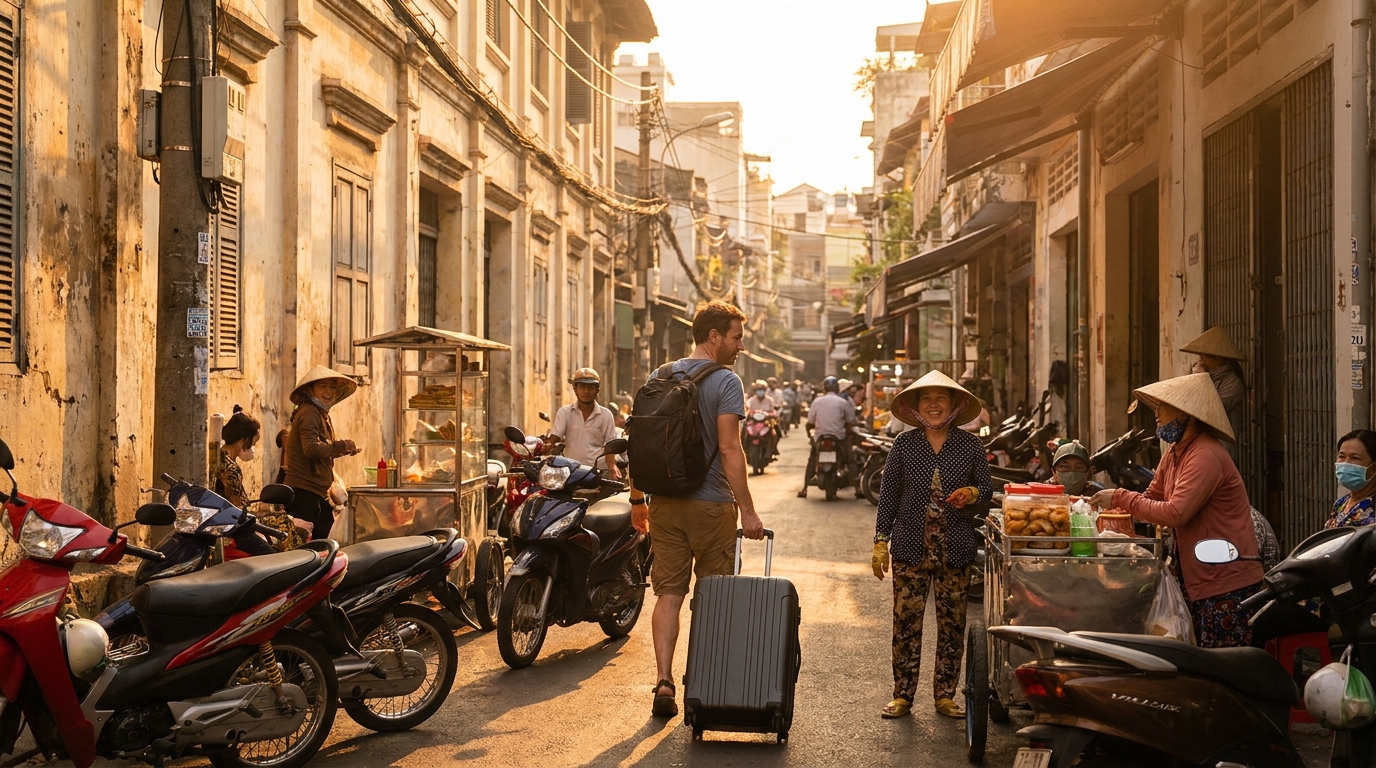
Step 1: Choose the Right Visa for Your Situation
Vietnam’s visa landscape changed meaningfully in August 2023, and the 5-year multiple-entry visa introduced for select nationalities has become the single biggest quality-of-life upgrade for incoming expats. Here is what each option actually means in practice:
E-visa (90 days, single or multiple entry)
Available to citizens of all countries since August 2023 through the Vietnam National E-Visa Portal. Cost: USD 25 (single entry) or USD 50 (multiple entry). Best for scoping trips and short-stay digital nomads.
Business visa (DN1 / DN2 — up to 1 year)
Requires sponsorship from a Vietnamese company. DN1 is for employees of Vietnamese entities; DN2 is for those doing market research or working with foreign-invested partners.
Work permit + LD visa (up to 2 years)
The gold standard for employed expats. Requires a university degree, two years of relevant experience, a clean criminal record (notarized and apostilled in your home country), and a health check from an approved Vietnamese clinic.
Temporary Residence Card (TRC, up to 10 years)
Granted to spouses of Vietnamese citizens, investors, and certain work-permit holders. The TRC replaces the need for repeated visa runs.
Pro tip: Begin your criminal background check and document apostille process at least 8 weeks before departure. This is the most common timeline-killer in the relocation process.
Step 2: Understand the Real Cost of Living in Saigon (2026)
Most generic articles quote a single “Saigon is cheap” number. The reality depends heavily on whether you live like a local or import a Western lifestyle. Here is what the data actually shows:
| Category | Single Expat (USD/month) | Family of 4 (USD/month) |
|---|---|---|
| Rent (District 1, mid-range) | $700 – $1,400 | $1,800 – $3,500 |
| Groceries (Western brands) | $250 – $400 | $700 – $1,100 |
| Dining out (mixed local/Western) | $200 – $500 | $500 – $900 |
| Transport (Grab + occasional taxi) | $60 – $120 | $150 – $300 |
| Utilities + internet | $80 – $150 | $130 – $220 |
| Health insurance (international) | $90 – $180 | $350 – $700 |
| Total | $1,380 – $2,750 | $3,630 – $6,720 |
Sources: Numbeo Cost of Living Index (2025); Mercer Cost of Living City Ranking 2024 (HCMC ranked 111 of 226 cities); author research.
According to IMF World Economic Outlook (October 2025), Vietnam’s GDP per capita is projected at roughly USD 4,950 in 2026, growing 6.1% year-on-year — meaning prices in Saigon are rising faster than most ASEAN capitals, but from a low base. Lock in a longer lease early.

Step 3: Pick the Right Neighborhood
Saigon is technically 22 districts, but only five matter for most incoming expats. Each has a different personality.
District 1 — Central, Walkable, Energetic
The heart of the city. Ben Thanh Market, the Opera House, Notre-Dame Cathedral, the Saigon River, and 90% of the Grade-A office stock are all here. Best for: professionals working in finance, consulting, or tech who want to walk to meetings and dinners. Browse serviced residences in central Saigon to see typical layouts and pricing.
Thao Dien (Thu Duc City, formerly District 2) — Family Expat Hub
Leafy, low-rise, and home to most international schools (ISHCMC, BIS, AIS). The Crescent, Estella Place, and the riverside cafés make it feel half-European. Best for: families with school-age children.
District 3 — Quiet Sophistication
Tree-lined streets, French colonial architecture, the best independent coffee scene in the city, and lower rents than D1. Best for: writers, creatives, long-stay digital nomads.
Phu My Hung (District 7) — Planned, International
Master-planned community with wide sidewalks (rare in Saigon), parks, and a large Korean expat community. Best for: families who prefer suburban predictability over urban energy.
Binh Thanh — Up-and-Coming
Landmark 81 (Vietnam’s tallest building) sits here. Mix of luxury and local. Best for: budget-conscious professionals who still want a river view.
Step 4: Find Housing Without Getting Burned
Saigon’s housing market is split between three main options, each with very different cost and convenience profiles:
- Serviced apartments — Fully furnished, weekly housekeeping, included utilities and internet, 24/7 reception. Best for the first 3–6 months while you settle in.
- Long-term lease apartments — 12-month minimum, you handle furniture and utilities. Cheaper per square meter but requires Vietnamese-speaking help for paperwork.
- Standalone houses / villas — Common in Thao Dien and Phu My Hung; mostly relevant for families.
The smartest move for new arrivals is to book a serviced apartment for the first 30–90 days, use that time to explore neighborhoods in person, then commit to a longer arrangement once you know which streets you actually like walking down at 7pm. Our amenities and on-site services are designed around exactly this transition window — pool, gym, co-working lounge, and bilingual concierge so you can focus on settling in rather than chasing electricity bills.
Watch out: Avoid paying more than one month’s deposit + one month’s rent upfront on direct landlord deals. Anything beyond that is a red flag. Reputable serviced operators publish their terms transparently.

Step 5: Healthcare — Better Than Most Expect
According to the World Health Organization (WHO Vietnam Country Profile, 2024), Vietnam’s life expectancy at birth is 74.6 years — higher than the regional Southeast Asia average. For expats, the practical reality is even better because the private hospital network in Saigon is genuinely international.
Top expat-friendly hospitals:
– FV Hospital (District 7) — JCI-accredited; French management; English- and French-speaking staff.
– Vinmec Central Park (Binh Thanh) — Vingroup’s flagship; strong in maternity and pediatrics.
– Raffles Medical Saigon (District 1) — Singapore-based; excellent for executive health checks.
– Family Medical Practice (multiple locations) — 24/7 GP and house-call service; the default for most expats.
International health insurance typically runs USD 1,100–2,200/year for a single adult under 45, dramatically less than US equivalents. Cigna Global, April International, and Pacific Cross are the most commonly used providers.
Step 6: Open a Bank Account and Move Money
You can open a Vietnamese bank account on a business or work visa (not on a tourist or e-visa). Bring:
- Passport with valid visa
- Work permit OR TRC OR letter from employer
- Local phone number (get a Viettel or Mobifone SIM at the airport)
- Proof of address (rental contract)
Easiest banks for foreigners: Vietcombank, Techcombank, VPBank, HSBC Vietnam, Standard Chartered Vietnam.
For incoming international transfers, Wise (formerly TransferWise) and Revolut both work reliably to Vietnamese accounts. Cash is still king for street food, traditional markets, and most Grab transactions — but VietQR (the unified QR code payment system mandated by the State Bank of Vietnam in 2024) is now accepted nearly everywhere, including coffee carts.
Step 7: Day-to-Day Life — What Actually Changes
The lifestyle adjustments most new expats underestimate:
- Motorbike density. HCMC has roughly 8.6 million registered motorbikes according to the Department of Transport (2024). Crossing the street is a learned skill — walk slowly, predictably, and never run.
- Weather rhythm. Two seasons: dry (December–April) and rainy (May–November). Rainy season afternoon storms last 30–60 minutes — plan errands for mornings.
- Air quality. AQI regularly hits 100–150 during dry season. A HEPA air purifier at home is non-negotiable for long-term residents.
- Language. English is widely spoken in District 1, Thao Dien, and Phu My Hung. Outside those zones, learn the basics: xin chào (hello), cảm ơn (thank you), bao nhiêu (how much).
- Food. Saigon was ranked #4 best food city in the world by Time Out’s 2024 global readers’ survey. Banh mi for USD 1, pho for USD 2, and Michelin-recognized restaurants for under USD 30.
Step 8: Register Your Temporary Residence (Within 24 Hours)
This is the rule almost every expat forgets. Under Decree 144/2021/ND-CP, every foreigner staying in Vietnam must register their temporary residence with the local police within 24 hours of arriving at any new address. Most hotels and serviced apartments handle this automatically — confirm with your accommodation provider that registration was completed and ask for a copy of the receipt. If you rent privately, your landlord is legally responsible; in practice, you may need to push them to file it.
Failure to register can result in fines of VND 500,000 – 2,000,000 (USD 20–80) and complications during visa extensions.
Pros and Cons of Moving to Saigon (Honest Version)
Pros
– Cost of living roughly 38% lower than NYC and 30% lower than Singapore (Numbeo, 2025)
– Friendly, entrepreneurial, young population (median age 32, GSO 2024)
– World-class food at every price point
– Direct flights to most Asian capitals in under 5 hours
– Fast-growing economy (~6% annual GDP growth, IMF 2025)
– Large, organized expat community
Cons
– Traffic and air quality during peak season
– Bureaucracy can be slow if you do not have local help
– Limited green space inside D1
– Banking and rental paperwork is paper-heavy
– Property purchase remains restricted for foreigners (leasehold only, max 50 years)
Frequently Asked Questions
How much money do I need to move to Saigon as an expat?
Budget USD 5,000–8,000 for the first month, including visa costs, flight, two months’ rent deposit, furniture or serviced apartment, SIM card, initial groceries, and emergency buffer. A family of four should budget USD 10,000–15,000.
Is Saigon safe for foreigners?
Yes. Vietnam consistently ranks among the safer countries in Southeast Asia. The Global Peace Index 2024 (Institute for Economics & Peace) ranks Vietnam 41st of 163 countries — ahead of the UK, US, and France. Petty theft (bag snatching from motorbikes) is the main concern; violent crime against foreigners is rare.
Can I move to Saigon without a job?
Yes — on a tourist e-visa, business visa with sponsorship, or by setting up a Vietnamese company. Many expats arrive on e-visas to job-hunt or scout in person, then convert to a work permit + LD visa once employed. Self-employed remote workers commonly cycle through 90-day e-visas or use a 1-year DN2 visa via a Vietnamese partner agency.
What is the best district for a single expat?
District 1 if you want walkability, nightlife, and to be at the center of everything. District 3 if you prefer a quieter, more local feel with great coffee shops. Thao Dien if you want a leafy, international vibe with easy access to Western groceries.
Do I need to speak Vietnamese to live in Saigon?
No, but learning 50–100 essential phrases dramatically improves daily life. English is widely understood in expat areas, restaurants, and major businesses. Outside those zones, Google Translate (with the offline Vietnamese package downloaded) handles 90% of situations.
How long does it take to feel settled in Saigon?
Most expats report 3–6 months to feel truly settled — long enough to establish a doctor, a regular gym, a favorite phở spot, and a neighborhood you know by heart. Starting in a serviced apartment with a bilingual concierge shortens this curve significantly.
Can I bring my pet to Vietnam?
Yes. Dogs and cats need a microchip, valid rabies vaccination (administered at least 30 days before travel), and an international health certificate issued within 10 days of departure. No quarantine on arrival for animals from rabies-controlled countries.
What is the weather like year-round?
Tropical. Average daytime temperature 27–34°C (81–93°F) year-round. Dry season (Dec–Apr) is sunny and dusty; rainy season (May–Nov) brings short, intense afternoon storms. There is no true cold season.
Your Next Step
Moving to Saigon is one of the most rewarding relocations in Southeast Asia — but only if your first 90 days are smooth. The expats who thrive are the ones who land in a serviced apartment with bilingual support, then take their time choosing where to settle long-term.
Ready to make your move easier? Land, unpack, and start exploring — we handle the rest.
Planning to make Saigon your base?
For more Saigon guides, check out: Healthcare Costs in Saigon for Expats: Clinics Insurance and What to Budget, Gym and Wellness Costs in Ho Chi Minh City: What Expats Pay Monthly.