
Saigon Chinatown (Cholon): Complete Visitor Guide to District 5
Ho Chi Minh City’s Saigon chinatown cholon is a topic every expat and long-stay visitor needs to understand before settling in Saigon. 
Cholon is home to Vietnam’s largest ethnic Chinese community, estimated at approximately 400,000 Hoa people as of 2025, according to the General Statistics Office of Vietnam. The neighbourhood covers most of District 5 and holds over 40 active temples, pagodas, and clan association buildings, a wholesale market that predates the French colonial period, and some of the most authentic Chinese-Vietnamese food in Southeast Asia. It’s 15 minutes from Ben Thanh Market by Grab.
Most visitors to Saigon spend their time in District 1 and miss Cholon entirely. That’s a significant gap. The neighbourhood operates on a different rhythm from the tourist corridor — market activity peaks at dawn, temple worship runs through the morning, and the streets are significantly quieter and more local-feeling by early afternoon. This guide covers how to see it properly.
Key Takeaways
- Cholon means “big market” in Hokkien; home to Vietnam’s largest ethnic Chinese community (~400,000 Hoa people, GSO Vietnam 2025)
- Main attractions: Thien Hau Temple, Binh Tay Market, Quan Am Pagoda, and dozens of clan association buildings
- Best visited 07:00-12:00; afternoon heat reduces market activity significantly
- Grab motorbike from District 1: 15-20 minutes, 30,000-40,000 VND; no Metro access as of 2026
- Hu tieu Nam Vang (Phnom Penh noodle soup) is Cholon’s signature dish — best eaten at morning market stalls
Saigon Chinatown Cholon: What Is Cholon and Why Should You Visit?
Cholon (Cho Lon) means “big market” in Hokkien Chinese and has been the commercial and cultural centre of the Chinese-Vietnamese community in Saigon since the late 18th century. A 2023 heritage assessment by the Ho Chi Minh City Department of Culture found that District 5 contains 43 registered Chinese-Vietnamese cultural heritage buildings, more than any other district in the city.
The neighbourhood was founded by Chinese immigrants, primarily Cantonese and Hokkien, who settled near Saigon in the 1770s. By the 19th century, Cholon had grown into a separate city from Saigon, connected by canal. The French colonial administration merged the two cities in 1931. The canal was filled in during the 1980s to create Tran Hung Dao Boulevard, which now marks the eastern edge of the neighbourhood.
What makes Cholon worth visiting in 2026 specifically is that it functions as a working neighbourhood rather than a preserved showcase. The temples are active worship sites, not reconstructions. The markets sell to local buyers, not tourists. The clan association buildings are genuinely occupied by their founding communities. The layer of daily life you encounter here is harder to find in the increasingly tourist-facing streets of District 1.
[PERSONAL EXPERIENCE] Arriving in Cholon at 07:30 on a Tuesday morning was the single most unexpectedly compelling experience of my last Saigon visit. The wholesale market sections around Binh Tay were in full operation: vendors loading handcarts, buyers negotiating in Cantonese and Vietnamese simultaneously, smoke from temple incense mixing with street food steam. Nothing about it was performing for tourists. That’s the point.
What Are the Main Attractions in Cholon?
Vietnam’s National Administration of Tourism recorded Cholon as the fourth most visited neighbourhood in Ho Chi Minh City by international tourists in 2025, behind District 1’s Ben Thanh area, the Old Quarter’s Dong Khoi corridor, and the Pham Ngu Lao backpacker area. The main draws are clustered within a walkable area of approximately one square kilometre.
Binh Tay Market
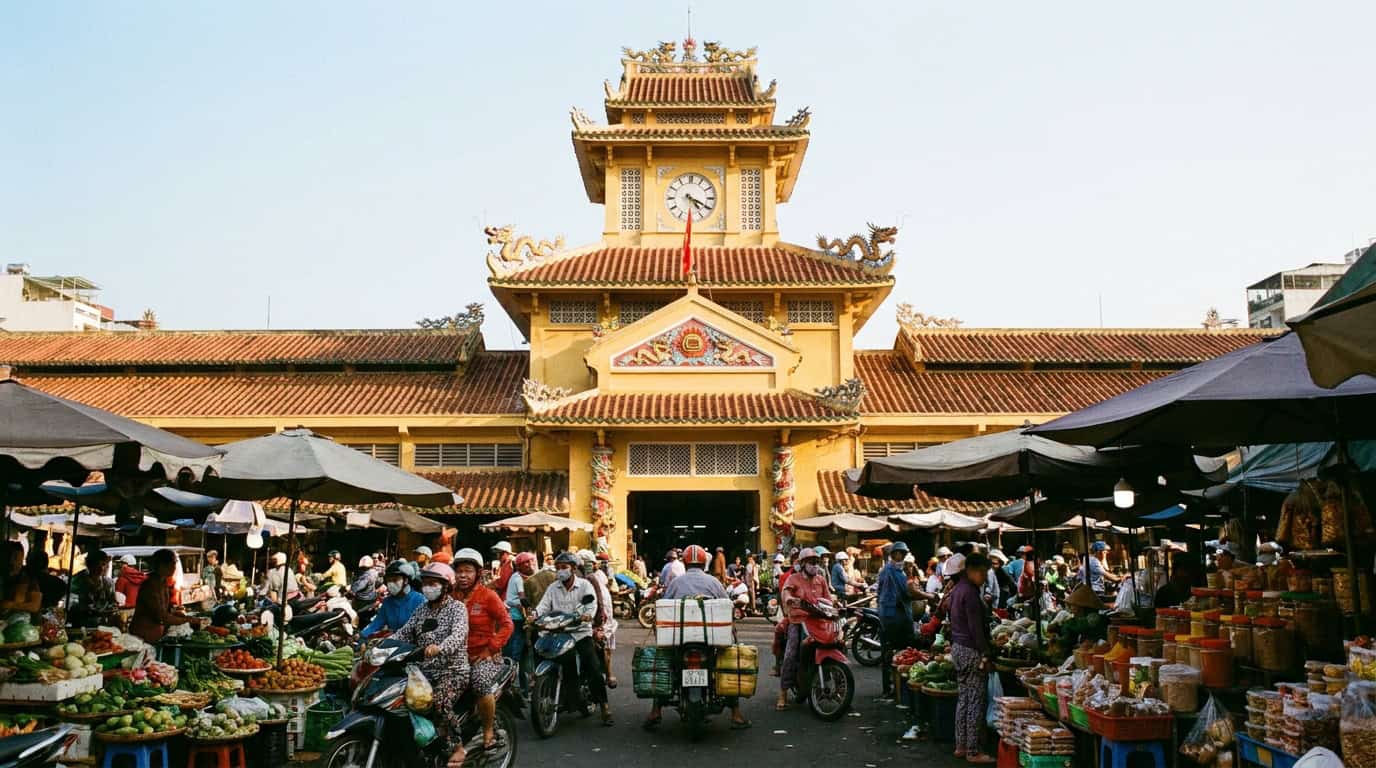
Binh Tay Market is the wholesale hub of Cholon and one of the largest markets in Ho Chi Minh City. The current building dates to 1928, designed by Chinese merchant Quach Dam who contributed significantly to its construction cost. The ornate tiered roof structure with its central clock tower and Chinese architectural motifs makes it visually distinctive even among Saigon’s many colonial-era markets. Most trading happens in the early morning; the market is still active through early afternoon but less atmospheric after 11:00.
Binh Tay handles wholesale trade in dry goods, textiles, household items, and food products. It’s not primarily a tourist market — you’re unlikely to find souvenirs here. What you will find is a working commercial market where Saigon’s supply chain is visible: restaurateurs buying in bulk, vendors restocking stalls, wholesale buyers loading motorbike trailers. The ground-floor walkways under the eaves are the most photogenic areas.
Thien Hau Temple
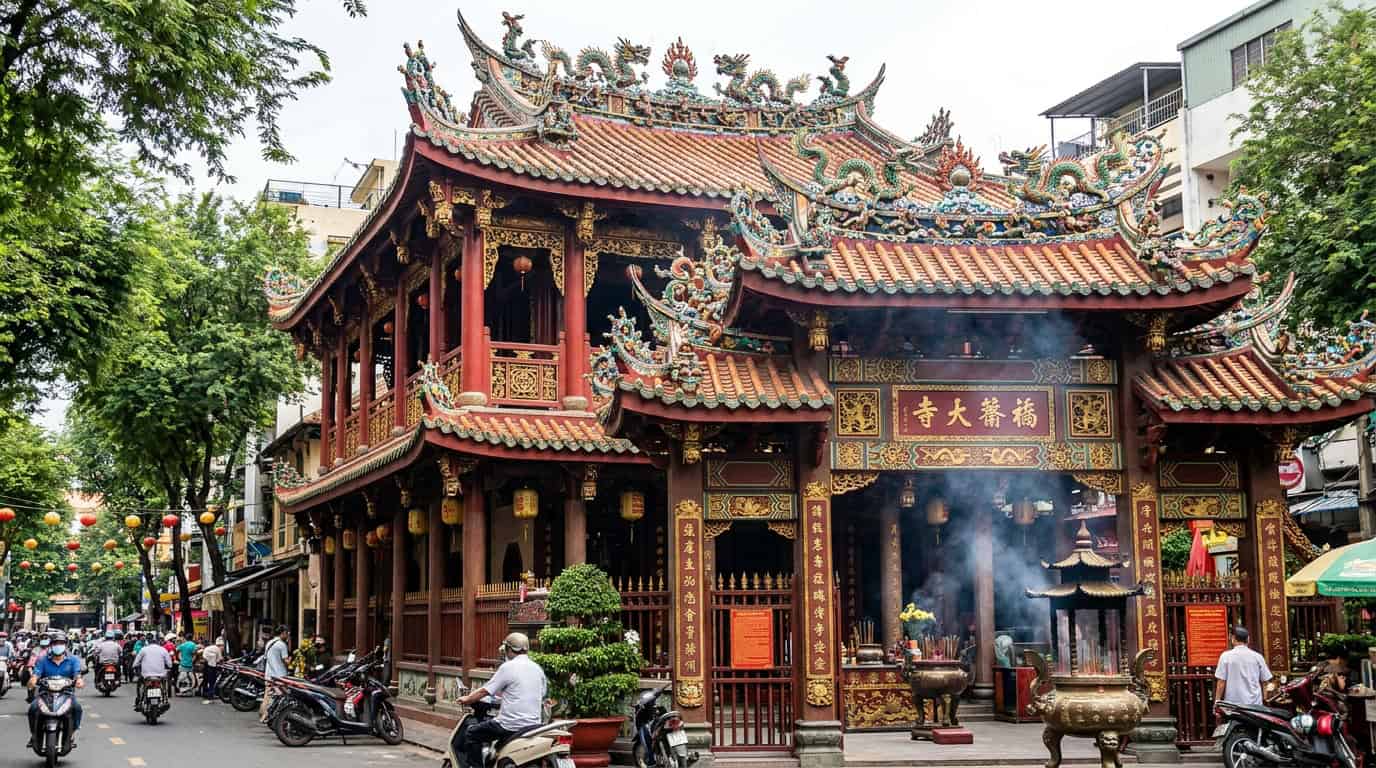
Thien Hau Temple at 710 Nguyen Trai Street is the spiritual centre of Cholon’s Cantonese community and one of the oldest temples in HCMC, dating to the 1760s. The suspended incense coils that fill the ceiling are the temple’s most distinctive feature. Entry is free.
Quan Am Pagoda
Quan Am Pagoda (Chua Quan Am) at 12 Lao Tu Street is a 5-minute walk from Thien Hau Temple and a highlight of the Cholon circuit in its own right. The pagoda is dedicated to Quan Am, the Buddhist/Taoist goddess of mercy, and features an elaborately decorated main hall with ceramic figurines on the roof ridge depicting scenes from Chinese legend. The interior shrines are densely packed and lit by red lanterns. Entry is free.
What Should You Eat in Cholon Saigon?
Cholon is widely regarded as the best neighbourhood in Ho Chi Minh City for Chinese-Vietnamese cuisine, according to a 2025 survey of Saigon food writers published in Gia Dinh online magazine. The Chinese-Vietnamese food traditions here differ from the more Vietnamese-adapted Chinese food found in District 1 restaurants. The difference is most obvious at breakfast.
Hu Tieu Nam Vang
Hu tieu Nam Vang (Phnom Penh noodle soup) is Cholon’s signature breakfast dish. The broth is lighter and cleaner than pho, typically made from pork bones and dried seafood, served with rice noodles, minced pork, shrimp, liver, and fresh herbs. The dish arrived via the Cambodian (Phnom Penh) Chinese community — “Nam Vang” is the Vietnamese name for Phnom Penh. Morning stalls around Binh Tay Market serve it from around 06:00. Expect to pay 40,000-60,000 VND for a full bowl.
Dim Sum at Thanh Xuan
Thanh Xuan at 56 Tan Thanh Street opens from 05:30 and serves Cantonese-style dim sum until mid-morning. The turnover is fast and the steamers come fresh. Har gow (shrimp dumplings), siu mai (pork and shrimp dumplings), and cheung fun (rice noodle rolls) are the standards. Thanh Xuan is a working-class dim sum restaurant — plastic chairs, fast service, excellent food. Budget around 150,000-200,000 VND per person for a full dim sum breakfast.
[UNIQUE INSIGHT] The real gem in Cholon food isn’t in any single restaurant — it’s the wholesale dried-goods section of Binh Tay Market, where vendors sell Chinese herbs, dried seafood, and specialty ingredients that don’t appear in District 1 supermarkets. Walking through these aisles is an education in Chinese-Vietnamese cooking ingredients. Dried scallops, lotus seeds, preserved mustard greens, cloud ear fungus — these are the foundations of the cuisine visible in bulk.]
How Do You Get to Cholon from District 1?
Cholon is 3-4 kilometres from central District 1. Vietnam’s Grab app recorded over 3 million daily rides across Southeast Asia in 2025. A Grab motorbike from Ben Thanh Market to Binh Tay Market costs 30,000-40,000 VND and takes 15-20 minutes in morning traffic. A Grab car for groups of 2-4 costs 60,000-80,000 VND for the same route.
There’s no Metro line serving Cholon as of 2026. Bus route 1 from Ben Thanh Bus Station connects to Cholon for around 6,000 VND but takes 30-45 minutes with stops. Most visitors use Grab as the practical balance between cost and time. Cycling from District 1 is possible on flat roads but not recommended for first-time visitors navigating unfamiliar streets.
The best approach for a full Cholon morning is to Grab to Binh Tay Market first (arrive by 07:30-08:00 to catch peak market activity), then walk or Grab the short distances between the main temples, and finish with a Grab back to District 1 before midday. The temples are generally walkable between each other once you’re in the neighbourhood.
Frequently Asked Questions
What is Cholon in Saigon?
Cholon means “big market” in Hokkien and is Saigon’s Chinatown, occupying most of District 5. It’s home to Vietnam’s largest ethnic Chinese (Hoa) community, approximately 400,000 people (General Statistics Office of Vietnam, 2025). Founded in the 18th century, it includes Binh Tay Market, Thien Hau Temple, Quan Am Pagoda, and 43 registered Chinese-Vietnamese heritage buildings. It operates as a working neighbourhood — markets, temples, and clan halls in daily active use.
How far is Cholon from District 1?
Cholon is 3-4 kilometres from central District 1, a 15-20 minute Grab motorbike ride costing 30,000-40,000 VND. Grab car for groups costs 60,000-80,000 VND. Bus route 1 from Ben Thanh takes 30-45 minutes for around 6,000 VND. There’s no direct Metro access to Cholon as of 2026. Most visitors use Grab for the convenience and low fare, combining Cholon with neighbouring District 5 street food into a half-day trip.
What should I eat in Cholon Saigon?
The standout dishes are hu tieu Nam Vang (Phnom Penh noodle soup, from morning stalls near Binh Tay Market, 40,000-60,000 VND), Cantonese dim sum at Thanh Xuan restaurant (56 Tan Thanh Street, from 05:30, around 150,000-200,000 VND per person), and banh bao (Chinese-Vietnamese steamed buns) from street vendors throughout the neighbourhood. Cholon is widely considered the best place in HCMC for Chinese-Vietnamese food.
Is Cholon safe for tourists?
Cholon is generally safe during daylight hours. Exercise standard petty-theft precautions around Binh Tay Market (crowded spaces mean pickpocket risk; keep phones and cameras close). Grab is the safest transport choice at all hours, including returning to District 1 after dark. Most visitors explore Cholon as a morning trip and return to District 1 before midday, which aligns both with peak activity hours and with avoiding the neighbourhood after dark as an unfamiliar visitor.
What is the best time to visit Cholon?
The best time is 07:00-12:00 for maximum activity: Binh Tay Market at full wholesale operation, temple morning worshippers arriving with fresh incense, and cooler temperatures before midday heat peaks. Weekday mornings are less crowded than weekends. The lunar calendar matters: the 1st and 15th days of each lunar month see peak temple activity with elaborate offerings. Tet (lunar new year) brings spectacular decorations but extreme crowds around Binh Tay Market and Thien Hau Temple.
Planning to make Saigon your base?
For more Saigon guides, check out: Saigon 7-Day Itinerary: A Week in Ho Chi Minh City, Saigon 3-Day Itinerary: The Perfect First-Timer’s Guide.
Explore more: Best Day Trips from Ho Chi Minh City: Mekong, Cu Chi, and Beyond · Mekong Delta Tour Saigon: The Best One-Day River Experience from D1 · Expat Guides to Saigon · Saigon Apartment Residences