
Saigon Expat Guide: Living in Ho Chi Minh City as a Foreigner
Ho Chi Minh City’s Saigon expat guide is a topic every expat and long-stay visitor needs to understand before settling in Saigon. 
Ho Chi Minh City has one of Southeast Asia’s most established expatriate communities. The HCMC Immigration Department (2025) estimates over 80,000 registered foreign residents in the city, with a significant additional population of digital nomads and long-stay visitors operating on tourist and e-visa arrangements. The city’s combination of low cost of living, fast internet, a dynamic social scene, and genuinely good food has made it a first-choice base for location-independent workers, retirees, and career expats across three decades of sustained growth.
Key Takeaways
- HCMC has 80,000+ registered foreign residents — one of the largest expat populations in Southeast Asia (HCMC Immigration Department, 2025).
- Comfortable expat living costs $1,500-2,500 USD/month — approximately 40-50% less than Bangkok for comparable lifestyle quality.
- Thao Dien (District 2 / Thu Duc City) has the densest expat concentration with international schools and villa compounds.
- FV Hospital (D7) and Family Medical Practice (D1) are the primary international-standard healthcare options.
- The 90-day e-visa ($25 USD) is the standard entry point; most long-term expats use work permits or temporary residence cards.
How Much Does It Cost to Live in Saigon?
According to Numbeo’s 2025 Cost of Living Index, Ho Chi Minh City ranks as approximately 65% cheaper than London and 55% cheaper than Sydney for comparable living standards. A comfortable expat lifestyle — Western-standard apartment, mixed local and Western dining, daily Grab use, and one international trip per quarter — runs $1,500-2,500 USD per month. That’s a compelling number for anyone earning a remote salary in dollars, pounds, or euros.
The budget categories break down roughly as follows. A budget expat living in a local apartment and eating primarily Vietnamese food can manage on $800-1,200 USD monthly. A comfortable expat with a Western-style apartment, occasional restaurants, and a social life sits in the $1,500-2,500 USD range. Premium expats in serviced apartments with frequent Western dining, a gym membership, and regular taxis pay $3,000-5,000 USD. Each tier represents a genuinely different lifestyle, not just spending variation on the same activities.
Accommodation is the largest single cost driver. A decent one-bedroom apartment in District 1 runs $600-1,200 USD per month. The same space in Thao Dien (D2) runs $700-1,400 USD. In District 3 — which many expats consider the best balance of local feel and accessibility — $500-900 USD gets a comfortable one-bedroom. Utility bills add $50-100 USD monthly depending on air-conditioning use. Internet is fast and cheap: $10-15 USD per month for 200Mbps fibre.
What Are the Best Neighbourhoods for Expats in Saigon?
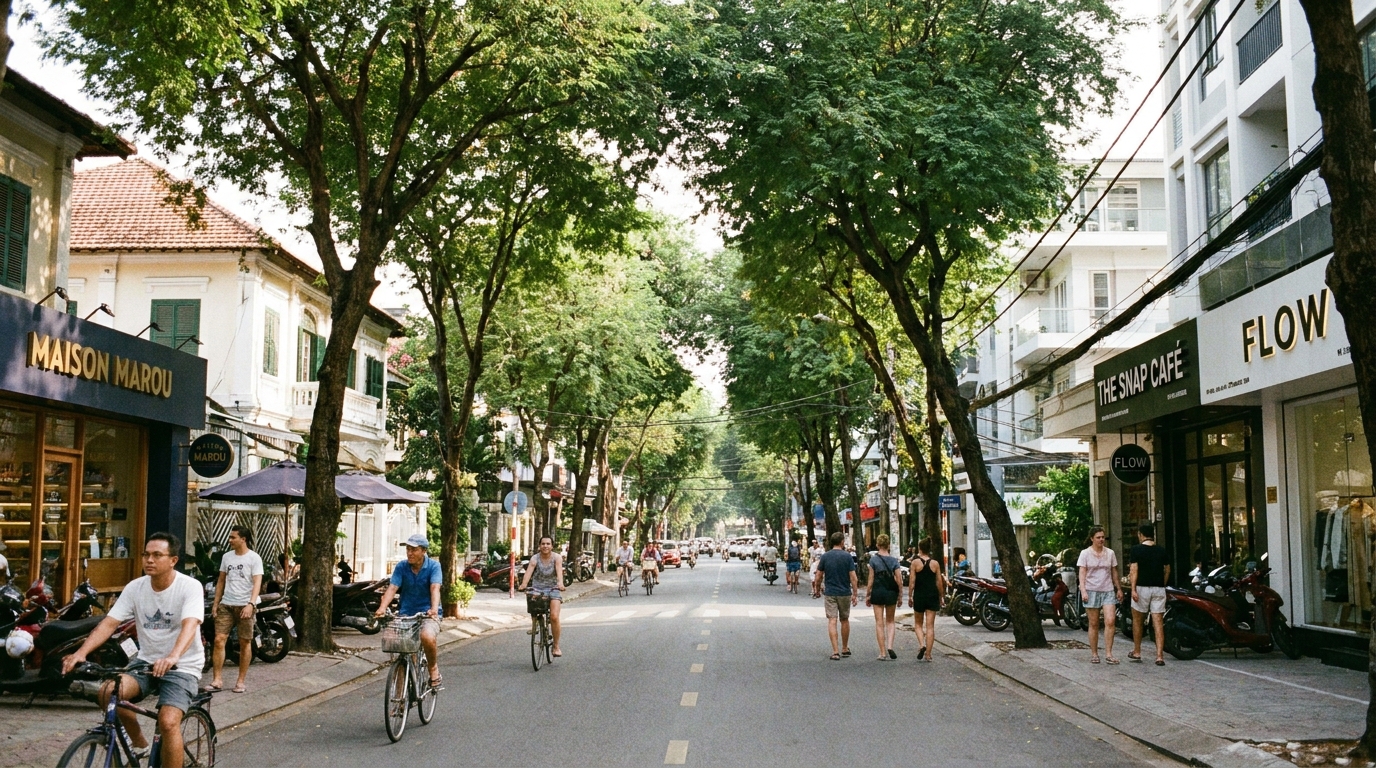
Neighbourhood selection is the most consequential lifestyle decision for a new Saigon expat. The city’s districts vary dramatically in feel, price, infrastructure, and the ratio of local-to-expat activity. According to a 2025 survey by InterNations HCMC, 64% of expatriates in the city rated neighbourhood choice as their single most important decision in the first month of arrival.
District 1 is the city centre: maximum convenience, dense tourist infrastructure, walking distance to government offices and international banks. It’s the most expensive residential option and the least “local” experience. Long-term expats who want to feel embedded in Vietnamese urban life tend to move out of D1 after six to twelve months.
District 3 is the most popular neighbourhood among expats who want to live more locally without sacrificing convenience. Tree-lined streets, good cafe density, walkable for morning runs, easy Grab access to D1. Rents are lower than D1. The food scene on the backstreets is excellent. It’s our consistent first recommendation for new arrivals who ask where to start.
Thao Dien in District 2 (now administratively part of Thu Duc City) has the largest foreign resident community in absolute numbers. It’s where the international schools concentrate, where villa compounds with swimming pools are affordable, and where the density of Western restaurants, yoga studios, and international supermarkets creates a lifestyle that requires minimal Vietnamese language ability. It’s also the district that feels least like Saigon — a trade-off that some expats want and others specifically avoid.
What Visa Options Are Available for Long-Term Stays?
Vietnam’s visa policy has evolved significantly since 2023. The e-visa extension from 30 to 90 days (with multiple-entry options now available in most categories) has reduced the administrative burden on digital nomads and long-stay tourists considerably. According to the Vietnam Ministry of Foreign Affairs (2025), over 4.2 million e-visas were issued to foreign nationals in 2025, a 180% increase over 2022 figures.
The e-visa (90-day single or multiple entry, $25 USD) is the standard starting point. It’s applied for online through the official Vietnam Immigration Portal, takes 3 business days, and requires a passport scan and a digital photo. Most nationalities are eligible. This is the right choice for first arrivals and for digital nomads testing the city before committing to a longer arrangement.
Business visas (DN category) are renewable and require a local company sponsor or a letter from a Vietnamese-registered business. Investment visas suit those investing over $200,000 USD in Vietnamese businesses. The most stable long-term arrangement is a work permit plus temporary residence card (TRC), which gives 1-2 year stays and multiple-entry access without needing to leave the country. This requires employment by a Vietnamese-registered company. Most digital nomads without formal employment use consecutive 90-day e-visas, entering via Tan Son Nhat International Airport on each renewal cycle.
How Good Is Healthcare for Expats in Saigon?

Vietnam’s public healthcare system is improving but remains limited in English-language accessibility and equipment standards at most public facilities. A 2025 report by the Pacific Cross International health insurer found that 91% of expatriates in Vietnam use private hospitals exclusively. The good news is that Saigon has several genuinely world-class private hospitals operating at costs well below equivalent facilities in Singapore or Bangkok.
FV Hospital in District 7 is the most cited recommendation across expat networks. It’s a French-Vietnamese joint-venture hospital with English-speaking staff throughout all departments, accreditation from the Joint Commission International (JCI), and the full range of specialist services. A standard GP consultation costs $60-80 USD. Specialist consultations run $80-150 USD. Emergency presentations start around $200-500 USD for initial assessment and treatment.
Family Medical Practice at 34 Le Duan Street, District 1, is the most convenient D1 option for non-emergency consultations. Hanh Phuc International Hospital specialises in obstetrics and paediatrics and has strong reviews from expat families. International health insurance is strongly recommended — an unplanned hospital admission without coverage can run $3,000-15,000 USD depending on treatment complexity. Pacific Cross, Cigna, and Bupa all operate standard expat health insurance products in Vietnam.
What Is the Expat Community Like in Saigon?
Saigon’s expat community is diverse, long-established, and remarkably accessible to newcomers. The city has been receiving foreign residents continuously since the 1990s reopening, which means the infrastructure — English-language social groups, sporting clubs, professional networks, and international schools — is mature and functioning. According to InterNations’ 2025 Expat Insider Report, HCMC ranked in the top 15 global cities for expat social integration.
[PERSONAL EXPERIENCE] The practical reality of integrating into Saigon’s expat community is straightforward. The Facebook group “Expats in Ho Chi Minh City” (100,000+ members) is the primary public forum for practical questions, housing leads, and event announcements. InterNations HCMC runs monthly professional meetups. The Thao Dien area has enough walkable density of cafes and co-working spaces that casual social connections happen organically. The city’s size means there are communities for nearly every professional background, nationality, and interest.
The most common complaints among long-term expats are traffic (which genuinely does not improve with familiarity beyond the first six months), bureaucratic complexity for business registration and visa processes, and air quality during certain seasonal periods. The most common praise is for the food quality and price, the energy and pace of the city, the ease of hiring domestic help (maids, drivers, and nannies at $200-400 USD monthly), and the lack of the social stratification that marks expat life in some other Asian cities.

Frequently Asked Questions: Saigon Expat Guide
How much does it cost to live in Saigon?
2026 monthly budget estimates: Budget expat (local apartment, local food): $800-1,200 USD. Comfortable expat (Western apartment, mixed local/Western food, daily Grab): $1,500-2,500 USD. Premium expat (serviced apartment, Western lifestyle): $3,000-5,000 USD. Saigon is approximately 40-50% cheaper than Bangkok for comparable lifestyle quality (Numbeo, 2025). The largest cost driver is accommodation choice.
What are the best neighbourhoods for expats in Saigon?
District 1 is most convenient (city centre, all services). District 3 is best for local feel with good cafes and walkability. Thao Dien in District 2 / Thu Duc City has the largest expat community, international schools, villa compounds, and the densest Western infrastructure — though it feels the least like Saigon. Binh Thanh offers good value between D1 and Thao Dien. District 7’s Phu My Hung serves the Korean and Japanese expat communities primarily.
What visa do expats use for long-term stays in Saigon?
E-visa: 90-day single or multiple entry, online application, $25 USD (Vietnam Ministry of Foreign Affairs, 2025). Business visa (DN): renewable with a local sponsor. Investment visa: for those investing $200,000+ in Vietnam. Work permit plus temporary residence card: for those employed by Vietnamese-registered companies, giving 1-2 year stays. Most digital nomads use consecutive 90-day e-visas with international entries via Tan Son Nhat Airport.
Is healthcare good in Saigon?
Public healthcare is limited for non-Vietnamese speakers; 91% of expats use private hospitals (Pacific Cross, 2025). Best options: FV Hospital (D7, JCI-accredited, English throughout, $60-80 USD GP consultation); Family Medical Practice (D1, convenient for non-emergency); Hanh Phuc International (obstetrics and paediatrics). International health insurance is strongly recommended. Emergency hospital visits without insurance start from $200-500 USD for initial assessment.
What is the expat community like in Saigon?
HCMC has 80,000+ registered foreign residents plus a large digital nomad community. Thao Dien has the densest expat concentration. The main online communities are “Expats in Ho Chi Minh City” (Facebook, 100,000+ members) and InterNations HCMC. HCMC ranked in the top 15 global cities for expat social integration (InterNations Expat Insider, 2025). Most expats find the city welcoming, affordable, and energetic. Main complaints are traffic and bureaucratic complexity.
Planning to make Saigon your base?
For more Saigon guides, check out: District 4 Saigon Guide: Seafood, Locals, and Hidden Gems Near D1, District 3 Saigon Guide: Leafy Streets, Cafes, and the Best of Local Saigon.