
The best saigon street food guide is not a listicle written from a hotel lobby — it is a working knowledge of which alley serves the cleanest bún bò Huế before 8 AM, which cart near Bến Thành disappears by noon, and why the cơm tấm on Võ Văn Tần tastes different from the one three blocks south. This guide covers every major district, every essential dish, and every time-of-day window you need to eat well in Ho Chi Minh City in 2025 and beyond.
Key Takeaways
- District 1 anchors the tourist circuit but Districts 3, 4, and Bình Thạnh serve more authentic, cheaper versions of the same dishes.
- Street food hours follow strict rhythms — breakfast spots close by 10 AM, late-night grills open after 9 PM, and missing the window means missing the dish.
- According to the Vietnam Tourism Authority, Ho Chi Minh City attracts over 5 million international visitors annually, making its street food scene one of the most commercially adapted in Southeast Asia — knowing where locals eat is the real skill.
- Hygiene varies by cart, not by district — look for high turnover, clean chopstick containers, and vendors who blanch noodles in fresh water.
- A full day of street food eating — breakfast, lunch, afternoon snack, dinner, late-night bowl — costs between 120,000 and 220,000 VND if you eat where residents eat.
Why This Saigon Street Food Guide Starts with Districts, Not Dishes
Most food guides organise by dish. This one organises by district because that is how residents navigate the city. You do not wake up in District 3 and travel to District 7 for bánh mì. You learn your neighbourhood’s rhythm first, then branch out. Each district in Ho Chi Minh City has a distinct street food identity shaped by the communities that settled there — Chinese-Vietnamese traders in District 5, Hue migrant families in District 4, working-class lunch culture in Bình Thạnh. Understanding that geography makes every meal more legible.

Street food is the daily currency of life in D1. This guide maps the best dishes, the best alleys, and the best times of day for each — written by and for people who eat here every week, not once on a holiday.
District 1 Street Food: The Tourist Trap and the Hidden Layer
District 1 is simultaneously the worst and best place to eat street food in Saigon. The worst: inflated prices on Bùi Viện, reheated food near Bến Thành, and phở that costs three times what it should. The best: the early-morning alleys that tourists never find before they wake up.
Hẻm 39 Đinh Công Tráng runs a row of bánh mì carts from 6 AM that serve construction workers and office staff. The pâté is house-made, the bread arrives hot from the oven at the end of the alley, and the entire transaction takes 90 seconds. On Lý Tự Trọng, the cơm tấm strip opens at 7 AM and sustains a genuine lunch crowd of local office workers through 1 PM. Pork chop, broken rice, shredded pork skin, a fried egg, and a bowl of broth for 55,000–65,000 VND.
For evening eating in District 1, the stretch of Hoàng Sa along the canal offers grilled skewers and cold beer at plastic tables from roughly 6 PM. It is not hidden — but it is honest, and the canal breeze makes it more comfortable than the interior streets.
District 3 Street Food: The Residential Sweet Spot of This Saigon Street Food Guide
District 3 is where Saigon’s food culture is most concentrated relative to tourist presence. The district is dense, residential, and full of multi-generational food vendors who have operated from the same address for decades.

Võ Văn Tần is the district’s main artery for daytime eating. The bún bò Huế shop at number 47 opens at 6 AM and closes when the pot empties — usually by 10:30. The broth is built overnight with lemongrass, shrimp paste, and pork knuckle; the spice level is adjustable at the table. Two blocks north, a permanent bánh cuốn stall serves steamed rolled rice sheets with wood-ear mushroom and pork mince from a dedicated steaming table — a process that requires the same deft wrist motion the vendor’s mother used.
For lunch, the alleys off Nguyễn Thị Minh Khai between numbers 150 and 200 house four or five rotating rice-plate vendors who set up fold-out tables by 11 AM. Competition keeps prices honest and quality high. For afternoon snacks, Trần Quốc Toản has a cluster of chè shops — Vietnamese sweet dessert soups — that run from 2 PM until early evening.
District 4 Street Food: The Migrant Kitchen Nobody Talks About Enough
District 4 sits directly across the canal from District 1 and is often skipped entirely by short-term visitors. That is a mistake. The district received a large influx of migrants from Central Vietnam — particularly Hue and Đà Nẵng — in the post-reunification decades, and the food reflects that heritage with unusual concentration.
Xóm Chiếu Market is the anchor. From 5 AM the market lanes fill with vendors selling bánh ướt (wet rice crepes), bún thịt nướng (grilled pork noodles), and a style of bánh mì with grilled pork and pickled daikon that is closer to Central Vietnamese preparation than the Saigon standard. The market thins by 9 AM; a second wave of vendors opens for lunch around 11.
The stretch of Vĩnh Khánh street is famous among residents for its late-night seafood grills. From 8 PM, vendors line both sides of the street with charcoal grills loaded with clams, oysters, and mantis shrimp. Salt-and-chilli ốc len (mud creepers) are the local specialty — eaten with a thin metal pick and a cold can of Saigon Beer. According to a 2024 report by the Ho Chi Minh City Department of Tourism, District 4’s food street on Vĩnh Khánh serves an estimated 3,000 diners per night during peak season.
District 5 Street Food: Chinese-Vietnamese Cooking at Its Purest
Cholon — the historic Chinese quarter spanning District 5 and parts of District 6 — operates on a different culinary logic from the rest of the city. The dominant influences are Cantonese, Teochew, and Hokkien, filtered through a century of Vietnamese adaptation.
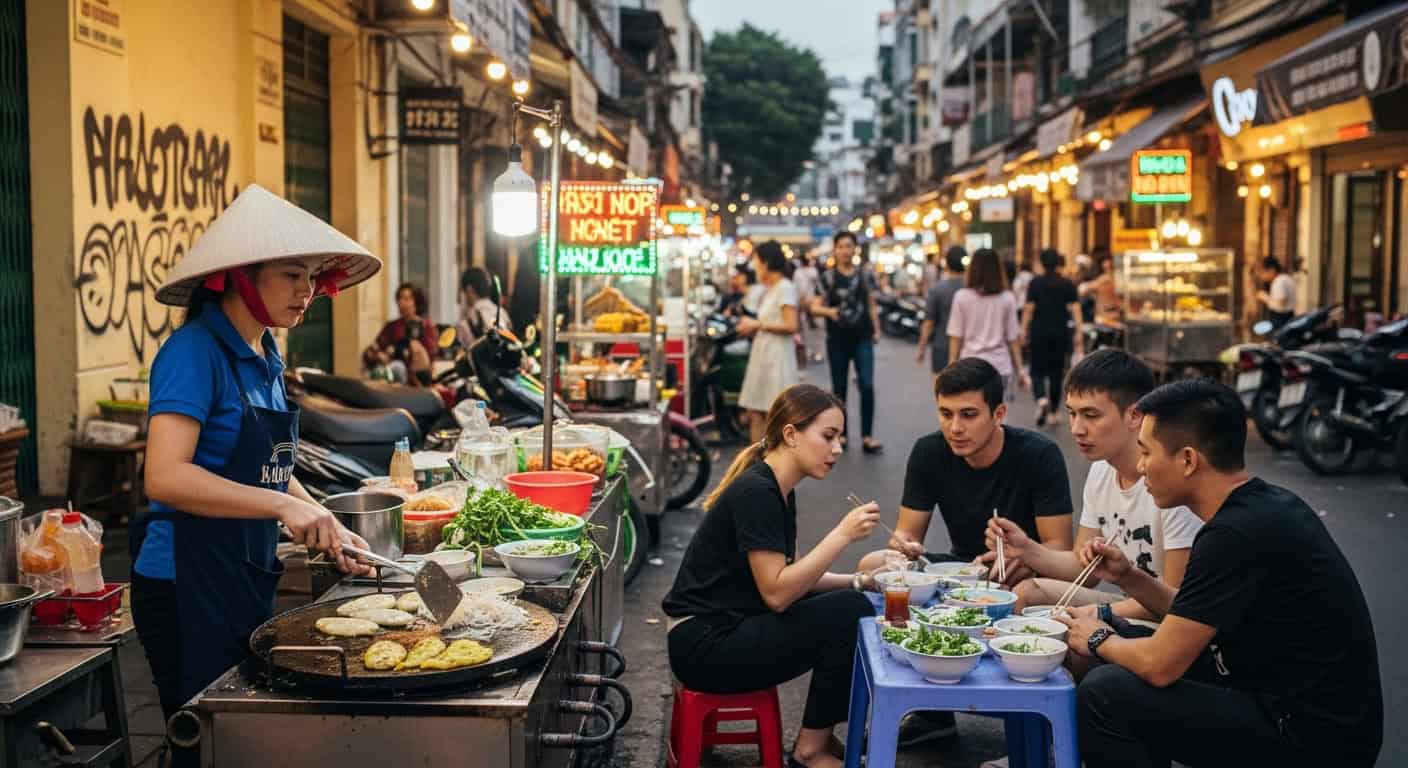
Châu Văn Liêm is the primary food street. Char siu pork sold by weight from hanging hooks, dimsum pushed on carts from 6 AM, and bowls of hủ tiếu (clear rice noodle soup) that are notably cleaner in flavour than the southern Vietnamese version. The broth here relies on dried flounder and pork bones rather than the fish sauce-heavy base of District 1 versions.
Triệu Quang Phục specialises in herbal congee shops that open at 7 AM and serve medicinal-style rice porridge with ginger, century egg, and salted fish. The clientele is predominantly older Hoa (ethnic Chinese) residents who have been eating there since childhood. These shops are not on any tourist map; they exist because the neighbourhood needs them.
For sweets, the Bình Tây Market area has stalls selling bánh lọc, sesame balls, and a flaky spiral pastry filled with red bean paste that has no common Vietnamese name — residents just call it “the round one.”
Bình Thạnh District Street Food: The Working Lunch Capital
Bình Thạnh is a high-density residential and office district north of District 1. Its street food culture is built around the midday meal window: fast, filling, and cheap enough that office workers eat out every day rather than cooking.
The intersection of Đinh Tiên Hoàng and Bạch Đằng anchors a strip of rice and noodle vendors that sets up from 10:30 AM and packs away by 2 PM. The cơm bình dân format — a tray cafeteria of rotating daily dishes — is the dominant model. You point at what you want: braised catfish in clay pot, morning glory with garlic, stir-fried pork with lemongrass. The plate costs 40,000–55,000 VND.
For breakfast, Phan Đăng Lưu running north from the roundabout has several phở shops and at least two bánh mì carts that operate from 5:30 AM specifically for early-commute traffic. The vendors know their regulars by order; customisation requests are welcomed and remembered.
Phú Nhuận and Gò Vấp: The Snack Districts
These two districts north of the city centre are less commonly covered in a saigon street food guide aimed at visitors, but for residents they represent the best afternoon and evening snack culture in the city.
In Phú Nhuận, the block of Phan Xích Long between numbers 100 and 200 has been called the best café-and-snack street in Saigon by Vietnamese food writers for several years running. The savoury end of the strip offers bánh tráng nướng (grilled rice paper topped with egg, spring onion, and dried shrimp) and bắp nướng (charcoal-grilled corn with scallion butter). The sweet end offers ice cream sandwiched in bread rolls, shaved ice, and freshly-pressed sugar cane juice.
Gò Vấp’s food culture centres on the Quang Trung corridor and leans heavily toward grilled meat and beer. From 5 PM, the area around Ngã Tư Ga fills with family-style grilling restaurants that spill onto the pavement. These are not tourist establishments — they are where extended families come on weekends, which means the food is cooked for people who will come back.
The Time-of-Day Framework Every Saigon Street Food Guide Needs
Street food in Ho Chi Minh City does not operate on restaurant hours. Missing the time window often means missing the dish entirely. This framework applies across districts.
- 5:00–8:00 AM — Breakfast window: Phở, bún bò Huế, bánh mì, bánh cuốn, and cháo (congee). Many of the best breakfast vendors close before 10 AM when the pot is empty.
- 10:30 AM–1:30 PM — Lunch window: Cơm tấm, cơm bình dân, grilled pork noodles, bún thịt nướng. Vendors who serve office workers are busiest 11:30 AM–12:30 PM.
- 2:00–5:00 PM — Afternoon snack window: Chè, bánh tráng nướng, fresh fruit with chilli salt, sugarcane juice, corn. School dismissal at 4:30 PM creates a secondary surge.
- 6:00–9:00 PM — Dinner window: Seafood grills, lẩu (hotpot), bún mắm, grilled skewers, fresh spring rolls. This is when plastic-table culture is at its peak.
- 9:00 PM–2:00 AM — Late-night window: Hủ tiếu, mì (egg noodle soup), grilled offal, ốc (snails and shellfish), instant noodle upgrades at 24-hour carts.
Hygiene, Pricing, and Ordering: Practical Notes for the Saigon Street Food Guide Reader
Hygiene in street food is determined by turnover and behaviour, not location. A vendor who sells 200 bowls of noodles before 9 AM is restocking ingredients constantly — there is no opportunity for food to sit. A vendor with four customers all morning is a different calculation.
Practical indicators of a trustworthy cart: the vendor blanches noodles in a separate pot of clean water rather than the broth pot, chopsticks and spoons are stored in a dedicated container with drainage holes, fresh herbs are kept in water or a cooler, and the vendor handles food and money with the same hand only between customers (not simultaneously).
On pricing: District 1 charges 20–40% more than surrounding districts for identical food. If you are living in or near D1, the efficient move is crossing into District 3 or District 4 for breakfast. The extra ten minutes on a motorbike pays for itself within the first week.
Ordering without Vietnamese is possible at most carts — pointing at what the person next to you is eating is universally understood. The phrase “cho tôi một tô” (give me one bowl) covers most noodle situations. Indicating spice level with fingers (one for mild, three for full heat) is also reliably interpreted.
The 10 Essential Dishes and Where to Find Each
- Bánh mì: Best in the morning rush, from independent carts rather than chains. Look for vendors with visible baguette deliveries.
- Cơm tấm: Broken rice with grilled pork chop — the definitive Saigon lunch. Strongest in Districts 1, 3, and Bình Thạnh.
- Bún bò Huế: Spicy beef and pork noodle soup from Central Vietnam. District 3 and District 10 have the most authentic preparations.
- Hủ tiếu: Clear pork-and-seafood noodle soup, Mekong Delta origin. District 5 for the Chinese-style version, District 4 for the southern variant.
- Bánh cuốn: Steamed rice rolls — eaten for breakfast with chả lụa (Vietnamese pork sausage) and fried shallots.
- Gỏi cuốn: Fresh spring rolls — best assembled to order at the table, not pre-rolled. Markets are the best source.
- Bún thịt nướng: Grilled pork vermicelli — District 4 versions use charcoal grills visible from the street.
- Ốc (shellfish): Salt-and-chilli preparations at night markets and street stalls from 7 PM onwards.
- Chè: Sweet dessert soups in dozens of varieties — coconut, mung bean, taro, black sesame — from afternoon stalls across all districts.
- Bánh tráng nướng: Grilled rice paper — the Phú Nhuận strip on Phan Xích Long does the best version in the city.
What Changes in 2025: New Trends in the Saigon Street Food Scene
The street food landscape shifts every year. In 2025, several trends are reshaping how and where people eat. First, the consolidation of food delivery apps — primarily ShopeeFood and GrabFood — has pulled some street food vendors into ghost kitchen models, reducing foot traffic at physical stalls. This has paradoxically increased the quality of the vendors who stayed, as the remaining street operations attract committed regulars rather than incidental customers.
Second, the afternoon snack culture has expanded significantly among younger Saigonese. According to a 2025 consumer survey published by Nielsen Vietnam, 68% of Ho Chi Minh City residents aged 18–34 eat a dedicated afternoon snack outside the home at least three times per week, up from 54% in 2022. This has driven new vendor investment in the 2–5 PM time slot across residential districts.
Third, a quiet revival of heritage preparations — particularly Hoa (ethnic Chinese) cooking in District 5 and Cham-influenced preparations in some District 8 markets — is being driven by younger vendors who trained with grandparents and are now adapting those techniques for street-side service. These operations are small, cash-only, and worth seeking out before they scale or disappear.
You May Also Find Useful
- District 1 Saigon 2026: Complete Neighborhood Guide for Visitors and Long-Stay Residents
- Best Restaurants in Saigon: From Street Food to Fine Dining in 2026
- Saigon Street Food Tour: The Best Food to Try and Where to Find It
- Premium Apartments in District 1 Saigon 2025: The Complete Guide for Discerning Long-Stay Residents
Frequently Asked Questions
What is the best district for street food in Saigon?
For variety and authenticity combined, District 4 and District 3 outperform District 1 for residents. District 1 is accessible and well-mapped for first-time visitors, but its prices are elevated and its best food operates in the early-morning window that most visitors miss. Districts 4 and 3 offer genuine neighbourhood eating at resident prices across all time slots.
Is Saigon street food safe to eat for foreigners?
Yes, with standard precautions. High-turnover vendors are consistently safe because ingredients do not have time to spoil. Avoid pre-cut fruit that has been sitting in the sun, skip cold drinks with ice at vendors who have no refrigeration, and trust your nose — fresh broth smells clean and complex, not sour. Most long-term expats in Ho Chi Minh City eat street food daily without incident.
What time should I eat street food in Saigon?
The best window for the most variety is between 6:30 and 9:00 AM, when breakfast vendors are at full operation and the day’s best bowls are being served. For an evening experience, 7 to 10 PM captures the full range of grills, shellfish carts, and late-night noodle stalls. Arriving outside these windows means finding many stalls closed or serving through their last ingredients.
How much does street food cost in Ho Chi Minh City in 2025?
In local-facing districts, a full bowl of noodles costs 35,000–55,000 VND, a bánh mì costs 20,000–35,000 VND, and a plate of cơm tấm runs 50,000–70,000 VND. In District 1 tourist areas, add 30–50% to those figures. A full day of eating — breakfast, lunch, afternoon snack, and dinner — costs a resident approximately 150,000–220,000 VND eating entirely from street vendors.
Do I need to speak Vietnamese to order street food in Saigon?
No. Pointing at neighbouring diners’ bowls, holding up fingers for quantity, and using basic phrases (một tô for one bowl, không cay for no spice, cảm ơn for thank you) is sufficient for the vast majority of transactions. Vendors who operate near residential areas rather than tourist zones are often more patient with non-Vietnamese speakers because they are not managing a high-volume tourist queue.
Official Resources
For the most up-to-date information on saigon street food guide, visit the Vietnam Tourism – Food and Drink.