
The most practical saigon travel tips are the ones that come from living here, not visiting for a weekend. Ho Chi Minh City rewards preparation and punishes assumptions, so whether you land at Tan Son Nhat with a suitcase or a backpack, the 30 points below cover everything from SIM cards and traffic to hidden costs and neighbourhood choices that most first-timers only learn the hard way.
Key Takeaways
- Book a hotel in District 1 for your first stay — it keeps transport costs low and orientation simple.
- A local SIM card from Viettel or Vietnamobile costs under 150,000 VND and solves every navigation problem instantly.
- Grab (ride-hailing) is safer and cheaper than negotiating with street-hail taxis for most journeys.
- The wet season runs May–November; pack a compact rain jacket and expect afternoon downpours daily.
- Cash in Vietnamese Dong is still king at markets, street food stalls, and smaller guesthouses.
1. Saigon Travel Tips for Getting Your Bearings Fast
Ho Chi Minh City has 22 districts, but the vast majority of visitor needs — restaurants, cafes, consulates, hospitals, expat services — cluster in Districts 1, 3, and Binh Thanh. District 1 (D1) is the commercial and tourist core. Bui Vien Street in D1 is backpacker central; Nguyen Hue Boulevard is the Instagram boulevard; Le Loi and Dong Khoi connect the main landmarks. Spend your first day walking D1 on foot to get a physical feel for distances. Nothing is as far apart as it looks on a map.

District 3 borders D1 to the northwest and is quieter, leafier, and increasingly popular with long-stay visitors. Binh Thanh sits north of the Saigon River and is where many expat families and mid-range apartment buildings concentrate. For a first visit, base yourself in D1 and explore outward.
2. The Airport: What to Do the Moment You Land
Tan Son Nhat International Airport (SGN) is about 7 km from central D1, but traffic can turn that into a 45-minute crawl at peak hours (7–9 am and 5–7 pm). Before you exit arrivals, do three things: buy a local SIM card from one of the official carrier counters inside the terminal (Viettel and Vietnamobile are the most reliable; expect to pay 80,000–150,000 VND for a 30-day data package), withdraw Vietnamese Dong from an ATM inside the terminal before customs rather than exchanging foreign currency at the counter (bank rates beat airport exchange rates by 3–5%), and pre-book a Grab car from the arrivals hall rather than accepting offers from drivers outside the exit doors.
Fixed-price airport taxis exist but are easy to mistake for unmarked private cars. If you must take a metered taxi, use Vinasun (green cars) or Mai Linh (green-and-white cars) — both are metered and reliable.
3. Currency, ATMs, and Tipping — Practical Saigon Travel Tips
The Vietnamese Dong (VND) runs at roughly 25,000–26,000 VND to one US dollar as of mid-2026. Street food costs 30,000–80,000 VND per dish; a local cafe coffee is 25,000–45,000 VND; a Grab motorbike ride across D1 is 15,000–35,000 VND. Always carry small bills — 10,000, 20,000, and 50,000 notes — because market vendors rarely have change for 500,000 notes.
Tipping is not a traditional Vietnamese custom, but it is expected in tourist-facing restaurants and hotels. A 5–10% tip at sit-down restaurants is appreciated but not mandatory. Rounding up Grab fares by a small amount is a kind gesture but not required. Never tip at street stalls — it creates awkward price confusion.
According to the Vietnam National Authority of Tourism 2024 annual report, international arrivals to HCMC reached 5.1 million in 2024, making it the country’s single largest international gateway — which means vendor pricing is increasingly tourist-aware in high-traffic zones. Always check that you are being quoted in Dong, not dollars, especially in Ben Thanh Market.
4. Getting Around: The Honest Guide to Saigon Traffic
Saigon traffic is the city’s defining characteristic and its most intimidating feature for new arrivals. Approximately 8.5 million registered motorbikes operate in HCMC according to the city’s Department of Transport (2024 figures), and the traffic flow functions on an improvised logic that looks chaotic but has internal rules. When crossing a street on foot, move at a slow, steady, predictable pace — bikes will flow around you. Never stop suddenly. Never run. Make eye contact with the nearest approaching rider so they know where you are going.
For getting around as a visitor, Grab is the non-negotiable recommendation. Open the app, enter your destination, see the price before you confirm. Grab Bike (motorbike) is faster and cheaper; Grab Car is more comfortable and better for luggage or rain. Avoid driving a motorbike yourself unless you have experience with Asian traffic — the insurance situation for foreign riders is complex and hospital bills are not.
5. Food and Where to Eat: District 1 as Your Base
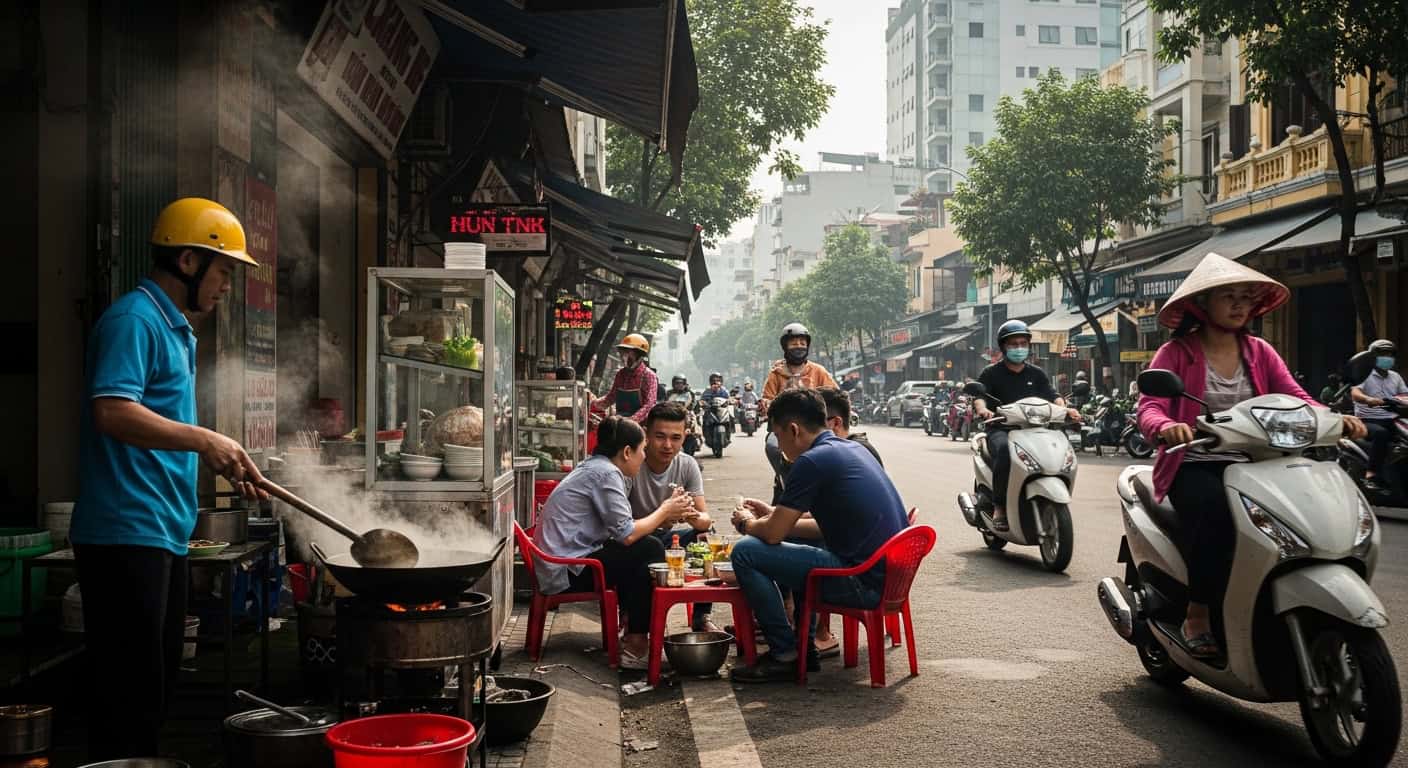
Among all saigon travel tips, food guidance generates the most requests. The answer is simple: eat where locals eat. That means plastic stools on the pavement, laminated menus in Vietnamese, and prices under 60,000 VND. Pho (noodle soup), banh mi (baguette sandwiches), com tam (broken rice with grilled pork), hu tieu (clear noodle soup), and bun bo Hue (spicy beef noodles) are the staples. Ben Thanh Market’s food stalls are convenient but priced for tourists; walk two blocks in any direction for half the price and better quality.
For mid-range dining, the streets around Ly Tu Trong, Nam Ky Khoi Nghia, and Pasteur in D1 have dozens of reliable Vietnamese restaurants with English menus. Bui Vien concentrates cheap beer and Western-style bar food. For fine dining, the rooftop restaurants on Nguyen Hue and the French Quarter streets around Dong Khoi offer the best of both Vietnamese and international cooking.
Food hygiene: stick to busy stalls with high turnover. Ice in drinks at established venues is made from filtered water; ice at unknown stalls is a calculated risk. Bottled water is 5,000–10,000 VND everywhere.
6. Weather, Seasons, and Packing for HCMC
Ho Chi Minh City has two seasons: dry (December–April) and wet (May–November). The dry season is the peak travel window — temperatures sit at 28–34°C with low humidity and clear skies. The wet season brings daily afternoon downpours that last 30–90 minutes before clearing completely. The rain is warm and the city functions normally through it, but you will be soaked without a compact rain jacket or travel umbrella.
Year-round packing essentials: lightweight breathable clothes (cotton or linen), reef-safe sunscreen, a reusable water bottle for filtered water refills, and a small daypack that can be worn at the front in crowded areas. A light long-sleeved layer is useful for heavily air-conditioned restaurants and shopping malls — the temperature differential between outside (35°C) and inside (19°C) is genuinely punishing.
Tet (Vietnamese Lunar New Year) typically falls in late January or early February. The city empties for about a week as residents return to home provinces. Businesses close. Transport is disrupted. Book accommodations well in advance if you are visiting around Tet, and expect reduced services.
7. Safety and Scams Every Visitor Should Know
Saigon is broadly safe for international visitors. Violent crime targeting tourists is rare. The risks are almost entirely petty theft and overcharging. The most common incidents: bag-snatching from motorbikes (keep bags on the side away from the road, or better, wear them across your chest), overcharging at non-metered taxis (use Grab), and tourist menus with inflated prices (check that the menu price matches your bill).
Specific scams to recognise: the “closed temple” trick (a tuk-tuk driver says your intended destination is closed and offers to take you to a different one — do not engage); the shoe-shining ambush (someone polishes your shoes without asking and then demands payment); and the cyclo scenic tour that ends with a price three times the amount verbally agreed at the start. A polite but firm no is always an acceptable response.
Regarding health: HCMC has several international-standard hospitals. FV Hospital (French-Vietnamese Hospital) in District 7 and Vinmec in Tan Binh are the best options for serious medical needs. Travel insurance that covers medical evacuation is strongly recommended.
8. Accommodation Choices: Why District 1 Makes Sense
Whether you are arriving for a week or moving for a year, these 30 Saigon travel tips compress 12 months of local knowledge into one readable guide. The D1 perspective is intentional — this is where the most useful tips actually apply. District 1 puts you within walking distance of Ben Thanh Market, the War Remnants Museum, the Reunification Palace, major bus stops, and dozens of food streets. For first-time visitors, that walkability is worth paying a modest premium over accommodation in outer districts.
Budget options: guesthouses on Bui Vien and De Tham streets run from $10–20 USD per night. Mid-range: serviced apartments and 3-star hotels around Pham Ngu Lao cost $30–70 USD. For longer stays, monthly serviced apartments in D1 start around $500–700 USD per month for a studio with utilities included — significantly cheaper than equivalent accommodation in Bangkok or Singapore. Airbnb operates legally in Vietnam; short-stay apartment rentals are widely available and often better value than hotels for stays over five nights.
9. Internet, SIM Cards, and Staying Connected
Vietnam has fast, reliable 4G coverage throughout HCMC and reasonable 5G expansion in central districts as of 2026. The easiest solution remains a local SIM. Viettel is the largest network and has the most consistent rural coverage if you plan to travel outside the city. Vietnamobile and Gmobile offer cheaper packages for city-only use. All SIM cards require passport registration at the point of sale — a five-minute process at the airport counter or any carrier store.
Public Wi-Fi is available at most cafes, restaurants, and hotels and is generally reliable. Co-working spaces have proliferated in D1, D3, and Binh Thanh — a day pass typically costs 100,000–200,000 VND and includes unlimited coffee. Major options include Toong, Dreamplex, and Up Coworking.
VPN use is common among expats and long-stay visitors for accessing content restricted in Vietnam. Download and configure your preferred VPN before arriving — some VPN provider websites are blocked within the country.
10. Day Trips and Getting Out of D1
Some of the best saigon travel tips involve leaving the city entirely for a day. The Mekong Delta is 70–90 km south of HCMC and accessible by bus (Phuong Trang / FUTA bus lines are the most reliable) or day-tour from Ben Thanh area. My Tho and Ben Tre are the standard entry points. Cu Chi Tunnels, the former Viet Cong underground network, are 70 km northwest and usually visited on half-day tours from D1. Vung Tau beach is 120 km southeast — a fast ferry from the Bach Dang pier in D1 takes 90 minutes and costs about 250,000 VND.
For longer excursions: Da Lat (highland city, 300 km north) is a 6–8 hour bus ride or 45-minute flight. Mui Ne beach resort area (200 km northeast) is a 4–5 hour bus journey. Both are accessible via overnight sleeper buses that depart from Mien Dong bus station in Binh Thanh district.
11. Language, Manners, and Getting By
Vietnamese is a tonal language and notoriously difficult for short-stay visitors to acquire beyond basic phrases. The good news is that English is widely spoken in tourist zones, hotels, and restaurants in D1. Outside tourist corridors, Google Translate’s camera translation function (point your phone at a Vietnamese menu or sign) is remarkably accurate and useful.
Basic courtesy phrases make a genuine impression: xin chao (hello), cam on (thank you), bao nhieu tien (how much does it cost), and khong cam on (no thank you) will be appreciated everywhere you use them. Vietnamese people are generally warm and curious about foreign visitors — a smile and a genuine attempt at the language goes a long way even when pronunciation is imperfect.
On manners: remove shoes before entering homes and some traditional restaurants (look for a shoe rack at the entrance). Dress modestly at temples and pagodas — cover shoulders and knees. Pointing with your foot or touching someone’s head are considered disrespectful. Otherwise, the city is relaxed and informal.
12. The Final Saigon Travel Tips: Mindset and Expectations
The most important of all saigon travel tips is a mindset one: the city does not slow down for you. It operates at its own pace, on its own logic, and the visitors who enjoy it most are the ones who observe and adapt rather than compare and resist. The heat is real, the noise is constant, the traffic is relentless, and the food is extraordinary. Give yourself three days before you feel comfortable, and most visitors find that by day four they do not want to leave.
Keep a backup of your passport on your phone. Keep 500,000 VND in cash on your person at all times. Know the address of your hotel in Vietnamese (Google Translate it before you go out). Download Grab, Google Maps (offline maps for HCMC), and Google Translate before you leave the airport Wi-Fi zone. With those four tools and the 30 points in this guide, you are better prepared than most people who have been here a month.
You May Also Find Useful
Frequently Asked Questions
Is Saigon safe for solo travellers?
Yes. Ho Chi Minh City is considered safe for solo travellers including solo women. The primary risks are petty theft (bag snatching from motorbikes) and tourist-targeting scams, both of which are easily avoided with basic awareness. Violent crime against tourists is rare. The city is lively at all hours in central districts, and the density of people in D1 means you are rarely isolated.
How much money do I need per day in Saigon?
A budget traveller eating street food, using Grab motorbikes, and staying in a guesthouse can live comfortably on $25–35 USD per day. A mid-range traveller using restaurants, occasional taxis, and a 3-star hotel should budget $60–100 USD per day. The city is one of Southeast Asia’s best value destinations at every budget level.
What is the best time of year to visit Ho Chi Minh City?
December through March is the peak dry season and generally considered the best time to visit — lower humidity, no rain, and temperatures around 28–30°C. November and April are shoulder months with good weather and fewer crowds. Avoid the school holiday peaks in July and August if you want the best hotel prices, though the weather is manageable even in wet season.
Do I need a visa for Vietnam?
Visa requirements depend on your nationality. Citizens of many countries including the UK, France, Germany, Italy, Spain, Australia, and South Korea can enter visa-free for 45 days as of 2023 policy changes. US citizens are also now eligible for 45-day visa-free entry. Citizens of other nationalities should apply for an e-Visa ($25 USD) through the official Vietnam immigration portal before travelling. Always check the current policy for your specific passport on the official Vietnam Immigration Department website.
Can I use US dollars in Saigon?
USD is widely accepted at hotels, tour operators, and some upscale restaurants, but you will always get a worse deal paying in dollars than in Dong. Street food, local markets, Grab rides, and most everyday transactions require Dong. Withdraw Dong from ATMs using your international debit card — BIDV and Vietcombank ATMs have the most reliable foreign card acceptance and among the lowest withdrawal fees.
Official Resources
For the most up-to-date information on saigon travel tips, visit the Vietnam National Administration of Tourism.