
When weighing saigon vs singapore expats need to consider, the answer in 2025 is clearer than it has ever been: Ho Chi Minh City delivers a genuinely modern, well-connected urban lifestyle at roughly a quarter of Singapore’s cost. That gap used to come with serious trade-offs — unreliable infrastructure, limited international schooling, a thin dining and arts scene. Those trade-offs have eroded faster than most people expected, and for expats who have already done their Singapore chapter, District 1 Saigon is the most logical next move.
Key Takeaways
- Singapore’s cost of living runs 3–4× higher than Saigon at an equivalent expat lifestyle level, with rent being the single largest driver.
- Saigon’s metro Line 1 opened in late 2024, materially improving east–west connectivity and signalling a long-overdue infrastructure shift.
- International school fees, private healthcare quality, and high-speed internet in HCMC have all improved significantly since 2020.
- Singapore’s strict regulatory environment offers stability and predictability; Saigon rewards adaptability and offers far greater disposable income in return.
- For finance, logistics, and regional-HQ roles, Singapore remains the stronger launchpad; for entrepreneurship, remote work, and lifestyle-first expat life, Saigon wins on nearly every metric.
The Real Cost Difference Between Saigon and Singapore for Expats
Numbers rarely tell the whole story, but in the saigon vs singapore expats debate, the numbers are stark enough to anchor any comparison. According to Numbeo’s Cost of Living Index (2025), Singapore ranks as the 3rd most expensive city globally, while Ho Chi Minh City sits comfortably in the affordable tier. A two-bedroom apartment in Singapore’s core central region runs SGD 5,000–8,000 per month. An equivalent-quality two-bedroom in District 1 or District 2 Saigon runs USD 1,000–2,000. That single line item reframes every other calculation in the comparison.
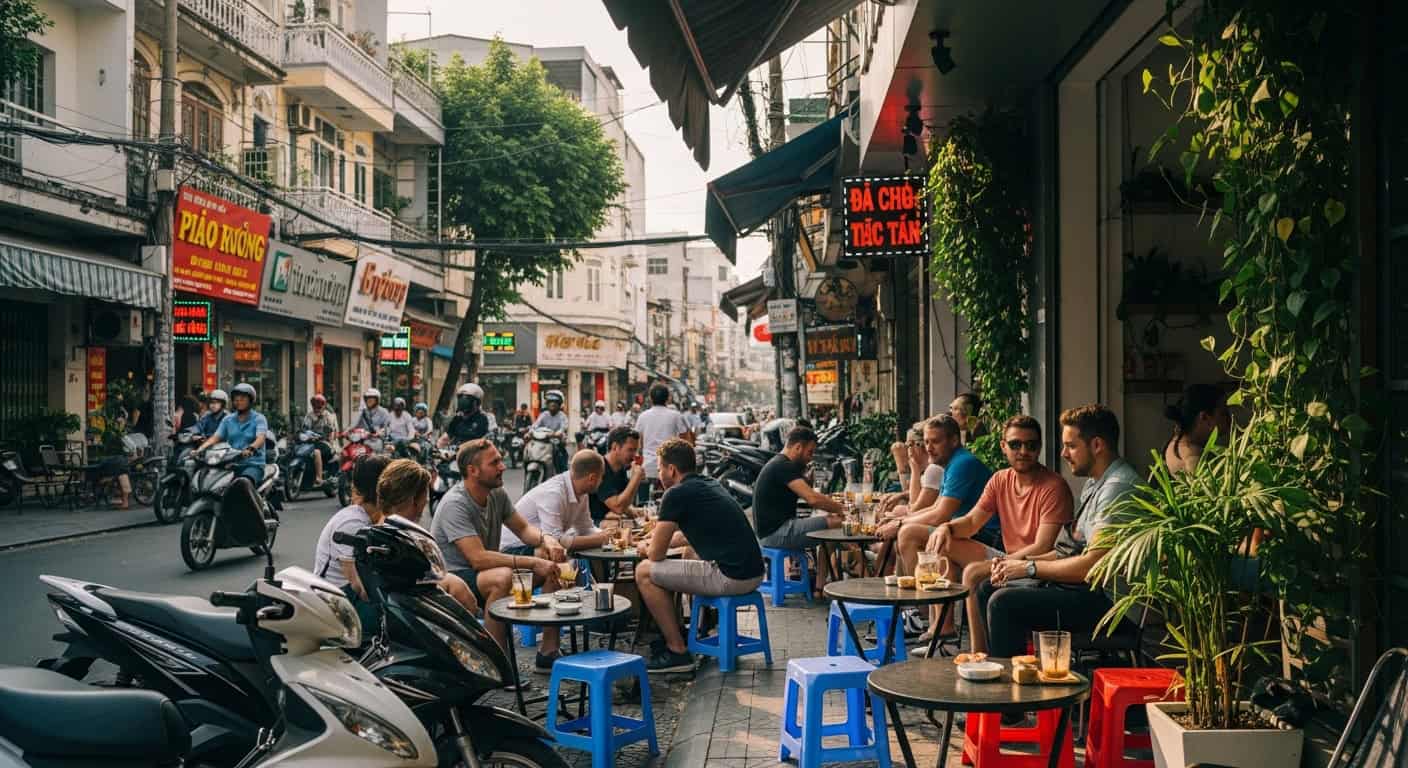
Groceries, dining, domestic help, and entertainment follow the same pattern. A business-district lunch in Singapore costs SGD 15–25 at a decent mid-range restaurant. The same meal in Saigon is USD 4–10. Singapore is four times the cost of Saigon at equivalent lifestyle level. The infrastructure gap has narrowed significantly since 2020. For expats who have done Singapore and want the next chapter, D1 Saigon is the most natural next move — start at.
Housing and Accommodation: Where the Gap Is Most Visible
Housing is the most immediate pressure point for any expat relocation decision. Singapore’s housing market operates under structural scarcity — the island is 733 km², planning controls are tight, and expat demand is perennially high. Orchard, Tanjong Pagar, and CBD-adjacent apartments command a premium that is essentially non-negotiable.
Saigon offers genuine choice. District 1 — the CBD equivalent — has a deep inventory of serviced apartments, high-rise condominiums, and boutique residences ranging from studio to four-bedroom. Districts 2 (Thao Dien) and 7 (Phu My Hung) offer quieter, more suburban alternatives popular with families. Furnished two-bedroom apartments in D1 with pool, gym, and 24-hour security start at USD 1,200/month. In Singapore, that budget would not cover a studio in a comparable location.
Infrastructure and City Liveability in 2025
The infrastructure argument has long been Singapore’s strongest card, and it remains valid — but the gap is closing. Singapore’s MRT, Changi Airport, and digital government services are world-class by any standard. For years, Saigon’s infrastructure was the clearest reason to accept the higher Singapore price tag.

That calculus shifted in late 2024. According to the Ho Chi Minh City Metro Management Board, Metro Line 1 — connecting Ben Thanh in District 1 to Suoi Tien in Thu Duc — formally opened to passengers in December 2024 after years of delay. It is the city’s first metro line and already carries tens of thousands of daily commuters. Five additional lines are in various stages of planning and construction. The airport expressway has also reduced journey times between Tan Son Nhat and the city centre. Road congestion remains a legitimate frustration, particularly during peak hours, but motorbike culture and the rise of Grab have made short-distance urban mobility genuinely efficient.
Fibre internet in Saigon is fast, affordable, and nearly universal in modern residential buildings — 200–500 Mbps plans cost USD 10–15/month. Power reliability in central districts has improved substantially over the past five years.
Saigon vs Singapore Expats: Healthcare Comparison
Singapore’s private and public healthcare system is routinely rated among the best in Asia. For expats requiring complex care or specialist procedures, it remains a step ahead. Costs, however, are significant even with insurance — a standard GP consultation runs SGD 60–120 at a private clinic.
Saigon’s private healthcare landscape has developed quickly. FV Hospital (French-Vietnamese), Vinmec, City International Hospital, and Hanh Phuc are all Joint Commission International (JCI) accredited or equivalent, with English-speaking staff. A GP consultation at a reputable international clinic costs USD 30–60. For routine care, dental work, dermatology, and non-emergency procedures, Saigon’s private facilities are more than adequate for the vast majority of expats. Comprehensive international health insurance — covering evacuation and Singapore or Thailand treatment for serious cases — runs USD 1,500–3,000/year, significantly less than comparable Singapore premiums.
Education Options for Expat Families
Singapore’s international school system is extensive and globally recognised — UWCSEA, Tanglin Trust, and the Singapore American School are among the best international schools in Asia. Waiting lists are common, and fees reflect demand: SGD 30,000–50,000 per year is standard at top-tier institutions.

Saigon’s international school market has expanded dramatically. According to ISC Research (2024), Vietnam now has over 150 international schools, with the highest concentration in Ho Chi Minh City. ISHCMC (International School HCMC), British Vietnamese International School, Renaissance International School, and Saigon South International School offer IB, Cambridge IGCSE, and American curricula. Annual fees range from USD 10,000 to USD 25,000 — meaningful savings for families running multiple children through the system simultaneously.
Career and Business Environment
For certain career tracks, Singapore remains the dominant regional hub. Finance, legal, multinational regional HQs, and institutional consulting roles are concentrated in Singapore in a way that Saigon does not yet replicate. If your career path requires proximity to Singapore’s professional ecosystem, that constraint is real.
The picture is different for entrepreneurs, remote workers, and professionals in tech, creative industries, or Southeast Asia-focused roles. Saigon’s startup ecosystem — centred around Hoa Lu and the emerging Thu Duc tech corridor — is genuinely active. Vietnam’s digital economy grew at double-digit rates through 2023–2024. The cost of building a team, renting office space, and running operations in Saigon is dramatically lower than Singapore. Many founders who established initial credibility or funding in Singapore have deliberately moved their operating base to HCMC to extend their runway.
Culture, Food, and Social Life
This is where personal preference dominates, and honest comparison is harder. Singapore’s multicultural, multilingual social scene is sophisticated, internationally diverse, and extremely well-organised. The food culture is exceptional. The city is clean, safe, and efficient in ways that consistently impress newcomers.
Saigon is louder, messier, and more kinetic. The food scene — from street pho at 06:00 to rooftop cocktail bars overlooking the Saigon River — is one of the most compelling in Asia. The expat community is smaller and tighter than Singapore’s, which many residents value. The sense that the city is visibly building itself in real time creates an energy that appeals to a particular type of expat. After Singapore’s polish, many find Saigon’s rougher edges genuinely refreshing rather than frustrating.
Visa and Legal Considerations
Singapore’s Employment Pass and Dependent Pass system is transparent, professionally managed, and well-suited to high-income corporate expats. Permanent residency is achievable over time. The regulatory environment is predictable and rule-of-law is robust.
Vietnam’s visa framework has improved materially. The E-visa now allows 90-day stays, extendable once, with straightforward online application. Long-term options include the temporary residence card (TRC), obtainable through employment contracts, business registration, or property ownership. The system requires more active management than Singapore’s but is navigable. Digital nomads and remote workers without a local employer typically use a combination of E-visa extensions and border runs, or establish a local single-member LLC for formal residency.
Safety, Climate, and Quality of Daily Life
Both cities are safe by global standards. Singapore’s crime rate is exceptionally low; Saigon’s street crime is also minimal in central districts, though petty theft (bag snatching on motorbikes) warrants awareness, particularly in tourist-heavy areas. Both cities have negligible violent crime risk for expat residents.
Climate is the one area where honest preference matters more than objective ranking. Both cities are hot and humid year-round. Saigon has a clearer dry season (November–April) versus wet season divide. Singapore’s rainfall is more evenly distributed and tropical showers are shorter and more predictable. Neither city suits people who dislike heat; both suit expats who have already decided to live in tropical Asia.
Who Should Choose Saigon vs Singapore
The saigon vs singapore expats decision ultimately comes down to career stage and lifestyle priority. Singapore makes sense if your role requires physical proximity to regional HQ infrastructure, you are in finance or institutional professional services at a senior level, your children are already enrolled in Singapore’s international schools, or you place very high value on regulatory predictability and world-class public services.
Saigon makes sense if you are a remote worker or digital entrepreneur seeking to maximise disposable income without giving up urban quality of life, you are at a career transition point and want to reduce overhead while building something new, your family is open to an excellent but less-famous school system at roughly half the cost, or you have already lived in Singapore and want the next chapter to feel genuinely different. For that last group especially — expats who have already experienced Singapore’s efficiency and want something rawer, more affordable, and more energising — D1 Saigon is the obvious destination.
The Bottom Line: Is the Cost Gap Still Worth the Quality Trade-Off?
In 2025, for the majority of saigon vs singapore expats weighing this choice, the answer is no — the quality trade-off no longer justifies the cost gap. That trade-off existed clearly in 2015 and was still arguable in 2020. By 2025, Saigon’s infrastructure, healthcare, schooling, and urban amenities have improved to a level where the four-to-one cost differential is simply very hard to justify on quality-of-life grounds alone. The expats who most reliably choose Singapore over Saigon are those whose careers genuinely require it — not those who prefer it for lifestyle reasons.
If you are evaluating this decision and your career allows geographic flexibility, the maths are unambiguous. Saigon is not Singapore, and it will not try to be. What it offers instead — energy, affordability, cuisine, a tight expat community, and a city that feels like it is becoming rather than already arrived — is, for a growing number of people who have lived in both places, the better deal.
You May Also Find Useful
Frequently Asked Questions
Is Saigon cheaper than Singapore for expats?
Yes, significantly. At an equivalent lifestyle level — similar apartment quality, international school, dining out regularly, private healthcare — Saigon runs approximately 70–75% cheaper than Singapore. The largest single saving is rent, where comparable apartments cost three to four times more in Singapore’s central districts than in District 1 or District 2 Saigon.
Is it safe to live in Saigon as an expat?
Saigon is safe for expat residents. Violent crime is extremely rare in central districts. The primary risk is petty theft — particularly bag and phone snatching by motorbike — which is manageable with basic street awareness. Most expats in D1, D2, and D7 report feeling genuinely comfortable and secure in their daily lives.
How does healthcare in Saigon compare to Singapore?
For routine and most specialist care, Saigon’s international private hospitals — FV, Vinmec, City International — are more than adequate and significantly cheaper. For highly complex procedures or treatments requiring cutting-edge technology, Singapore (or Bangkok) remains the preferred destination. Most expats in Saigon maintain international health insurance with medical evacuation cover for this reason.
Can I move to Saigon without a job offer?
Yes. Vietnam’s 90-day E-visa is easy to obtain online and covers most nationalities. Remote workers, freelancers, and entrepreneurs commonly live in Saigon on E-visas while establishing local business registration or seeking an employment-based residence permit. The visa situation requires more active management than Singapore’s employment pass system but is workable for most expats.
What areas of Saigon are best for expats comparing it to Singapore-style living?
District 1 is the closest equivalent to Singapore’s CBD — central, walkable, full of international restaurants, serviced apartments, and business infrastructure. District 2 (particularly Thao Dien) suits families and those wanting a quieter, villa-style suburban feel. District 7’s Phu My Hung is a planned township with wide streets and a large South Korean and Japanese expat community. All three offer quality comparable to Singapore’s residential zones at a fraction of the price.
Official Resources
For the most up-to-date information on saigon vs singapore expats, visit the Vietnam Tourism Official Guide.