
Silk shopping in Saigon is easier when you know which boutiques, markets, and tailor districts sell authentic Vietnamese silk.
Saigon is one of Southeast Asia’s best destinations for silk shopping in Vietnam and Saigon, offering everything from hand-loomed ao dai fabric in narrow alley shops to luxury boutiques stocking certified mulberry silk. Whether you want a custom-tailored dress ready in 48 hours or a bolt of raw silk to take home, Ho Chi Minh City has options at every price point — if you know where to look.
Key Takeaways
- Ben Thanh Market and the surrounding fabric lanes on Le Cong Kieu are the most accessible starting points for silk shopping in Saigon, but prices are tourist-marked.
- Nguyen Trai Street in District 5 is the wholesale fabric district locals use — expect dramatically lower prices per metre.
- Authentic Vietnamese mulberry silk (lua to tam) is heavier, slightly textured, and has a muted sheen; avoid anything described as “silk-feel” polyester blends.
- Custom tailoring from good-quality silk fabric typically takes two to five days; budget at least one fitting session.
- According to the Vietnam Textile and Garment Association, Vietnam exported over USD 44 billion in textiles and garments in 2024, with silk and premium fabrics representing a growing share of domestic craft retail.
Why Saigon Is a Top Destination for Silk Shopping in Vietnam
Ho Chi Minh City sits at the commercial heart of southern Vietnam and acts as the distribution hub for silk produced in the country’s central highlands, the Mekong Delta, and in specialist weaving villages further north. Unlike Hoi An, which has a more curated tourist-tailoring market, Saigon gives you simultaneous access to wholesale fabric streets, mid-range boutiques, and export-quality showrooms — all within a city that is genuinely fun to navigate by motorbike taxi. The result is a broader price range and more authentic negotiating culture than you will find in more overtly tourist-focused towns.

Vietnamese silk craftsmanship dates back more than a thousand years. The country cultivates both mulberry silkworms for fine-filament silk and wild silkworms for the rougher, more textured lua tho used in traditional costumes. When you do silk shopping Vietnam Saigon-style, you are tapping into that long production chain at its southernmost retail end.
Understanding Vietnamese Silk: What You Are Actually Buying
Before you spend a single dong, it helps to understand the basic categories of silk you will encounter during silk shopping in Saigon.
- Mulberry silk (lua to tam): The gold standard. Fine filaments, smooth handle, and a subtle natural sheen. Produced in quantity in Bao Loc (Lam Dong Province) and in Ha Dong near Hanoi. Most premium ao dai fabric falls into this category.
- Dupioni / raw silk: Heavier, with a natural slub texture caused by two silkworms spinning a single cocoon. Excellent for structured garments and home furnishings.
- Brocade silk (lua gam): Woven with metallic threads into intricate patterns. Common in traditional festival wear. Heavier and less drapey than plain weaves.
- Organza and chiffon blends: Lightweight, sheer. Often blended with a small percentage of synthetic for stability. Popular for scarves and linings.
- Polyester “silk”: The thing to avoid. Feels slightly clammy, burns with a sooty black smoke (the classic burn test), and pills quickly. Unfortunately common at tourist-facing stalls.
The burn test is the quickest field check: genuine silk burns slowly, smells like burning hair, and leaves a crushable ash. Polyester melts, smells acrid, and leaves a hard bead.
Ben Thanh Market and the Tourist Fabric Stalls
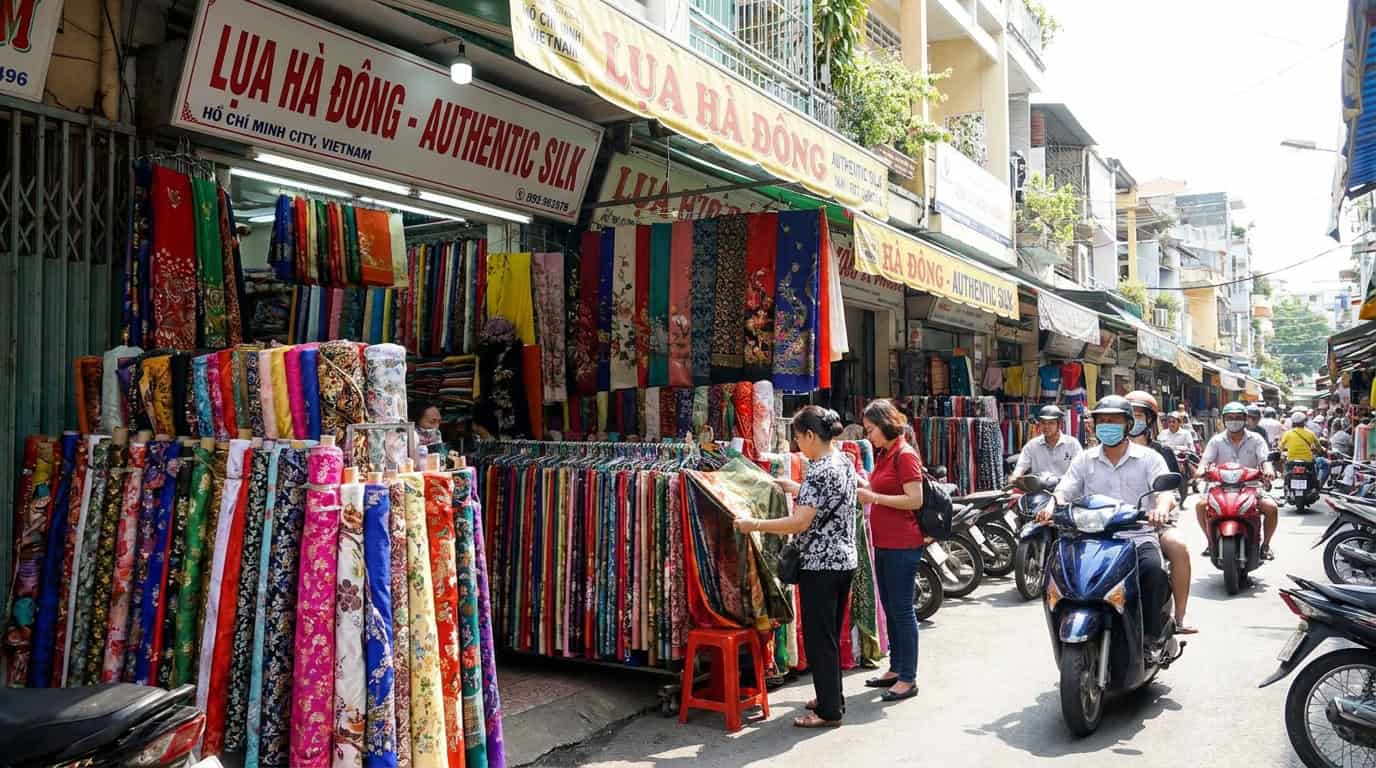
Ben Thanh Market (Cho Ben Thanh) in District 1 is the obvious first stop for most visitors doing silk shopping Vietnam Saigon for the first time. The inner ring of fabric stalls stocks silk scarves, ao dai panels, and pre-cut sarong lengths. Quality is variable and prices are set for negotiation — expect the opening quote to be two to four times the fair value. That said, Ben Thanh is useful for orientation: you can handle a lot of different fabric weights quickly, compare sheens side by side, and get a feel for the market before moving to cheaper sources.

The streets immediately behind Ben Thanh — particularly Phan Chu Trinh and the small lanes running toward District 3 — have independent tailors and fabric merchants who are slightly less tourist-oriented and more willing to give accurate answers about fibre content.
Nguyen Trai: The Wholesale Silk District for Serious Shoppers
If Ben Thanh is the introduction, Nguyen Trai Street (Districts 1 and 5) is the advanced class. This is where Saigon’s garment factories, boutique tailors, and experienced expats buy fabric by the metre. The street and its side lanes — particularly around Cho An Dong (An Dong Market) — are lined with wholesale fabric warehouses that are open to retail customers. Prices per metre can be 40 to 60 percent lower than Ben Thanh for equivalent quality.
Navigation tip: look for shops displaying bolts stacked floor to ceiling. The best ones have staff who can tell you exactly where each roll was produced. Vietnamese language ability helps here, but most established shops have at least one English-speaking staff member for expat clients.
Ao Dai Boutiques: Ready-to-Wear and Custom Silk Garments
The ao dai — Vietnam’s iconic fitted tunic — is the most popular silk purchase for visitors and residents alike. For silk shopping in Vietnam and Saigon at the premium end, several boutiques in District 1 and District 3 combine high-grade mulberry silk with skilled tailoring.
- Ao Dai Hanh on Le Thanh Ton Street is a long-standing favourite among expats, offering both ready-to-wear sizes and bespoke orders with a 48-to-72-hour turnaround.
- Kimmy Fashion near the Opera House stocks Vietnamese-produced silk in an exceptional colour range, with in-house tailors who speak functional English.
- Thuy Design House in the Thao Dien area of District 2 (Thu Duc City) targets the premium market with hand-painted silk panels and couture-level construction.
For custom work, bring a reference image and arrive early in your trip to allow time for the fitting-adjustment-collection cycle. One fitting is usually sufficient for experienced tailors, but two fittings produce noticeably better results.
Silk Scarves, Gifts, and Souvenirs: Where to Buy Well
Not every silk purchase needs to be tailored. Silk scarves, pocket squares, and cushion covers make excellent gifts, and Saigon has no shortage of supply. The key distinction is between machine-printed silk (lower cost, consistent pattern edges) and hand-painted or hand-block-printed silk (higher cost, slightly irregular edges that confirm hand production).
The Craft Link-style shops along Dong Khoi Street in District 1 stock fair-trade silk products from highland ethnic minority cooperatives. Prices are higher than market stalls but the provenance is clear and the quality consistent. According to the Vietnam Craft Village Association’s 2025 report, there are currently 47 active silk-weaving craft villages across Vietnam, with products increasingly sold through HCMC retail intermediaries to both domestic and international buyers.
Silk shopping rewards time and local knowledge. Our long-stay tenants pick up insider tips quickly — after a few weeks in Saigon you will know exactly which stall in which market has the best dupioni in the colour you want, and you will have the vendor’s phone number saved.
Custom Tailoring With Silk: How the Process Works
The process of getting something tailored from silk fabric in Saigon follows a fairly standard sequence, whether you are working with a boutique or a market tailor.
- Fabric selection: Choose your silk type, weight, and colour. Buy slightly more than the tailor recommends — better to have leftover than to run short mid-garment.
- Design consultation: Bring reference photos. A good tailor will flag construction problems with your chosen design and suggest adjustments.
- Measurements and deposit: Expect to pay 30 to 50 percent upfront. Get a written receipt with the promised completion date.
- First fitting: Try the basted (loosely sewn) garment for fit before final seaming. This is the critical intervention point.
- Collection and final payment: Inspect carefully in good light before paying the balance. Minor alterations should be included at this stage.
Budget three to five days minimum. Rushing the process is the most common cause of disappointing results. If a tailor promises completion in four hours, that is a warning sign, not a selling point.
Spotting Authentic Silk: Quality Checks in the Market
The burn test is the most reliable field check for silk shopping Vietnam Saigon markets, but there are additional signals worth knowing.
- The ring test: Genuine silk fabric can be pulled through a ring significantly smaller than the folded fabric’s width. Polyester resists and snags.
- The crumple test: Scrunch a piece tightly in your fist for ten seconds. Silk springs back with minimal creasing. Polyester holds creases sharply.
- Price floor awareness: High-quality mulberry silk fabric costs a minimum of 150,000 to 200,000 VND per metre at wholesale. If you are being quoted significantly less, it is not silk.
- Certificate of origin: Reputable boutiques can show documentation linking their fabric to specific mills. Ask for it.
Practical Tips for Silk Shopping in Vietnam and Saigon
A few logistical points that make silk shopping Vietnam Saigon visits more productive:
- Go in the morning. Fabric districts are cooler, less crowded, and vendors are fresher and more willing to explain products in detail.
- Bring cash in small denominations. Most small fabric shops do not take cards, and many avoid card transactions even when they technically could take them.
- Negotiate consistently but not aggressively. The culture around pricing is theatrical but not adversarial. Smiling and patient counter-offering gets better results than walking away.
- Use a grab bike between markets. Ben Thanh to An Dong Market is a ten-minute ride and saves considerable energy for the actual shopping.
- Pack fabric flat, not rolled, in checked luggage. Wrinkles from rolling take weeks to fall out of heavier weaves.
Silk Home Furnishings: Cushions, Throws, and Table Runners
Beyond clothing, Saigon’s silk market supplies excellent home textiles. Raw silk and dupioni are particularly well-suited to cushion covers and light drapery — the natural texture suits contemporary interiors and the Vietnamese colour palette (rust, indigo, moss, saffron) translates beautifully into home furnishing contexts.
The Ben Thanh area and the shops along Pasteur Street in District 1 stock the widest range of ready-made silk home textiles. For custom furnishing fabric by the metre, the Nguyen Trai wholesale district again offers the best value. Several workshops near District 4’s craft lanes also do custom cushion covers and table runners on short lead times — useful if you want something sized precisely for your apartment or home.
Budget Guide: What Silk Costs in Saigon
Prices fluctuate with the season and exchange rates, but the following ranges give a realistic framework for silk shopping in Saigon in 2026:
- Silk scarf (machine-printed, 90cm x 180cm): 150,000 to 300,000 VND at market stalls; 400,000 to 700,000 VND at boutiques for hand-painted versions.
- Mulberry silk fabric per metre (plain weave): 150,000 to 300,000 VND wholesale; 400,000 to 600,000 VND retail boutique.
- Brocade silk per metre: 300,000 to 800,000 VND depending on metallic thread density and pattern complexity.
- Custom ao dai (fabric plus tailoring): 800,000 to 2,500,000 VND for market tailors; 3,000,000 to 8,000,000 VND for boutique work.
- Ready-to-wear silk dress from established boutique: 1,200,000 to 4,000,000 VND.
You May Also Find Useful
Frequently Asked Questions
Where is the best place for silk shopping in Saigon for first-time visitors?
Start at Ben Thanh Market to orient yourself and handle different fabric types, then move to the Nguyen Trai wholesale district in Districts 1 and 5 for better prices once you know what you want. Boutiques along Le Thanh Ton and Dong Khoi in District 1 are the best choice for ready-made garments and guaranteed quality.
How can I tell if Vietnamese silk is genuine or synthetic?
The most reliable test is the burn test: pull a few threads from an inconspicuous seam and hold a flame to them. Genuine silk burns slowly, smells like burning hair, and leaves a crushable ash. Polyester melts, smells acrid, and leaves a hard plastic bead. The crumple test (scrunch in your fist — silk releases, polyester holds creases) and the ring test (silk pulls through a small ring easily) are additional checks you can do without damaging the fabric.
Is it worth getting clothes custom tailored from silk in Saigon?
Yes, for most visitors it is one of the best value-for-money experiences available in the city. Quality tailors in Saigon can produce garments that would cost three to five times as much in Western markets. The key is allowing enough time — at least three to five days — and bringing clear reference images. Rushing the process is the most common source of disappointment.
What Vietnamese silk items make the best souvenirs to bring home?
Silk scarves are the most practical souvenir: lightweight, compact, and easy to pack. Hand-painted scarves make more distinctive gifts than machine-printed versions. Silk pocket squares and small silk pouches also pack well. If you have luggage space, cushion covers in Vietnamese brocade travel reasonably well when packed flat and are almost always admired at home.
How do prices at Saigon silk markets compare to Hoi An?
Fabric prices are generally lower in Saigon’s wholesale districts than in Hoi An’s tourist-facing tailoring market. Hoi An has more tailors with strong English skills and experience dressing Western body proportions, which adds a convenience premium. For fabric buying alone, Saigon offers better value; for an end-to-end tailoring experience with less negotiation friction, Hoi An competes strongly. Many long-term Saigon residents buy fabric in the city and use a trusted local tailor rather than the tourist tailoring circuit.
Official Resources
For the most up-to-date information on silk shopping vietnam saigon, visit the Vietnam Tourism Official Guide.