
Vietnam banking for expats is straightforward once you know which banks accept foreign residents, what documents you actually need, and how to avoid the fees that quietly drain accounts every month. In Ho Chi Minh City, most working expats have a local account running within a week of arrival — and it changes everything about daily life, from paying rent to splitting a dinner bill without fumbling for cash.
Key Takeaways
- Most expats in HCMC open accounts at Vietcombank, HSBC Vietnam, or Techcombank within the first two weeks of arrival.
- You need a valid passport, a Vietnam visa or temporary residence card, and proof of local address — a lease agreement works perfectly.
- International transfers are fastest through Wise or Revolut linked to a local VND account, cutting fees compared to traditional wire transfers.
- ATM withdrawal limits, foreign transaction fees, and currency conversion spreads vary significantly between banks — always read the fee schedule.
- A local VND account is essential for paying D1 rent, utilities, and motorbike taxis; card-only living in Saigon is still impractical outside premium areas.
Decision table: choose the right Vietnam bank as an expat
The best bank is the one that matches your documents, transfer needs, and daily branch access.
| Bank choice | Best for | Strength | Possible drawback |
|---|---|---|---|
| Vietcombank | Mainstream expat banking and remittances | Large network and strong international transfer familiarity | Branch experience can vary |
| Techcombank | Digital-first daily banking | Modern app, strong local payments, low daily fees | Eligibility depends on branch and status |
| HSBC Vietnam | Premium international banking | Cross-border support and multi-currency familiarity | Higher balance or fee expectations |
| Employer salary bank | Work-permit holders | Easiest payroll and HR support | May not be the best for personal transfers |
Decision rule: Open the account you can actually maintain first; optimise for premium features only after salary, rent, and local transfers work reliably.
Why Vietnam Banking for Expats Matters Before Anything Else
Arriving in Saigon without a local bank account is manageable for the first week, but it gets frustrating fast. Landlords want VND transfers, not cash handed over in envelopes. Utility companies bill in VND. Grab charges in VND. The city runs on local rails, and so should your money. Vietnam banking for expats is not complicated — it is just a process, and one that rewards people who tackle it early.

Sorting your bank account is the last piece of practical admin before Saigon becomes home. Our D1 lease payments, utilities, and daily spending all run smoothly once it’s done.
Which Banks Do Expats Actually Use in Ho Chi Minh City
The short answer is: Vietcombank for reliability, Techcombank for the app, HSBC Vietnam for international features, and VPBank or MB Bank if your employer uses them for payroll.
- Vietcombank — The most widely accepted bank in Vietnam. ATMs everywhere, stable internet banking, and staff at the District 1 branches speak workable English. Processing times for international transfers are slower than HSBC but fees are lower.
- Techcombank — The best mobile banking app of any Vietnamese bank right now. Zero-fee domestic transfers, a sleek interface, and easy onboarding if you have a TRC (Temporary Residence Card). Expats who plan to stay more than a year tend to prefer it.
- HSBC Vietnam — The obvious choice if you already bank with HSBC globally. Account linking, international wire transfers with competitive rates, and English-language support throughout. Minimum deposit requirements are higher, but the trade-off is genuine international banking infrastructure.
- ANZ / Standard Chartered — Both have reduced their retail footprint in Vietnam. ANZ transferred its retail operations to Shinhan Bank Vietnam; worth knowing if you were expecting a branch.
- VPBank and MB Bank — Popular with expats on local employment contracts because many Vietnamese companies pay salary into these accounts. Serviceable apps, reasonable fees.
Documents Required to Open a Bank Account in Vietnam
Vietnam banking for expats requires less paperwork than most people expect, but the exact list varies slightly by bank and visa type. Come prepared with originals and photocopies of everything.
- Valid passport — All banks require this. Make sure it has at least six months of validity remaining.
- Proof of legal stay — A valid visa, e-visa, or Temporary Residence Card (TRC). A tourist visa works at most banks but some require a longer-stay document for full-feature accounts.
- Proof of local address — A signed lease agreement with your name on it, or a utility bill in your name. This is where having a proper lease for your D1 apartment makes a practical difference.
- Employment letter or business registration — Not always required for basic accounts, but speeds up approval and unlocks higher transfer limits.
- Tax ID (MST) — Required at some banks if you want to open an interest-bearing savings account.
Bring two sets of photocopies. Vietnamese bank branches still work heavily on paper, and the photocopying shop on the street outside every bank branch exists for a reason.
Step-by-Step: Opening Your Account at a HCMC Branch
Walk into a branch in District 1 on a weekday morning. Avoid the last two days of any month — branches fill up with businesses doing monthly reconciliations. The process at most major banks follows the same pattern.
- Take a queue number at the front desk and explain you want to open a personal account as a foreigner.
- A staff member will check your documents and confirm eligibility — this usually takes five minutes.
- Complete the account opening form (bilingual forms available at Vietcombank and HSBC).
- Make the initial deposit — typically 500,000 VND to 1,000,000 VND (roughly $20–$40 USD).
- Receive your debit card on the spot or wait three to five business days for it to be issued.
- Download the bank’s app and activate internet banking before leaving the branch while staff can assist.
Total time in branch: 45 minutes to two hours depending on queue length. Bring something to read.
Sending Money to and from Vietnam: The Honest Guide
International transfers in and out of Vietnam are legal and common for expats, but the mechanism matters enormously for fees and speed. According to the World Bank’s Remittance Prices Worldwide database, the average cost of sending $200 to Vietnam in Q1 2025 was 5.2% through traditional bank transfers, compared to under 1% via fintech services like Wise.

The practical playbook for most Saigon expats:
- Wise (formerly TransferWise) — Send money from your home country to your Vietnamese VND account at mid-market exchange rates. Fast, transparent, and the most cost-effective option for regular transfers under $10,000 USD.
- Revolut — Works well for expats who maintain a European or UK account. You can hold VND in-app and transfer to local accounts, though limits apply on free plans.
- SWIFT wire transfer — Use this for large amounts (property deposits, lump-sum transfers) where the flat fee is proportionally small. Your Vietnamese bank will provide a SWIFT code and account details.
- Western Union / MoneyGram — Expensive and slow. Avoid unless it is the only option for a recipient.
For receiving salary or freelance income in Vietnam, Payoneer and Stripe payouts can land in Vietnamese bank accounts — confirm with your bank that they accept incoming transfers from these platforms before setting it up.
Understanding VND: Currency Basics Every Expat Should Know
The Vietnamese Dong (VND) trades at approximately 25,000–25,500 per USD as of mid-2025. The large denominations look alarming until you recalibrate: 500,000 VND is about $20, and 1,000,000 VND is roughly $40. Getting comfortable with mental math in millions takes a few weeks but becomes second nature.
The State Bank of Vietnam manages a managed float exchange rate system. According to the State Bank of Vietnam’s 2024 Annual Report, the VND depreciated approximately 4.8% against the USD over 2024, within the central bank’s managed band. This matters for expats receiving income in foreign currency — a weaker VND means your purchasing power in Saigon increases slightly when converting.
ATMs dispense VND in denominations of 100,000, 200,000, and 500,000. Most machines cap withdrawals at 3,000,000–5,000,000 VND per transaction (roughly $120–$200). If you need larger cash amounts, go to the bank teller.
Fees, Limits, and What to Watch Out For
Vietnam banking for expats has some hidden friction points that are worth knowing before they appear on your statement.
- Foreign transaction fees — Using a foreign card at Vietnamese ATMs typically incurs a 1.5–3% foreign transaction fee from your home bank plus a local ATM fee of around 25,000–55,000 VND per withdrawal. After the first week, this adds up.
- Daily transfer limits — Standard accounts at Vietnamese banks cap daily internet banking transfers at 100,000,000–500,000,000 VND. For rent payments on higher-end D1 apartments, confirm your limit before your transfer bounces.
- International transfer documentation — Transfers above $10,000 USD equivalent require documentation of purpose under State Bank regulations. Keep copies of lease agreements, employment contracts, or invoices that explain large outbound transfers.
- Dormant account fees — Some banks charge quarterly fees on accounts with no activity for six months. If you travel and leave Vietnam, set a calendar reminder to make a small transaction every few months.
- Currency conversion spreads — Banks set their own buy/sell spreads on USD/VND exchanges. Check the rate at your branch versus the mid-market rate before converting large amounts; spreads of 1–2% are normal, but wider spreads occur at airport counters and hotel desks.
Digital Payments and E-Wallets in Ho Chi Minh City
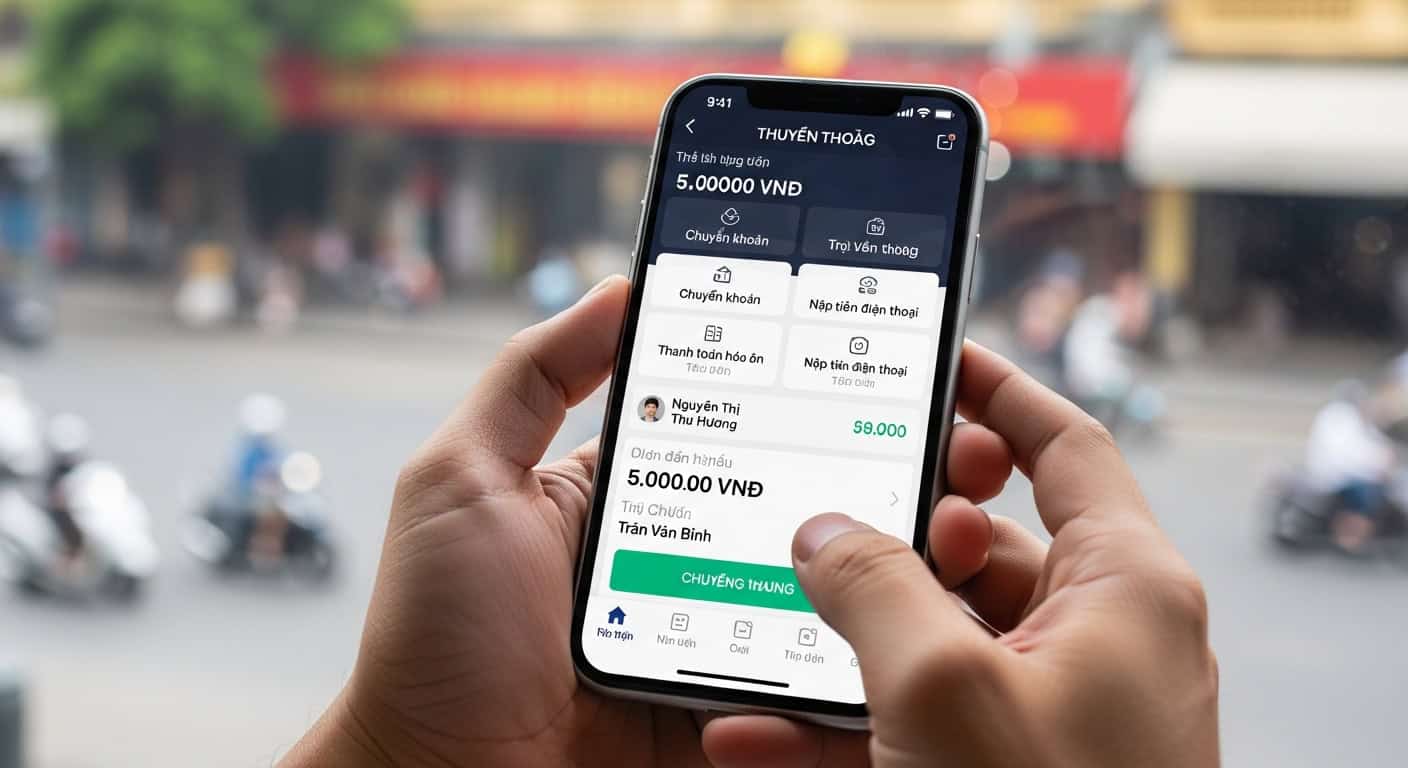
Saigon has moved aggressively toward cashless payments in the last three years. QR code payments via VietQR appear on menus, market stalls, and parking meters. Most Vietnamese e-wallets require a local bank account and a Vietnamese phone number to activate fully.
- MoMo — The dominant e-wallet in Vietnam. Accepted at convenience stores, food delivery, taxi apps, and utilities. You can link it to a local bank account and top up easily.
- ZaloPay — Integrated with the Zalo messaging app. Strong penetration in HCMC, especially for restaurant payments and bill splitting.
- VNPay — Widely used for utility bill payments, online shopping, and government fee payments. If you are paying water or electricity bills online, this is often the most reliable method.
- Grab Pay — Linked to your Grab account. Convenient for daily transport and GrabFood orders.
Apple Pay and Google Pay work at contactless terminals in larger retailers and malls, but adoption outside premium retail is still limited. Cash remains necessary for wet markets, older restaurants, and street food.
Tax Implications for Expats with Vietnamese Bank Accounts
Having a Vietnamese bank account does not automatically create a tax obligation, but it creates a paper trail that connects you to the Vietnamese tax system. A few key points:
- Expats resident in Vietnam for 183 days or more in a calendar year are considered tax residents and pay Vietnamese personal income tax on worldwide income.
- Foreign-sourced income transferred into Vietnam is generally not taxable in Vietnam if your employment income is already taxed locally — but confirm this with a local tax advisor for your specific situation.
- Interest earned on Vietnamese savings accounts is subject to a 5% withholding tax, automatically deducted by the bank.
- FATCA reporting applies if you are a US citizen — Vietnamese banks are signatories to FATCA agreements and will report account information to US authorities.
Practical Tips From Long-Term Saigon Residents
The expat community in District 1 and District 3 has collectively burned through enough bad banking experiences to have developed a clear consensus on what works.
- Open accounts at two banks — one international (HSBC) for large transfers and one local (Vietcombank or Techcombank) for daily spending. The redundancy pays for itself the first time one app goes down.
- Get a VND debit card even if you primarily spend on a foreign credit card. Landlords, markets, and smaller restaurants all prefer VND card or cash.
- Set your home bank to no-fee international withdrawals if possible. Charles Schwab (for US residents) and Starling Bank (for UK residents) are popular choices among expats specifically because they refund foreign ATM fees.
- Keep 3–5 million VND in cash at home for power outages, market days, and the occasional street food run. Cashless infrastructure in HCMC is good but not yet universal.
- Photograph or scan all your bank documents, account agreements, and card details and store them securely in the cloud. If your wallet is stolen, having account numbers and bank hotlines available remotely saves hours.
You May Also Find Useful
Frequently Asked Questions
Can I open a bank account in Vietnam on a tourist visa?
Yes, most major Vietnamese banks including Vietcombank and Techcombank will open basic accounts for foreigners on tourist visas. However, accounts opened on tourist visas often have lower daily transfer limits and may not be eligible for savings accounts with competitive interest rates. A Temporary Residence Card or work permit unlocks full-feature accounts.
How long does it take to open a bank account as an expat in HCMC?
The in-branch process takes 45 minutes to two hours. Your debit card is either issued immediately or arrives within three to five business days. Internet banking and the mobile app can typically be activated the same day. HSBC Vietnam may take longer due to additional compliance checks for new international customers.
What is the best way to transfer money to Vietnam from abroad?
Wise is the most cost-effective option for regular transfers up to $10,000 USD, offering mid-market exchange rates with transparent fees. For larger amounts, a SWIFT wire transfer directly to your Vietnamese bank account is more appropriate. Avoid Western Union for anything other than emergency cash pickups.
Do I need a Vietnamese bank account to rent an apartment in Saigon?
Technically no, but practically yes for anything beyond a short-term serviced apartment. Most landlords in District 1 and surrounding districts require monthly rent paid via bank transfer to a Vietnamese account. Paying by international transfer adds unnecessary complexity and exchange rate risk for both parties.
Are there any restrictions on taking money out of Vietnam?
Expats can transfer money out of Vietnam legally, but transfers above $10,000 USD equivalent require documentation of the money’s source and purpose — a salary payslip, lease termination agreement, or similar. The State Bank of Vietnam monitors capital outflows, and banks are required to report large international transfers. Plan large exit transfers in advance and keep your paperwork current.
Official Resources
For the most up-to-date information on vietnam banking for expats, visit the State Bank of Vietnam.