
Vietnam Currency Exchange: Best Rates, Where to Exchange, and What to Avoid
Vietnam currency exchange is one of the first practical challenges every newcomer to Ho Chi Minh City faces. The short answer: exchange at a gold shop (tiệm vàng) in District 1 or use a local ATM for the best rates — avoid airport counters, hotel desks, and any place that charges a flat fee. This guide covers exactly where to go, what rates to expect, and the traps that cost expats and tourists hundreds of dollars every year.
Key Takeaways
- Gold shops (tiệm vàng) on Nguyễn Công Trứ Street, D1 consistently offer the best USD/VND rates in HCMC — often within 0.1–0.2% of the interbank rate.
- Airport exchange counters typically offer 3–5% below the street rate; avoid them except for emergency pocket money.
- Vietcombank and Techcombank ATMs have the lowest foreign withdrawal fees among local banks — always choose to be charged in VND, not your home currency.
- Vietnam is still a heavily cash-based economy; carry enough dong for markets, street food, and taxis at all times.
- Wise and Revolut cards are now widely usable at ATMs and major retailers, often beating bank exchange rates by 1–2%.
Decision table: where should you exchange money in Vietnam?
Exchange choice depends on urgency, amount, and whether you need a receipt.
| Channel | Typical fit | Best for | Trade-off |
|---|---|---|---|
| Reputable gold shop or exchange counter | Best street rates | Clean USD/EUR cash and medium amounts | Check legality, receipt availability, and note condition |
| Bank branch | Official and receipt-backed | Large or documented exchanges | Slower process and sometimes weaker rates |
| Major bank ATM | Convenient VND access | Small-to-medium cash needs | Foreign card fees and transaction caps |
| Airport counter | Emergency cash only | First taxi or SIM purchase | Usually weaker rates |
| Wise or international transfer | Bank-to-bank funding | Long-stay residents | Requires receiving account and timing buffer |
Related planning guides
Decision rule: For long stays, combine one reliable local account with small ATM withdrawals and documented transfers for larger amounts.
Understanding Vietnamese Currency: The Dong (VND)
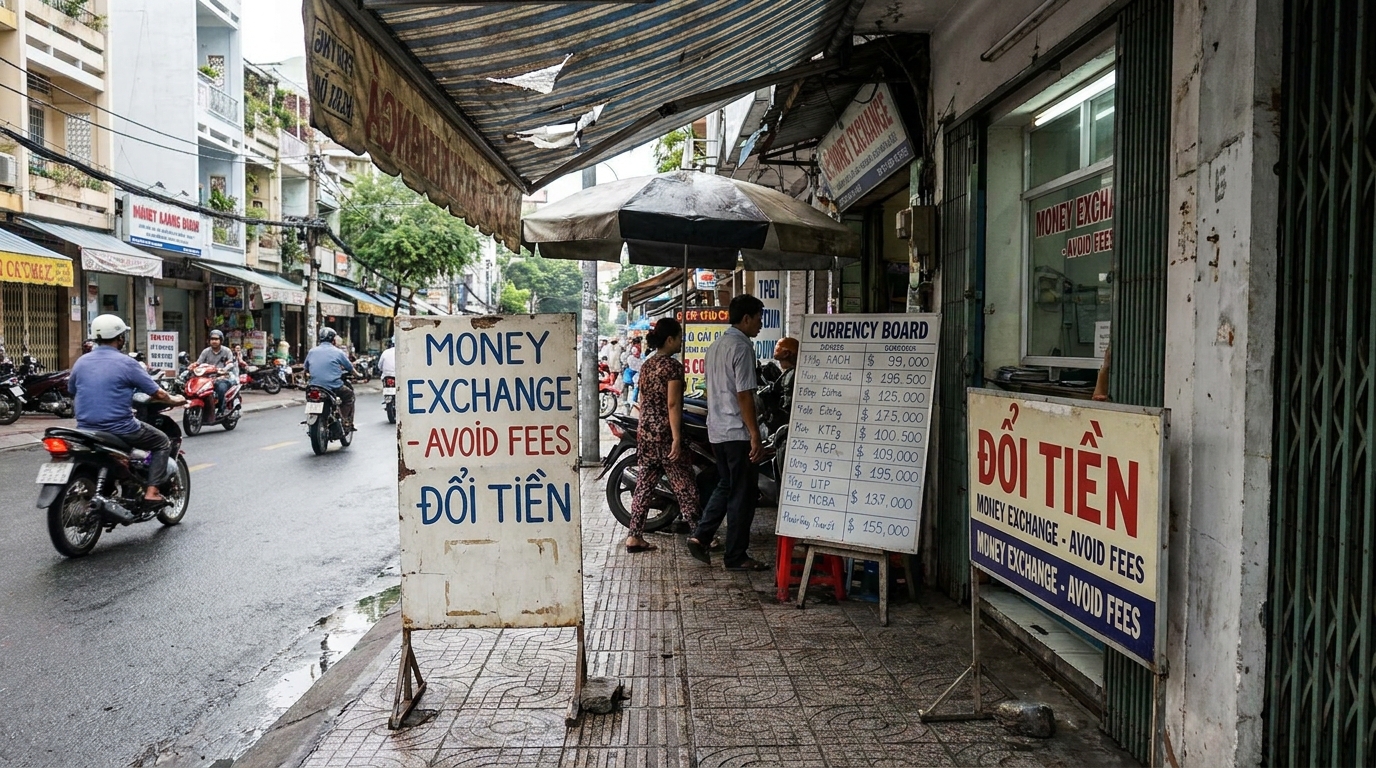
The Vietnamese dong (VND, symbol ₫) is the sole legal tender in Vietnam. Notes come in denominations of 1,000, 2,000, 5,000, 10,000, 20,000, 50,000, 100,000, 200,000, and 500,000 VND. The 500,000 note is worth roughly USD 20, which means you will routinely carry what looks like a thick wad of cash. Don’t let the zeros intimidate you — mentally dividing by 25,000 gives you a quick USD equivalent. Foreign currencies, including USD and CNY, circulate informally in some tourist areas but are not legal tender; paying in foreign currency is technically prohibited for retail transactions.
Current Exchange Rates: What to Expect in 2026
As of mid-2026, the USD/VND rate hovers around 25,300–25,500 at reputable exchange points. The State Bank of Vietnam sets a daily central rate and allows banks to trade within a ±5% band. According to the State Bank of Vietnam, the official central rate for USD/VND in early 2026 averaged approximately 24,850, with commercial rates at authorised dealers running 1–3% above that band in practice. For EUR, GBP, AUD, and SGD, expect rates 0.3–0.8% wider than the equivalent USD cross-rate. Always check vietcombank.com.vn or techcombank.com.vn for the day’s published rates before heading out — they update every 30 minutes on business days.
Best Places for Vietnam Currency Exchange in Ho Chi Minh City
District 1 is ground zero for competitive vietnam currency exchange. Here are the top options ranked by rate quality:
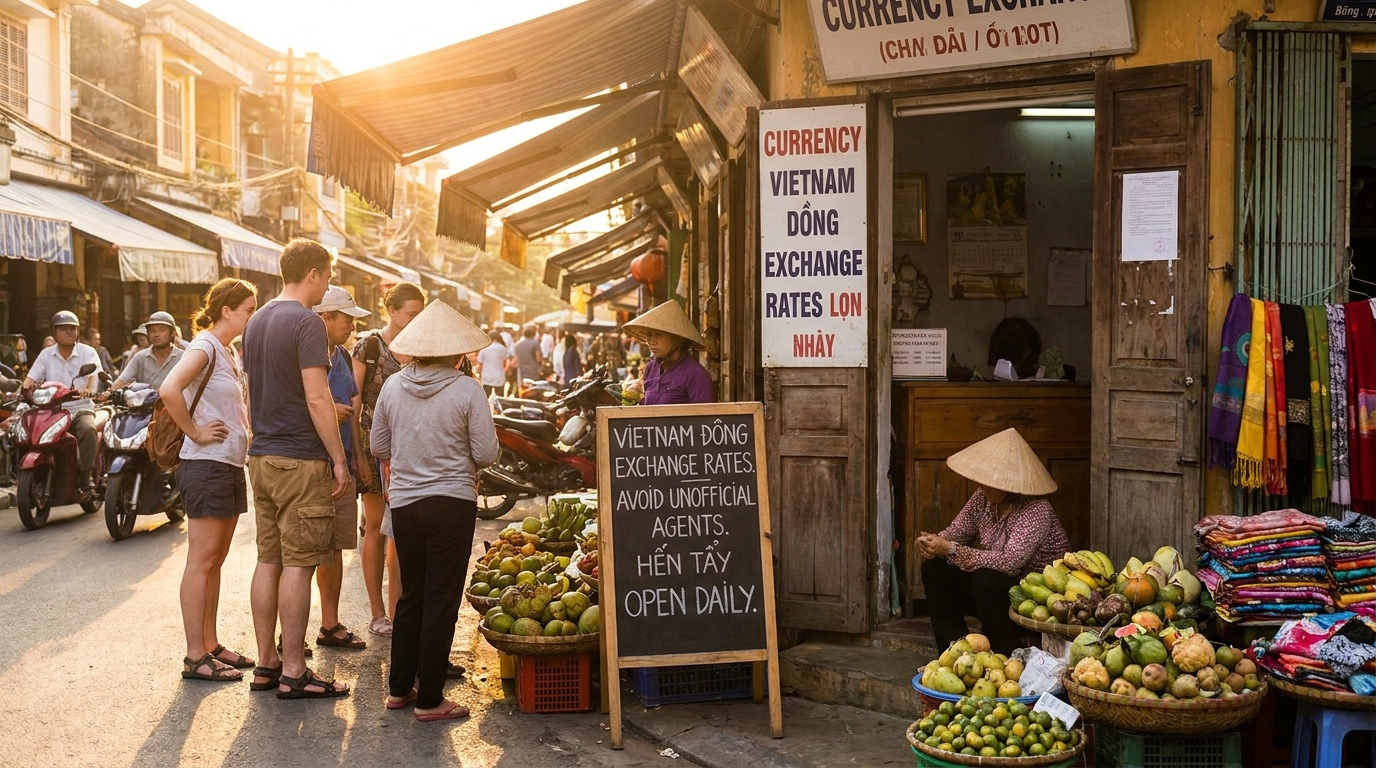
- Licensed gold shops (tiệm vàng), Nguyễn Công Trứ St, D1 — The cluster of shops near the corner of Nguyễn Công Trứ and Hồ Tùng Mậu is the city’s most competitive exchange corridor. Rates are updated frequently and typically sit within 0.1–0.3% of the interbank mid-rate. Bring clean, unmarked bills — torn or heavily stamped USD notes are refused or discounted.
- Sacombank and Vietcombank branch tellers — Slightly below gold shop rates but 100% legal, receipt-issuing, and useful for large amounts. Bring your passport. Limits on USD purchases are enforced under SBV regulations.
- Vietcombank and Techcombank ATMs — For card-based withdrawal, these two banks have the lowest per-transaction fees (50,000–90,000 VND) and do not apply a dynamic currency conversion mark-up if you select VND. Daily limits are typically 5–7 million VND per transaction, with 2–3 transactions allowed per day.
- Wise / Revolut card at ATMs — If your home bank charges high foreign transaction fees, loading a Wise or Revolut account and withdrawing from a Vietcombank ATM often yields rates 1.5–2% better than using a traditional debit card.
Our welcome pack includes a D1 map of the best ATMs and exchange counters within 5 minutes of the building — so you’ll know exactly where to head on your first morning without hunting around.
Vietnam Currency Exchange at the Airport: What It Costs You
Tân Sơn Nhất International Airport has multiple exchange counters operated by Vietcombank and private dealers. Convenient? Yes. Good value? No. Airport counters routinely post rates 3–5% below the street rate. On a USD 1,000 exchange, that gap equals USD 30–50 left on the table. The practical advice: exchange just enough at the airport to cover your taxi or Grab ride and first meal — roughly USD 20–30 — then go to D1 the following day for the bulk of your cash. Alternatively, use the Vietcombank ATM inside the arrivals hall, which posts the bank’s published rate, and select VND when prompted.
Hotel and Bureau de Change Rates: Avoid Unless Desperate
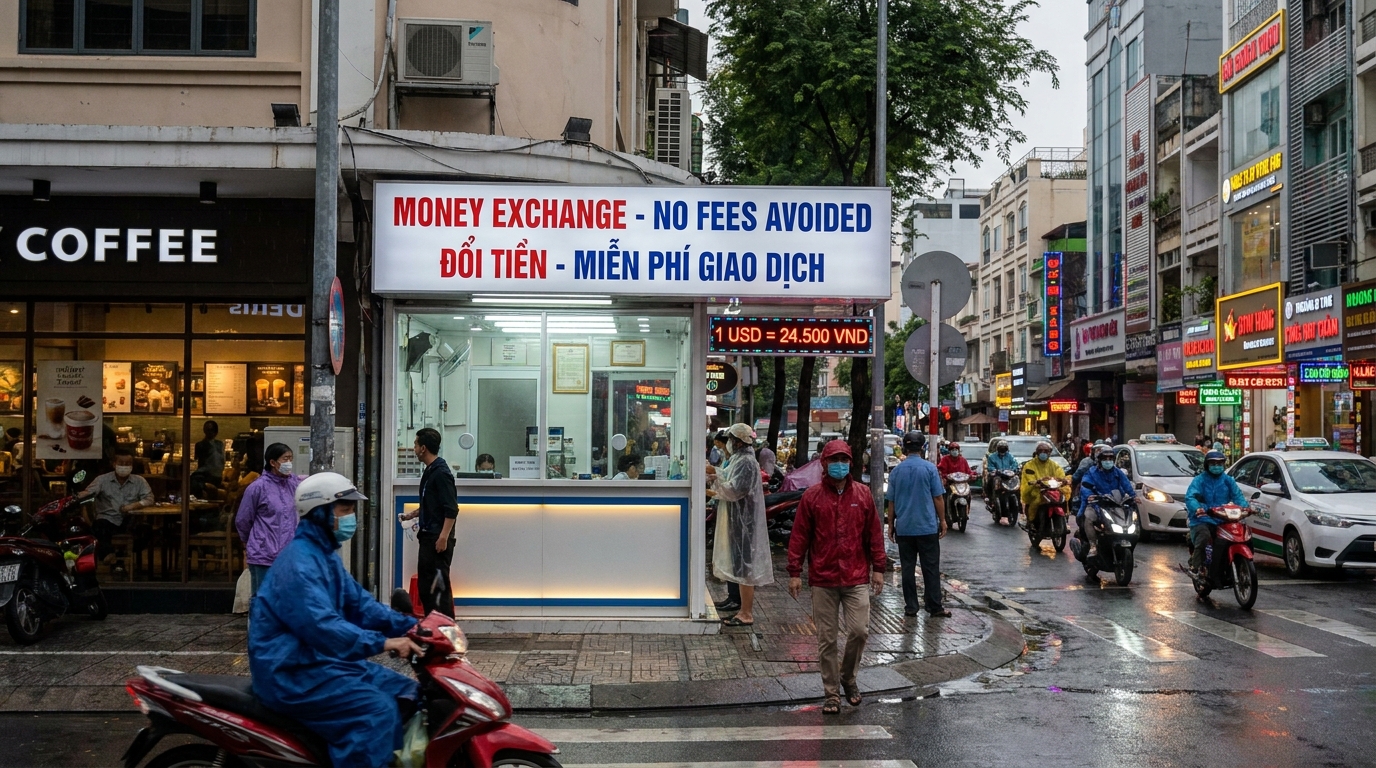
Five-star hotels in HCMC offer vietnam currency exchange at their front desk as a guest convenience, not as a competitive service. Rates are typically 4–8% below street. Small bureau de change shops in the backpacker areas of Phạm Ngũ Lão (Bui Vien strip) may advertise flashy rates on LED boards but add hidden spreads or round down aggressively. The only scenario where hotel exchange makes sense is late at night when you genuinely have no other option.
ATMs in Ho Chi Minh City: Fees, Limits, and Tricks
According to a 2024 survey by the State Bank of Vietnam’s Payment Department, over 68% of foreign visitors to HCMC used ATM withdrawals as their primary cash source — up from 54% in 2022, reflecting growing card penetration. Knowing which ATMs to use matters:
- Vietcombank: 50,000 VND fee per transaction, up to 5M VND per pull, widely available in D1.
- Techcombank: 55,000 VND fee, modern machines with English menus, reliable uptime.
- BIDV: 60,000 VND fee, higher per-transaction limit (7M VND) — good for large withdrawals.
- Citibank / HSBC: No fee for their own cardholders; limited locations in HCMC.
- Avoid: standalone “Euronet” or third-party machines found in tourist shops — they charge 200,000–250,000 VND per transaction and apply dynamic currency conversion.
Critical setting: whenever an ATM asks “Do you want to be charged in USD (or your home currency)?” — always select VND. Selecting your home currency activates dynamic currency conversion (DCC), which adds 3–5% to the exchange rate charged by the ATM operator.
Mobile Payment and Cards: How Far Can You Go Cashless?
HCMC’s payment landscape has changed significantly since 2022. Major supermarkets (Co.opmart, Vinmart, Lotte), all Circle K and FamilyMart convenience stores, most sit-down restaurants, and ride-hailing apps (Grab, Be) now accept Visa/Mastercard or QR payments. However, wet markets, street food stalls, independent pharmacies, and many local cafes remain cash-only. Even in well-connected areas like Bến Thành or Thảo Điền, having 200,000–500,000 VND in your pocket at all times prevents awkward situations. Expats who try to go entirely cashless in HCMC regularly run into friction.
Sending Money to Vietnam: Remittances and Wire Transfers
If you need to move larger amounts into Vietnam — whether for rent, business, or supporting family — the vietnam currency exchange equation changes. Bank wire transfers via SWIFT are slow (2–4 business days) and carry fees of USD 20–40 at both sending and receiving banks. Better options for 2026:
- Wise (formerly TransferWise): Mid-market rate, transparent fee typically 0.4–0.8% of transfer amount, arrives in 1–2 business days to a Vietnamese bank account.
- Western Union / MoneyGram: Cash pickup available across HCMC but the exchange spread is 2–4%; only worth it for recipients without bank accounts.
- Cryptocurrency OTC desks: Technically a grey area under SBV regulations; not recommended for newcomers.
Note: Vietnam has capital controls. There are limits on how much VND you can reconvert to foreign currency when leaving. Keep exchange receipts if you plan to convert VND back at departure.
Common Scams and Mistakes in Vietnam Currency Exchange
HCMC is generally safe for cash transactions at licensed venues, but a few recurring traps are worth knowing:
- Short-changing on large notes: Always count your dong in front of the teller before walking away. Counting errors on 500,000-dong notes are suspiciously common at certain tourist-area shops.
- Fake 500,000 notes: Counterfeit polymer notes do circulate. Under UV light, genuine notes show a security strip. Most gold shops use UV checkers automatically; request this if you receive a stack of 500K notes.
- Rate bait-and-switch: A board advertises 25,400 but the teller keys in 25,100. Confirm the rate verbally and watch the calculator screen before handing over cash.
- Unlicensed street exchangers: Men approaching you near backpacker areas offering “best rate” in hushed tones. Rates are never better than gold shops and fraud risk is high.
- DCC at POS terminals: Restaurants and shops sometimes pre-select your home currency on the card terminal. Always check the total before signing — it should show VND.
How Much Cash Should You Carry in HCMC?
A practical daily budget in VND terms for a comfortable lifestyle in District 1:
- Street breakfast + coffee: 50,000–80,000 VND
- Grab bike across D1: 20,000–40,000 VND
- Lunch at a local restaurant: 80,000–150,000 VND
- Evening beer at a bar: 40,000–80,000 VND per drink
For a typical day out, carrying 500,000–1,000,000 VND (roughly USD 20–40) is sufficient and avoids the need for multiple ATM trips. For a weekend trip to Phú Quốc or Đà Lạt, withdraw before you leave — ATM availability and rates outside HCMC vary significantly.
Tips for Long-Term Expats Managing VND
If you’re living in HCMC rather than just passing through, your vietnam currency exchange strategy should evolve beyond tourist habits. Opening a VND account at Techcombank or VPBank as a foreigner requires your passport and a local address (your lease agreement works). Once you have a local account, you can receive salary or rental income in VND, pay bills via banking apps, and withdraw with no foreign transaction fees. According to HSBC’s 2025 Expat Explorer Report, Vietnam ranked among the top 10 destinations globally for expat financial satisfaction, with low cost of living and improving digital banking infrastructure cited as key factors. Setting up a multi-currency account with Wise linked to your local VND account gives you maximum flexibility for managing income streams in multiple currencies.
You May Also Find Useful
Frequently Asked Questions
Where is the best place for Vietnam currency exchange in Ho Chi Minh City?
Licensed gold shops (tiệm vàng) on Nguyễn Công Trứ Street in District 1 consistently offer the best rates for USD/VND exchange — typically within 0.1–0.3% of the interbank rate. For card-based access, Vietcombank and Techcombank ATMs offer the lowest fees among local banks. Always avoid airport counters for large amounts.
Should I exchange money before travelling to Vietnam?
No. Exchange rates for VND offered outside Vietnam are significantly worse than what you’ll get in HCMC. Bring USD, EUR, or GBP in clean, unmarked bills and exchange on arrival — or simply use your debit/Wise card at a Vietcombank ATM in the arrivals hall for a fair rate with no pre-trip fuss.
Is it better to use USD or VND in Vietnam?
Always use VND for retail transactions. Paying in USD is technically prohibited for most retail purchases under Vietnamese law, and vendors who do accept USD will apply an unfavourable exchange rate. The only common exception is some landlords quoting rent in USD — but even then, payment is typically made in VND at an agreed rate.
What is the current USD to VND exchange rate?
As of mid-2026, the commercial rate at reputable exchange points is approximately 25,300–25,500 VND per USD. Rates fluctuate daily within the State Bank of Vietnam’s permitted band. Check Vietcombank’s website (vietcombank.com.vn) for the current published buying and selling rates before exchanging large amounts.
Can I use my credit card everywhere in Ho Chi Minh City?
Visa and Mastercard are widely accepted at supermarkets, malls, sit-down restaurants, and hotels. However, street food vendors, wet markets, local cafes, and many small shops remain cash-only. Always carry a reasonable amount of VND cash regardless of how reliant you are on cards at home.
Official Resources
For the most up-to-date information on vietnam currency exchange, visit the State Bank of Vietnam.