
A Vietnam emergency medical guide helps expats plan what to do before a health problem, accident, or urgent hospital visit happens.
When a vietnam emergency medical situation strikes, your first 60 minutes determine everything — knowing which number to call, which hospital accepts international patients, and whether your insurance covers evacuation can be the difference between a smooth recovery and a financial and logistical nightmare. Ho Chi Minh City has improved its emergency infrastructure dramatically, but the system still requires expats and travelers to navigate it proactively.
Key Takeaways
- Dial 115 for Vietnam’s national ambulance service, but response times in District 1 average 12–18 minutes — private hospital ambulances are often faster.
- FV Hospital and Columbia Asia are the two leading international-standard facilities in Ho Chi Minh City, both within 10 minutes of central District 1.
- Travel insurance with a minimum USD 50,000 medical evacuation clause is essential; Vietnam’s 2024 Ministry of Health data shows medical evacuation costs averaging USD 28,000–65,000 per case.
- Keep your passport, insurance card, and a Vietnamese-language emergency card on your person at all times — language barriers remain the single biggest delay factor at public hospitals.
- Our emergency card, included in every apartment’s welcome folder, lists vetted contacts, hospital addresses in Vietnamese, and the exact phrases you need in a crisis.
Vietnam Emergency Medical Guide: Vietnam Emergency Medical Numbers You Must Save Today
Before anything else, save these numbers in your phone under a contact labeled “Vietnam Emergency.” The national ambulance line is 115. Police is 113, fire is 114. For English-speaking assistance, the international hospitals operate 24-hour hotlines: FV Hospital at (028) 54 11 33 33, and Columbia Asia Saigon at (028) 39 23 00 11. In a vietnam emergency medical situation, calling the private hospital directly and requesting their ambulance almost always delivers faster, better-equipped response than the public 115 service — particularly for cardiac events and trauma.

Save the number of your country’s embassy as well. The US Embassy Duty Officer line is +84 28 3520 4200. The British Consulate emergency number is +84 90 401 0713. These contacts can assist with hospital liaison, translator access, and family notification.
How Vietnam’s Emergency Medical System Works
Vietnam operates a three-tier hospital classification system: district hospitals handle basic care, provincial hospitals manage moderate cases, and national or international-standard hospitals provide advanced diagnostics and surgery. For expats facing any serious vietnam emergency medical event, bypassing the first two tiers and heading directly to a licensed international facility saves critical time and avoids language and equipment gaps.
The national emergency medical network, administered under Circular 14/2023/TT-BYT, mandates that all public hospitals provide stabilization regardless of insurance status or nationality. You cannot legally be refused emergency treatment. However, full admission and elective procedures require either cash deposit or a confirmed insurance guarantee letter — hospitals will request this within two to four hours of admission.
Top International Hospitals for Vietnam Emergency Medical Care in Ho Chi Minh City
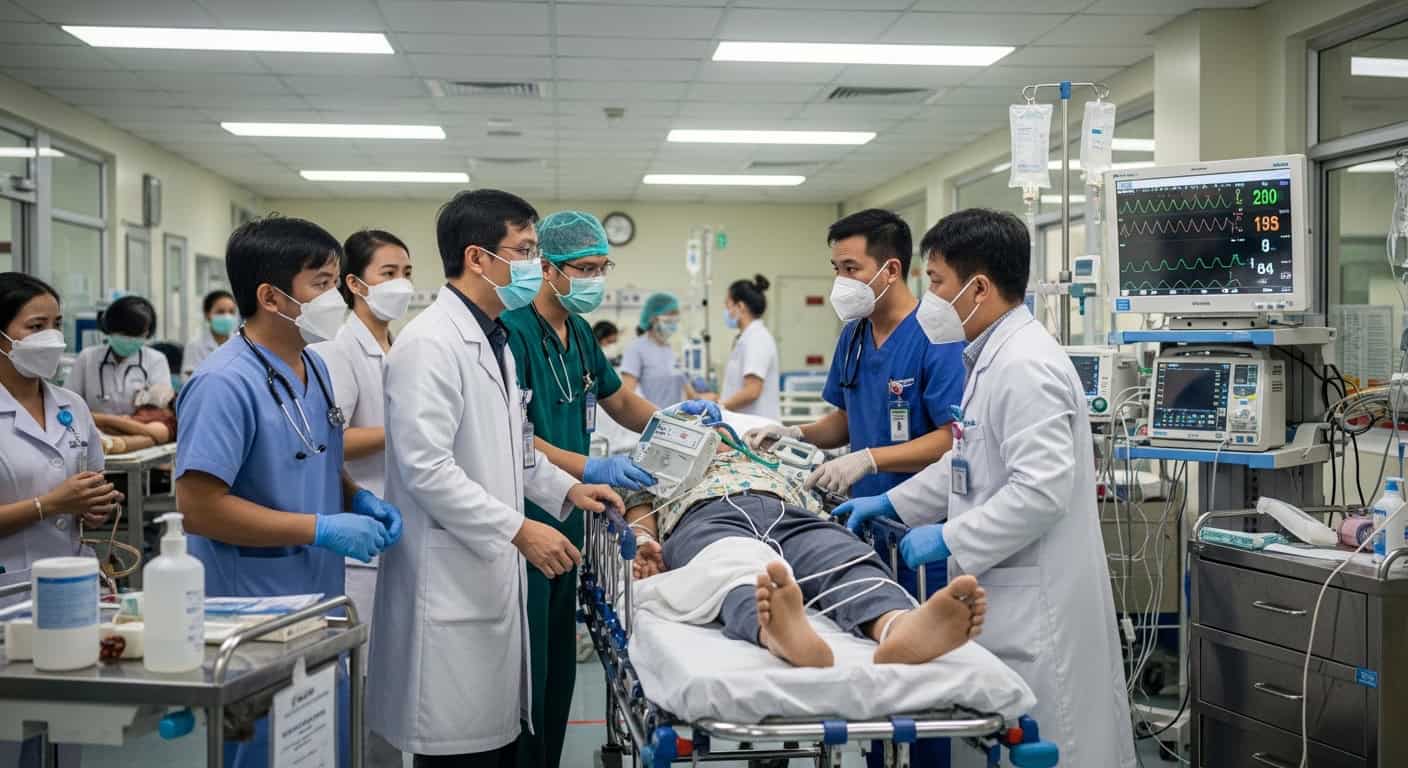
For any serious vietnam emergency medical situation in Saigon, these facilities offer 24/7 emergency departments staffed by internationally trained physicians with English-language capability.

FV Hospital (Français-Vietnamien) — 6 Nguyen Luong Bang, District 7. Accredited by Joint Commission International (JCI), the global gold standard for hospital quality. Full trauma bay, cardiac catheterization lab, MRI and CT scanning around the clock, and adult and pediatric ICU. FV Hospital is within 10 minutes of a well-run serviced building.
Columbia Asia Saigon — 8 Alexandre de Rhodes, District 1. Strategically located in the heart of the city, Columbia Asia is also within 10 minutes of a well-run serviced building, making it the fastest option for residents. General surgery, orthopedics, cardiology, and a dedicated international patient center that handles insurance billing directly.
Hanh Phuc International Hospital — Specializes in gynecology and obstetric emergencies — essential knowledge for female expats and pregnant travelers.
Vinmec Central Park — Binh Thanh District. JCI-accredited, strong oncology and neurology departments. Excellent for specialist referrals.
Our emergency card in every apartment’s welcome folder lists all four hospitals in both English and Vietnamese, with GPS coordinates for your taxi or ride-share driver.
What to Do in the First 10 Minutes of a Medical Emergency
A structured response to any vietnam emergency medical event prevents panic from compounding the crisis.
- Assess and call: Determine if the patient is conscious and breathing. Call 115 or the nearest international hospital hotline simultaneously.
- Do not move trauma patients: Suspected spinal or head injuries require stillness until paramedics arrive.
- Retrieve your documents: Passport, insurance card, and the emergency card from your welcome folder. Photograph them with your phone as backup.
- Communicate clearly: If calling 115, state the address in Vietnamese if possible — your emergency card has your building’s address pre-printed in Vietnamese script.
- Notify your insurer: Most travel and expatriate health insurance policies require notification within 24–48 hours of an emergency admission.
Common Medical Emergencies in Vietnam and How to Handle Them
Certain vietnam emergency medical scenarios occur with disproportionate frequency among foreign residents and visitors.
Motorbike accidents: Vietnam recorded 11,400 traffic fatalities in 2024 according to the National Traffic Safety Committee, with tens of thousands of injuries. If involved in or witnessing a motorbike accident, call 115 immediately, do not move the patient unless they are in imminent danger from traffic, and document the scene with photos for insurance purposes.
Heat stroke and dehydration: Saigon’s wet-season temperatures exceed 38°C with high humidity. Confusion, hot dry skin, and loss of consciousness indicate heat stroke — a life-threatening emergency. Move the patient to shade, apply cool water to the skin, and seek vietnam emergency medical care immediately.
Food poisoning and GI emergencies: Mild cases resolve with oral rehydration, but signs of sepsis — fever above 38.5°C combined with confusion, rapid heart rate, or inability to keep any fluids down — require emergency evaluation. Columbia Asia and FV both have rapid IV hydration protocols for expat patients.
Cardiac events: Vietnam’s cardiac emergency infrastructure improved significantly with the 2023 rollout of 42 AED stations across District 1 public spaces. If you witness a collapse and the person is unresponsive with no pulse, begin CPR (30 compressions to 2 breaths) and send someone to retrieve the nearest AED while you continue.
Allergic reactions and anaphylaxis: Tropical fruits, shellfish, and bee stings trigger anaphylaxis in predisposed individuals. If you carry an epinephrine auto-injector (EpiPen), use it immediately and still proceed to emergency care — adrenaline buys time but does not resolve the underlying reaction.
Travel Insurance: What Your Policy Must Cover for Vietnam
Inadequate insurance is the most preventable vietnam emergency medical catastrophe. A standard tourist policy covering USD 10,000 is dangerously insufficient. The benchmarks for Vietnam, based on 2025 International SOS and Allianz claims data, are:
- Inpatient medical: Minimum USD 100,000 (USD 200,000 recommended for long-stay expats).
- Medical evacuation: Minimum USD 50,000. Air evacuation from Vietnam to Singapore or Bangkok averages USD 28,000–65,000 depending on condition severity and aircraft type.
- Repatriation of remains: Costs range from USD 8,000 to USD 20,000 — often overlooked.
- 24-hour assistance hotline: Your insurer must have a dedicated line available around the clock, not a general call center.
Confirm that your policy covers motorbike riding if you plan to ride — many standard policies explicitly exclude this. Also confirm dengue fever is listed as a covered illness; some budget policies exclude it as a “tropical disease.”
Navigating Language Barriers During a Vietnam Emergency Medical Event
Language is the most underestimated risk in a vietnam emergency medical scenario at public facilities. Even at international hospitals, nuanced symptom descriptions and medical history require clear communication. Practical strategies:
Use our emergency card. The card in your welcome folder includes pre-written Vietnamese phrases covering your symptoms, allergies, blood type, and current medications. Show it to any healthcare provider.
Google Translate offline pack: Download the Vietnamese language pack before you need it. The camera translation function reads Vietnamese medical signage in real time.
International hospital advantage: FV and Columbia Asia maintain English-speaking reception 24 hours. If you are stable enough to choose, routing to these facilities eliminates the language barrier entirely.
Embassy liaisons: Many embassies maintain lists of bilingual medical interpreters who can be deployed to public hospitals — another contact included on our emergency card.
Medical Evacuation: When to Consider Leaving Vietnam
Some vietnam emergency medical conditions exceed local capability even at international hospitals. Neurosurgical trauma, complex pediatric cardiac surgery, and some oncological emergencies may require evacuation to Bangkok’s Bumrungrad International or Singapore General Hospital.
Your insurer’s 24-hour assistance line makes the evacuation decision jointly with the treating physician. Never self-arrange evacuation — doing so almost always voids reimbursement. The sequence is: stabilize at local international hospital then contact insurer, insurer coordinates with treating team, and evacuation is authorized or denied with medical justification.
Commercial medical escorts on scheduled flights are used for stable patients who do not require in-flight intensive care — significantly cheaper at USD 3,000–8,000 versus a full air ambulance at USD 28,000–65,000.
Pharmacies and Over-the-Counter Medications in Vietnam
Vietnam has over 57,000 licensed pharmacies as of the 2024 Ministry of Health census, with clusters operating 24 hours in District 1 near Ben Thanh Market and along Nguyen Thi Minh Khai Street. Most common antibiotics, antiparasitics, and analgesics are available over the counter without prescription.
For genuine emergencies, do not rely on pharmacy self-treatment. Pharmacists are not trained for vietnam emergency medical triage and cannot administer IV medications, run diagnostics, or monitor vital signs. Use pharmacies only for confirmed minor issues: mild diarrhea, minor wound dressing, cold symptom management, or to fill a prescription from a licensed physician.
Pre-Trip Medical Preparation: The Essential Checklist
The best vietnam emergency medical response begins before you land in the country.
- Carry a laminated medical summary card in English and Vietnamese listing blood type, allergies, current medications (generic names), and chronic conditions.
- Bring a 30-day supply of prescription medications plus a written prescription for customs if carrying controlled substances.
- Confirm your vaccinations: Hepatitis A, Hepatitis B, Typhoid, and Japanese Encephalitis are recommended by the CDC for Vietnam travel.
- Register with your embassy’s traveler registration program (STEP for Americans, LOCATE for Australians) so they can find you in a crisis.
- Review our welcome folder on arrival — the emergency card is there, and the building manager’s WhatsApp number is available 24 hours a day.
Why Your District 1 Location Is a Medical Safety Advantage
Location matters enormously in a vietnam emergency medical event. District 1 sits at the center of Ho Chi Minh City’s international medical infrastructure. FV Hospital and Columbia Asia are both within 10 minutes of a well-run serviced building — a geographic advantage that is genuinely rare in a city of ten million where cross-district travel can take 40 minutes in peak traffic.
Our emergency card is in every apartment’s welcome folder and provides the complete resource set: hospital addresses in Vietnamese, direct hospital hotlines, insurance liaison contacts, and the building address formatted for emergency services. Residents who have used the card in real emergencies consistently report that it reduced time-to-treatment by eliminating the administrative fumbling that characterizes most expat medical crises.
You May Also Find Useful
- Vietnam Health Insurance for Expats: The Complete 2026 Comparison Guide
- Vietnam Health Insurance for Travellers: What You Need and Where to Buy
- International Health Insurance for Expats in Vietnam: Best Plans and Costs 2026
- Medical Costs in Vietnam for Expats 2025: What Things Actually Cost Without and With Insurance
Frequently Asked Questions
What is the emergency number in Vietnam?
The national ambulance number in Vietnam is 115. Police is 113 and fire is 114. For faster vietnam emergency medical response in Ho Chi Minh City, calling an international hospital directly — FV Hospital at (028) 54 11 33 33 or Columbia Asia at (028) 39 23 00 11 — often delivers quicker, better-equipped assistance than the public ambulance service.
Do Vietnamese hospitals accept foreign health insurance?
International hospitals including FV Hospital and Columbia Asia work directly with major international insurers including Cigna, Aetna, Allianz, and AXA. They can issue a guarantee of payment letter so you are not required to pay upfront. Public hospitals generally require cash or a local Vietnamese insurance card and do not process international claims directly.
Is medical care in Vietnam good enough for serious emergencies?
For stable serious conditions, Ho Chi Minh City’s JCI-accredited international hospitals provide care equivalent to regional hubs like Bangkok and Singapore. Complex neurosurgery, advanced pediatric cardiac surgery, and some oncology cases may still require medical evacuation. Your insurer and treating physician make this decision jointly.
How much does a medical emergency cost in Vietnam without insurance?
A three-day inpatient stay at FV Hospital for a moderate condition typically costs USD 2,500–6,000. A trauma admission with surgery can reach USD 15,000–40,000. Air evacuation adds USD 28,000–65,000. Traveling without adequate vietnam emergency medical coverage is a serious financial risk.
What vaccinations do I need before traveling to Vietnam?
The CDC recommends Hepatitis A, Hepatitis B, Typhoid, and Japanese Encephalitis for most Vietnam travelers. Rabies pre-exposure vaccination is recommended for those spending extended time outdoors or working with animals. Consult a travel medicine specialist before departure for personalized advice.
Official Resources
For the most up-to-date information on vietnam emergency medical, visit the World Health Organization Vietnam.