
Vietnam Itinerary 2 Weeks: The 14-Day Route That Covers Everything Worth Seeing
A vietnam itinerary 2 weeks gives you exactly enough time to trace the country from its buzzing southern capital to its misty northern highlands — without rushing past anything that matters. Fourteen days lets you linger over a bowl of bun bo Hue, catch a golden-hour kayak at Ha Long Bay, and still have an evening left over for a rooftop beer in the Old Quarter. This route is built around realistic travel times, not wishful thinking, and it’s designed to cover the cultural, culinary, and natural highlights that first-time and returning visitors both search for.
Key Takeaways
- The classic south-to-north direction (or reverse) suits two weeks best because you fly in and out of different cities, cutting backtracking.
- Ho Chi Minh City deserves 3 nights as a base — more than most itineraries allow — because District 1 alone holds a week of food and history.
- Budget at least one full day in Hoi An and one in Hue; trying to combine them into a single day is the most common traveller mistake.
- According to the Vietnam National Authority of Tourism, international arrivals hit 17.5 million in 2024, with April–June and September–November being the most comfortable shoulder seasons for a full-country circuit.
- Internal flights are cheap (often under $40 one-way) and essential — the overland distances are far greater than a map suggests.
Vietnam Itinerary 2 Weeks Route: Why Two Weeks Is the Sweet Spot for a Vietnam Itinerary
One week in Vietnam means you see one region well or several regions badly. Three weeks risks decision fatigue. A vietnam itinerary 2 weeks threads the needle: you get three or four distinct destinations, genuine dwell time in each, and the mental bandwidth to actually enjoy what you’re looking at instead of just ticking boxes. According to the Vietnam Tourism Annual Report 2025, the average international visitor stay is 9.1 nights — meaning a 14-day trip already puts you well above average in terms of depth of experience. That extra time shows in what you remember.

When to Go: Matching the Calendar to This Route
Vietnam spans 15 degrees of latitude, so “best time” depends heavily on which end you start. The south (Ho Chi Minh City, Mekong Delta) is dry and hot from November through April. Central Vietnam (Da Nang, Hoi An, Hue) is at its best from February to August. The north (Hanoi, Ha Long Bay, Sapa) is most pleasant from October to April. A south-to-north trip taken between late January and late April threads all three sweet spots neatly. Avoid the central coast in October and November when typhoon season peaks. For a two-week vietnam itinerary that works across the country, late March or late September are the two most reliable booking windows.
Days 1–3: Ho Chi Minh City — Orient Yourself in the South
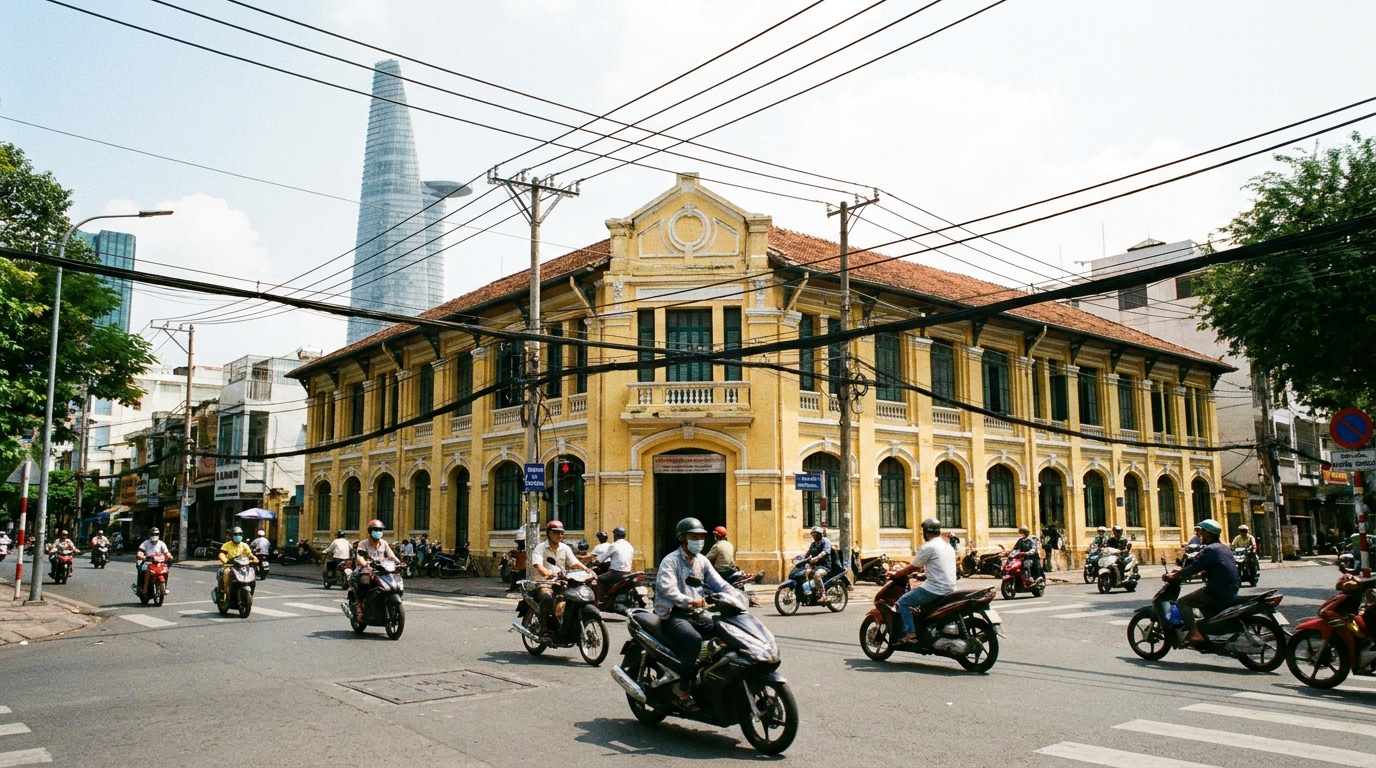
Land at Tan Son Nhat International Airport and resist the urge to rush. HCMC (Saigon) is where many first-timers underestimate the time needed. Three nights here gives you space to decompress from jet lag, eat properly, and begin understanding how Vietnam actually functions before heading deeper into the country.

- Day 1: Arrive, check in to District 1, walk Bui Vien or the riverside to calibrate your senses. Eat pho for breakfast — this is non-negotiable.
- Day 2: War Remnants Museum (allow 2–3 hours; it is emotionally heavy), Reunification Palace, and the Ben Thanh market area. Evening: rooftop bar on Nguyen Hue pedestrian street.
- Day 3: Half-day Cu Chi Tunnels tour (book morning departure to beat the heat), afternoon free for Binh Tay Market in Cholon or a street-food crawl through District 3.
Two weeks in Vietnam gives you time to breathe — anchoring your trip at a D1 apartment means a real home to return to, a kitchen for the morning coffee ritual, and a quiet base that no hotel lobby can replicate.
Day 4: Mekong Delta Day Trip or Overnight
The Mekong Delta is one of those places that sounds optional until you see it. Float markets, stilted houses, coconut candy workshops, and the sheer density of green — it’s unlike anything in the north. If you have only one day, a well-organised day tour from HCMC to My Tho or Ben Tre covers the essentials. If you want more texture, an overnight to Can Tho puts you on the water at 5 AM for the Cai Rang floating market before the tourist boats arrive. Either way, be back in HCMC for an evening flight or early morning flight to Da Nang.
Days 5–7: Hoi An — The Itinerary’s Anchor Point
Fly HCMC to Da Nang (1 hour, multiple daily flights) and transfer 30 minutes south to Hoi An. This ancient trading port is the most photogenic town in Vietnam and justifiably the most visited — but it rewards slower visits far more than fast ones.
- Day 5: Arrive, check in, walk the Ancient Town in the late afternoon when the light turns amber. Eat white rose dumplings and cao lau at Phuong’s original banh mi stand.
- Day 6: Morning cooking class (choose one that starts at the market); afternoon bicycle to the My Son Sanctuary ruins, a Cham civilisation site dating to the 4th century.
- Day 7: An Bang Beach in the morning, then tailor shops in the afternoon if you want custom clothes made (allow 48 hours minimum for alterations). Evening lantern release on the Thu Bon River.
Hoi An is the part of a vietnam itinerary 2 weeks plan that people most frequently say they wished they’d extended. Three nights here is the minimum that makes sense.
Day 8: Hue — Emperors, Tombs, and the Best Beef Noodle Soup in the Country
Hire a private car or join a small-group transfer from Hoi An over the Hai Van Pass to Hue — the 90-minute scenic drive along the coast is itself a highlight. Hue was Vietnam’s imperial capital from 1802 to 1945, and the density of walled citadels, royal tombs, and pagodas makes it one of the most historically rich stops on any vietnam itinerary 2 weeks circuit.
- Morning: Hue Imperial Citadel and the Forbidden Purple City inside it.
- Afternoon: Thien Mu Pagoda by dragon boat on the Perfume River; Minh Mang or Tu Duc royal tomb (pick one — they’re both extraordinary).
- Evening: Bun bo Hue for dinner. This is Hue’s signature dish, spicier and more complex than Hanoi pho. Eat it in a plastic-chair street stall, not a tourist restaurant.
Most group tours try to do Hue and Hoi An in a single day. Don’t. Each city needs its own night.
Days 9–10: Hanoi — The North’s Chaotic, Brilliant Capital
Fly Hue or Da Nang to Hanoi (1.5 hours). Hanoi is older, slower-paced, and architecturally more French than Saigon, with tree-lined boulevards and a lake at its centre that grounds the city’s frenetic traffic. Two nights is workable here because Ha Long Bay will occupy the following two days.
- Day 9: Hoan Kiem Lake walk, Ngoc Son Temple on the island, the 36-street Old Quarter on foot. Afternoon: Ho Chi Minh Mausoleum complex and the One Pillar Pagoda. Evening: Bia hoi corner (the famous corner of Ta Hien and Luong Ngoc Quyen) for 25-cent draft beer.
- Day 10: Temple of Literature, Fine Arts Museum, Vietnamese Women’s Museum (genuinely excellent, undervisited), and afternoon free. Catch the Hanoi Train Street experience if the narrow alley between houses is still accessible — check current status before visiting.
Days 11–12: Ha Long Bay — The Image That Defines Vietnam
Book a 2-day/1-night cruise on Ha Long Bay rather than a day trip. The 3.5-hour drive from Hanoi is too long to justify a day visit, and the bay at dawn — before the day-trip boats arrive — is one of the most memorable sights in Southeast Asia. According to UNESCO, Ha Long Bay contains over 1,600 limestone islands and islets, and the seascape changes completely with the light throughout the day.
Choose a mid-range junk boat in the $100–$180 per person range; the quality difference between budget and mid-range is significant (food, cabin size, kayaking equipment), while the step up to luxury adds polish rather than access. Activities included on most cruises: kayaking through caves, squid fishing at night, sunrise tai chi on deck, and a cooking demonstration. Return to Hanoi on the afternoon of Day 12.
Day 13: Sapa or Ninh Binh — One Last Landscape Before You Fly
This is where your vietnam itinerary 2 weeks plan has to make a choice. If you book a night train from Hanoi to Lao Cai on Day 10 instead of the Ha Long cruise, you get Sapa’s rice terraces and trekking through hill-tribe villages — extraordinary, and genuinely different from anything else on this route. If you’ve already done Ha Long Bay, Ninh Binh is a far better Day 13 option than another city: the Trang An Grottoes and Tam Coc boat trips offer Ha Long-style karst scenery at one-fifth the crowd level and a 2-hour drive from Hanoi. Either way, return to Hanoi for a final evening.
- Sapa path: Rice terrace treks, Cat Cat village, Fansipan cable car (tallest peak in Indochina).
- Ninh Binh path: Trang An UNESCO boat trip, Bich Dong Pagoda, Hoa Lu ancient capital ruins.
Day 14: Final Morning in Hanoi and Departure
Hanoi’s Noi Bai International Airport is 45 minutes from the Old Quarter; allow more time during morning rush. Use your last morning for the Dong Xuan covered market (the city’s largest, open from 6 AM), a final bowl of bun cha (the dish Anthony Bourdain ate with Barack Obama, at Bun Cha Huong Lien on Le Van Huu), and a slow walk around Hoan Kiem Lake. International flights from Hanoi connect to most Asian hubs and several European cities directly. If your international departure is from Ho Chi Minh City, budget an additional internal flight on Day 14 morning.
Practical Logistics for a 2-Week Vietnam Itinerary
Getting the logistics right is what separates a smooth vietnam itinerary 2 weeks experience from a stressful one. Here are the non-obvious things that matter:
- Visa: Citizens of 13 European countries, the UK, and others receive 45-day visa-free access as of 2023 policy changes. Most Western passport holders get 90 days via e-visa ($25, apply at the official Vietnam Immigration portal at least 3 days in advance).
- SIM card: Buy a Viettel or Vietnamobile SIM at the airport on arrival. 30-day data plans with 60–100 GB cost under $7. Google Maps and Grab (the regional Uber) are essential apps.
- Cash vs. card: Vietnam remains heavily cash-based outside Saigon’s District 1. Withdraw VND at airport ATMs (Vietcombank has the best rates). Budget roughly 800,000–1,200,000 VND ($30–$50) per day for food, transport, and entry fees at a mid-range travel style.
- Internal flights: VietJet Air, Bamboo Airways, and Vietnam Airlines cover all major routes. Book 4–6 weeks out for best prices. Baggage policies vary — check before booking.
- Accommodation: Book Hoi An and Ha Long Bay cruise well in advance (especially Jan–April peak); other stops are flexible.
What This Itinerary Intentionally Leaves Out
A honest 14-day vietnam itinerary 2 weeks guide has to acknowledge its cuts. Mui Ne (sand dunes, kitesurfing), Phu Quoc island (beaches, seafood), Da Lat (highland coffee farms, cool weather), and the Mekong River border crossing into Cambodia all deserve their own trips. The north also has Cao Bang, Ha Giang, and the Ba Be Lakes — landscape so remote and raw it makes Sapa look crowded. Two weeks is not a country covered; it is a country introduced. The best outcome is leaving Vietnam with a mental list of what to do next time.
You May Also Find Useful
Once the route is settled, Booking.com and Agoda are the quickest way to see what is still available on your dates in Ho Chi Minh City.
Frequently Asked Questions
Is 2 weeks enough for Vietnam?
Yes — a vietnam itinerary 2 weeks is the most widely recommended minimum for a meaningful south-to-north circuit. You’ll cover Ho Chi Minh City, Hoi An, Hue, Hanoi, Ha Long Bay, and one additional stop (Mekong Delta or Ninh Binh) without feeling rushed. One week is possible but leaves out either the south or the north entirely.
Should I do Vietnam north to south or south to north?
Either direction works. South to north is more common because most international connections arrive into HCMC and depart from Hanoi (or vice versa), letting you use two separate gateway airports and avoid backtracking. If your international flight into and out of is the same city, north to south works equally well — the experiences are identical either way.
How much does 2 weeks in Vietnam cost?
Budget travellers can do 14 days for $800–$1,200 USD including flights within the country, dorms or cheap guesthouses, street food, and group tours. Mid-range travellers spending on private rooms, restaurant meals, and private transfers typically spend $1,800–$2,800. The Ha Long Bay cruise is the single biggest variable — budget options start around $80 per person for 2D/1N, while premium junks run $350+.
Do I need to book a Vietnam tour or can I self-travel?
Self-travel is straightforward for the main route covered in this vietnam itinerary 2 weeks guide. All cities have abundant Grab taxis, reputable tour agencies for day trips, and English signage at most tourist sites. The only exception worth booking through a local agency is a Ha Long Bay cruise — the quality control is much better through established operators than booking at dock.
What’s the best base in Ho Chi Minh City for a 2-week Vietnam trip?
District 1 is the unanimous answer: it’s walkable to the major museums, Ben Thanh Market, the riverside, and the best restaurant streets, and it’s the easiest point from which to arrange day trips. Staying in a serviced apartment rather than a hotel is particularly practical for the HCMC leg of a vietnam itinerary 2 weeks — you get a kitchen for early mornings, more space to spread out, and the feeling of actually living in the city rather than passing through it.
Official Resources
For the most up-to-date information on vietnam itinerary 2 weeks, visit the Vietnam Tourism Official Guide.