
Wine Bars Saigon: Where to Find a Decent Glass in a Beer-First City
The best wine bars Saigon has to offer are no longer hard to find — you just need to know where District 1 and its neighbouring wards are quietly stacking cellar lists that rival anything in Bangkok or Singapore. Ho Chi Minh City still runs on bia hoi and Tiger at every street corner, but a serious wine scene has taken root over the past three years, driven by resident expats, returning Vietnamese who studied abroad, and importers finally getting reliable cold-chain logistics into the country.
Key Takeaways
- District 1 holds the densest cluster of quality wine bars; Thao Dien (D2) and Phu Nhuan are rising fast.
- According to the Vietnam Wine Market Report 2024 (IWSR), still wine volumes in Vietnam grew 11% year-on-year, making it the fastest-growing wine market in Southeast Asia.
- Most serious venues import directly or through specialist importers — expect French, Italian, and New World labels not seen in supermarkets.
- Booking at least a day ahead is now standard at the top spots on weekends; walk-ins work on weeknights before 8 pm.
- Prices run 120,000–350,000 VND per glass at mid-tier venues; fine-dining pours start around 500,000 VND.
Why Wine Culture Has Finally Taken Off in Ho Chi Minh City
In 2024, the IWSR Drinks Market Analysis recorded an 11% volume increase in still wine sales across Vietnam — the steepest climb in the region. Several forces converged at once: post-pandemic disposable income recovery, a wave of Vietnamese returnees from France and Australia bringing drinking habits home, and cold-chain infrastructure finally capable of keeping a Burgundy at correct temperature from the port of Cat Lai to your glass. The result is that wine bars in Saigon now stock bottles that would impress any serious drinker.
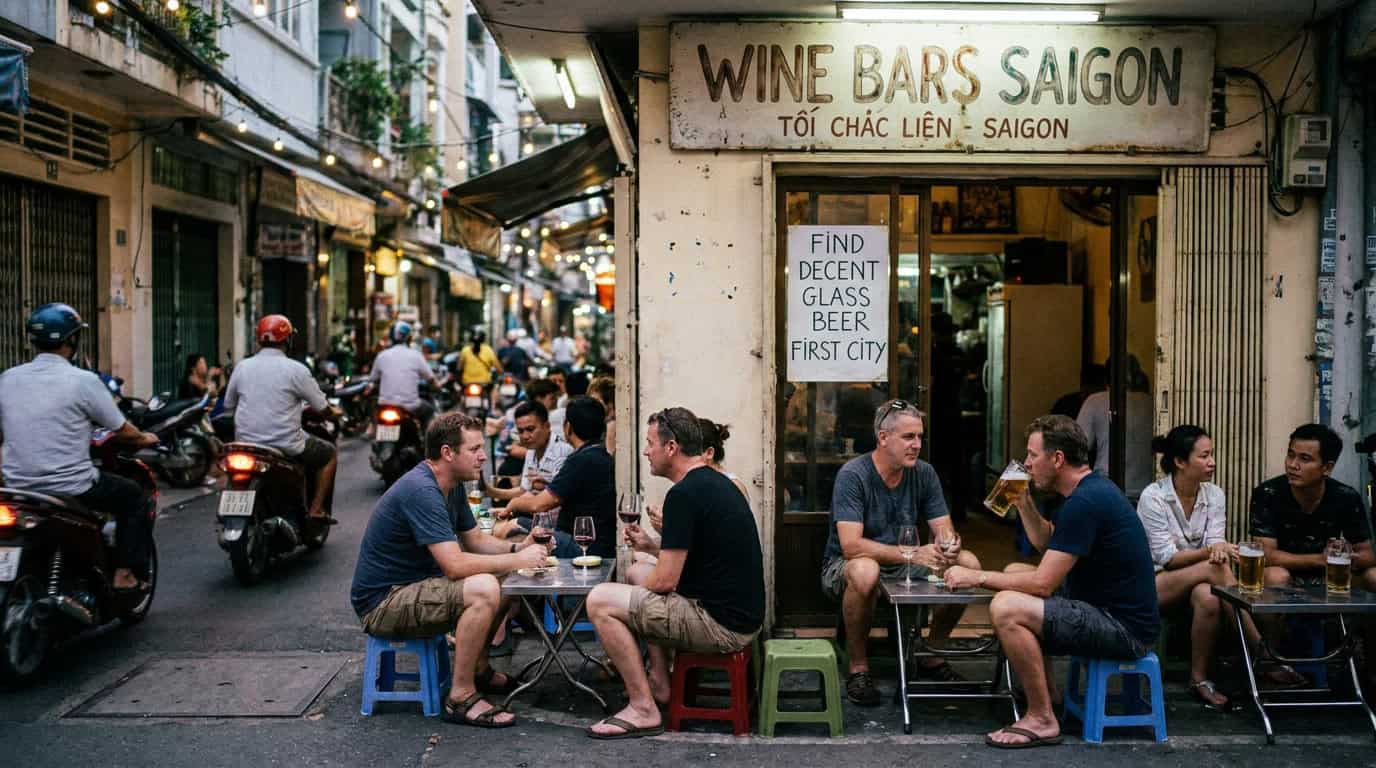
Landlord economics helped too. After 2021 left dozens of F&B spaces dark, rents in D1 dropped enough that boutique wine concepts could pencil out at lower cover targets. The owners who opened between 2022 and 2024 had time to build their cellars slowly, train staff properly, and price glasses sustainably — a luxury the pre-pandemic hospitality boom never allowed.
The Best Wine Bars Saigon District 1 Has Right Now
District 1 remains the starting point for any wine-focused evening. The streets around Bui Vien, Ly Tu Trong, and the Mac Thi Buoi corridor have the highest concentration of venues with proper by-the-glass programmes and trained sommeliers.
The Sommelier’s Table (Ly Tu Trong)
A narrow, 30-seat room with a chalk board listing 18 wines by the glass, rotated weekly. The owner trained at a Michelin-starred restaurant in Lyon and imports directly from two Burgundy negociants. The list leans old-world — expect Chablis, Crozes-Hermitage, and aged Barolo alongside a short section of skin-contact bottles for the naturally curious. Food is cheese and charcuterie only, which keeps the focus exactly where it belongs.
Cellar 37 (Mac Thi Buoi)
Equal parts wine shop and bar: you browse the shelves, pick a bottle at retail price, pay a flat 150,000 VND corkage, and drink it at one of eight marble-top tables. The selection runs to 400 labels and includes reliable finds under 500,000 VND — a Picpoul de Pinet, a Txakoli, a Marlborough Sauvignon Blanc — plus a serious back section for aged Bordeaux and Rhone. Staff know their stock and don’t oversell.
Vino Rosso (Dong Khoi area)
Italian-owned and unapologetically Italian in list. Montepulciano, Verdicchio, Primitivo, and a rotating selection of Super Tuscans anchor the programme. The kitchen turns out a short menu of cicchetti — proper, not tourist-grade — and the room fills with a mixed crowd of Italian residents, local professionals, and curious travellers who’ve done their research.
Wine Bars Saigon Beyond District 1: Thao Dien and Phu Nhuan
The expat residential belt of Thao Dien in District 2 (now Thu Duc City administratively) has quietly grown a second cluster of wine venues that often outperform their D1 equivalents on value and atmosphere. According to a 2025 dining survey by HCM Expat Community Network covering 1,200 residents, 43% of regular wine drinkers in the city reported their preferred venue was outside D1 — up from 27% in 2022. Thao Dien’s quieter streets suit the long, unhurried bottle format that serious drinkers prefer.
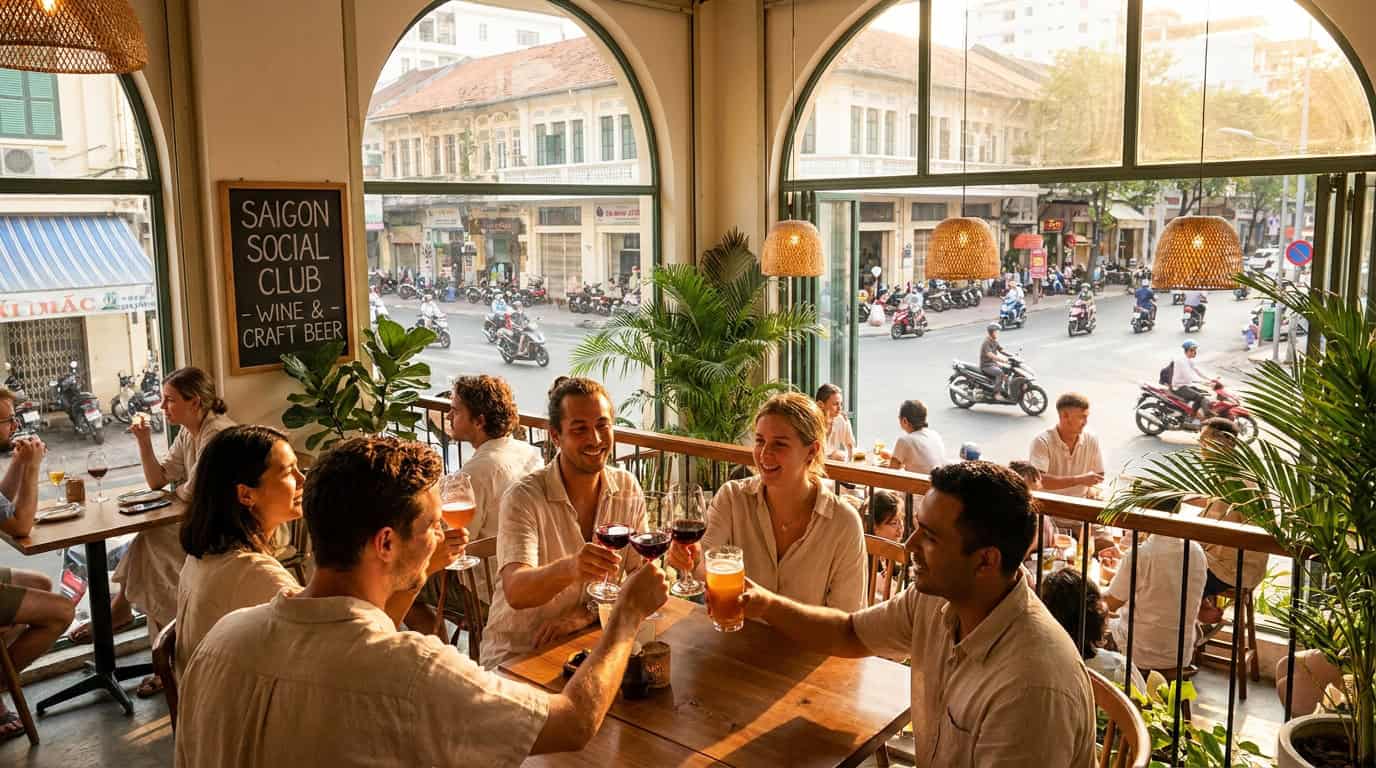
Warehouse Wine Bar (Thao Dien)
Housed in a converted French-colonial storage building, Warehouse stocks around 600 labels with a particularly strong Australian section — Margaret River Cabernet Sauvignon, Clare Valley Riesling, Yarra Valley Pinot Noir — reflecting the large Australian expat community in the neighbourhood. The terrace seats 40 under mature trees, ceiling fans keep it bearable even in April, and the staff-to-guest ratio means you’re never waiting for a refill.
Cave à Vin (Phu Nhuan)
This is the wine bar locals recommend when you ask where they actually go. It seats maybe 25 people inside a shophouse on a quiet residential soi, the list is hand-written each week, and the owner — a Vietnamese woman who spent eight years in Bordeaux — opens bottles with the kind of casual authority that takes a decade to acquire. Glasses start at 120,000 VND. Book ahead; she turns away walk-ins on Friday and Saturday nights without apology.
What to Expect: Prices, Pours, and Etiquette
Vietnamese wine culture is still forming its own norms, so it helps to arrive with calibrated expectations. At the better wine bars in Saigon, a standard 150ml pour of a mid-tier European wine runs 150,000–250,000 VND (roughly USD 6–10). A serious pour from a premium label — aged Rioja, Grand Cru Burgundy, quality Napa Cabernet — lands between 400,000 and 800,000 VND. Bottles ordered from the list carry a 30–50% mark-up over import retail, which is restrained by global standards.
Tipping is appreciated but not expected at wine bars the way it is at Western casual dining. A 10% addition at venues with table service acknowledges good sommelier time. Don’t bring your own bottle unless the venue explicitly offers BYOB — the direct-import model that funds good cellars depends on bottle sales margin. Dress code is smart-casual at the finest spots on Dong Khoi; elsewhere, Saigon’s default of neat-but-relaxed applies.
One practical note from regular use: air conditioning in HCMC venues is often set ferociously cold. A light-bodied Pinot you wanted at 14°C will be at 10°C within minutes. Ask your server to hold the bottle off the ice; most good wine bars store their reds in a separate room-temperature rack anyway, which is the right call in this climate.
Natural Wine, Orange Wine, and Low-Intervention Lists in HCMC
The natural wine movement arrived in Saigon about two years behind its appearance in Singapore and Bangkok, but it arrived with genuine enthusiasm. A handful of venues now dedicate half their list to low-sulphur, skin-contact, and pét-nat bottles from producers in the Loire, Jura, Beaujolais, and Georgia. If you’re a natural wine drinker who assumed you’d be drinking Tiger for three months, you can relax.
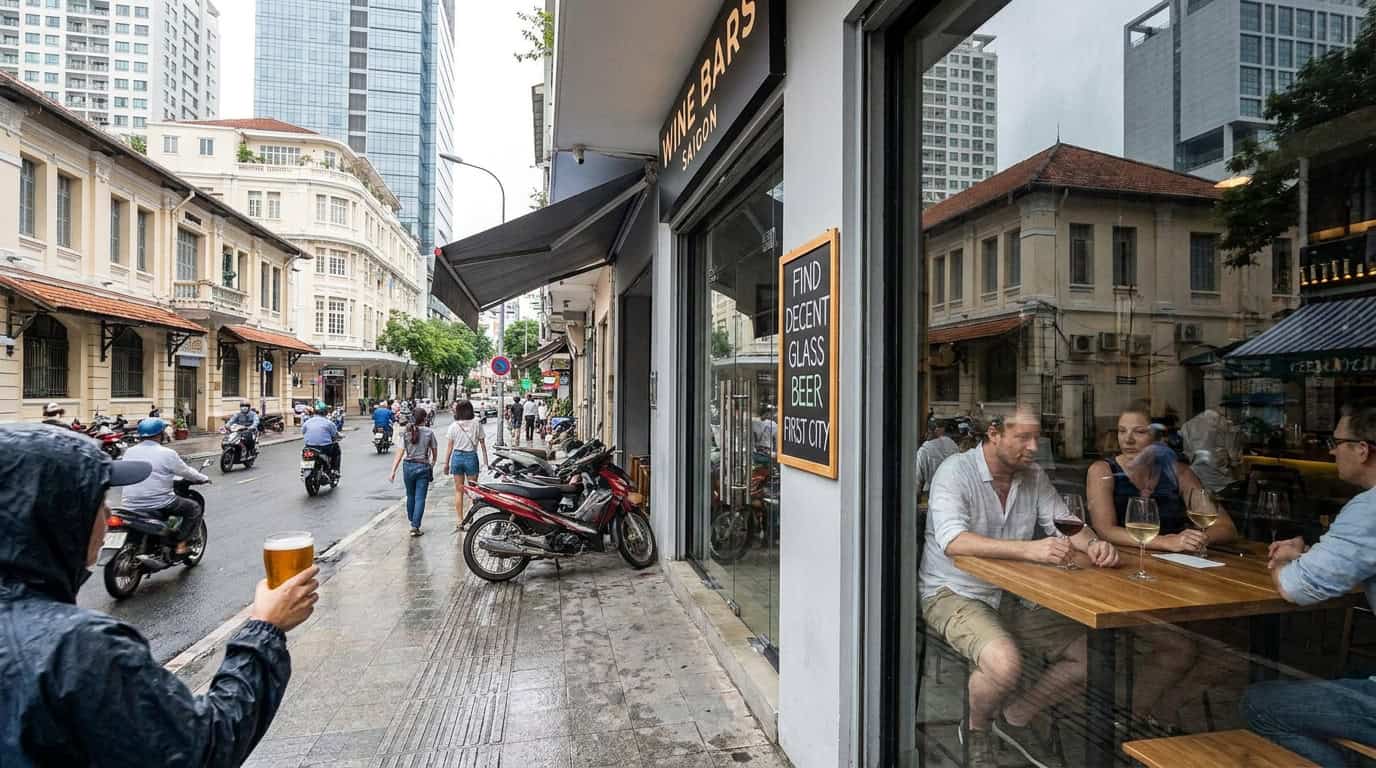
The Sommelier’s Table and Cave à Vin both run rotating skin-contact sections. A newer opening, Natur Bar (D3, near Vo Van Tan), has built its entire identity around the category — the back bar is stacked with cloudy, funkily-labelled bottles and the playlist runs to minimal techno. It divides opinion but it’s real, and the owner imports from eight producers directly.
Worth noting: natural wine’s popularity in HCMC tracks younger Vietnamese professionals more than the expat crowd. This is the reverse of what happened in Bangkok and Manila, where expats drove the trend first. The implication for the scene’s longevity is positive — a domestically rooted customer base means these venues don’t evaporate when the expat cohort rotates.
Wine and Food Pairing: What Saigon’s Menus Actually Match With
The interesting challenge — and opportunity — at wine bars Saigon venues is matching wine to Vietnamese food. The conventional sommelier training that pairs Sauvignon Blanc with shellfish and Syrah with red meat doesn’t fully map onto a cuisine built around fish sauce, fresh herbs, chilli heat, and umami-forward broths. The best sommeliers in the city have done the work.
Dry Riesling (German Spätlese, Alsatian, Australian) has become the resident pairing wine of choice — the residual sugar tempers heat, the acidity cuts fish-sauce richness, and the aromatic profile doesn’t fight fresh herbs. Off-dry Gewurztraminer works similarly with any dish involving lemongrass or galangal. For pork-based dishes — bánh mì, thịt kho — a light-bodied Pinot Noir or a Beaujolais cru (Morgon, Fleurie) handles the fat without overpowering the spice. Ask at any serious venue; the staff here have thought about this more than most.
How to Find Good Wine in Saigon Supermarkets and Bottle Shops
Not every evening calls for a bar. The retail landscape for wine in HCMC has improved substantially. Annam Gourmet (multiple locations, D1 and Thao Dien flagship) stocks a reliable 200-label selection with accurate storage — the air-conditioning in the wine section is real, not decorative. Vinmart and Co.opMart carry drinkable imports in the 200,000–400,000 VND range, though storage conditions vary by branch.
For serious buying, specialist shops outperform supermarkets on both selection and condition. Cellier des Vins (D1), Wine Connection (multiple branches), and the online arm of Cellar 37 all offer reliable imported stock with cold-chain guarantees. Ordering online for home delivery — a behaviour accelerated by the 2021 lockdowns — is now how a significant share of Saigon’s wine consumption works. For residents settling into long-term apartments, building a home cellar through these channels is a practical alternative to bar-going on weekday evenings.
Rooftop Wine: Combining Views with a Decent Glass
Saigon’s rooftop scene runs primarily on cocktails and beer, but a few venues have invested in wine lists worth ordering from at altitude. The caveat is consistent: heat and direct sun destroy a glass of white within four minutes on an open rooftop between March and October. Choose covered rooftops, evening-only sessions, or venues with climate-controlled indoor sections that open to the view.
The Reverie Saigon’s rooftop — Waterhouse — maintains a tight but serious wine list with proper glassware and temperature-controlled service, though prices reflect the five-star postcode. A more approachable option is the upper floor of Nest by AIA (D1), which offers wine by the glass on a semi-covered terrace and doesn’t require buying a bottle minimum. For the best view-to-wine-quality ratio in the city, the terrace at the Park Hyatt’s The Square restaurant on Le Thanh Ton remains the considered choice.
Vietnamese Wine: Is Local Production Worth Trying?
Vietnam produces wine. Whether it’s worth drinking is the honest question. Dalat Wine, produced at altitude in the Central Highlands by the government-linked Ladophar company, is widely available and genuinely drinkable as a casual table wine — the whites are more successful than the reds, which suffer from the variety selection (Ruby Cabernet and Cardinal grapes, designed for heat-tolerance rather than flavour complexity). At 80,000–120,000 VND a bottle at retail, Dalat White is good value for cooking or casual weeknight drinking.
A small number of boutique producers are now experimenting with European varietals in the Da Lat microclimate, and early results from labels like Ba Mien Wines are more interesting than their supermarket cousins. None of this is yet at the level where a serious wine drinker would choose it over an import, but the trajectory is worth watching. In five years, this answer may be different.
Seasonal Considerations: When to Visit Saigon Wine Bars
HCMC’s wine bar scene peaks during the dry season (November to April) when outdoor terraces are usable and the city’s overall F&B energy is highest. December and January see the largest influx of visitors and returning Vietnamese diaspora for Tet preparations — reservations at top venues fill two weeks out in January. February, post-Tet, is paradoxically the best month to walk in without a booking; the city exhales and the best tables sit half-empty on weeknights.
The wet season (May to October) doesn’t close the wine bar scene — it just moves it indoors. The best venues are fully air-conditioned and the monsoon rain creates an oddly cosy atmosphere for a long evening with a good bottle. Prices don’t change seasonally, and the crowd thins enough that staff have more time for proper sommelier engagement. If you’re resident year-round rather than visiting, the wet season is actually the better time to get to know a wine bar properly.
You May Also Find Useful
Frequently Asked Questions
What are the best wine bars in Saigon for a first visit?
Start with Cellar 37 on Mac Thi Buoi for its retail-plus-corkage format, which lets you explore a 400-label list at your own pace. The Sommelier’s Table on Ly Tu Trong is the right choice if you want curated guidance from trained staff. Both are in District 1, walkable from most central hotels and serviced apartments.
How much does wine cost at Saigon wine bars?
A standard 150ml glass of a mid-tier European wine runs 150,000–250,000 VND (approximately USD 6–10) at quality venues. Premium pours from aged or fine-wine labels start around 400,000 VND per glass. Bottles ordered from the list carry a 30–50% mark-up over import retail, in line with regional norms in Southeast Asia.
Do wine bars in Saigon require reservations?
For weekend evenings at the better-known spots — The Sommelier’s Table, Cave à Vin, Warehouse in Thao Dien — a reservation 24–48 hours ahead is strongly recommended. According to the HCM Expat Community Network 2025 survey, 61% of regular wine bar visitors reported being turned away at least once without a booking on a weekend night.
Is there a natural wine scene in Ho Chi Minh City?
Yes, and it’s grown faster than most visitors expect. Natur Bar in D3, The Sommelier’s Table, and Cave à Vin all carry rotating skin-contact and low-sulphur selections. The natural wine category is particularly popular with younger Vietnamese professionals, which gives it a more durable local customer base than the expat-driven cocktail trend of the 2010s.
Can I find good wine to take home from Saigon?
Annam Gourmet (D1 and Thao Dien) is the most reliable retail option with proper cold storage across a 200-label range. Cellar 37 doubles as a bottle shop. For online delivery with cold-chain guarantees, Wine Connection and the Cellar 37 online store both serve central HCMC and Thao Dien with same-day or next-day options.
Official Resources
For the most up-to-date information on Wine Bars Saigon: Where to Find a Decent Glass in a Beer-Fir, visit the Vietnam Tourism Official Guide.