
Saigon Transport Guide: Getting Around Ho Chi Minh City
Getting around Ho Chi Minh City is straightforward once you understand your Saigon transport options. 
Ho Chi Minh City has approximately 8.5 million registered motorbikes and 700,000 cars for a population of nearly 13 million, making it one of the world’s highest vehicle-density urban environments, according to the HCMC Department of Transport (2025). That density is both the city’s most intimidating feature for new arrivals and, once understood, its most efficient transport characteristic. Getting around Saigon is easier and cheaper than in most comparably sized cities — if you use the right tools for each situation.
Key Takeaways
- GrabBike is the fastest and most affordable option for most short trips — 15,000-30,000 VND for 1-3km in D1.
- Metro Line 1 (opened December 2025) covers the D1 spine east to Binh Duong; Metro Line 2 is under construction as of 2026.
- Vinasun and Mai Linh are the only trustworthy metered taxi operators — avoid all unmarked taxis.
- HCMC has 8.5 million registered motorbikes (HCMC Department of Transport, 2025) — traffic is intense but flows predictably.
- Grab is substantially safer than hailing street taxis — all pricing is fixed upfront, no haggling required.
What Is the Best Way to Get Around Saigon?
For most visitors and expats, Grab is the correct default transport answer for 80% of all Saigon journeys. A 2025 consumer research report by Momentum Works found that Grab holds approximately 75% of the ride-hailing market in Vietnam, with Be and Gojek splitting the remainder. The app works reliably throughout the city, prices are fixed before you confirm the booking, and the driver tracking eliminates the negotiation friction that makes unmetered taxis problematic.
GrabBike (motorbike rides) is the fastest option for journeys under 5km in dense District 1-3 traffic. A 1-3km ride costs 15,000-30,000 VND. A 5km cross-district trip runs 35,000-55,000 VND. You sit on the back of the driver’s motorbike wearing a provided helmet, weaving through traffic at a pace that walking or a car in the same traffic simply can’t match.
GrabCar is better for groups, luggage, or passengers who find the motorbike option uncomfortable. A GrabCar for the same 5km trip costs 60,000-90,000 VND — roughly 2-3 times more expensive but still cheaper than most Western equivalents. For airport transfers, a GrabCar from Tan Son Nhat to D1 runs 100,000-150,000 VND depending on time of day.
How Do You Use Grab in Saigon?
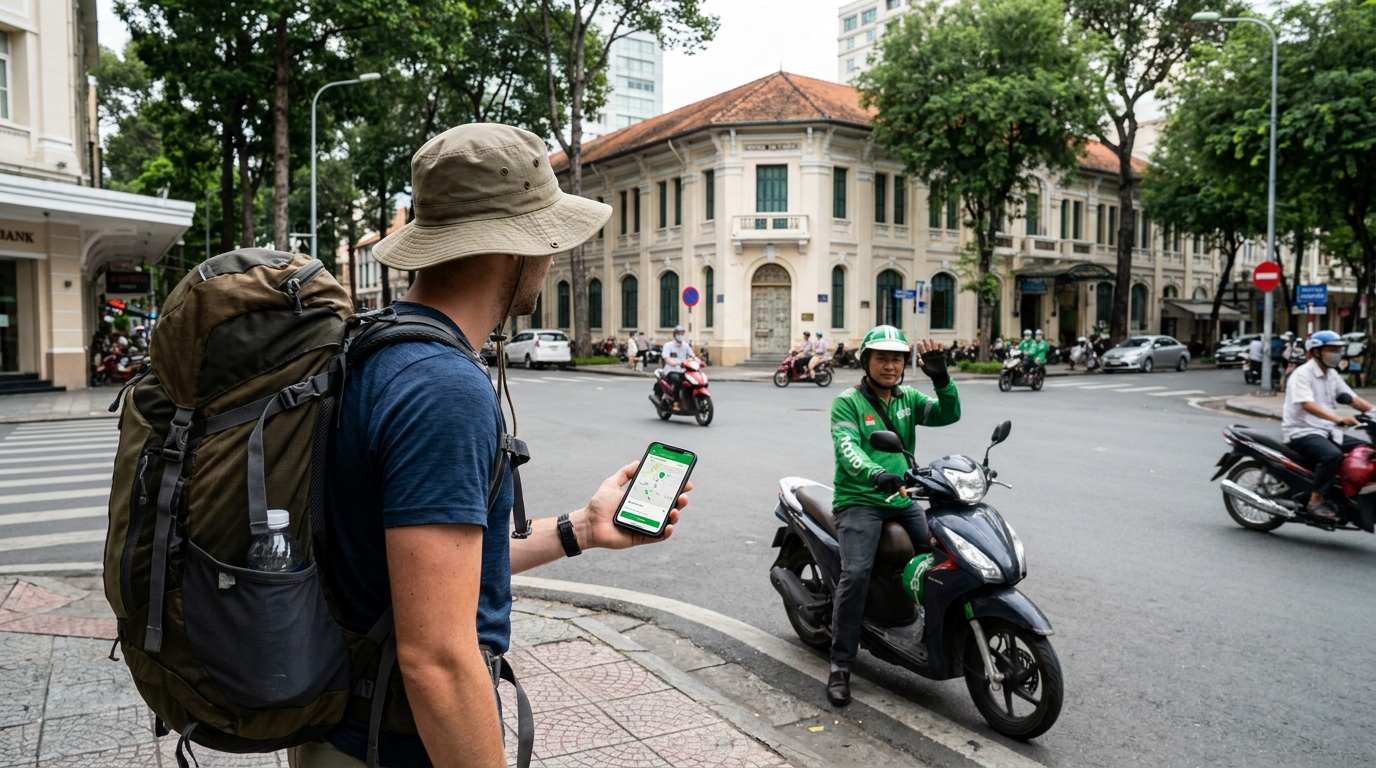
Grab is the dominant ride-hailing platform across Southeast Asia. As of 2025, Grab operates in over 700 cities and serves approximately 35 million users monthly across the region, according to Grab’s 2025 Annual Report. In Saigon, the app is genuinely ubiquitous — used by tourists, expats, and a large proportion of Vietnamese residents for everything from short hops to airport runs.
Setup: Download the Grab app from the App Store or Google Play. Create an account using a phone number (international numbers work fine). Enter your destination and pickup point. Select the service type — GrabBike for motorbike, GrabCar for a car, GrabTaxi for a metered cab booked through the app. The price is shown before you confirm. Match with a driver, track on the map, and meet at the confirmed pickup point. Payment can be in cash on arrival or via linked card or GrabPay wallet.
The most common user error is setting the pickup pin in the wrong location — zooming in on the map to confirm the pin is on your actual building entrance, rather than the nearest main road, saves time and confusion. In D1’s dense street grid, many buildings are 100-200 metres from where the auto-pin lands. Drivers cannot read addresses easily, so the pin accuracy matters more than the typed address.
[PERSONAL EXPERIENCE] After years of using Grab in Saigon, the fastest workflow for regular routes is saving frequently used addresses as “Home”, “Office”, and named favourites. The app keeps your last 10 destinations in history. Confirming a familiar route takes under 30 seconds from opening the app to driver assignment, which is genuinely competitive with hailing a taxi in any city.
What Is the Saigon Metro Like?
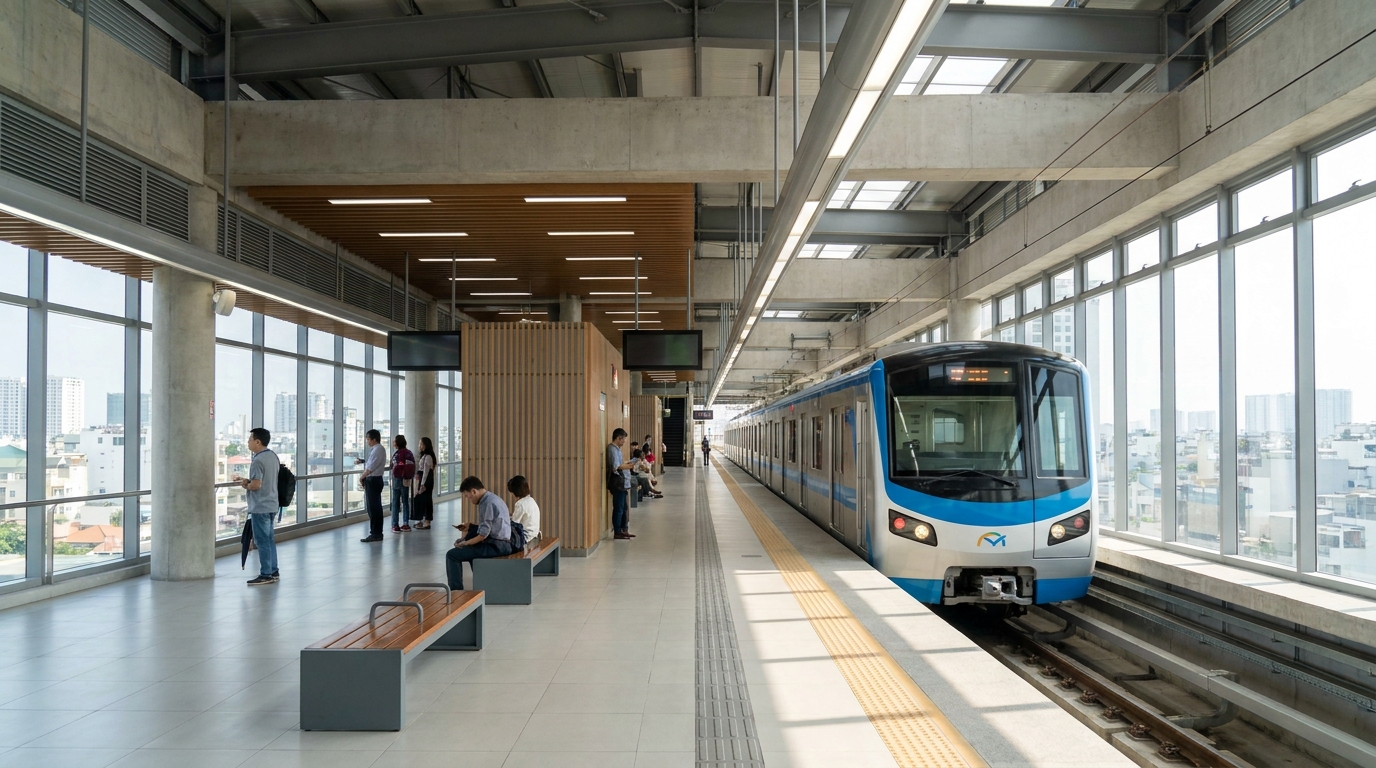
Metro Line 1 (Ben Thanh to Suoi Tien) opened in December 2025 after more than a decade of construction delays and budget overruns. The 19.7km elevated and underground line has 14 stations and runs from Ben Thanh in central D1 east through residential suburbs to the Suoi Tien cultural park on the Binh Duong border. Construction cost approximately $2.49 billion USD, funded primarily by Japanese development financing (JICA, 2025).
Single-trip fares range from 6,000-20,000 VND depending on journey length. A day pass costs 40,000 VND. Trains run from 05:30 to 22:00, with peak-hour frequency of every 5-7 minutes. The stations are clean, air-conditioned, and well-signposted in Vietnamese and English. For journeys along the D1 spine toward the eastern suburbs — particularly for visitors staying near Thao Dien or the university districts — the Metro is genuinely faster than road transport during morning and evening peak hours.
The honest limitation is coverage. One line serving the eastern corridor doesn’t transform the transport picture for most visitors, who rarely need to travel that specific route. Metro Line 2 (from Ben Thanh north to Tham Luong) is under construction as of 2026, with a projected opening date that HCMC officials have revised multiple times. Metro coverage meaningful for daily tourist or expat use is still several years away from the density that Bangkok, Singapore, or even Hanoi (if its Metro expansion accelerates) will offer.
Are Metered Taxis Safe and Reliable in Saigon?
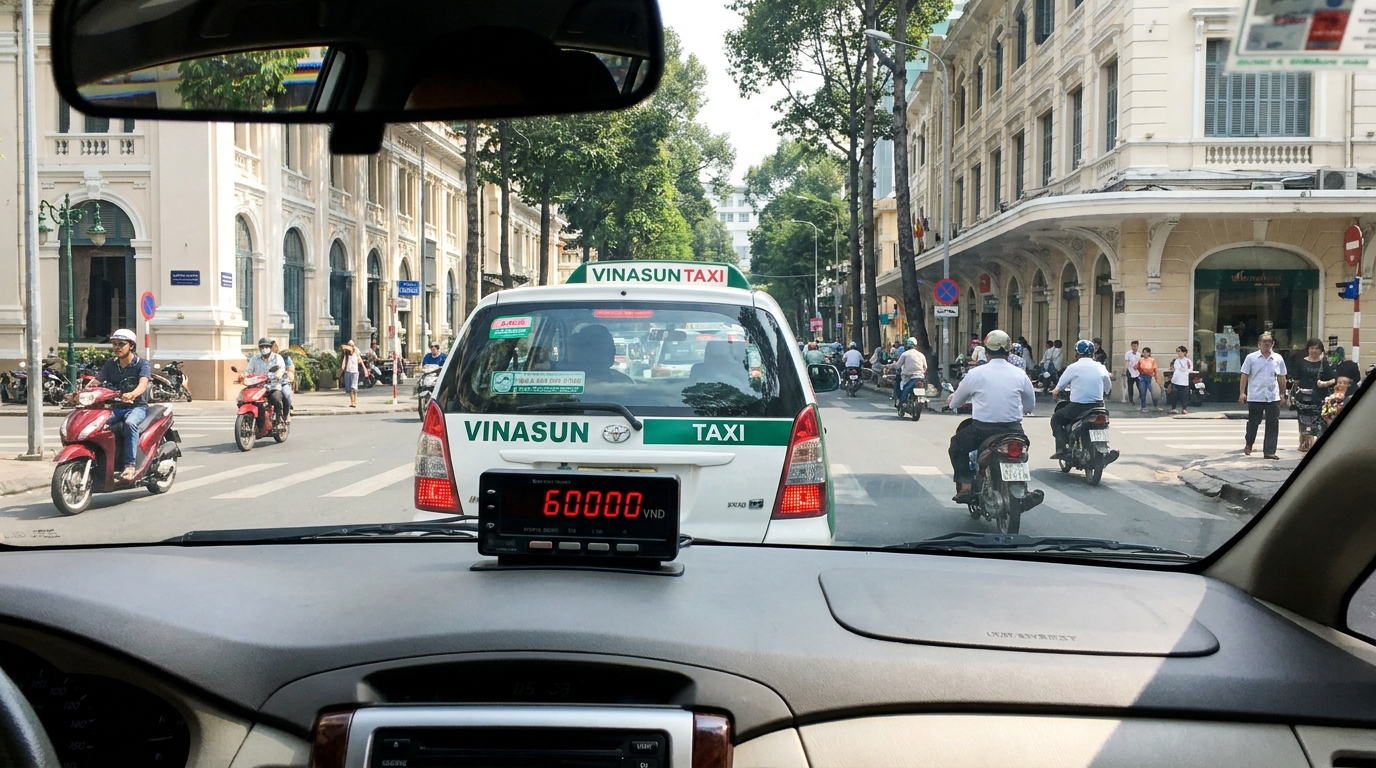
Metered taxis in Saigon have a documented history of overcharging tourists through tampered meters and non-standard routes. The U.S. Consulate in Ho Chi Minh City (2025) specifically warned against using unbranded taxis and recommended verifying the meter is running from the moment you enter. Two operators maintain a reliable reputation: Vinasun (white-green livery, distinctive lettering) and Mai Linh (green livery). These two operators are the only metered taxis worth using if you’re not on Grab.
Metered fares: starting charge approximately 12,000-15,000 VND. Each additional kilometre runs 12,000-16,000 VND. A 5km cross-district trip in D1 costs approximately 70,000-90,000 VND. The meter runs from departure, not from booking — so traffic jams add to the cost. Taxis are most useful for airport runs with luggage, for journeys where you don’t have phone signal for Grab, or for elderly travellers who find the GrabBike format uncomfortable.
Avoid any taxi that approaches you proactively outside airports, tourist sites, or large hotels. Legitimate metered taxis wait in taxi stands or are called by hotel staff. The aggressive roadside tout taxi is almost always either unlicensed or using a tampered meter. At Tan Son Nhat Airport, use only the official taxi rank outside the arrival hall or the Grab pickup zone — the fare-quoted touts inside the terminal are a consistent tourist trap.
Is It Safe to Ride Motorbikes in Saigon?
Vietnam recorded approximately 11,000 traffic fatalities in 2023, making it one of Southeast Asia’s higher road-accident mortality countries relative to population, according to the World Health Organization (2025). The risk is real and concentrated primarily at intersections, where right-of-way norms differ significantly from Western road rules. Saigon’s traffic, however, moves at speeds lower than most Western cities — it’s dense rather than fast, which changes the risk profile considerably.
Self-riding legally requires a Vietnamese driving licence for stays of any length — a requirement that’s frequently unenforced but that affects your insurance position in case of accident. International driving licences are not accepted under Vietnamese law for motorbikes. The practical reality is that many short-stay tourists rent manual motorbikes without a Vietnamese licence and ride without incident. But that’s a personal risk calculation, not an official recommendation.
For those new to Asian traffic, using GrabBike for the first 1-2 weeks provides useful observation time — you experience the traffic from the back of a motorbike driven by someone who understands the flow, which teaches you far more than reading about it. The traffic is not chaotic in the Western sense. It has its own logic, which becomes readable within a few days of observation. Experienced riders find Saigon manageable. First-time riders in Asia should earn that assessment through experience rather than assumption.
Frequently Asked Questions: Saigon Transport Guide
What is the best way to get around Saigon?
GrabBike is the fastest and most affordable for most short trips in D1-3 — 15,000-30,000 VND for 1-3km. GrabCar for groups or luggage. Metro Line 1 (opened December 2025) for the D1-to-eastern-suburbs corridor. Vinasun or Mai Linh taxis for journeys without a phone or for luggage-heavy trips. Walking works well in the colonial D1 core within a 1km radius. Grab holds approximately 75% of Vietnam’s ride-hailing market (Momentum Works, 2025).
How do you use Grab in Saigon?
Download the Grab app, create an account using any international phone number. Enter your destination, select GrabBike (cheapest), GrabCar, or GrabTaxi. All pricing is shown and fixed before confirmation — no haggling. Match with a driver, track on map, pay in cash or via linked card. Zoom in to confirm the pickup pin is on your actual entrance. Save frequent addresses as favourites to reduce booking time to under 30 seconds.
Is it safe to ride motorbikes in Saigon?
Legally requires a Vietnamese driving licence for any stay length — international licences are not accepted under Vietnamese law for motorbikes. Traffic is dense rather than fast, but the intersection risk is real (Vietnam: ~11,000 road fatalities in 2023, WHO). New arrivals to Asian traffic should use GrabBike for 1-2 weeks first to observe traffic flow before self-riding. Helmets are legally required and universally worn. Personal risk calculation, not official recommendation.
What is the HCMC Metro like?
Metro Line 1 (Ben Thanh to Suoi Tien, 19.7km, 14 stations) opened December 2025 after construction delays. Fares: 6,000-20,000 VND per journey; day pass 40,000 VND. Trains run 05:30-22:00, every 5-7 minutes at peak. Construction cost $2.49 billion USD (JICA, 2025). Clean, air-conditioned, English-signposted. Useful for the D1-to-east corridor. Metro Line 2 is under construction as of 2026. Overall network coverage remains limited for daily tourist use.
How much do taxis cost in Saigon?
Vinasun and Mai Linh are the two trustworthy metered operators. Starting fare: 12,000-15,000 VND. Per-kilometre rate: 12,000-16,000 VND. A 5km D1 trip costs approximately 70,000-90,000 VND. Grab Car for the same trip is usually 10-20% cheaper. Always verify the meter is running from departure. Avoid all unbranded taxis and roadside touts. The U.S. Consulate HCMC (2025) specifically recommends against unlicensed taxi operators for safety and overcharging risk.
Planning to make Saigon your base?
For more Saigon guides, check out: District 4 Saigon Guide: Seafood, Locals, and Hidden Gems Near D1, District 3 Saigon Guide: Leafy Streets, Cafes, and the Best of Local Saigon.