
Getting Around Ho Chi Minh City: Grab, Motorbike, Bus, and Walking Compared
Getting around Ho Chi Minh City is straightforward once you understand your Grab motorbike bus walking Ho Chi Minh City options. Getting around Ho Chi Minh City means choosing between a handful of radically different options — each with its own cost, speed, and comfort trade-off. Whether you rely on Grab, rent a motorbike, hop on a bus, or simply walk the blocks of District 1, your choice shapes your daily budget and how much of the city you actually experience. This guide breaks down every realistic option for getting around Ho Chi Minh City in 2026, with real prices and honest pros and cons from someone who uses all of them.
Key Takeaways
- Grab is the fastest way to book transport and is safe, metered, and available city-wide 24/7.
- Motorbike taxis (xe om) and self-rental bikes are cheaper but require confidence navigating HCMC traffic.
- The public bus network covers most districts for under 8,000 VND per ride — the most underrated budget option.
- Walking is practical only in compact areas like District 1 and parts of District 3, where most expat accommodation clusters.
- Staying centrally in District 1 cuts daily transport spending dramatically compared to outer districts.
Grab Motorbike Bus Walking Ho Chi Minh City: Grab: The Default Choice for Getting Around Ho Chi Minh City
For most visitors and new expats, Grab is the go-to for getting around Ho Chi Minh City. The app works in English, fares are shown before you confirm, and drivers are rated — so there is no haggling, no language barrier, and no sudden price inflation at tourist spots.

A GrabBike (motorbike) from Ben Thanh Market to Bui Vien Street costs roughly 15,000–25,000 VND. A GrabCar covering the same distance runs 50,000–70,000 VND. Surge pricing kicks in during rush hours (7–9 am and 5–7 pm) and heavy rain, sometimes doubling standard fares. Still, Grab remains affordable by any international standard.
Best for: Arrivals, late-night trips, luggage runs, or any journey where you want air conditioning and zero negotiation.
Drawbacks: Traffic jams affect GrabCars just as badly as any vehicle. During peak hours a GrabBike will reach your destination far faster than a car — but you arrive sweaty in the heat.
Motorbike: The Fastest Way Through Saigon Traffic
The motorbike is the native rhythm of Ho Chi Minh City. According to the Ho Chi Minh City Department of Transport, the city had over 7.3 million registered motorbikes as of 2024 — roughly one for every resident. That density is exactly why they work: bikes filter through gridlock that stops cars dead.
Renting a semi-automatic scooter (Honda Wave or equivalent) costs 150,000–200,000 VND per day from reputable rental shops in District 1. Monthly rentals drop to 2,000,000–3,500,000 VND. Fuel adds roughly 30,000–50,000 VND daily for typical city use.
Best for: Long-term residents, people comfortable in chaotic traffic, and anyone needing flexible point-to-point travel across multiple districts in a day.
Drawbacks: International driving permits are required for legal operation, though enforcement is inconsistent. Parking fees (5,000–15,000 VND) add up. Theft risk is real — always use a disc lock. Rain gear is essential from May to November.
Xe Om (Motorbike Taxis): Cheap but Negotiate First
Before Grab arrived, xe om drivers were the backbone of short-distance transport. You still find them clustered outside markets, bus stations, and residential alleys. Fares should be agreed before you get on — typical short trips cost 20,000–40,000 VND, slightly cheaper than Grab on equivalent routes.
The catch is that without a metered app, prices are negotiable and tourists regularly overpay. Xe om drivers are less consistent in quality than Grab, and very few speak English. That said, a regular xe om driver near your apartment can become a reliable, affordable daily commute partner once you establish a fair rate.
Public Bus: The Most Underrated Option for Getting Around Ho Chi Minh City
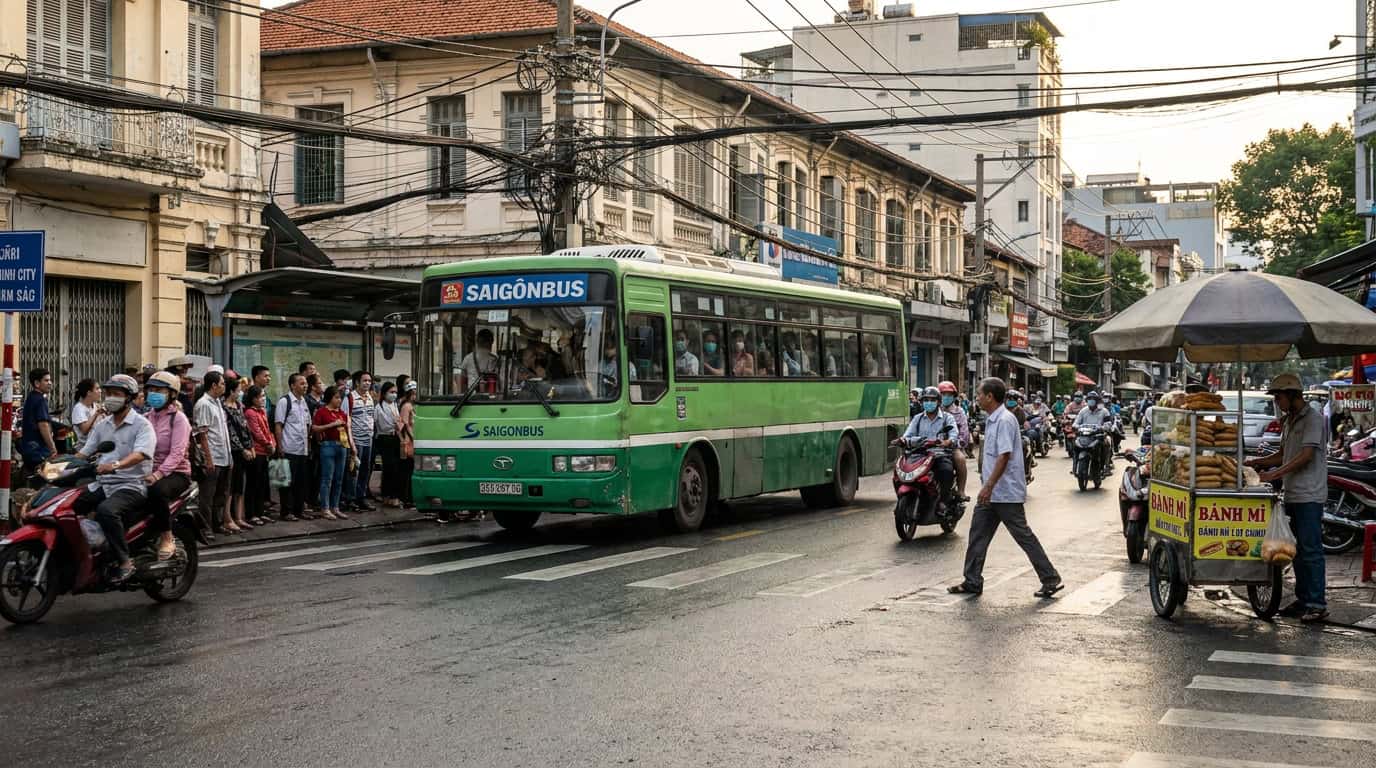
The HCMC public bus network is genuinely extensive and almost entirely ignored by tourists. According to the Ho Chi Minh City Urban Traffic Management Center, the bus network operated over 130 routes covering all 22 districts as of 2025, carrying approximately 1.2 million passengers per day.
Fares are fixed at 6,000–8,000 VND per journey — less than 40 US cents. Monthly passes cost around 200,000 VND. Route maps and real-time tracking are available on the BusMap app (free, English interface), which makes navigating the system accessible even without Vietnamese language skills.
Best routes for expats: Route 01 (Ben Thanh to Cho Lon), Route 152 (Airport to District 1), and Route 04 (District 1 to Thu Duc) are well-maintained, frequent, and air-conditioned.
Best for: Commuters on a fixed budget, travel along major corridors, and anyone who wants to move around the city without needing a data connection.
Drawbacks: Buses do not reach every street, schedules slip during peak hours, and the last buses on most routes run by 9–10 pm.
Metro Line 1: The New Commute Corridor
Ho Chi Minh City’s first metro line (Ben Thanh to Suoi Tien) opened for full commercial operation in late 2024 and has already changed daily commuting for residents along the route. Fares start at 7,000 VND and cap at 20,000 VND for the full 19.7 km line. Trains run every 10 minutes during peak hours and are air-conditioned, clean, and on schedule.

For expats living in District 1 or Binh Thanh and working toward Thu Duc or the tech parks along the eastern corridor, the metro is now the obvious commute choice. The Ben Thanh hub integrates with bus routes and is walkable from most District 1 accommodation.
Best for: Residents commuting east, airport-adjacent trips connecting at future interchange stations, and anyone wanting predictable travel times.
Taxi: When You Need Comfort Without the App
Traditional metered taxis remain useful when you have luggage, are traveling with elderly passengers, or simply prefer not to use an app. Vinasun and Mai Linh are the two reputable fleets — both use tamper-sealed meters and are required to display driver identification. Starting fare is around 12,000–15,000 VND, with per-kilometer rates of 15,000–18,000 VND.
Avoid unmarked taxis without visible company branding — overcharging tourists is common in this sector. If in doubt, Grab Car typically undercuts traditional taxi rates on most city routes.
Cycling: Possible but Niche
Cycling in HCMC is a minority sport rather than a transport backbone. There are no protected bike lanes in the city center, and sharing the road with millions of motorbikes demands experience and confidence. That said, early-morning rides along Nguyen Hue Boulevard or through Tao Dan Park are genuinely pleasant before 7 am when traffic is thin.
Rental bicycles (pedal) are available through some hotels and short-term apartment operators for 50,000–100,000 VND per day. The Mobike and similar dockless bike-share schemes have had limited success in HCMC due to infrastructure gaps, though small-scale local schemes operate in some newer residential zones.
Best for: Early morning leisure rides, short trips within District 1 in cooler months, fitness-focused residents.
Walking in Ho Chi Minh City: District 1 Is the Exception
In most of Ho Chi Minh City, walking is a last resort rather than a first choice. Pavements are frequently blocked by parked motorbikes, vendor carts, or simply do not exist. Heat and humidity from March to May make walks over 15 minutes genuinely uncomfortable without planning.
District 1 is the clear exception. The pedestrianized Nguyen Hue Boulevard, the riverside promenade, the grid between Ben Thanh Market and the Opera House, and the cafe-lined streets of Pham Ngu Lao are all designed to walk. Most daily needs — food, coffee, convenience stores, pharmacies, and co-working spaces — sit within a 10-minute walk of centrally located apartments.
District 1’s walkability is unmatched in HCMC — stay with us and reduce your daily transport spending significantly. When your apartment is already at the center of the action, you stop paying for rides you would otherwise need just to reach anything worth visiting.
Best for: Evening strolls, sightseeing between Notre-Dame Cathedral and the Saigon River, reducing daily transport costs when your base is central.
Comparing Costs: A Practical Breakdown
Transport costs add up faster than most visitors expect when staying in outer districts. Here is a realistic daily cost comparison for a person doing 4 trips (8 single journeys) across the city:
- Grab (mix of bike and car): 120,000–200,000 VND/day
- Xe om (negotiated): 80,000–150,000 VND/day
- Public bus only: 48,000–64,000 VND/day
- Motorbike rental (fuel included): 180,000–250,000 VND/day (all-day flexibility)
- Metro + bus combination: 40,000–80,000 VND/day depending on route
- Walking (District 1 base): 0–40,000 VND/day for occasional short rides
The math is clear: a central location converts transport spending into accommodation value. Paying slightly more per night to stay in District 1 typically costs less over a week or month than paying lower rent in District 7 or Binh Duong while Grabbing everywhere.
Safety Tips for Getting Around Ho Chi Minh City
Traffic injuries remain a serious concern in Vietnam. The National Traffic Safety Committee reported over 6,500 road fatalities nationally in 2024, with motorbikes involved in the majority of accidents. Practical steps reduce your risk significantly:
- Always wear a helmet on motorbikes — both as driver and passenger. Fines apply, and the risk is real.
- Cross streets slowly and steadily — do not freeze or run. Traffic flows around predictable pedestrians.
- Avoid phones on motorbikes. Bag snatching from moving bikes is the most common theft method targeting tourists in HCMC.
- Book Grab over unbranded xe om after dark in unfamiliar neighborhoods.
- Check your GrabBike driver’s plate number before getting on — a small but important verification step.
Best Strategy for Short Stays vs. Long-Term Residents
Your ideal approach to getting around Ho Chi Minh City depends on how long you are staying.
Short stays (under 2 weeks): Rely on Grab for all transport. Download the app before you land. Use bus Route 152 from the airport to save 200,000 VND on your first trip. Stay in District 1 and walk as much as the heat allows.
Medium stays (2 weeks to 3 months): Add a monthly bus pass for corridor commutes. Consider a short-term motorbike rental if you are comfortable with city traffic. Keep Grab for rain and late nights.
Long-term residents (3+ months): Owning or long-renting a motorbike is the most cost-effective and flexible option. Register it properly, maintain insurance, and build a relationship with a local mechanic. Supplement with metro for eastern corridor commutes.
You May Also Find Useful
Frequently Asked Questions
Is Grab safe to use in Ho Chi Minh City?
Yes. Grab is the safest and most reliable app-based transport in HCMC. Driver profiles, trip tracking, and in-app payment reduce the risks associated with unmetered transport. Always verify the driver’s license plate before boarding.
Can I rent a motorbike in Ho Chi Minh City as a foreigner?
Legally, you need a Vietnamese driving license or an International Driving Permit (IDP) endorsed for motorbikes. Practically, many short-term visitors rent without one, but the legal and insurance implications in an accident are serious. If you plan to ride regularly, obtain the correct documentation.
How does getting around Ho Chi Minh City compare to Bangkok or Kuala Lumpur?
HCMC has less developed public transit than Bangkok (which has the BTS Skytrain) or KL (with its LRT network), but motorbike infrastructure compensates significantly. Grab fares are cheaper than Bangkok equivalents, and the density of the city means most destinations are reachable within 20 minutes from a central base.
Is the HCMC metro worth using?
For the specific corridor it serves (District 1 to Thu Duc), absolutely. It is fast, cheap, air-conditioned, and avoids surface traffic entirely. For other routes it does not yet help, but future lines will expand coverage substantially by 2030.
What is the cheapest way to get from Tan Son Nhat Airport to District 1?
Bus Route 152 runs directly from the airport to Ben Thanh Market for 6,000–8,000 VND and takes 40–60 minutes depending on traffic. A GrabCar covers the same route in 20–40 minutes for 150,000–250,000 VND. The bus is the clear budget winner if you have manageable luggage.
Official Resources
For the most up-to-date information on getting around ho chi minh city, visit the Vietnam Tourism Official Guide.