
District 7 Saigon Guide: Phu My Hung, Expats, and What’s There
District 7 is Saigon’s most planned urban area, built from scratch on reclaimed swampland in the 1990s as a joint venture between the city government and a Taiwanese developer. What emerged is Phu My Hung township: wide boulevards, international schools, a large Korean and Japanese community, and apartment blocks that cater to families who want space, greenery, and good infrastructure. It’s as different from the chaotic energy of District 1 as any part of the city gets.
Key Takeaways
- Phu My Hung is home to the largest concentration of Korean expatriates in Vietnam, estimated at 30,000+ residents
- District 7 has 5 international schools including RMIT University’s Vietnam campus
- Average apartment rent in Phu My Hung runs 15-30% higher than equivalent size in District 2
- The district is 8-10 km from District 1 center, typically 20-30 minutes by car
- SC VivoCity and Crescent Mall are the main retail anchors, both family-focused with cinema and food hall
What Is Phu My Hung, and Why Is District 7 So Different?
Phu My Hung is a master-planned township covering roughly 2,600 hectares in the southern part of District 7. It was developed by Phu My Hung Corporation, a joint venture between the Ho Chi Minh City government and Central Trading & Development Group of Taiwan, starting in the late 1990s. According to Phu My Hung Corporation (2024), the township now houses over 100,000 residents. That planned origin explains everything from the wide roads and underground cabling to the formal parks and canal-side promenades that feel unlike anywhere else in the city.
Where other Saigon districts evolved organically from village networks and French colonial grids, District 7’s Phu My Hung zone was designed with infrastructure first. That makes it quieter, cleaner, and more car-dependent than the rest of the city. It also makes it the first choice for Korean and Japanese families who want international school access and community density in one area.
Who Lives in District 7?
District 7 has Vietnam’s highest concentration of Korean expatriates, with estimates from the Korean Embassy in Hanoi (2024) suggesting over 150,000 Koreans live in Vietnam, with 30,000+ concentrated in and around Phu My Hung. The result is a genuinely Korean neighborhood along Nguyen Thi Thap Street and the streets behind Lotte Mart: Korean BBQ restaurants, Korean bakeries, Korean-language hagwon tutoring centers, Korean supermarkets, and Korean-speaking real estate agents.
Japanese and Taiwanese communities are also significant. Vietnamese upper-middle-class families make up the majority of residents overall, drawn by the same factors as expats: space, school access, and lower pollution than the inner districts. The community skews young-family rather than single professional, which shapes the area’s restaurants, services, and after-school infrastructure.
What Are the Best Restaurants and Food in District 7?
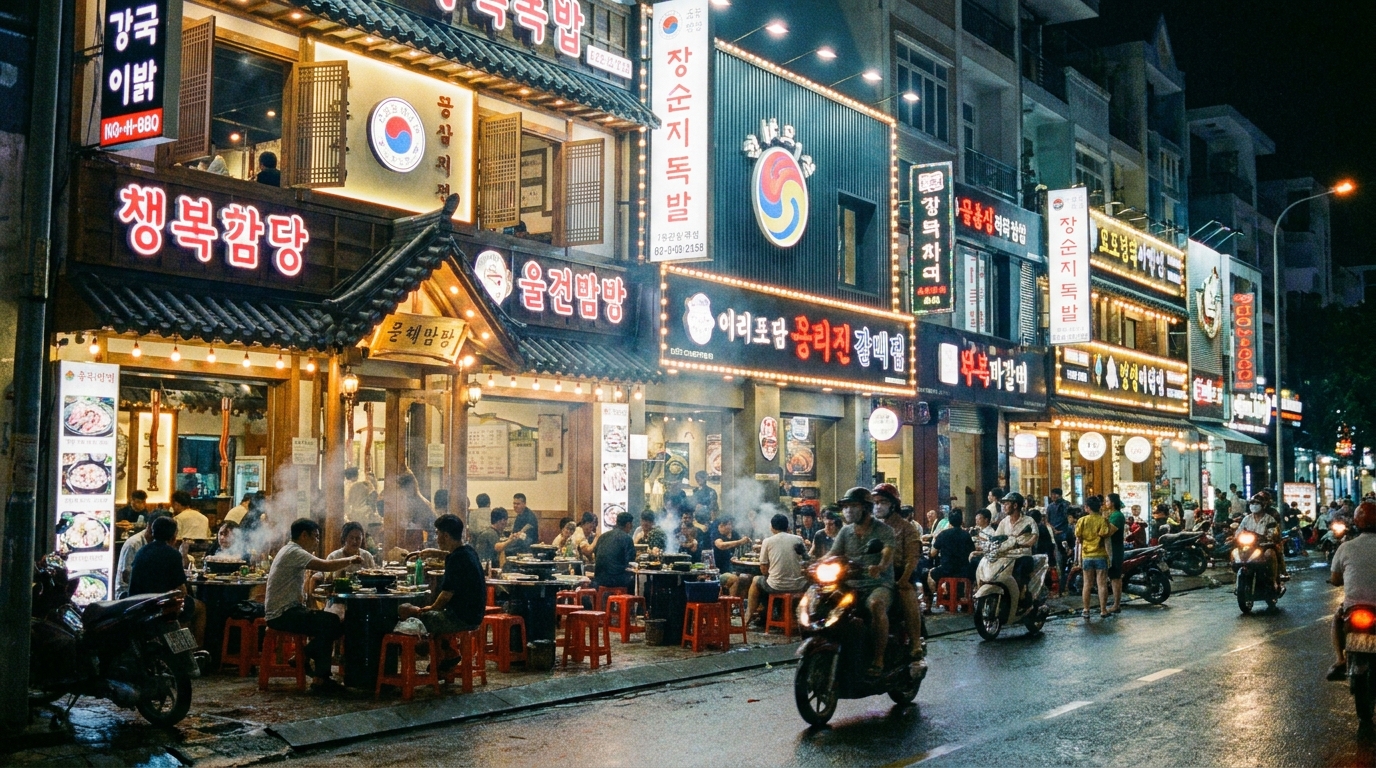
District 7’s restaurant scene is more internationally diverse than any other area outside of Districts 1 and 2. Korean BBQ on Nguyen Thi Thap Street alone offers 30+ options ranging from budget to premium. Japanese ramen shops, izakayas, and sushi counters cluster around the Lotte Mart and E-town areas. A 2024 survey by Foody (Vietnam’s leading restaurant review platform) found that District 7 had the highest per-capita restaurant density of any district outside the CBD, with over 1,200 active listings.
Korean BBQ and Korean Food
Nguyen Thi Thap Street between the Crescent Lake and Lotte Mart is ground zero for Korean food in Vietnam. Options range from high-end Korean BBQ with premium cuts and full side dishes to affordable Korean fast food chains and Korean bakeries. Lotte Mart’s food court offers an accessible introduction. Prices for a full Korean BBQ dinner for two run 300,000-700,000 VND depending on the cut and venue. The quality here genuinely competes with Korean restaurants in Bangkok and Singapore at lower price points.
International and Local Food Options
Beyond Korean food, Crescent Mall’s dining floor covers Japanese, Thai, Western fast food, and Vietnamese chains. The canal-side promenade at Crescent Lake has developed into a restaurant strip with options ranging from craft beer bars to Japanese shabu-shabu. Local Vietnamese com tam (broken rice) and pho options line the residential streets at a fraction of the tourist-district prices. District 7 residents generally eat better value food than those living in Districts 1 or 3.
What International Schools Are in District 7?
District 7 is the top choice for expatriate families with school-age children partly because of its international school concentration. RMIT University Vietnam’s Ho Chi Minh City campus is on Nguyen Van Linh Boulevard and serves tertiary students. The Korea International School (KIS) and Korean Cultural Center serve the Korean community. According to Vietnam’s Ministry of Education and Training (2024), District 7 hosts 4 internationally accredited K-12 schools within 5 km of Phu My Hung’s residential core, a density unmatched in any other city district.
[UNIQUE INSIGHT] For families choosing between District 7 and Thao Dien (District 2), the international school comparison often drives the decision. Thao Dien has British International School (BIS) and ISHCMC nearby, which rank higher on international league tables. District 7 has more Korean-curriculum options and stronger Korean community infrastructure. The choice usually follows where the child’s school friends will be.
Where Should You Live in District 7?
Phu My Hung has several distinct residential zones. The area around Crescent Lake and the Hung Gia and Hung Vuong compounds offers the most established expat community feel, with canal-side walking paths, proximity to Crescent Mall, and easy access to Nguyen Thi Thap’s restaurant strip. Apartment sizes in these complexes tend to be larger than equivalent Saigon market pricing, reflecting the master-plan standards. According to CBRE Vietnam (2025), average asking rent for a 2-bedroom apartment in Phu My Hung runs 18-25 million VND per month, compared to 15-20 million VND for a comparable unit in Thao Dien.
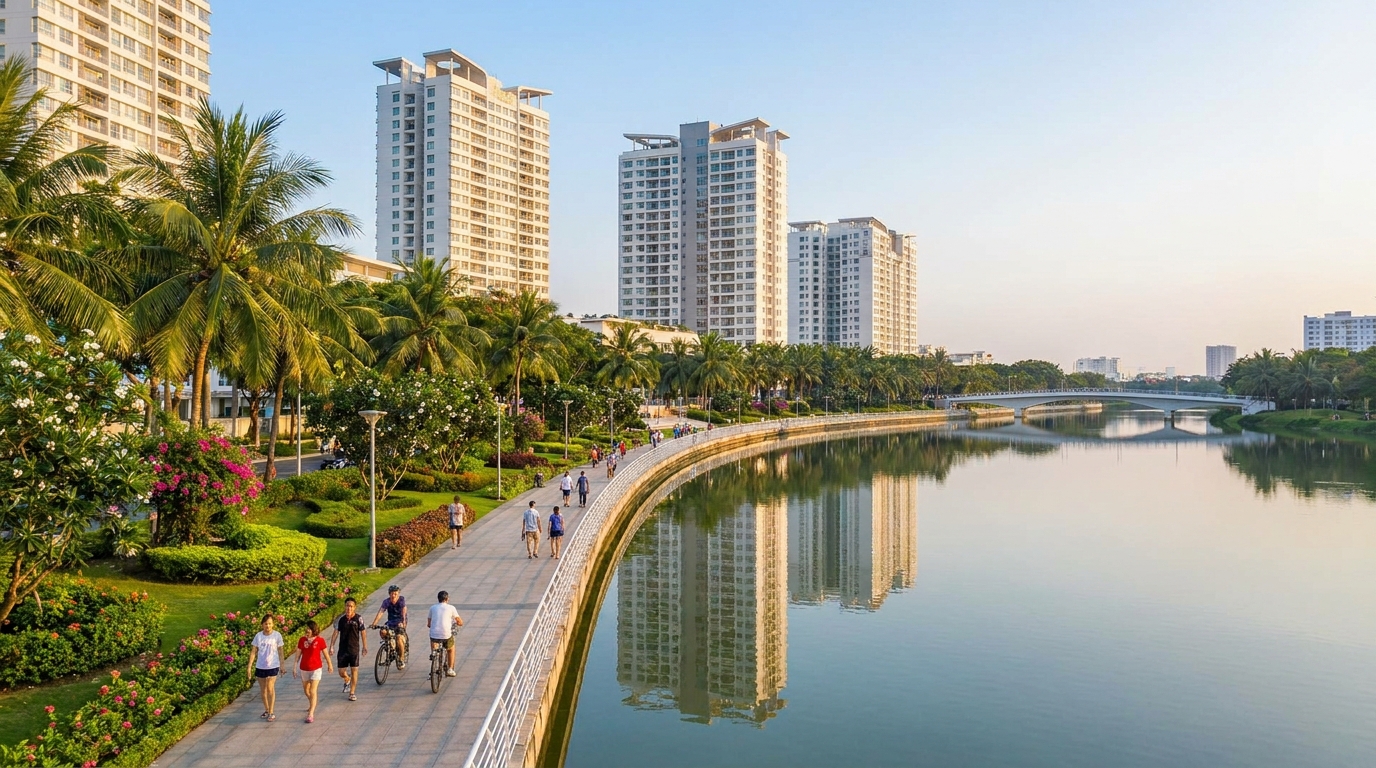
The newer southern developments around Nguyen Luong Bang and Nguyen Huu Tho Street offer newer construction at similar prices but with longer commute times to District 1. These areas appeal to buyers more than renters since the long-term value proposition is clearer. Renters who need daily city access tend to prefer the more central Phu My Hung zones.
How Do You Get to District 7 from the Rest of Saigon?
District 7 sits 8-10 km south of District 1 via the Thu Thiem Tunnel or the Khanh Hoi Bridge and Nguyen Van Linh Boulevard. By car or taxi, the journey from central District 1 takes 20-35 minutes in normal traffic and 40-60 minutes during peak hours. The Thu Thiem Tunnel is toll-free; Nguyen Van Linh route is typically faster on weekends. Grab bikes and cars are available throughout, and rideshare pricing to central districts runs about 50,000-100,000 VND during non-peak hours.
The Metro Line 4 in planning phases is expected to connect District 7 to the city center by the early 2030s, which is a significant long-term infrastructure argument for property investment in the area. For now, a personal vehicle or reliable rideshare dependence is essentially required for daily District 7 living.
Frequently Asked Questions: District 7 Saigon
Is District 7 good for expats in Saigon?
Yes, particularly for families with children in international schools or expatriates from Korean and Japanese backgrounds looking for community. The trade-off versus Districts 1, 2, or 3 is distance from the city center and the need for a vehicle. District 7 offers larger apartments, better parking, more green space, and lower street noise than inner-city districts.
How far is District 7 from District 1?
District 7 is approximately 8-10 km from central District 1, depending on your specific location within the district. By car during off-peak hours, the journey takes 20-30 minutes via the Thu Thiem Tunnel or Khanh Hoi Bridge. During rush hour (7-9 AM and 5-7 PM), expect 40-60 minutes. There is no direct metro connection yet.
What is the Korean area of District 7 called?
The Korean community in District 7 is concentrated primarily along Nguyen Thi Thap Street and the surrounding blocks near Lotte Mart and SC VivoCity. There’s no single formal name for the area, but locals and expats commonly refer to it as the Korean district or “Koreatown.” It has the highest density of Korean restaurants, shops, schools, and services in Vietnam.
Are there apartments available in District 7 for short-term rental?
Yes, though short-term furnished rentals are less common than in Districts 1 or 2. Most available accommodation is structured as 6-12 month leases. Serviced apartments and some guesthouses near Crescent Mall offer month-to-month flexibility at a premium. For stays over 3 months, negotiating a lease directly with a landlord through a local real estate agent yields significantly better pricing than serviced options.
What is the closest mall to Phu My Hung?
Crescent Mall on Ton Dat Tien Street is the primary shopping mall for Phu My Hung residents, with a full-service department store, cinema, gym, and extensive food court. SC VivoCity on Nguyen Van Linh Boulevard is larger and caters more to family shopping with a wider retail mix. Lotte Mart on Nguyen Thi Thap is the main Korean grocery and department store. All three are within 5 minutes’ drive of central Phu My Hung.
For more Saigon guides, check out: District 4 Saigon Guide: Seafood, Locals, and Hidden Gems Near D1, District 3 Saigon Guide: Leafy Streets, Cafes, and the Best of Local Saigon.
For official information and further reading, visit Lonely Planet — Ho Chi Minh City.
Explore more: Wine Bars Saigon: Where to Find a Decent Glass in a Beer-First City · Saigon Cooking Classes: Learn Vietnamese Cuisine from the Source · Expat Guides to Saigon · Saigon Apartment Residences