
Saigon Street Food Guide: Night Markets, Carts, and the Rules of Eating Like a Local
Ho Chi Minh City has more than 30,000 registered street food vendors spread across its 24 districts, according to the HCMC Department of Food Safety (2025). That density makes Saigon one of the most concentrated street food cities in Southeast Asia, and it means that within 200 metres of almost any apartment or hotel in District 1, you have a dozen options for breakfast, lunch, and dinner. The harder question isn’t where to find street food. It’s knowing which stall is worth stopping at and which dish to order first.
This guide is the DIY companion to our sister article on . It covers the ten essential dishes, the best streets and markets by zone, night market hours, unwritten etiquette rules, food safety assessment, and a full price guide in VND so you know what a fair price looks like before you sit down.
Key Takeaways
- HCMC has 30,000+ registered street food vendors (HCMC Dept of Food Safety, 2025) — one of the densest ecosystems in Southeast Asia
- A full street meal costs 40,000-80,000 VND ($1.60-3.20 USD) — ranked most affordable eating-out city in Southeast Asia (Economist Intelligence Unit, 2025)
- Best food zones: Ben Thanh surrounds, D4 seafood streets, Bui Vien area, Hoang Sa canal
- Night markets run 18:00-23:00; breakfast stalls sell out by 09:00-09:30 — timing matters
- The Michelin Guide Vietnam (2023) included four street food vendors in its inaugural listing, validating the city’s street food credibility internationally
What Are the 10 Essential Saigon Street Foods?
The Vietnam National Administration of Tourism (VNAT) listed Ho Chi Minh City as Vietnam’s top domestic culinary destination in 2023, citing the city’s unique role as a migration hub where northern, central, and southern Vietnamese cooking traditions converge on a single street corner. Ten dishes represent the true core of that identity. Miss these, and you haven’t really eaten Saigon.
Banh Mi
Banh mi is Vietnam’s most internationally recognised street food, and Saigon does it differently from every other city. The baguette is shorter, crispier, and made with a rice flour blend that creates a shattering crust around an airy crumb. Standard fillings: pate, mayonnaise, pickled daikon and carrot, cucumber, fresh coriander, chilli slices, and a protein. Common proteins are cha lua (Vietnamese pork sausage), thit nuong (grilled pork), and trung chien (fried egg). Price: 30,000-55,000 VND. Banh Mi Huynh Hoa at 26 Le Thi Rieng, District 1, is the most famous single vendor in the city — queues form from 15:00 daily until sold out.
Pho
Southern pho differs from the Hanoi original. The broth is sweeter, the portions are larger, and the table accompaniments are more generous: a full plate of bean sprouts, Thai basil, hoisin sauce, and sriracha comes standard. Pho bo (beef) is the benchmark; pho ga (chicken) is lighter and just as good. Best time: 05:30-09:00 before the stock runs out at the best specialist shops. Price: 50,000-80,000 VND. Pho Hung on Nguyen Trai Street (multiple D1 and D5 locations) is the most consistently recommended for visitors.
Bun Bo Hue
Bun bo Hue is a central Vietnamese dish, but Saigon’s large Hue migrant community has made it a city staple. The broth is built on lemongrass and shrimp paste, noticeably spicier than pho, served with thick round noodles and a combination of beef slices, pork hock, and — optionally — cubes of congealed pork blood. It’s a morning dish. The best versions disappear by 09:00. Price: 50,000-80,000 VND. The Ho Thi Ky Flower Market area in District 10 has the highest concentration of specialist bun bo Hue stalls in the city.
Com Tam
Com tam (broken rice) is the working soul of Saigon’s street food culture. The dish was born from necessity: the broken grains left over from milling that were considered too low-quality to sell as whole rice. Today, a full com tam plate carries suon nuong (charcoal-grilled pork chop), bi (shredded pork skin with toasted rice), a fried egg, sliced cucumber, and a small dish of pickled vegetables — all dressed with nuoc cham. Look for stalls with a visible charcoal grill; the smoky char on the pork chop is the defining flavour. Price: 40,000-70,000 VND.
Banh Xeo
Banh xeo is a sizzling turmeric-yellow rice flour crepe, cooked in a screaming-hot wok with coconut milk, filled with shrimp, pork belly, bean sprouts, and spring onion. You eat it by tearing off sections, wrapping each piece in fresh lettuce and herbs, and dipping in nuoc cham. The name means “sizzling cake” — a direct reference to the sound when the batter hits the oiled pan. A full-size banh xeo costs 60,000-100,000 VND. Districts 3 and Binh Thanh have the highest density of dedicated banh xeo restaurants in the city.
Goi Cuon
Goi cuon (fresh spring rolls) are the lighter counterpart to the fried cha gio. Translucent rice paper wraps shrimp, poached pork slices, rice vermicelli, lettuce, mint, and coriander into tight cylinders served cold with a peanut-hoisin dipping sauce. They’re sold at dedicated stalls and as starters at com tam restaurants. Two rolls typically cost 20,000-35,000 VND. Goi cuon deteriorate quickly once assembled, so look for stalls that roll them to order rather than pre-packing them in plastic wrap.
Banh Trang Nuong
Banh trang nuong is Saigon’s street-side pizza. A dried rice paper disc is griddled directly over charcoal, topped with egg, spring onion, dried shrimp, pork floss, chilli sauce, and mayonnaise, then folded in half and eaten straight from the vendor’s cart. It’s a late-afternoon and evening snack, sold near school gates and night markets. Price: 15,000-30,000 VND. The simplest and cheapest item on this list — and completely addictive.
Bun Thit Nuong
Bun thit nuong is a cold vermicelli bowl built for lunch. Room-temperature rice vermicelli sits under sliced grilled pork (or a mini cha gio fried spring roll), topped with crushed roasted peanuts, pickled vegetables, fresh herbs, and a generous pour of nuoc cham. It’s not a soup. It’s a salad-style noodle dish eaten at midday when something lighter than com tam feels right. Price: 40,000-60,000 VND. Most com tam stalls also serve bun thit nuong on the same menu.
Hu Tieu
Hu tieu is the noodle soup of Saigon’s Cholon (Chinese-Vietnamese) community. The base is hu tieu Nam Vang, a clear pork-bone-and-dried-shrimp broth served with thin tapioca noodles, sliced pork, minced pork, shrimp, and fried garlic. It can be served wet (as soup) or dry (kho), with the broth on the side for dipping. The dry version lets you taste the noodles and toppings independently before mixing. Price: 50,000-70,000 VND. District 5’s Chau Van Liem Street is the canonical address for hu tieu in the city.
Che
Che is the umbrella term for Vietnamese sweet soups and dessert drinks. Cold che ba mau (three-colour dessert with coconut milk, mung bean, and pandan jelly) is the most visual and most photographed. Che chuoi (banana and coconut milk) is the most comforting. Che troi nuoc (glutinous rice balls in ginger syrup) is the most traditional. A cup of che from a street cart costs 15,000-30,000 VND. Che vendors concentrate around Ben Thanh Market and along Hoang Sa canal in the evenings.
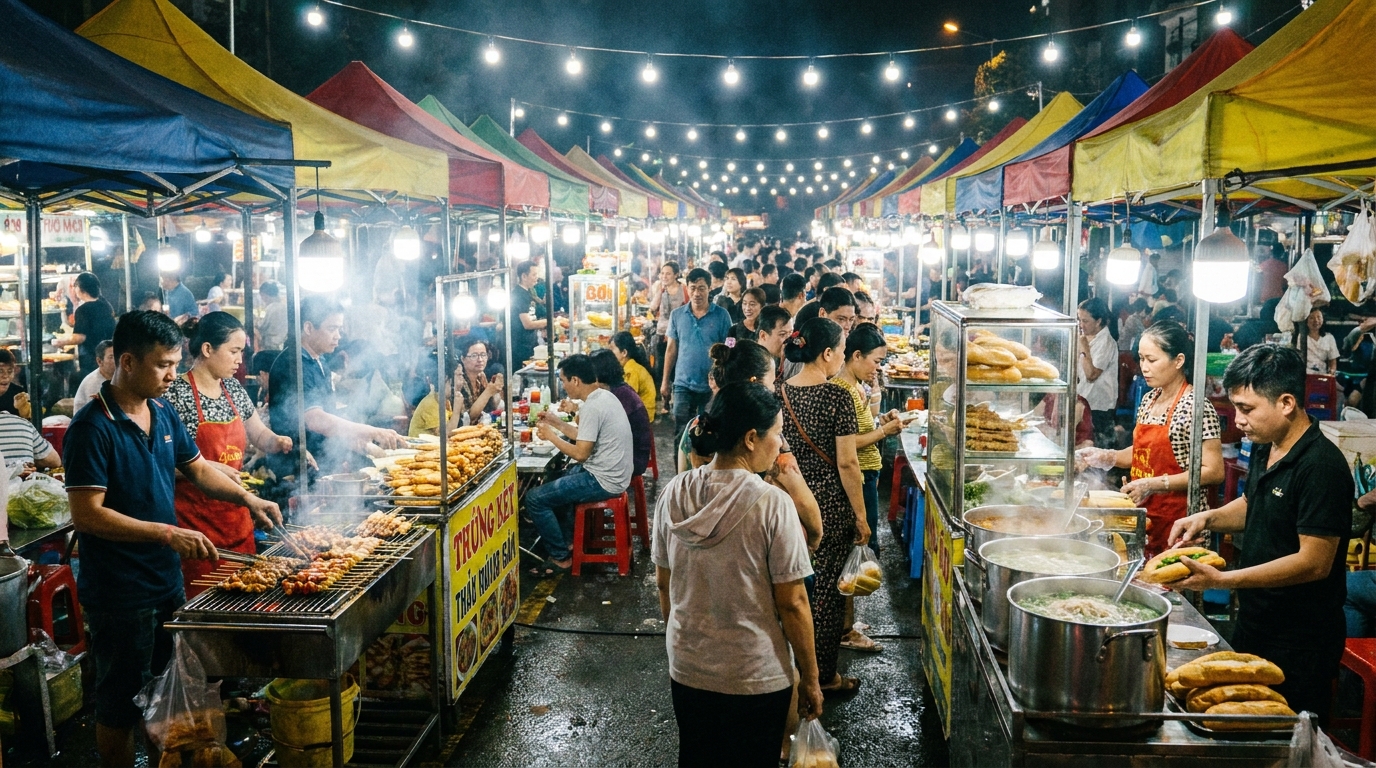
Where Are the Best Street Food Zones in Saigon?
A 2025 survey by Gia Dinh Magazine found that 72% of the city’s highest-rated street food stalls are outside the tourist corridor of Districts 1 and 3 — concentrated in Districts 4, 5, 10, Binh Thanh, and Phu Nhuan. The tourist zones have convenience; the surrounding districts have the best versions of the food. Here’s where to go for each type of eating experience.
Bui Vien and Pham Ngu Lao Area (District 1)
The Bui Vien walking street and the Pham Ngu Lao backpacker block are the most accessible street food zones for first-time visitors. The food here is adapted for international palates — less fish sauce intensity, more English menus, higher prices. A banh mi costs 50,000-70,000 VND here versus 30,000-45,000 VND two kilometres away. It’s not bad food. It’s convenient food. Use it on your first night to get your bearings, then move outward from day two.
Ben Thanh Market Surrounds (District 1)
The streets immediately around Ben Thanh — particularly Le Thanh Ton, Phan Boi Chau, and the Ben Thanh Night Market on Phan Chu Trinh — host the densest concentration of stalls in District 1 that still serve primarily local customers. The food quality is noticeably higher than Bui Vien. Ben Thanh Night Market runs from roughly 18:00 until 23:00 and has around 100 stalls covering most of the essential Saigon dishes, plus grilled seafood, fresh fruit, and che desserts. Prices are moderate: most dishes 50,000-90,000 VND.
District 4 Seafood Streets
District 4 sits directly across the Ben Nghe Channel from District 1 — a five-minute walk across the bridge on Vo Van Kiet Boulevard. The Xom Chieu and Hoang Dieu streets in D4 are Saigon’s most concentrated evening seafood zone. Vendors grill whole fish, clams, snails (oc), and prawns directly on charcoal braziers at the roadside. A full seafood spread for two, including grilled clams (ngheu nuong), snails in lemongrass (oc len xao sa), and a grilled fish, costs 200,000-350,000 VND. The zone comes alive from 18:00 and peaks around 20:00-21:00.
[PERSONAL EXPERIENCE] D4’s seafood streets have a completely different energy from anything in District 1. The tables are pushed right to the edge of the road, the charcoal smoke drifts across both lanes of traffic, and the vendors shout out their specials in rapid Vietnamese. Nobody speaks much English, the menu is whatever’s fresh that day, and you order by pointing at the seafood displayed in buckets. It’s the most genuinely local street food experience within walking distance of a D1 apartment.
Hoang Sa Canal (Districts 1 and 3 Border)
The Hoang Sa canal road running along the Nhieu Loc-Thi Nghe canal between Districts 1 and 3 has become one of Saigon’s most pleasant evening eating streets over the last five years. Vendors sell banh trang nuong, bap xao (stir-fried corn), banh mi, che, and fresh coconut from carts parked along the canal bank. The setting — open water, evening breeze, low lighting — makes it the most atmospheric street eating experience in the central districts. Most items cost 15,000-50,000 VND. Peak time: 18:00-21:00.
Pham Van Dong Night Market (Binh Thanh District)
Pham Van Dong Night Market is the largest dedicated night market in Ho Chi Minh City, running along Pham Van Dong Street in Binh Thanh District, roughly 6 kilometres from District 1. The market operates Thursday through Sunday from 17:00 to 23:00 and draws primarily local shoppers and families rather than tourists. The food section covers around 200 stalls offering regional Vietnamese dishes, grilled meats, fresh seafood, and street snacks at prices 20-30% lower than equivalent stalls in District 1. It’s the most complete single-site street food experience in the city for volume and variety.
[UNIQUE INSIGHT] The gap between tourist-zone and local-zone street food pricing in Saigon is narrowing, but the gap in quality is not. A 2025 review of TripAdvisor’s top-rated HCMC street food experiences found that 14 of the top 20 were located more than 2 kilometres from the Ben Thanh Market tourist centre. The food is better outside the tourist corridor not because vendors are hiding it — it’s because stalls catering primarily to Vietnamese customers maintain higher turnover, fresher ingredients, and tighter recipe discipline to hold repeat business from local regulars who cook the same dishes at home.

What Are Saigon’s Best Night Markets for Street Food?
Vietnam’s Ministry of Culture, Sport and Tourism reported in 2023 that night markets generate approximately 18% of total street food revenue in Ho Chi Minh City, despite operating only in evening hours. Two markets stand out for food quality and atmosphere. Both are worth a visit on different nights for different reasons.
Ben Thanh Night Market
Ben Thanh Night Market occupies the streets surrounding the Ben Thanh Market building from around 18:00 to 23:00 nightly. The market has roughly 100 food stalls arranged in a horseshoe around the market building’s southern and eastern facades, plus a cluster of seafood grills on Phan Chu Trinh Street. It’s very accessible from District 1 accommodation — a 10-15 minute walk from most hotels on Nguyen Hue or Dong Khoi. Food quality is better than most of Bui Vien, prices are moderate, and the central location makes it a logical first-night destination for visitors who’ve just arrived and want to eat quickly without planning.
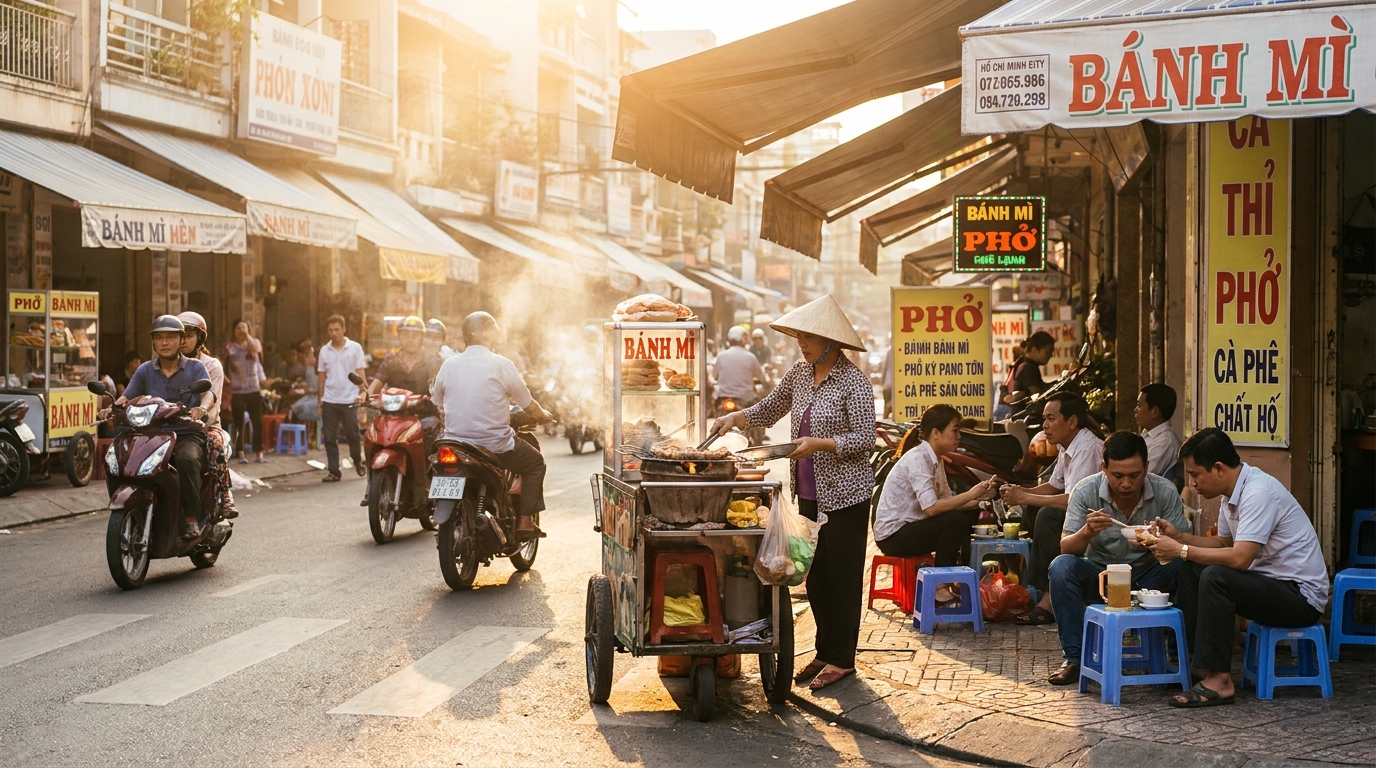
Pham Van Dong Night Market
Pham Van Dong Night Market runs Thursday to Sunday, 17:00-23:00, along Pham Van Dong Street in Binh Thanh District. It’s the largest night market in the city by stall count — around 200 food vendors — and draws an almost entirely local crowd. Regional dishes from central and northern Vietnam appear here that rarely show up in District 1: bun cha (Hanoi-style grilled pork vermicelli), banh nam (Hue steamed flat rice cake), and mut (candied fruit snacks). Getting there takes a Grab ride of roughly 20 minutes from District 1, 40,000-60,000 VND. The effort is worth it for anyone wanting to eat beyond the tourist circuit for a night.
What Are the Unwritten Rules of Street Eating in Saigon?
The WHO’s Global Food Safety Initiative identified behavioral norms around street food consumption as a key factor in both food safety outcomes and the quality of the eating experience for international visitors (WHO, 2022). Knowing the unspoken rules means faster service, better food, and less awkwardness at the plastic stool. There aren’t many rules, but the few that exist matter.
The Point-and-Order System
Most street vendors have limited or no English. The standard interaction is: approach the stall, make eye contact, point at what you want (either at a displayed dish, at an existing customer’s bowl, or at a menu photo), hold up fingers for quantity, and nod. Vendors are experienced at communicating across the language gap. Don’t overthink it. If you can say “mot” (one) and “hai” (two) in Vietnamese, you’ll manage 95% of transactions. Smiling matters. Patience matters more.
Plastic Stool Etiquette
The plastic stools and low tables that define Saigon street eating are not assigned seating. Sit where there’s space. If a table already has customers, it’s normal to sit down and join them — tables are shared by default. Don’t wait to be seated. Vendors will notice you when you sit down and come to take your order. Leaving the stool is fine when you’re done; there’s no formal check-out process. Pay when you’re finished or when the vendor brings the bill, whichever comes first.
The Herb Plate is Free
The plate of fresh herbs, bean sprouts, and sliced chilli that arrives with pho, bun bo Hue, and similar noodle dishes is complimentary. You’re expected to add them yourself. There’s no extra charge. Similarly, the condiment tray — fish sauce, chilli sauce, vinegar, and sugar — on com tam tables is there to use. Vietnamese eating culture assumes you’ll adjust the seasoning of your dish to your taste. Don’t wait to be asked. Taste first, then season.
Pricing and Bargaining
Street food in Saigon is fixed-price at market stalls and most specialist vendors. You don’t bargain for food. Asking the price before ordering is normal and expected; holding up the correct notes and coins is sufficient. At very local stalls with no visible price list, asking “bao nhieu?” (how much?) before eating is sensible. At tourist-facing markets (Ben Thanh Night Market, Bui Vien), prices are posted. Tipping is not expected or customary at street food stalls — it’s occasionally appreciated but never required.
The street food is everywhere in D1 — but knowing where to go first makes all the difference.
How Do You Assess Food Safety at a Street Stall?
The WHO’s Five Keys to Safer Food framework, applied to street food contexts in Southeast Asia (WHO Regional Office for the Western Pacific, 2023), identifies stall turnover rate and cooking temperature as the two most reliable indicators of street food safety. The practical translation for visitors: a busy stall that cooks everything to order is safer than a quiet stall with pre-cooked food sitting out. Food safety risks are real but manageable with a few basic assessments before you sit down.
The Five-Second Assessment
Before sitting at any stall, run through five quick checks. First: is food cooked to order, or has it been sitting? Opt for freshly made. Second: how many customers are there? High turnover means fresh ingredients and high stock rotation. Third: is the cooking surface and serving area visibly clean? A vendor who wipes down between customers is maintaining basic hygiene. Fourth: are raw and cooked foods kept separate? Cross-contamination is the main risk at high-volume stalls. Fifth: does the ice in drinks come from a sealed bag? Avoid drinks with loose or cloudy ice.
What to Avoid
Raw salad vegetables washed in tap water are the highest-risk item on any Saigon street food menu. Pre-cooked meats that have sat in the open for hours — particularly at low-traffic stalls — are the second. The garnish plates served with pho (raw bean sprouts, fresh basil) carry a small risk if you have a sensitive stomach; skip them on your first few days. Shellfish at street stalls are higher risk than at established seafood restaurants. Fruit that you peel yourself (banana, mandarin) is safe; pre-cut fruit from carts carries a small risk from the knife and cutting surface.
What Most Visitors Find
The overwhelming majority of visitors eat Saigon street food throughout their stay with no issues. Vietnamese people eat from street stalls daily from childhood. The food is generally cooked at high heat, consumed fresh, and rotated rapidly at busy stalls. Traveller’s stomach from Saigon street food is less common than it was a decade ago, as food safety standards at street vendor level have improved steadily. The WHO’s 2023 report on urban street food in Southeast Asia noted a 34% improvement in food hygiene compliance among registered street vendors in Ho Chi Minh City between 2019 and 2023.

When Is the Best Time of Day to Eat Street Food in Saigon?
The HCMC Department of Food Safety’s 2025 vendor census found that the highest concentration of active street food vendors occurs during two daily windows: 05:30-09:30 (breakfast) and 17:30-22:00 (evening). These are not just the busiest times — they’re the times when the food is best, because vendors are cooking to maximum demand with freshly prepared ingredients and at-temperature equipment. Each time window has a different menu.
Morning: 05:30-09:30
Pho, bun bo Hue, and chao long (rice porridge) are morning dishes. The specialist shops that make them prepare a single batch of stock each morning, serve it until it’s gone, and close. The best pho in Saigon does not serve dinner. Com tam is a morning and midday dish — the charcoal grill is lit early, the pork chops go on from 06:00, and the best cuts sell out by 09:30. If you’re staying near Ben Thanh or Pham Ngu Lao, a 07:00 walk is the best single strategy for finding the authentic morning food culture.
Midday: 11:00-14:00
Bun thit nuong, com tam, and fresh spring roll stalls run their highest volume at lunch. The 12:00-13:30 window is peak time: maximum freshness, maximum turnover, but also maximum competition for seats. Midday is not the best time for solo wandering — stalls fill quickly and vendors work fast. It’s the best time if you want to eat beside Vietnamese office workers and see the city’s working food culture in action. Avoid pre-cooked noodle and rice dishes at quiet stalls during the post-lunch 14:00-17:00 lull, when food has been sitting longest.
Evening: 17:30-23:00
The evening window is for seafood, grilled meats, banh trang nuong, che, and night markets. The D4 seafood streets, Hoang Sa canal, and Ben Thanh Night Market all peak between 19:00 and 21:00. Evening street food has a different energy from morning: more social, slower, oriented toward drinks and snacking alongside eating. Bia hoi (fresh draught beer, 10,000-15,000 VND per glass) is the standard evening street drink. Many stalls set up only in the evening and pack up by 22:00-23:00.
Frequently Asked Questions
What is the most famous street food in Saigon?
Banh mi and com tam (broken rice) are the two dishes most closely associated with Saigon’s street food identity. The Michelin Guide Vietnam (2023) included banh mi in its inaugural Saigon listing. A full com tam plate with grilled pork chop costs 40,000-70,000 VND. Both are available citywide, all day, from dedicated specialist stalls and general com tam restaurants alike.
How much does street food cost in Saigon?
A full meal from a street stall runs 40,000-80,000 VND ($1.60-3.20 USD), making Saigon the most affordable eating-out city in Southeast Asia per the Economist Intelligence Unit (2025). Snacks like banh trang nuong and che cost 15,000-30,000 VND. Tourist-corridor prices (Bui Vien, Ben Thanh Night Market) run 15-30% higher than equivalent stalls in local neighbourhoods.
Is Saigon street food safe to eat?
Yes for the majority of visitors who stick to freshly cooked, hot food from high-turnover stalls. WHO (2023) recorded a 34% improvement in food hygiene compliance among registered HCMC street vendors between 2019 and 2023. The main risks are raw garnishes washed in tap water and pre-cooked food at quiet stalls. A busy stall cooking to order is both the safest and usually the best-tasting option.
What are the best night markets for street food in Saigon?
Ben Thanh Night Market (nightly, 18:00-23:00, District 1) is the most accessible for visitors, with around 100 food stalls and moderate prices. Pham Van Dong Night Market (Thursday-Sunday, 17:00-23:00, Binh Thanh) is the largest at roughly 200 stalls, draws a local crowd, and offers regional dishes rarely found in D1. Vietnam Ministry of Culture (2023) notes night markets generate 18% of total HCMC street food revenue.
What time of day is best for street food in Saigon?
For breakfast dishes (pho, bun bo Hue, com tam): 05:30-09:30, before specialist stalls sell out. For general street eating: the lunch window 11:00-14:00 and the evening window 17:30-22:00. HCMC Department of Food Safety (2025) found the highest vendor density during those two windows. Avoid the 14:00-17:00 lull — that’s when pre-cooked food has been sitting longest and turnover is lowest.
For more Saigon guides, check out: Saigon Street Food Tour: The Best Food to Try and Where to Find It, Migo Saigon Food Street: Complete Guide to District 1’s Most Talked-About Dining Strip.
For official information and further reading, visit TripAdvisor — Ho Chi Minh City Restaurants.