
Saigon Central Post Office: History, Photos, and Visitor Tips
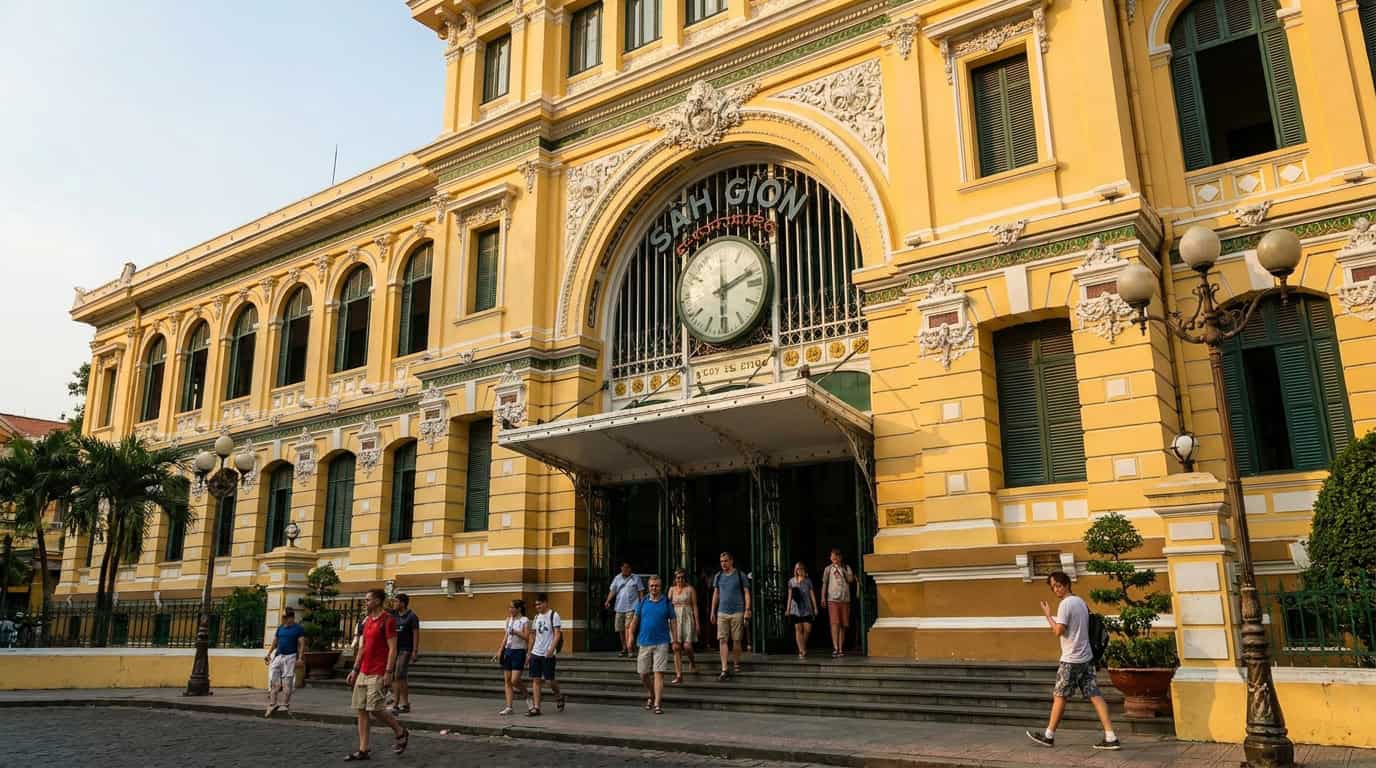
Saigon Central Post Office consistently ranks among the five most photographed buildings in Ho Chi Minh City, appearing in an estimated 70% of D1 travel itineraries shared on travel platforms (TripAdvisor HCMC Attraction Rankings, 2025). Built between 1886 and 1891 with technical input from Gustave Eiffel’s engineering firm, it remains a fully functioning post office more than 130 years after opening. Entry is free, the interior is extraordinary, and most visitors spend only 20 minutes inside — far less time than it deserves.
Key Takeaways
- Construction ran from 1886 to 1891, with Gustave Eiffel’s firm providing the iron structural framework that supports the barrel-vaulted ceiling.
- Entry is completely free and open to the public during post office operating hours.
- It’s a working post office: you can send a postcard from a building designed by Eiffel’s team. Stamps are on sale at the main counter.
- The building ranks among the top 5 most photographed in HCMC, appearing in ~70% of D1 itineraries (TripAdvisor, 2025).
- Notre-Dame Cathedral is 150 metres away — the two buildings make a natural 90-minute combined visit.
Who Built the Saigon Central Post Office?
The Post Office was constructed between 1886 and 1891 under the oversight of French architect Auguste Henri Vildieu, with the iron structural framework designed by the firm of Gustave Eiffel — who was simultaneously working on the Eiffel Tower in Paris (completed 1889) (ArchDaily, 2018). This means the Post Office’s iron skeleton was being engineered during the same years Eiffel’s Paris tower was being assembled. The two projects share structural DNA: both use exposed iron arches to create large, column-free interior spaces flooded with natural light.
French colonial administrators wanted the Post Office to serve a dual function: a working communications hub for the colony and a civic monument projecting French permanence. Vildieu’s design delivered both. The yellow ochre exterior, with its arched windows, pilastered facade, and roofline inscription “Buu Dien Trung Tam Thanh Pho” (Central Post Office of the City), is visible from across Paris Square. The interior, invisible from outside, is even more impressive.
What Does the Interior of the Saigon Central Post Office Look Like?
The moment you step through the main entrance, the barrel-vaulted ceiling stops most visitors in their tracks. The vault spans approximately 12 metres across and 60 metres in length, supported by the Eiffel-designed iron arches and pierced by dozens of arched clerestory windows that flood the hall with natural light (Architectural Digest, 2021). The effect is closer to a 19th-century European railway terminus than anything most visitors have previously seen in Vietnam. The floor is laid with original encaustic tiles — a terracotta geometric pattern that has survived remarkably intact.

At the far end of the hall, facing you as you enter, hangs a large portrait of Ho Chi Minh — a standard feature of government buildings in Vietnam. It’s positioned centrally, framed by the vault, and creates an unavoidable focal point. Most visitors photograph it instinctively. Around it, the original 19th-century wooden postal counter runs the full width of the far wall. Some of the original counter equipment — scales, letter holders, brass fittings — remains in use alongside modern terminals.
The Vintage Maps on the Walls
The most overlooked element of the interior is also its most historically interesting. On both side walls of the main hall, large painted maps are mounted under glass. These are reproductions of 19th-century French cartographic surveys: one showing Saigon and the surrounding region circa 1892, the other showing the telegraph network connecting Saigon to Phnom Penh and Hanoi. These are not decorative. They were the working infrastructure maps of the colonial communications network this building was designed to anchor.

Look closely at the Saigon map: the city boundaries it shows are a fraction of the current HCMC metropolitan area. What is now a city of 9 million people appears as a compact colonial administrative district along the river bend. The map makes the city’s growth over 130 years viscerally clear in a way that no historical explanation achieves on its own.
What Can You Actually Do at the Post Office?
The Post Office is a fully operational postal facility, not a museum. That distinction matters because it means you can do things here, not just look. Sending a postcard from a building that Eiffel’s firm helped design — to an address on the other side of the world — is a genuinely satisfying travel experience that costs under 20,000 VND.
The main counter offers the full range of Vietnam Post services: domestic and international letter posting, parcel shipping, registered mail, and philatelic stamp sales. The stamp selection at the counter includes commemorative issues and themed sets that make unusually good souvenirs. Postcard sets featuring HCMC colonial architecture are sold from a small stand near the entrance, typically priced at 10,000-20,000 VND per card.
Currency exchange is available at a booth near the north wall. The rate is competitive with street-level exchange houses and less likely to involve sleight-of-hand. Phone booths — styled in the original 1890s wooden cabinet design — are still installed along both side walls, though most are now decorative or converted to souvenir shops.
The souvenir stalls along the side walls sell the full range of Vietnamese tourist goods: lacquerware, silk scarves, wooden chopstick sets, and postcards. Prices are fixed and higher than Ben Thanh Market. The advantage is the setting — buying a lacquered box inside an Eiffel-framed vault is a different experience from buying the same box in a market stall.
What Are the Opening Hours?
The Post Office is open Monday to Friday from 07:00 to 19:00, and Saturday from 07:00 to 18:00. Sunday hours are typically 08:00 to 18:00, though the full postal counter services may be limited. Entry is free at all times during operating hours. No booking or ticket is required. The building does not close for a midday break, unlike some other HCMC attractions (Vietnam Post, 2025).
Weekday mornings before 10:00 offer the best combination of good light and low crowd density. The hall fills noticeably between 10:00 and 13:00 with tour groups. Weekend afternoons are busy but manageable — the sheer size of the hall means it rarely feels genuinely crowded.
Photography Tips: Best Angles and Lighting
The interior is the primary photographic subject, and the barrel vault demands a wide-angle lens or the widest setting your phone camera allows. Stand just inside the entrance and frame the full length of the hall toward the Ho Chi Minh portrait — this is the “classic” shot that appears in most travel feature photography. The best natural light for this angle is between 08:30 and 10:00, when the eastern clerestory windows back-light the dust and incense in the air.
For the maps, get close. A standard 24mm equivalent lens won’t do justice to the cartographic detail. The maps are behind glass, which creates glare at certain angles — shoot perpendicular to the wall surface rather than at an angle. The label text is in French and Vietnamese, and much of it is still legible if you examine the original 19th-century inscriptions.
The exterior is best photographed from across Paris Square, using the fountain as a foreground element. Late afternoon (16:00-18:00) lights the yellow facade warmly. The “Eiffel in Asia” narrative makes the external ironwork details — visible in the roofline and window casings — worth isolating as close-up shots.
How to Combine the Post Office With Notre-Dame Cathedral
The two buildings are 150 metres apart and take roughly 90 minutes to visit in combination. Start at the Post Office when it opens at 07:00 — this gives you the best interior light and the quietest conditions. Spend 35-40 minutes inside. Walk directly to Notre-Dame Cathedral and the Paris Square garden for 30-40 minutes, including a full exterior circuit. Return to the Post Office if you want to send a postcard or buy stamps — the counter queues are shorter before 09:00.
This sequence is one of the most efficient uses of a morning in D1. Both attractions are free, both are architecturally significant, and the short walk between them passes through the Paris Square fountain area — one of the most pleasant pedestrian spaces in the city. Add the Reunification Palace (700 metres south, 40,000 VND entry) and you have a complete half-day programme without needing any transport.
One of Saigon’s most photographed buildings is a short walk from our D1 apartments — no transport needed.
Frequently Asked Questions
Is the Saigon Central Post Office free to enter?
Yes, entry is completely free. The Post Office is a functioning government post office operated by Vietnam Post, open to the public during business hours. There is no ticket, queuing system, or entry gate. You walk in directly through the main doors on Paris Square. The only costs inside are if you choose to send mail, buy stamps, exchange currency, or purchase souvenirs from the stalls along the side walls.
Did Gustave Eiffel actually design the Post Office?
Eiffel’s firm provided the iron structural design for the building’s barrel-vaulted ceiling and framework, during the same period Eiffel was completing the Paris tower (1889). The architectural design was by French colonial architect Auguste Henri Vildieu. This is a common point of confusion: Eiffel’s contribution was structural engineering, not architectural design. Vietnam’s colonial-era buildings benefited substantially from French engineering innovation of this period, and the Post Office is the clearest example in HCMC.
Can you send international mail from the Saigon Central Post Office?
Yes. The main counter handles international airmail, registered international post, and EMS express mail service. International postcard rates as of 2025 are approximately 15,000-20,000 VND. Letters and parcels are priced by weight and destination. Estimated international delivery times run 7-14 days for airmail to Europe, North America, and Australia. Vietnam Post processes international mail through the main hub in Hanoi, so the Post Office functions as a collection and dispatch point rather than a customs clearance facility.
What are the best things to buy at the Saigon Central Post Office?
Commemorative postage stamps are the most unique purchase available at the Post Office. Vietnam Post issues themed stamp sets covering Vietnamese history, wildlife, and cultural events — priced from 50,000 VND per set. These are genuine collectibles not available in tourist markets. Postcards of HCMC colonial architecture are sold near the entrance at 10,000-20,000 VND. The souvenir stalls along the walls sell standard tourist goods at above-market prices — better value on these items at Ben Thanh or the riverside night market.
How long should you spend at the Saigon Central Post Office?
Most visitors spend 20-30 minutes inside, which is enough for a full walk-through and photos. If you want to examine the wall maps closely, send postcards, and browse the stamp collection, plan 45-60 minutes. The building ranks among the five most photographed in HCMC (TripAdvisor, 2025), so arriving before 09:00 on weekdays gives you the vault largely to yourself — a significantly different experience from the midday crowd.
Planning to make Saigon your base?
For more Saigon guides, check out: Saigon 7-Day Itinerary: A Week in Ho Chi Minh City, Saigon 3-Day Itinerary: The Perfect First-Timer’s Guide.