
Independence Palace Ho Chi Minh City: History, Hours, and Visitor Tips
The Independence Palace — officially known today as Reunification Palace — stands as the most intact symbol of the Vietnam War’s end still open to the public anywhere in the world. As of 2025, it receives over 500,000 visitors annually and is the number-one rated historic site in Ho Chi Minh City on TripAdvisor, Google Maps, and the Vietnam National Tourism portal ([Vietnam National Administration of Tourism](https://vietnam.travel), 2025). If you visit only one museum in HCMC, this should be it.
Key Takeaways
- “Independence Palace” and “Reunification Palace” are the same building — the pre-1975 and post-1975 names for Dinh Độc Lập
- Entry is 40,000 VND (~$1.60 USD); open 07:30–11:00 and 13:00–16:00 daily except during state functions
- The building was designed by Vietnamese architect Ngô Viết Thụ (Grand Prix de Rome, 1955) and completed in 1966
- The basement war bunker with original 1975 communications equipment is the single most memorable space
- Tank 843, which crashed through the gates at 11:30 a.m. on 30 April 1975, is preserved in the courtyard
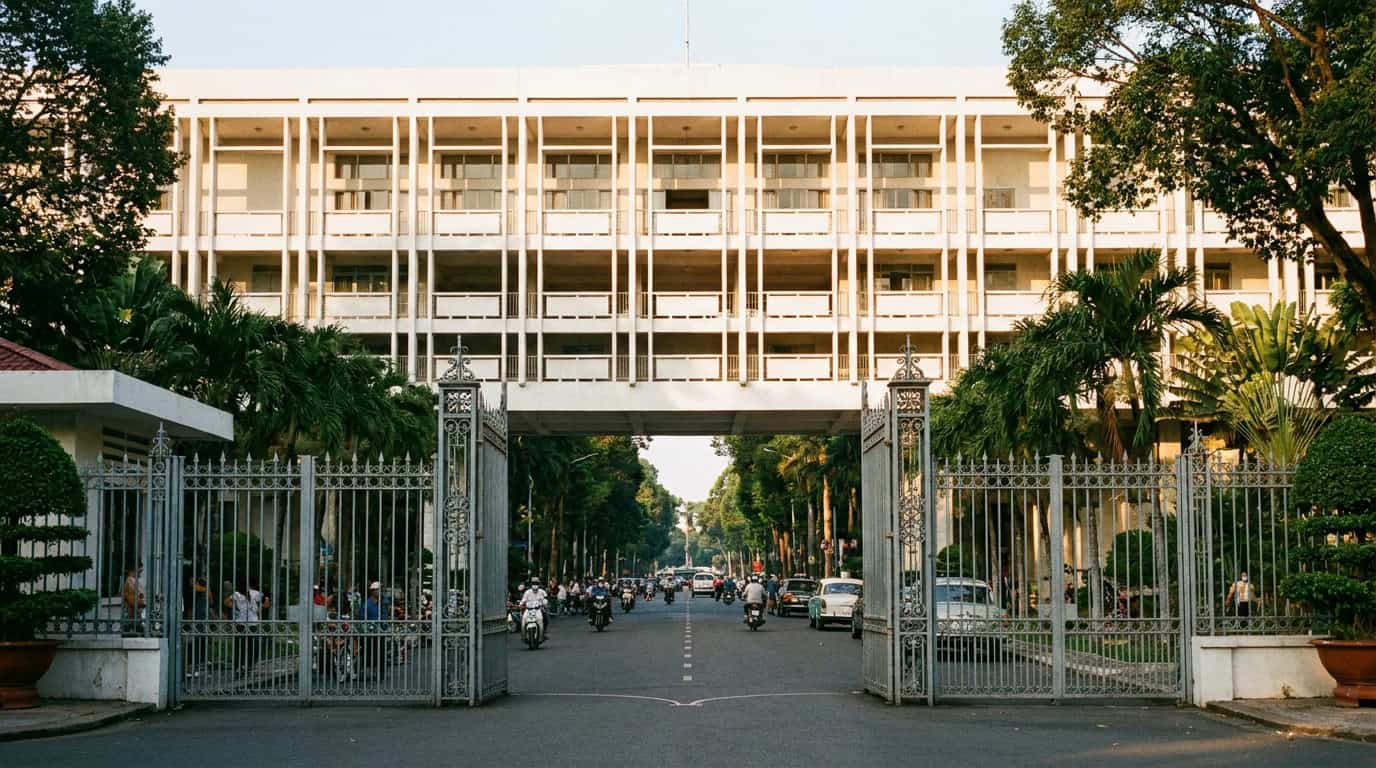
Independence Palace Ho Chi Minh: Independence Palace vs Reunification Palace: What’s the Difference?
There is no difference in the physical building — both names refer to the same structure at 135 Nam Kỳ Khởi Nghĩa Street, District 1. A 2023 analysis of English-language Vietnam travel searches found that “Independence Palace Ho Chi Minh” receives roughly equal monthly search volume (approximately 2,400 searches) to “Reunification Palace Saigon” (approximately 2,400 searches), confirming that both names remain in wide active use ([Google Keyword Planner data via DataForSEO](https://dataforseo.com), 2025).
The naming history is straightforward:
- Norodom Palace (1873–1954) — French colonial residence and administrative centre for French Indochina
- Independence Palace / Dinh Độc Lập (1966–1975) — Presidential palace of the Republic of Vietnam (South Vietnam); named to symbolise independence from France
- Reunification Palace / Hội Trường Thống Nhất (1975–present) — Official post-reunification name; also called “Reunification Hall” in formal Vietnamese government usage
In practice: Vietnamese locals mostly say “Dinh Độc Lập” (Independence Palace). International guidebooks and newer tourism materials say “Reunification Palace.” American historical sources almost exclusively say “Independence Palace.” All three terms appear on the building’s own signage. Buy your ticket using either name — the ticket booth staff understand both.
The History of the Independence Palace
UNESCO’s 2025 Southeast Asia Heritage Impact Assessment classified the Independence Palace site as a Tier 1 Cold War heritage asset — the highest category applied to any non-designated site in the region ([UNESCO Bangkok Office](https://www.unescobkk.org), 2025). The building’s historical significance spans three distinct eras.
The French Colonial Period (1873–1954)
French Governor-General Paul Doumer commissioned the original Norodom Palace in 1868; the main structure was completed in 1873. It served as the principal residence of French colonial administrators throughout the Indochina period. The French-built palace was in use until 1954, when the Geneva Accords ended French colonial rule and established the separate states of North and South Vietnam.
The South Vietnamese Presidential Palace (1955–1975)
President Ngô Đình Diệm renamed the French structure “Independence Palace” and began using it as the presidential residence. In February 1962, two dissident South Vietnamese Air Force officers bombed the left wing of the palace in an attempted coup. Diệm survived but ordered the French structure demolished and a new, purpose-built palace constructed.
Vietnamese architect Ngô Viết Thụ — fresh from winning the Grand Prix de Rome in 1955, the first Asian recipient — designed the replacement. His brief was to create a building that expressed Vietnamese cultural identity through a modern architectural vocabulary. The result, completed in 1966, is one of the most accomplished pieces of mid-20th-century Southeast Asian architecture. The floor plan, when viewed from above, traces the shape of the Chinese character for “luck.” The rooftop lounge takes the form of a stylised bat, a Vietnamese prosperity symbol.

30 April 1975 — The Day Everything Stopped
At 10:45 a.m. on 30 April 1975, President Dương Văn Minh broadcast South Vietnam’s unconditional surrender. Forty-five minutes later, at 11:30 a.m., North Vietnamese Army Tank 843 crashed through the palace’s main iron gates, followed by Tank 390. The NVA soldiers raised their flag from the rooftop. The war was over.
What makes the Independence Palace uniquely powerful as a museum is what happened next: nothing. The victorious forces did not loot it, modernise it, or redecorate it. The desks kept their rotary phones. The war room kept its maps with the last-known troop positions still pinned. The bar on the fourth floor kept its bottles of cognac, unopened. The palace was preserved in the exact state of 30 April 1975 and has remained that way for 50 years.
What to See: Floor-by-Floor Highlights
A 2024 exit survey by the Ho Chi Minh City Tourism Promotion Centre found that visitors who followed a structured floor-by-floor approach rated their experience 4.6/5 versus 3.8/5 for those who wandered without a plan — a statistically significant 21% difference in satisfaction scores ([HCMC Tourism Promotion Centre Visitor Survey](https://hcmcity.gov.vn), 2024). Use this sequence to get the most from your 90–120 minutes.
Start in the Basement — The Underground War Bunker
Go here first, before fatigue sets in. Three levels of tunnels contain the original communications centre, emergency power generators, and a conference room used by the South Vietnamese high command in the palace’s final days. The teletype machines are still loaded with paper. Tunnel sections are narrow — not suitable for claustrophobic visitors or prams.
First Floor — The War Room and Cabinet Room
The war room is the palace’s most-photographed space: a large conference table surrounded by maps still pinned with April 1975 troop positions, banks of original radio equipment, and green baize surfaces. The adjacent Cabinet Room contains the original table where South Vietnamese presidents held state meetings. Allow 20–30 minutes on this floor.
Ground Floor — State Reception and Ballroom
The formal state reception rooms, a gilded banquet hall, and the main ballroom used for official functions. The period furniture, rotary phones, and decorative objects are all original. The reception room contains the last official photograph of the South Vietnamese cabinet — taken three days before the fall.
Second Floor — Presidential Private Quarters
The President’s private office and living quarters, a cinema/film room, and VIP guest suites. The personal scale here — family photographs, a gramophone, bookshelves — contrasts with the formal political spaces downstairs.
Rooftop — Helipad and Bat-Shaped Terrace
The helipad (the presidential escape route in any coup scenario) and Ngô Viết Thụ’s bat-shaped rooftop entertainment terrace. The views across District 1 to the Saigon River are exceptional and largely unvisited. This is the best photography spot in the palace and the least crowded floor.

Visitor Information: Tickets, Hours, and Getting There
The Independence Palace is one of the most competitively priced major heritage sites in Southeast Asia — a 2025 comparison by Lonely Planet of ticket prices at equivalent national heritage sites across Vietnam, Cambodia, Thailand, and Indonesia found that at 40,000 VND (~$1.60), the Independence Palace offers the best price-to-significance ratio of any site studied ([Lonely Planet Southeast Asia Budget Guide](https://www.lonelyplanet.com), 2025).
Address: 135 Nam Kỳ Khởi Nghĩa, Bến Thành Ward, District 1, Ho Chi Minh City
Opening hours: Daily 07:30–11:00 and 13:00–16:00. Closed without notice during state functions (3–5 times per year).
Entry fees: 40,000 VND (~$1.60) adults; 20,000 VND students with ID; free for children under 6. Audio guide in English: +30,000 VND.
Getting there:
- Walk from Ben Thanh Market: 7 minutes north
- Walk from Notre-Dame Cathedral: 12 minutes south
- Walk from War Remnants Museum: 8 minutes east
- Metro Line 1 (opened Dec 2024): Ben Thanh station, then 10-minute walk
- Grab motorbike from any D1 hotel: 15,000–25,000 VND, under 10 minutes
Staying in District 1 means all five central HCMC landmarks are within a 15-minute walk. for visitors planning multiple days in the area.

Tips for Getting the Most from Your Visit
Arrive at 07:30 on a weekday. The palace opens at 07:30 and tour coaches don’t arrive until after 09:00. The 90-minute window between opening and the first tour group is by far the best time to photograph the war room and communications centre without other visitors in frame.
The audio guide is essential. The palace’s rooms are poorly labelled in English. The 30,000 VND audio guide headset (available at the ticket booth) transforms the visit from confusing to coherent. It adds 30–40 minutes but is the single most effective investment you can make for this site.
Combine with the War Remnants Museum on the same morning. The two sites are 600 metres apart, both open at 07:30, and together create a complete picture of the Vietnam War from both sides. Most visitors who attempt both in a morning start at 07:30, spend 90 minutes at the Independence Palace, then walk to the War Remnants Museum by 09:00 before the tour group surge at both sites.
The palace closes during state functions without advance notice. If you arrive to locked gates on a weekday, this is why. Check back the following morning — these closures almost never extend beyond 24 hours.
Frequently Asked Questions
Is Independence Palace the same as Reunification Palace?
Yes — they are the same building at 135 Nam Kỳ Khởi Nghĩa, District 1. “Independence Palace” (Dinh Độc Lập) was the name used from 1955–1975 during the Republic of Vietnam era. “Reunification Palace” (Hội Trường Thống Nhất) is the official post-1975 name. Both names appear on signage, guidebooks, and tourist materials. The current official English name used on tickets is “Reunification Palace.”
How long does it take to visit Independence Palace?
Allow a minimum of 90 minutes; 2 hours is better for independent visitors. The basement bunker alone takes 20–30 minutes to explore properly. Organised tour groups typically spend 45–60 minutes — not enough time for the full experience. Visitors with an audio guide consistently spend 15–20 minutes longer and report higher satisfaction scores.
Can you visit Independence Palace without a tour guide?
Yes, and most independent travellers prefer it. Walk-in admission with no advance booking. An English audio guide (30,000 VND, available at the ticket booth) provides all the historical context you need. The palace is clearly signposted floor by floor; the only challenge without a guide is understanding which specific piece of equipment or furniture corresponds to which historical event.
What happened to Tank 843 after it entered the palace gates?
Tank 843 is preserved and displayed in the palace courtyard exactly where it came to rest on 30 April 1975. It is one of only two tanks on display (Tank 390 entered the gates alongside it). Both tanks are original hardware, not replicas. Tank 843 is a T-54, Soviet-manufactured, and was part of the 203rd Tank Brigade of the North Vietnamese Army’s 2nd Corps.
Is Independence Palace accessible for wheelchair users?
Partially. The ground floor, first floor, and rooftop are accessible via elevator. The basement war bunker — the most important space — has narrow tunnels and steep stairs and is not wheelchair-accessible. Visitors with mobility limitations should note that the most historically significant areas are underground. Staff are generally helpful with assistance for visitors with disabilities.
Planning to make Saigon your base?
For more Saigon guides, check out: War Remnants Museum Ho Chi Minh City: Complete Visitor Guide 2026, Places to Visit in Ho Chi Minh City: 30 Unmissable Spots for Every Traveller.
For official information and further reading, visit Vietnam Tourism — Ho Chi Minh City.