
When weighing a saigon hotel district 1 stay against a serviced apartment for a month-long trip or relocation, the cost gap is larger than most travelers expect. A standard four-star hotel room in District 1 runs $70–$150 per night before taxes and service charges, while a fully managed serviced apartment in the same area costs $30–$60 per night on a monthly rate. Over 30 nights, that difference can exceed $1,500 — money that stays in your pocket without sacrificing comfort, central location, or daily housekeeping.
Key Takeaways
- A 30-night stay at a mid-range saigon hotel district 1 costs $2,100–$4,500 all-in; a comparable serviced apartment runs $900–$1,800.
- Hotels add 10% VAT plus 5–8% service charge on every invoice; serviced apartments typically include all utilities in one flat monthly rate.
- Serviced apartments in District 1 offer full kitchens, washing machines, and separate living areas — critical for stays beyond two weeks.
- According to the Vietnam National Authority of Tourism, hotel occupancy in Ho Chi Minh City averaged 72% in 2024, pushing walk-in rack rates higher than online averages suggest.
- Monthly apartment contracts can be terminated with 30 days’ notice, giving the same flexibility as rolling hotel bookings without the nightly premium.
What Does a Saigon Hotel District 1 Actually Cost Per Night?
Rack rates at a saigon hotel district 1 property vary widely by star rating and season. Budget guesthouses on Bui Vien Street start around $25–$40 per night, but they offer dormitory-style amenities and zero privacy. Mid-range four-star hotels — the Caravelle, Rex, Liberty Central — typically price at $90–$150 per night. Five-star options like the Park Hyatt or Hotel des Arts push $200–$400 before any extras.

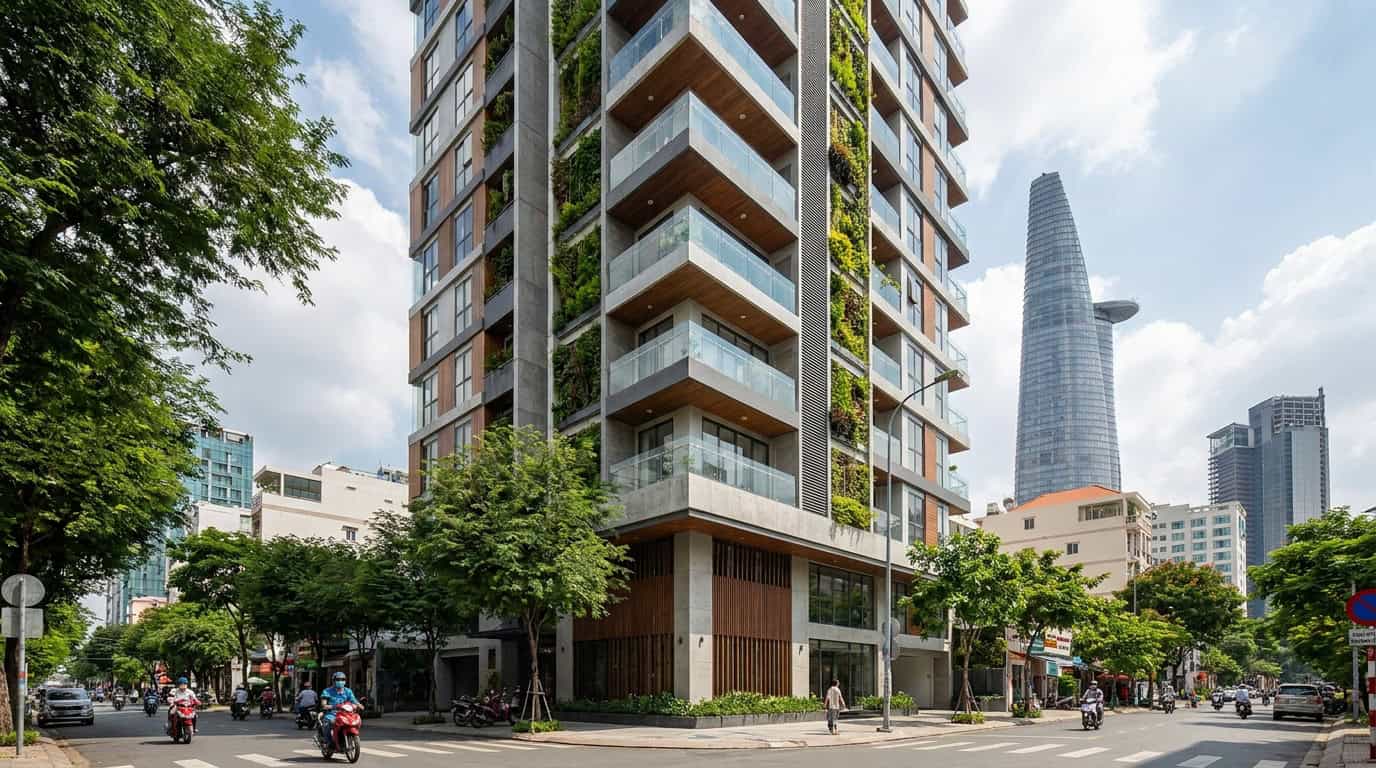
Those headline figures exclude the 10% VAT and 5–8% service charge that Vietnamese hotels legally apply to every bill. A $120 room becomes $139–$142 after fees. Order breakfast, use the minibar, or request late check-out and the real daily spend climbs further. For a 30-night stay at a mid-range property, the all-in total typically lands between $2,100 and $4,500 depending on the hotel tier and season.
The Hidden Costs Hotels Don’t Advertise
Beyond the nightly rate, extended hotel stays in District 1 generate a surprising list of add-on expenses that serviced apartments eliminate entirely.
- Laundry: Hotel laundry in District 1 charges $2–$5 per garment. A weekly load for one person costs $30–$60. Over 30 days, that’s $120–$240.
- Food and drink: Without a kitchen, every meal is eaten out or ordered to the room. Breakfast buffets at four-star hotels cost $15–$25 per person. Cooking even four meals a week in an apartment kitchen saves $200–$400 over a month.
- Workspace: Business travelers who work from the room pay for slow hotel Wi-Fi shared across hundreds of guests. Dedicated fiber connections in serviced apartments typically deliver 100–300 Mbps symmetric speeds.
- Storage: Standard hotel rooms offer minimal storage. Long-stay guests routinely rent external storage or live out of open suitcases, a quality-of-life tax that has no dollar value but genuine daily friction.
Saigon Hotel District 1 vs Serviced Apartment: A Side-by-Side Cost Table
The comparison below uses realistic 2025–2026 market rates for a single adult staying 30 nights in central District 1, Ho Chi Minh City.
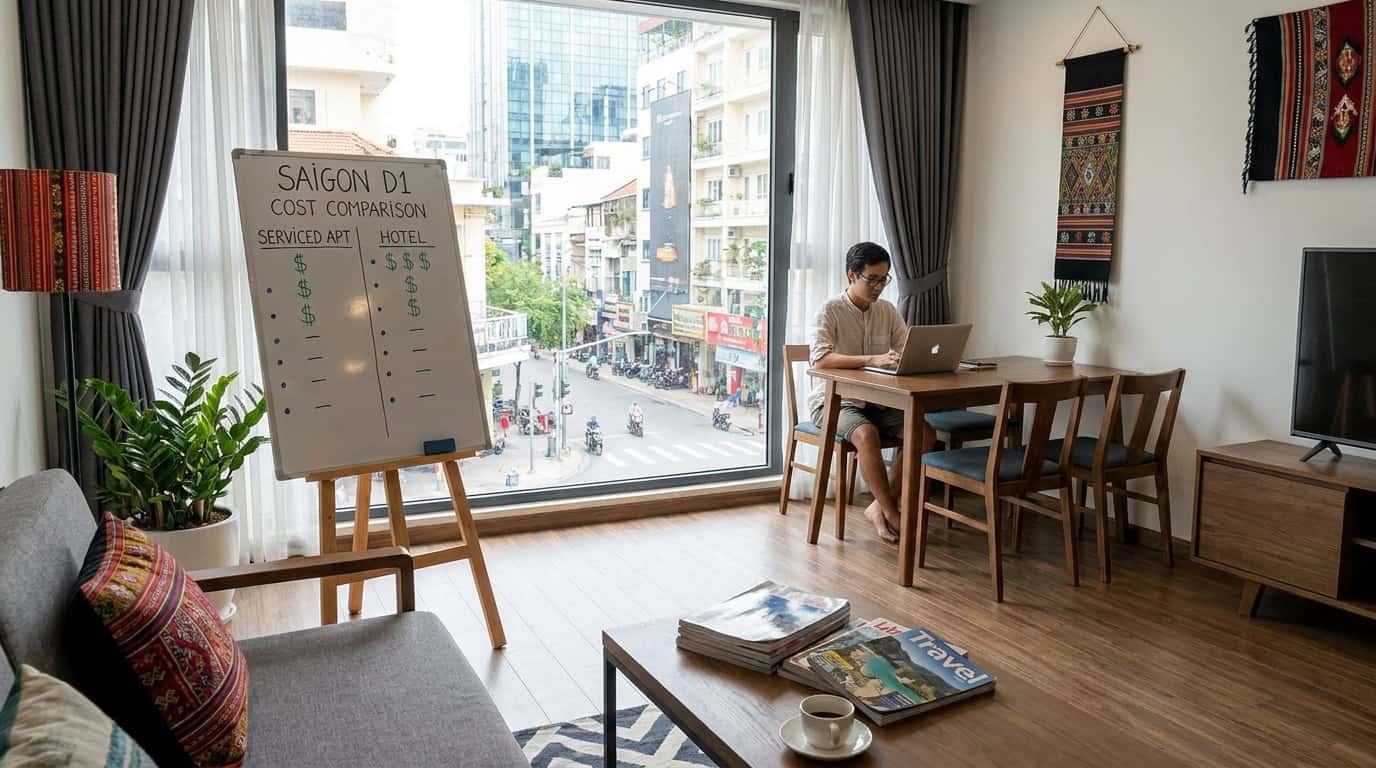
- Four-star hotel nightly rate (after taxes): $139–$165 | Monthly total: $4,170–$4,950
- Three-star hotel nightly rate (after taxes): $70–$100 | Monthly total: $2,100–$3,000
- Budget hotel/guesthouse: $35–$55 | Monthly total: $1,050–$1,650
- Serviced apartment (studio, monthly rate): $900–$1,200 all-inclusive
- Serviced apartment (1BR, monthly rate): $1,200–$1,800 all-inclusive
Thirty nights in a District 1 hotel costs $2,100–$4,500. The same period in our serviced apartment: $900–$1,800, fully managed. The math is simple — see the numbers at saigonapartment.vn/residences.
Location: Are Serviced Apartments as Central as District 1 Hotels?
A common misconception is that serviced apartments are pushed to the fringes of the city. In reality, dozens of professionally managed apartment buildings sit inside District 1’s core — within walking distance of Ben Thanh Market, the Opera House, and the Nguyen Hue pedestrian boulevard. Streets like Nguyen Thi Minh Khai, Nam Ky Khoi Nghia, and Le Thanh Ton host serviced apartment buildings that are closer to key business addresses than many hotels marketed as “District 1.”
For context on the city’s growth trajectory: According to the Ho Chi Minh City Department of Planning and Investment, the city added over 14,000 new businesses in the first half of 2024 alone, accelerating demand for both short-term and long-term accommodation in central districts. The influx has actually widened the price gap between hotels (which sell scarcity) and apartments (which compete on monthly value).
What You Get With a Serviced Apartment That a Hotel Can’t Match
A saigon hotel district 1 experience is optimized for two-night stays, not two-week or two-month ones. Serviced apartments are engineered for extended living.
- Full kitchen: Induction cooktop, microwave, refrigerator, and cookware. Wet markets in District 1 (Ben Thanh, Tan Dinh) sell fresh produce for a fraction of restaurant prices.
- Washing machine and dryer: Eliminates the hotel laundry markup entirely.
- Separate bedroom and living room: Essential for anyone working remotely or traveling with a partner. Hotel rooms collapse all functions into a single space.
- Fixed monthly billing: One invoice covers rent, electricity, water, Wi-Fi, and weekly housekeeping. No surprise charges at checkout.
- Address for mail and deliveries: Hotels cannot reliably accept packages or official correspondence. A serviced apartment provides a real street address.
Who Stays in District 1 Hotels vs Serviced Apartments?
Understanding the typical guest profile explains why both options exist at scale in Ho Chi Minh City.
Hotels suit: Tourists on 3–7 night city breaks, conference attendees with corporate expense accounts, travelers who value concierge and bellhop services, and guests who genuinely move daily between cities.
Serviced apartments suit: Digital nomads on 30–90 day stays, corporate relocatees, expats in trial periods before signing a long-term lease, families needing kitchen facilities, and anyone who calculates a per-night rate and compares it honestly to alternatives.
According to Savills Vietnam’s 2024 Ho Chi Minh City Residential Report, the serviced apartment segment saw occupancy rates of 80–85% among Grade A properties in District 1 during Q3 2024, outperforming many mid-market hotels in the same quarter. Demand is driven heavily by the regional corporate relocation market and the growing digital-nomad segment from Europe and North America.
Safety, Service, and Daily Life in District 1
District 1 is the safest and most international district in Ho Chi Minh City. Street crime is low by Southeast Asian capital standards. The neighbourhood offers 24-hour convenience stores (Circle K, GS25, Ministop), international supermarkets (Winmart, Co.opmart), dozens of coffee shops with reliable Wi-Fi, and a dense network of grab-bike drivers who make transport logistics trivial.
Serviced apartments in District 1 typically include 24/7 building security, CCTV, and a reception desk that handles deliveries and visitor registration — all standard features that parallel hotel security infrastructure. The day-to-day experience of living in a District 1 serviced apartment feels more like a premium residential building than a stripped-down rental.
How to Find a Legitimate Saigon Hotel District 1 Alternative
The serviced apartment market in Ho Chi Minh City has no central MLS-style database, which means many of the best deals circulate through direct operator websites and local networks rather than Airbnb or Booking.com. When evaluating options, check for the following:
- Monthly rate transparency: The quoted price should include electricity (typically capped at a fixed rate), water, internet, and housekeeping frequency.
- Contract flexibility: Reputable operators offer 1-month minimum stays with 30-day notice for termination, matching the effective flexibility of a rolling hotel booking.
- Building license: Confirm the building holds a valid serviced apartment operating license from the District 1 People’s Committee, not just a residential building permit.
- Furniture and appliance quality: Visit in person or request a video walkthrough before signing. Photographs flatter every space; a 5-minute video call reveals the real condition.
- Emergency contacts: Ask who to call at 2 AM if the air conditioner fails. A professional operator answers. A grey-market sublet does not.
Visa and Legal Considerations for Long Stays in District 1
Vietnam’s e-visa now permits stays of up to 90 days for citizens of 80+ countries, with the option to extend inside the country for a further 90 days without leaving. This makes the 30–90 day serviced apartment stay a legally straightforward option for most Western nationals. Hotels are required by law to submit guest registration to local police daily (the CT01/CT02 forms); reputable serviced apartment operators handle the same requirement, so there is no compliance advantage to choosing a hotel for visa registration purposes. Always confirm that your apartment operator performs this registration — it is a legal obligation, not an optional service.
Booking Timeline and Seasonal Pricing
District 1 hotel rates peak during Tet (Vietnamese Lunar New Year, January–February), the dry season peak (December–April), and major international events. Rates drop in the wet season (May–October), sometimes by 20–30%, but availability at well-run properties remains limited year-round due to the high baseline occupancy cited above.
Serviced apartment pricing is far more stable. Monthly rates rarely fluctuate more than 5–10% between seasons because operators price for long-term tenants, not for the nightly spot market. Booking 2–4 weeks in advance is usually sufficient; last-minute availability is common outside of Tet. The planning burden is significantly lower than managing a saigon hotel district 1 search across OTA platforms during peak periods.
Making the Final Decision: Hotel or Apartment for Your District 1 Stay
The break-even point between a mid-range saigon hotel district 1 property and a serviced apartment is roughly 10–14 nights. Below that threshold, hotel flexibility may justify the premium. Above it — particularly at 30 days or more — the apartment wins on every financial metric and matches or exceeds the hotel on comfort, space, and daily practicality.
For expats, corporate travelers, and long-stay tourists, the choice is rarely close once the true costs are compared side by side. The saigon hotel district 1 option makes sense for its intended use case: short, high-service stays where price sensitivity is low. For everyone else counting nights beyond two weeks, the serviced apartment calculus is straightforward.
You May Also Find Useful
- Free Things to Do in Saigon 2025: A Resident’s Guide to Zero-Cost Days in District 1
- Serviced Apartments vs Unfurnished Rentals in Saigon: Honest Comparison
- Apartments with a Pool in Saigon 2025: Where to Find Them in District 1 and What They Cost
- Serviced Apartment District 1 Saigon: Full Review of the Best Managed Residences
Rates in Ho Chi Minh City move a lot by season and by district. It is worth comparing current availability on Booking.com and Agoda before committing to anything.
Frequently Asked Questions
What is the average cost of a saigon hotel district 1 per night?
Mid-range four-star hotels in District 1 average $90–$150 per night before Vietnam’s 10% VAT and 5–8% service charge. After fees, the effective nightly rate is typically $100–$165. Budget guesthouses on Bui Vien start around $30–$50, while luxury properties (Park Hyatt, Caravelle) run $200–$400+.
Are serviced apartments in District 1 safe for solo travelers?
Yes. Grade A and B serviced apartment buildings in District 1 maintain 24/7 front desk staff, CCTV systems, key-card access, and building security. District 1 itself has one of the lowest petty crime rates in Ho Chi Minh City. Solo travelers — including solo female travelers — report feeling equally safe in well-run apartment buildings as in four-star hotels.
Can I get a monthly rate at a District 1 hotel?
Some hotels offer negotiated monthly rates, particularly in the wet season. However, even negotiated hotel monthly rates rarely drop below $2,000–$2,500 for a mid-range room because the hotel still absorbs daily housekeeping, front-desk staffing, and common-area maintenance costs. A serviced apartment at $900–$1,800 per month remains significantly cheaper.
What’s the minimum stay at a serviced apartment in District 1?
Most professional serviced apartment operators in District 1 set a minimum stay of 30 days. Some accept 2-week bookings at a slight premium. Short-stay platforms like Airbnb list apartments at nightly rates, but the per-night cost approaches hotel rates at that booking horizon — the savings are realized only at monthly or longer billing intervals.
Does a serviced apartment include cleaning and linen changes like a hotel?
Standard serviced apartment packages in District 1 include weekly housekeeping, fresh linen, and towel replacement. Some operators offer daily or bi-weekly housekeeping at no additional charge. This is comparable to extended-stay hotel programs and is explicitly confirmed in the rental contract before signing.
Official Resources
For the most up-to-date information on saigon hotel district 1, visit the Vietnam Tourism Official Guide.