
Things to Do in Saigon: 40+ Experiences You Can’t Miss
Ho Chi Minh City’s Things to do in saigon is a topic every expat and long-stay visitor needs to understand before settling in Saigon. In 2025, Vietnam recorded 21.2 million international arrivals — an all-time record, up 20.4% year-on-year (VietnamPlus, January 2026). A significant share of those visitors passed through Saigon, officially Ho Chi Minh City: a city of eight million people that somehow manages to feel both chaotically alive and deeply human at the same time. Most tourists plan two or three days. Most stay longer than they intended.
This guide covers 40+ things to do in Saigon, organised by category so you can build a trip around what matters to you — colonial history, street food at 2 a.m., a day in the Mekong Delta, or a rooftop cocktail above the city skyline. Costs, opening hours, and practical transport notes are included throughout.
Key Takeaways
- Saigon welcomed 6.1 million international visitors in 2024, up 38% on 2023 (Vietnam Insiders / HCMC Tourism Dept.)
- A mid-range daily budget is $50–80 USD; street food meals cost under $3 (Nomadic Matt, 2026)
- Metro Line 1 opened in December 2024 — the city’s first metro connects Ben Thanh Market to Suoi Tien in ~30 minutes
- The War Remnants Museum draws ~500,000 visitors per year, two-thirds international (museum records)
- Saigon has 5 Michelin-starred restaurants and 47 Michelin Selected venues (Michelin Guide Vietnam 2025)

Why Saigon Belongs on Your Southeast Asia Itinerary
In the first seven months of 2024, Ho Chi Minh City generated $4.3 billion USD in tourism revenue — a 15.4% increase year-on-year (VietnamPlus, 2024). The numbers reflect a city that’s genuinely earned its place among Southeast Asia’s great urban destinations. Daily costs remain among the region’s lowest: budget travellers spend $25–40 a day, mid-range visitors $50–80, and you’d have to work hard to spend over $100 on a non-luxury day.
What makes Saigon distinctive isn’t any single attraction — it’s the density. French colonial architecture stands beside glass towers. Markets that have traded for a century operate a block from Michelin-starred restaurants. The city is, quite literally, five different historical eras layered on top of each other, and every layer is still functioning.
In 2024, Ho Chi Minh City received 6.1 million international visitors — up 38% on 2023 — and a further 38 million domestic tourists, making it Vietnam’s dominant tourism hub (Vietnam Insiders, citing HCMC Tourism Dept., July 2024). At a mid-range daily spend of $50–80 USD, it remains one of Asia’s most accessible major cities for first-time visitors.
Not sure where to base yourself?
Historic Saigon: Must-See Landmarks and Museums
Ho Chi Minh City’s historical core packs more significant sites per square kilometre than almost any other Southeast Asian city. The War Remnants Museum alone draws approximately 500,000 visitors a year — roughly two-thirds international — and has welcomed more than 15 million cumulative visitors since opening (museum records). Most of these sites cluster within a 2km radius of Ben Thanh Market, making them walkable from any District 1 base.
1. War Remnants Museum
The most-visited museum in southern Vietnam. Three floors of photographs, military hardware, and first-person testimony covering the American War from the Vietnamese perspective. It’s confronting — deliberately so — and essential for anyone wanting to understand modern Vietnam. Open daily 7:30 a.m.–6 p.m. Entrance: 40,000 VND (~$1.60 USD). Allow two hours minimum.
2. Reunification Palace
The former Presidential Palace where North Vietnamese tanks broke through the gates on 30 April 1975, effectively ending the war. The 1960s modernist architecture is remarkable, the basement war rooms are genuinely atmospheric, and the rooftop helicopter pad offers one of the better views over the city’s green core. Open daily 7:30 a.m.–5 p.m. Entrance: 40,000 VND.
3. Notre-Dame Cathedral (Nha Tho Duc Ba)
The 1880 French colonial cathedral at the heart of District 1. Twin red-brick bell towers and a facade that used no locally sourced materials make it one of the most photographed buildings in Vietnam. Interior access may be limited due to ongoing renovation works started in 2017. Exterior is always accessible; free to enter when open.
4. Saigon Central Post Office
Completed in 1891 and attributed — with some historical debate — to Gustave Eiffel’s team. The barrel-vaulted interior, vintage painted maps of Cochinchine on the walls, and the Ho Chi Minh portrait at the far end are all worth seeing. It’s still a working post office; you can send a postcard home. Free to enter.
5. Ben Thanh Market
Ben Thanh receives an estimated 10,000–15,000 visitors per day, making it one of the most-trafficked sites in the city (Saigon Local Tour, 2024). Prices are tourist-adjusted — vendors expect negotiation. For a more authentic experience, visit the adjacent night market that runs on surrounding streets after 5 p.m. Free entry to the market itself.
6. Jade Emperor Pagoda (Phuoc Hai Tu)
Built in 1909 by Cantonese immigrants, this compact pagoda is among the most atmospheric religious sites in Saigon. Coiled incense spirals hang from the ceiling, the air carries permanent haze, and the carved wooden panels depicting heaven and hell are extraordinary in their detail. Free entry; a small donation is customary.
7. Fine Arts Museum (Bao Tang My Thuat)
Housed in a French-Chinese colonial building in District 1, this museum covers Vietnamese art from the 11th century to the present. The collection of lacquerwork and wartime propaganda posters is particularly strong. It’s often quiet — a welcome contrast to the busier museums. Entrance: 30,000 VND (~$1.20).
8. HCMC Museum
A compact but well-curated overview of the city’s history from prehistoric times through French colonial rule to post-reunification. The building itself — a 19th-century palace — is half the attraction. Located metres from the Reunification Palace; combine both in a half-day. Entrance: 30,000 VND.
9. Mariamman Hindu Temple
A functioning Hindu temple in central D1, built by Tamil Indian traders in the late 19th century. The gopuram entrance tower is covered in painted deities — a visually striking contrast to the surrounding streets. Free entry; shoes off at the entrance; non-Hindu visitors are welcome to observe respectfully.

Saigon’s Best Neighbourhoods to Explore on Foot
In 2024, HCMC received 38 million domestic visitors alongside its international arrivals (HCMC Tourism Dept.) — a figure that hints at how much of the city’s real character is invisible to standard tourist maps. Saigon’s texture is readable only at street level, in its neighbourhood cafes, alley markets, and sidewalk barbershops. These aren’t tourist circuits — they’re just how the city lives.
10. District 1 Walking Tour — The Colonial Core
The most walkable 2km stretch in HCMC. Start at Ben Thanh Market, walk north along Nguyen Hue Walking Street to the Opera House, turn east to the Central Post Office and Notre-Dame Cathedral, then continue to the War Remnants Museum. The route connects every major colonial-era site and takes about three hours at a comfortable pace with café stops.
11. Cholon — Saigon’s Chinatown
District 5’s Chinatown has been the economic engine of Saigon’s Chinese community since the 18th century. Thien Hau Pagoda, the wholesale markets on Hai Thuong Lan Ong Street, and the birdcage shops along Lao Tu Street are worth half a day each. A Grab ride from D1 takes about 15 minutes.
12. District 3 — Cafe Culture and Colonial Streets
D3 is where Saigon’s café scene concentrates. Vietnamese drip coffee, egg coffee, and coconut cold brew all thrive here. Vo Thi Sau Street and the surrounding blocks have some of the best-preserved French colonial residential architecture in the city — mostly unvisited by tourists, and all the better for it.
13. Binh Thanh — The Apartment Building
The so-called Hallway Apartment on Nguyen Thi Minh Khai — pastel balconies stacked 10 floors high, laundry flapping, flower vendors at the entrance — has become one of Saigon’s most photographed spots. The surrounding neighbourhood is also developing a local arts and boutique café presence worth exploring.
14. Thao Dien — Expat Village, District 2
Where Saigon’s expat community concentrates: international groceries, brunch spots, yoga studios, and riverside dining along the Saigon River. Worth a half-day for anyone planning a longer stay — it shows a distinctly different version of the city from the D1 tourist circuit, and the riverside views toward the Thu Thiem development are genuinely dramatic.
What to Eat and Drink in Saigon
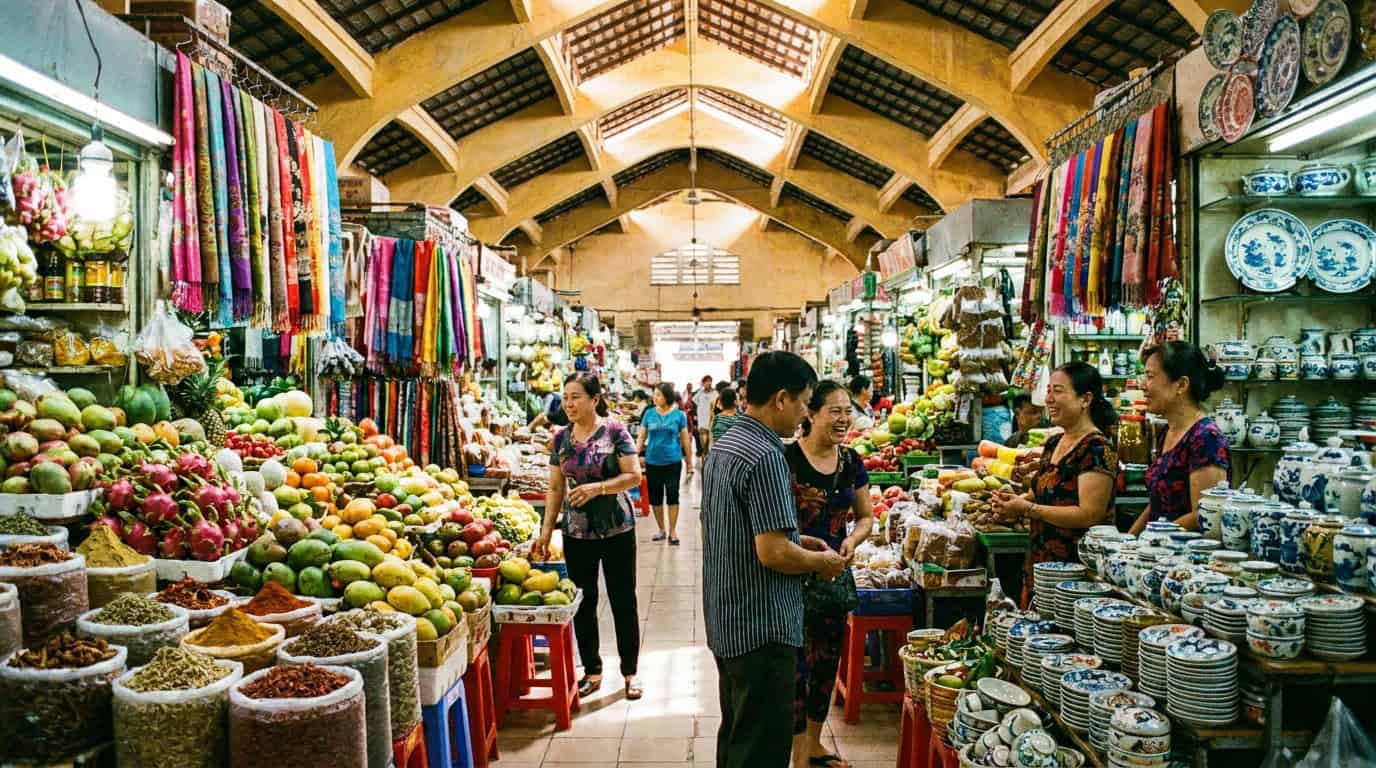
Vietnam’s largest city has 5 Michelin-starred restaurants and 47 Michelin Selected venues — the highest concentration of any Vietnamese city (Michelin Guide Vietnam 2025). That’s one end of the scale. At the other end, street food meals rarely exceed $3 USD (Nomadic Matt, 2026). Both ends are genuinely world-class, and the enormous middle ground is where most visitors spend most of their meals.
Saigon’s food culture draws on French culinary influence (baguettes, pate, coffee culture), Chinese migration (dim sum, congee, the use of soy), and indigenous Vietnamese cooking — combined into something that doesn’t quite exist anywhere else. The five dishes below are a starting point, not a ceiling.
15. Pho Bo (Beef Noodle Soup)
Southern pho differs from Hanoi’s version — sweeter broth, more garnish options, served with bean sprouts and fresh herbs. Pho Hung near the airport, Pho Le in D10, and dozens of unmarked corner spots in D1 are all worth trying. Expect to pay 50,000–80,000 VND ($2–3) per bowl.
16. Banh Mi Saigon
A direct product of French colonial food culture — baguette meets Vietnamese fillings. Banh Mi Huynh Hoa (D1) consistently draws queues and ships nationally. The banh mi bi (shredded pork skin) is the local D1 variant. From street vendors: under 30,000 VND ($1.20). It’s worth trying multiple versions — they vary significantly between vendors.
17. Com Tam (Broken Rice)
Com tam bi suon — broken rice with grilled pork ribs, shredded pork skin, steamed egg, and fish sauce dipping — is Saigon’s working lunch. Com Tam Moc in D3 is frequently cited as the city’s best. Served from early morning through mid-afternoon. Under 60,000 VND per serving.
18. Banh Xeo (Sizzling Crepe)
A crispy turmeric crepe filled with shrimp, pork, and bean sprouts, eaten by wrapping torn pieces in lettuce and fresh herbs, then dipping in fish sauce. Best in the restaurant alley on Dinh Cong Trang Street (D1) or at family-run spots in D4. The sizzling sound when batter hits the pan is part of the experience.
19. Bun Bo Hue
Spicier and more complex than pho — lemongrass, fermented shrimp paste, thick round noodles — technically from Hue but found throughout HCMC thanks to decades of internal migration. The best bowls are in D10 and D11. If you’ve only had pho, bun bo Hue will reset your baseline.
20. Street Food Tours — Evening Guided Routes
Multiple operators run guided street food tours of D1 and D4, typically by motorbike or on foot, running 3–5 hours in the evening. Useful for first-time visitors who want context alongside the food. Prices: $25–50 USD per person. Look for small-group tours (under 8 people) for a better experience.
21. Ben Thanh Night Market
The streets surrounding Ben Thanh transform after 5 p.m. into a night market with food stalls, craft vendors, and street entertainers. Prices are higher than neighbourhood restaurants, but it’s an accessible introduction to Vietnamese street food in a well-lit, easy-to-navigate setting.
22. Ho Thi Ky Flower Market (Midnight to Dawn)
One of Saigon’s most distinctive experiences. Vendors arrive from 11 p.m. to sort and sell lotus flowers, tropical blooms, and seasonal arrangements that supply flower shops across the city. The narrow alley, bare yellow bulbs, and motorbikes loaded with flowers create a scene unlike anything else in the city. Free; bring a torch and arrive between midnight and 3 a.m.
23. Michelin-Starred Dining
Anan Saigon (one star, Michelin Guide Vietnam 2025) on Hoang Dieu Street in D4 serves modern Vietnamese cuisine rooted in Saigon street food — widely considered the city’s best. CieL at the Reverie Saigon Hotel offers French-Vietnamese fusion at the other end of the register. Booking weeks ahead is advisable for any starred venue.
24. Craft Beer Scene — Taprooms in D1
Heart of Darkness Brewery, Pasteur Street Brewing Company, and East West Brewing Co. have anchored a genuine craft beer scene since 2015–2016. All three brew in-house, run food menus, and attract a mixed local and expat crowd. Pints: $4–7 USD. All are within 15 minutes’ walk of each other in D1.
Day Trips from Saigon: Cu Chi, Mekong Delta, and the Coast
Saigon’s position in southern Vietnam makes it one of the region’s best day-trip bases. The Cu Chi Tunnels are 40km northwest; the Mekong Delta begins an hour south; and the beach town of Vung Tau is 90 minutes by hydrofoil. Base yourself in District 1, day-trip outward, return each evening — it’s a genuinely efficient way to cover significant ground without repacking.
25. Cu Chi Tunnels — Half-Day or Full-Day
A 250km network of tunnels dug by Viet Cong fighters beneath the jungle northwest of the city, operational throughout the American War. Visitors can crawl through widened sections, see booby-trap demonstrations, and — at Ben Dinh — fire weapons on a range. Ben Dinh is closer to the city; Ben Duoc is larger and less crowded. Entry: $15–20 USD. Most tours depart central D1 at 7–8 a.m.
26. Mekong Delta — My Tho, Ben Tre, Can Tho
The delta’s floating markets, coconut candy workshops, and waterway villages start an hour south of HCMC. My Tho is closest (1.5 hours); Ben Tre adds coconut palm scenery; Can Tho (3.5 hours) hosts the famous Cai Rang floating market at dawn. Organised day tours covering My Tho and Ben Tre: $25–40 USD.
27. Vung Tau — Beach Day Trip
A former French colonial hill station 90km southeast on the South China Sea. The hydrofoil from Bach Dang pier takes 75 minutes (return ~$22 USD). Front Beach is busier; Back Beach is longer and quieter. The Christ the King statue on Nho Hill is visible from the water. Weekends draw HCMC day-trippers in volume — go on a weekday if possible.
28. Can Gio Mangrove Forest
A UNESCO-protected biosphere reserve 60km from the city — dense mangrove forest, macaque populations, and a WWII-era guerrilla base. Less visited than Cu Chi, which means fewer crowds and a more atmospheric experience. Day tours available from D1; the journey itself (boat through the mangroves) is half the appeal.
29. Mui Ne — Sand Dunes and Kite Coast
A 4–5 hour drive southeast reaches the dune town of Mui Ne — red and white sand dunes, kite surfing on the South China Sea, and a working fishing harbour. Better done as an overnight trip, but possible as a very long day trip.

Saigon After Dark: Rooftop Bars, Live Music, and Night Markets
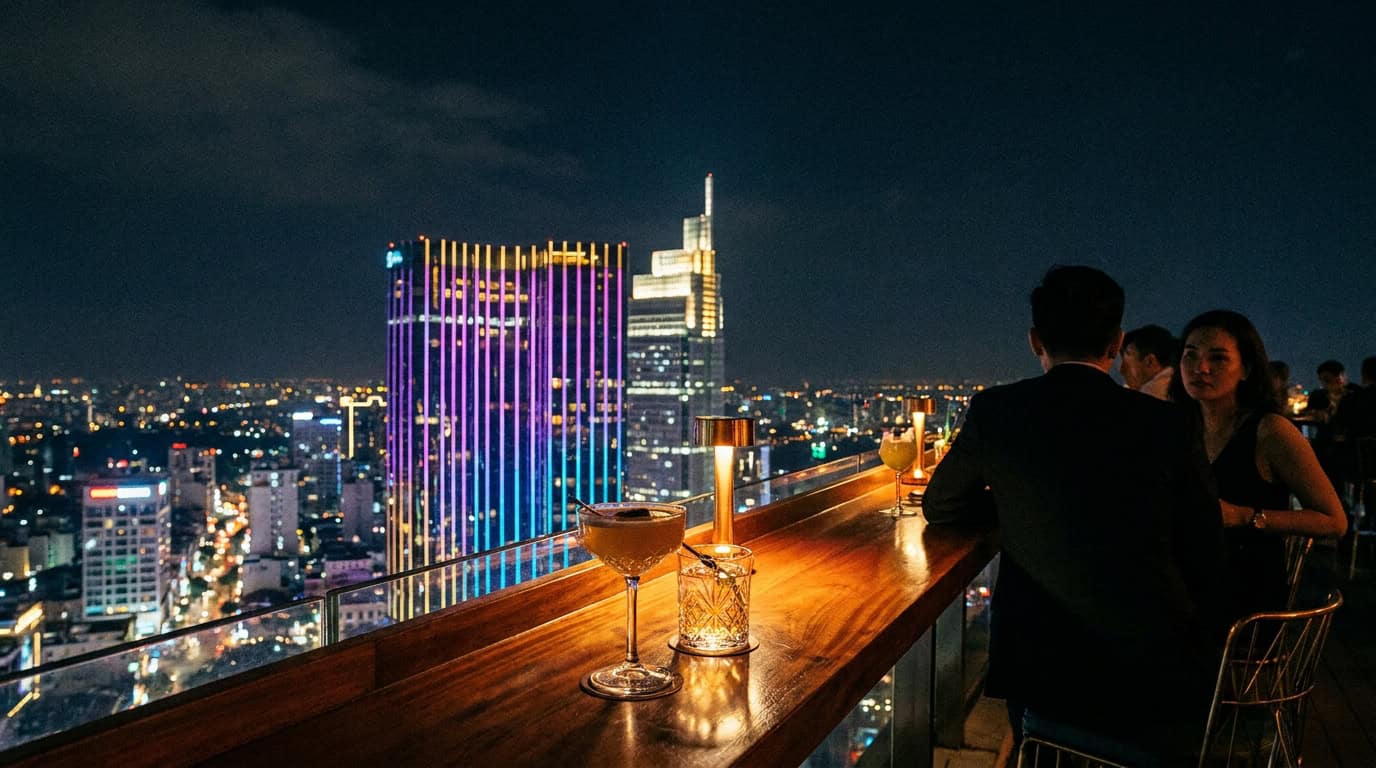
Saigon’s nightlife runs across three distinct scenes: the polished rooftop bar circuit above D1 towers, the craft taproom culture that spread through D1 and D3 from about 2016 onwards, and the street-level bia hoi scene of plastic stools, cold Tiger beer, and spontaneous conversation in back alleys. All three run in parallel each evening. All three are worth experiencing at least once.
30. Rooftop Bars in District 1
Saigon Saigon at the Caravelle Hotel (D1) has served sunset cocktails since 1959 — journalists watched air strikes from this terrace during the war. EON51 on the 51st floor of Bitexco Tower, the Executive Lounge at the Rex Hotel, and Glow Sky Bar at the InterContinental are all within 1km of each other. Smart casual dress expected. Cocktails: $8–15 USD.
31. Nguyen Hue Walking Street at Night
The pedestrian boulevard in D1 transforms after dark into a social commons — families, couples, skateboarding teenagers, and street performers all share the space. Flanked by the People’s Committee building and running toward the river, it’s at its best on Friday and Saturday nights. Free, and genuinely atmospheric without the noise of the Bui Vien strip.
32. Bui Vien Walking Street
Saigon’s most concentrated backpacker nightlife — loud, neon-lit, relentless after 9 p.m. Cold bia hoi runs under $1 USD; cocktail buckets and live cover bands are everywhere. It’s not subtle, but it’s a genuine subculture of the city. Most active Thursday–Sunday after 10 p.m. Decide in advance how you feel about that, then go anyway.
33. Live Jazz at Yoko Cafe
Yoko Cafe in D1 is Saigon’s best-known jazz venue — live performances most nights from around 8:30 p.m., no cover charge, and a crowd of regulars that includes both expats and Vietnamese musicians. The Acoustic Bar on Ngo Thoi Nhiem Street (D3) hosts solo singer-songwriters and small acoustic sets for a quieter alternative.
34. Saigon Opera House — AO Show
The Théâtre Municipal, built in 1897, is one of Southeast Asia’s best-preserved French colonial performance venues. The AO Show — a contemporary circus and dance performance celebrating Vietnamese village and urban life — runs multiple nights per week and is consistently the highest-rated cultural performance in the city. Tickets: $30–60 USD. Book online in advance.
Getting Around Saigon in 2026
Vietnam has more than 77 million registered motorcycles — the highest per-capita ownership rate in the world (Vietnamnet, November 2024). In HCMC alone, the count reaches an estimated 7.3–8.5 million vehicles. Understanding this context changes how you read a Saigon street crossing. Traffic doesn’t stop for pedestrians — you walk at a steady pace and vehicles flow around you. It takes about 20 minutes to get comfortable with it, and then it feels completely natural.
35. Metro Line 1 — Saigon’s First Metro (Opened December 2024)
Metro Line 1 connects Ben Thanh Market station in D1 to Suoi Tien terminal in Thu Duc across 14 stations and 19.7km. Journey time end-to-end: approximately 30 minutes. Fares: 12,000–26,000 VND (~$0.50–$1.05 USD) depending on distance. Air-conditioned, clean, and operating from 5:30 a.m. to 10 p.m. daily. Most published guides predate this opening — it’s a genuine improvement to getting around the city cheaply.
36. Grab — Motorbike and Car
Grab runs GrabBike and GrabCar across the city. GrabBike fares start at roughly 15,000 VND ($0.60) for short hops; GrabCar covers 5km for approximately 50,000–70,000 VND. Download the app and link a card before arrival. Paying in cash is possible but adds a small friction at the end of each ride.
37. Walking in District 1
D1’s tourist core is genuinely walkable — the War Remnants Museum to Ben Thanh Market is 900m on foot; the Central Post Office to the Jade Emperor Pagoda is a 25-minute walk. Footpaths are inconsistent (motorbikes park on them), but the distances are short enough that walking is often faster than waiting for a car. Wear flat shoes.
38. Public Bus — Cheap but Complex
HCMC’s bus network is extensive at 6,000–7,000 VND per trip (~$0.28 USD). Google Maps has integrated HCMC bus routes since 2019 and works reasonably well for D1 routes. The most useful route for visitors is Bus 109 from Tan Son Nhat Airport to the city centre — 45,000 VND, roughly 45 minutes with traffic.
Cultural Experiences and Local Life
Beyond the landmarks and the eating, Saigon offers a layer of ordinary local life accessible to visitors who slow down enough to notice it. These aren’t curated tourist activities — they’re just the city, and the city lets you in.
39. Morning Tai Chi at Tao Dan Park
Every morning before 7 a.m., Tao Dan Park in D3 fills with tai chi practitioners, aerobics groups, and badminton games. On Saturday mornings, the park hosts a cage-bird singing competition — owners bring prized birds in ornate cages and compare their songs. Free; a 20-minute walk from Ben Thanh Market.
40. Saigon Water Puppet Show
Water puppetry is a northern Vietnamese art form with origins in the 11th century, but several venues in HCMC run regular performances. The Golden Dragon Water Puppet Theatre in D5 runs multiple daily shows (~50 minutes each) with live traditional music. Tickets: 180,000–200,000 VND (~$7–8 USD).
41. Binh Tay Market — Wholesale Cholon
Cholon’s main 1920s market building deals in wholesale quantities of dried goods, spices, textiles, and household items. It operates at a completely different scale from Ben Thanh — less theatrical, more functional, and primarily local in its customer base. Free to walk through; go in the morning before 10 a.m.
42. Saigon by Motorbike — Self-Drive or Guided Tour
Renting an automatic scooter (100cc) runs about 150,000–200,000 VND/day ($6–8) from shops around Pham Ngu Lao backpacker street in D1. Several operators run guided motorbike food and culture tours led by local riders — significantly safer and more contextually rich than solo navigation on your first day.
43. Bach Dang Riverside Promenade
The Saigon River promenade at Bach Dang Wharf is best at dusk — tour boats depart here for dinner cruises, speedboats run to Vung Tau, and the café strip offers a quieter alternative to the inland D1 crowd. The view across to District 2’s rapidly growing skyline is one of the city’s better photography spots.
Base yourself at the centre of it all. Our District 1 serviced apartments put you within walking distance of most experiences in this guide — the War Remnants Museum, Ben Thanh Market, Nguyen Hue Walking Street, and a dozen rooftop bars are all under 20 minutes on foot. Ask about our weekly and monthly rates.
Practical Tips Before You Visit
In 2025, Vietnam received 21.2 million international arrivals — its highest-ever total — with Ho Chi Minh City accounting for roughly 40% of the national figure (VietnamPlus, January 2026). Most nationalities now qualify for a 90-day e-visa applied for online at the official immigration portal, with a typical processing time of 3 business days.
When to Visit
The dry season runs November–April. The wet season (May–October) brings heavy afternoon rain but lower hotel prices and thinner crowds at major sites. Temperatures sit between 25–35°C year-round. There’s no cold season in Saigon — pack for heat and occasional rain regardless of the month.
Currency and Payments
Vietnamese Dong (VND). ATMs are common throughout D1; Vietcombank and BIDV machines have the lowest fees for foreign cards. Cash is preferred at markets, street food stalls, and smaller restaurants. Hotels, upscale restaurants, and tour operators generally accept cards. Exchanging USD cash at gold shops (tiem vang) typically beats bank exchange rates.
Visa
The 90-day e-visa applies to most nationalities via immigration.gov.vn. Citizens of Germany, France, Italy, Spain, the UK, and several others qualify for extended visa exemptions. Requirements change periodically — verify your status before booking flights.
Internet and SIM Cards
Viettel and Mobifone SIM cards are available at Tan Son Nhat Airport arrivals for 100,000–200,000 VND ($4–8) with 5–10GB of data included. Coverage is reliable throughout HCMC and all the day-trip destinations in this guide. Café Wi-Fi in D1 is generally fast enough for video calls and remote work.
Frequently Asked Questions
What are the best things to do in Saigon for first-time visitors?
First-time visitors should start with the War Remnants Museum and Reunification Palace for historical grounding, then a street food evening in D4 or the Ben Thanh Night Market. The Cu Chi Tunnels are essential as a half-day trip. Allow at least three full days — two for D1 attractions, one for a day trip.
How many days should I spend in Saigon?
Two days covers the central D1 attractions. Three days adds the Cu Chi Tunnels or Mekong Delta. Four or more days allows Cholon, the rooftop bar circuit, neighbourhood walking in D3, and a second day trip. Most travellers who plan two days end up extending.
What’s the difference between Saigon and Ho Chi Minh City?
They’re the same city. Ho Chi Minh City (HCMC) is the official post-1975 name. “Saigon” remains in everyday use by locals, in tourism marketing, and on signage throughout the city. Technically, “Saigon” refers to the historic core covering Districts 1, 3, and 4. Using either name is understood everywhere and by everyone.
Is Saigon safe for tourists?
Generally yes. The main risks are petty theft (phone snatching from moving motorbikes is the most-reported incident), traffic (crossing streets requires sustained attention), and tourist-price scams in markets. Staying in D1 and using Grab for transport reduces exposure to most of these significantly.
How much does Saigon cost per day?
Budget travellers spend $25–40/day (hostel, street food, local transport). Mid-range visitors manage $50–80/day (hotel, restaurant meals, one paid attraction). Street food meals run under $3 USD, museum entry under $2, and a Grab motorbike ride under $1 for short distances. It’s genuinely affordable by any regional standard.
Conclusion
Saigon rewards curiosity more than rigid itinerary planning. The 43 items in this guide are a starting framework — the city has several layers beneath them that reveal themselves the longer you stay. Morning markets give way to afternoon café culture; colonial alleyways open onto contemporary art galleries; the street food gets better as you learn which vendors to trust.
Three things worth knowing before you go: base yourself in District 1 (everything is closer than it looks on a map), budget $50–80/day for a comfortable mid-range experience, and keep at least two days free for day trips beyond the city. The new Metro Line 1 makes getting around faster and cheaper than it’s ever been. Saigon hasn’t peaked yet — 2026 is a good time to come.
| |
For more Saigon guides, check out: Ho Chi Minh City Things to Do: Hidden Gems Beyond the Tourist Trail, The Complete Guide to Things to Do in Ho Chi Minh City (2026).
For official information and further reading, visit Lonely Planet — Ho Chi Minh City.
If you are doing this as a day out from elsewhere, Booking.com and Agoda show what is available to stay in Ho Chi Minh City on the nights around it.