
Vietcombank for expats is often the first local banking option to compare because of its branch network, ATM coverage, and foreign-customer familiarity.
For expats living in Ho Chi Minh City, choosing the right bank shapes everything from paying rent to receiving overseas transfers — and Vietcombank expat banking is one of the most practical choices available in 2025. Vietcombank (Joint Stock Commercial Bank for Foreign Trade of Vietnam) is Vietnam’s largest state-owned commercial bank by market capitalization, and its combination of English-language support, broad ATM coverage in District 1, and international transaction capability makes it a go-to option for foreigners putting down roots in Saigon.
Key Takeaways
- Vietcombank accepts expat account applications with a valid passport and Vietnam visa — no temporary residence card required at most branches.
- The bank offers both VND and multi-currency accounts, including USD and EUR savings options with competitive deposit rates.
- Vietcombank’s VCB Digibank app supports full English-language navigation, international wire transfers, and QR pay for daily expenses.
- District 1 has more Vietcombank branches and ATMs than any other district — four locations are within a 10-minute walk of most central apartment buildings.
- Monthly fees are low (around 11,000-22,000 VND for standard accounts), making Vietcombank cost-effective for long-stay residents on any budget.
Decision table: when Vietcombank is the practical choice
Vietcombank is often the safest default when you value branch access, remittances, and mainstream acceptance.
| Profile | Vietcombank fit | Why | Watch for |
|---|---|---|---|
| New long-stay expat | Strong fit | Large branch network and common expat familiarity | Bring complete documents and be patient |
| Receiving money from overseas | Strong fit | Established remittance and SWIFT handling | Fees, source-of-funds checks, and timing |
| Digital-first resident | Mixed fit | Functional for basics | App experience may feel less polished than newer banks |
| Premium perks seeker | Mixed fit | Reliable, but not always lifestyle-focused | Compare HSBC or Techcombank premium options |
Decision rule: Choose Vietcombank when reliability and network coverage matter more than the slickest app experience.
Why Vietcombank Is the Top Choice for Expats in Ho Chi Minh City
Saigon’s expat community has tested every major Vietnamese bank, and Vietcombank consistently ranks highest for reliability. The bank processes the highest volume of international transactions in Vietnam, which means incoming SWIFT transfers from the US, EU, Australia, or the UK arrive faster and with fewer compliance hold-ups than at smaller domestic banks. According to the State Bank of Vietnam’s 2024 Annual Report, Vietcombank handled over 38% of all foreign remittance inflows processed through commercial banking channels — a figure that underscores its dominance in cross-border money movement.

For a vietcombank expat account holder, that scale translates into practical benefits: staff at central District 1 branches deal with foreign customers daily, English signage is standard, and the call center has dedicated English-language lines. No other Vietnamese bank matches this combination of volume and expat-facing service infrastructure in HCMC.
Vietcombank Account Types Available to Foreign Nationals
Expats can open several different account types at Vietcombank, each suited to different financial habits.
- VND Payment Account: The standard current account for day-to-day spending, bill payments, and receiving local salary. This is the first account most expats open. A Visa or Mastercard debit card (Vietcombank Connect24) is issued with the account.
- Foreign Currency Payment Account: Hold and transact in USD, EUR, AUD, GBP, JPY, or SGD. Useful for expats receiving foreign-currency salaries or managing multi-currency expenses.
- VND Term Deposit: Fixed-term savings in dong with rates ranging from 3.0% to 4.8% per annum for 1-12 month terms as of mid-2025.
- Foreign Currency Term Deposit: USD deposits earn 0.1-0.8% annually — modest, but useful for parking foreign funds while maintaining liquidity.
- VCB Premier Account: A premium tier for higher-balance customers offering a dedicated relationship manager, priority queuing, and preferential FX rates. Requires a minimum monthly balance of around 500 million VND or equivalent.
Most vietcombank expat newcomers start with the VND Payment Account and add a USD account once they understand their income flow. The process for adding a foreign-currency account later is straightforward — it can be done at the same branch without new documentation.
Documents Required to Open a Vietcombank Account as an Expat
The documentation requirements are simpler than many expats expect. For a standard individual account you will need:
- Valid passport (original, not photocopy)
- Valid Vietnam visa, e-visa, or visa exemption stamp in your passport
- Your Vietnamese phone number (for OTP verification and VCB Digibank registration)
- A Vietnam address — your apartment address or your employer’s address is accepted
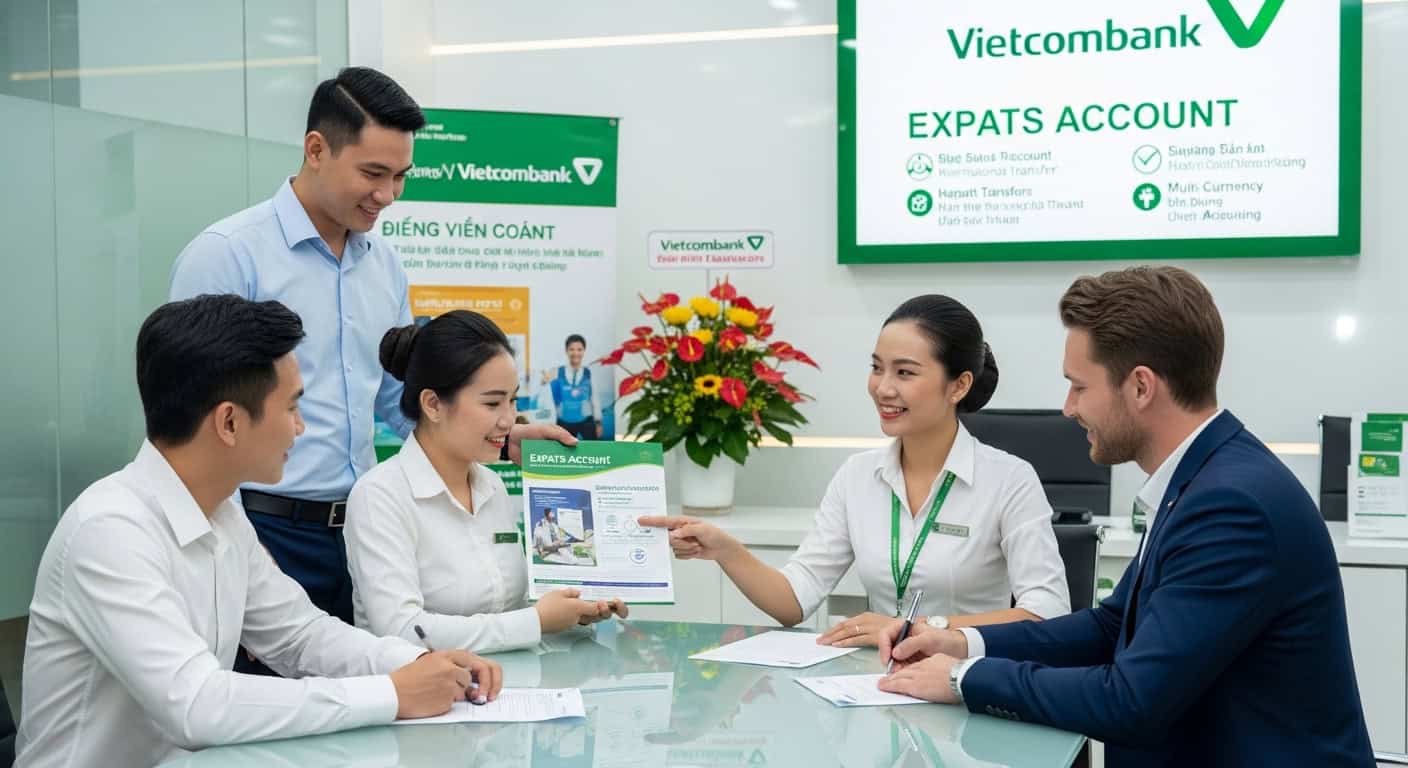
A temporary residence card (TRC) or work permit is not required at most Vietcombank branches in District 1, though some branches may ask for it if your visa has less than 30 days remaining. If you are on a tourist visa, you can still open an account, but the branch manager has discretion — visiting during a weekday morning at a main branch (not an ATM kiosk) significantly improves your chances. Bring a Vietnamese-speaking colleague or use Google Translate in offline mode to smooth out any language gaps with newer staff.
How to Open a Vietcombank Account Step by Step
Opening your first vietcombank expat account takes 30-60 minutes at the branch.
- Choose your branch: For first-time expat applications, go to a full-service branch rather than a transaction office. The Nguyen Hue branch (District 1) and the Le Loi branch handle the highest number of foreign applicants and staff are experienced with non-standard documentation.
- Take a queue number: Select Account Opening on the ticket machine. Arrive before 3:00 PM — branches stop taking new applications 45-60 minutes before closing.
- Fill out the account opening form: Staff will hand you a bilingual form. Enter your passport details exactly as they appear — middle names must match, even if they are long.
- Set up OTP and PIN: Your phone number is registered on the spot. You will receive an OTP to verify. Choose a six-digit PIN for your debit card.
- Make your opening deposit: The minimum is 100,000 VND (approximately USD 4). Bring cash.
- Activate VCB Digibank: Download the app before you arrive. Registration takes about five minutes using your new account number and registered phone number.
VCB Digibank: Mobile Banking for Vietcombank Expat Users
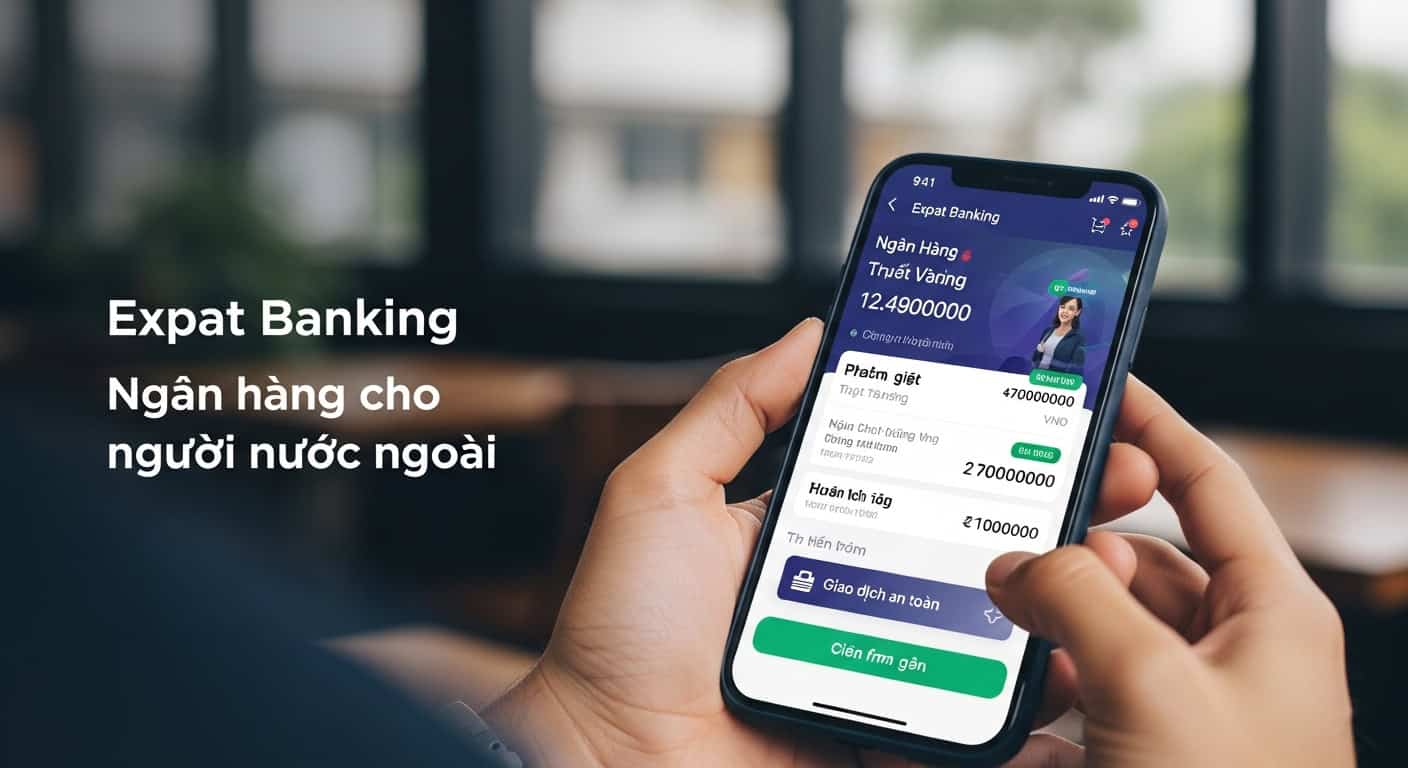
The VCB Digibank app is genuinely useful and fully English-capable. The app supports domestic transfers, international wire transfers (SWIFT outward remittance), bill payment, utility payment, VinID top-up, and QR code payments at most Saigon vendors. Face ID and fingerprint login work reliably on both iOS and Android.
For vietcombank expat users sending money home, the outward remittance function requires you to provide the recipient’s full bank details and a stated transfer reason. Processing time is typically 1-2 business days for major currency corridors. Fees for outward transfers run from 0.2% of the transfer amount (minimum 200,000 VND, maximum 1,000,000 VND) plus correspondent bank charges that vary by destination.
One tip: register for VCB Smart OTP (a software token inside the app) rather than relying on SMS OTP. SMS delivery can be slow during high-traffic periods, and Smart OTP works offline — important if you are travelling and need to authorize a transfer from abroad.
Receiving International Transfers at Vietcombank
Incoming SWIFT transfers to a Vietcombank account are among the fastest-clearing in Vietnam. Your SWIFT/BIC code is BFTVVNVX and your account number is the identifier for international senders. If your sender’s bank asks for an intermediary bank, Vietcombank’s correspondent in the US is Citibank New York.
According to data published by the World Bank’s Remittance Prices Worldwide database (Q4 2024), the average cost of sending USD 200 to Vietnam through bank channels was 6.1% — significantly higher than mobile wallet corridors. However, for larger amounts (USD 1,000+), bank transfer fees as a percentage drop sharply, and Vietcombank’s flat fee structure becomes competitive against services like Wise or Western Union for mid-to-large transfers.
Incoming foreign currency transfers can be received in the original currency (credited to your USD or EUR account) or converted to VND at Vietcombank’s daily buying rate. The buying rate is typically 20-50 VND below the mid-market rate per USD — comparable to other major Vietnamese banks.
ATM Network and Branch Access in District 1
Vietcombank has the widest ATM network in D1 — four branches within 10 minutes of a well-run serviced building. Long-stay residents who bank here report the smoothest rent and utility payment experience. This density matters in practical terms: you will almost never face an out-of-network fee for cash withdrawals, and if your card is swallowed by a machine, you can walk to a staffed branch quickly rather than waiting for courier card delivery.
ATM withdrawal limits are 5,000,000 VND per transaction and 20,000,000 VND per day for standard accounts. You can request a limit increase at the branch if you regularly need larger cash amounts — common for expats paying monthly rent in cash to older landlords.
Vietcombank ATMs also accept international Visa and Mastercard debit and credit cards, making them a reliable fallback for visitors. The machines display menus in English and Vietnamese.
Fees, Limits, and Currency Exchange for Expats
Understanding the fee structure prevents surprises on your monthly statement.
- Monthly account maintenance fee: 11,000 VND for a basic Connect24 account; 22,000 VND for Premier debit
- ATM withdrawal (Vietcombank network): Free for the first 5 transactions per month; 1,100 VND per transaction thereafter
- ATM withdrawal (other banks): 3,300 VND per transaction
- Domestic transfer (VCB Digibank): Free for same-bank transfers; 8,800-11,000 VND for interbank transfers
- International wire transfer (outward): 0.2% of amount (min 200,000 VND, max 1,000,000 VND)
- Card replacement: 50,000 VND standard; 100,000 VND for express
FX rates for walk-in cash exchange at Vietcombank branches are not always the most competitive in Saigon — dedicated exchange counters on Le Loi and Nguyen Hue streets typically offer rates 100-200 VND per USD better for large amounts. For amounts under USD 500, the convenience of your bank branch usually outweighs the marginal rate difference.
Common Problems Expats Face with Vietcombank (and How to Fix Them)
Even the best bank has friction points. Here are the issues that come up most often in the expat community and how to resolve them.
- Account frozen after overseas login: Vietcombank’s fraud detection flags logins from unfamiliar IP addresses. If your app stops working after travelling, call the 1800 545 415 hotline (free, 24/7) or visit a branch with your passport to re-verify identity. This takes about 15 minutes in person.
- International transfer rejected: Transfer rejections usually stem from missing or incomplete beneficiary details. Ensure you include the full bank name, SWIFT code, and a clear transfer purpose. The compliance team may call you to verify — keep your registered number accessible.
- Card declined at foreign POS: The Connect24 Visa debit card requires international transactions to be enabled. Activate this in the VCB Digibank app under Card Management before travelling.
- Passport renewal requiring account update: When your passport is renewed, you must visit a branch with both your old and new passport to update your KYC records. Online update is not yet available. Do this promptly — accounts can be restricted if KYC documents expire.
Vietcombank vs. Other Banks Popular with HCMC Expats
The main competitors for vietcombank expat accounts in District 1 are Techcombank, HSBC Vietnam, and VPBank.
- HSBC Vietnam offers the most polished English-language service and global account linking, but the minimum balance requirement (typically 5,000,000 VND) and limited ATM network make it less convenient for everyday use.
- Techcombank has competitive digital banking features and zero-fee domestic transfers, but its SWIFT infrastructure for outward remittances is slower than Vietcombank’s.
- VPBank is popular for its fintech-forward app, but branch staff English proficiency outside of major financial districts is inconsistent.
For most expats who need a reliable daily account with a strong ATM presence, fast international transfers, and tolerable English support, Vietcombank is the pragmatic first choice. Expats who travel frequently and need seamless global account management might add an HSBC account as a secondary option.
Tips for Getting the Most from Your Vietcombank Expat Account
A few practices separate expats who find Vietnamese banking smooth from those who find it frustrating.
- Set up automatic bill payment for electricity (EVN HCMC), water, and internet through VCB Digibank — this eliminates the need to visit payment kiosks and prevents service interruptions if you travel.
- Enable push notifications for every transaction. Fraud on Vietnamese bank accounts, while uncommon, does occur — real-time alerts let you spot unauthorized transactions within seconds.
- Keep at least 500,000 VND in your account at all times to avoid dormancy classification, which triggers a fee and can restrict online transactions.
- Save the branch manager’s direct line after your first visit. For compliance questions or account restrictions, direct branch contact resolves issues faster than the call center queue.
- Use VCB Digibank’s scheduled transfer feature to pre-set rent payments on the first of each month. Most District 1 landlords who accept bank transfer prefer Vietcombank-to-Vietcombank same-bank transfers because they settle instantly.
You May Also Find Useful
Frequently Asked Questions
Can expats on a tourist visa open a Vietcombank account?
Yes, in most cases. Vietcombank’s official policy requires a valid visa but does not specify visa type. Tourist visa holders have successfully opened accounts at full-service District 1 branches. Success rates are higher if your visa has at least 30 days remaining and you visit a main branch on a weekday morning. Some branches may decline at the teller’s discretion — if one branch refuses, try another.
How long does it take to open a Vietcombank account as a foreigner?
Account opening typically takes 30-60 minutes at the branch. Your debit card is printed on the spot at most District 1 branches using instant issuance machines — you leave with a functioning card the same day. International transaction activation and VCB Digibank setup add another 10-15 minutes if done at the branch.
Does Vietcombank offer accounts in USD for expats?
Yes. Foreign currency payment accounts in USD, EUR, GBP, AUD, JPY, and SGD are available to foreign nationals. You can open a USD account on the same visit as your VND account. USD term deposits are also available for parking larger foreign-currency balances, though interest rates are low (under 1% per annum as of 2025).
What is the Vietcombank SWIFT code for receiving international transfers?
Vietcombank’s SWIFT/BIC code is BFTVVNVX. When providing your account details to overseas senders, always include your full 16-digit account number, the SWIFT code, the bank name (Joint Stock Commercial Bank for Foreign Trade of Vietnam), and the branch address. For USD transfers from the US, the intermediary bank is Citibank New York.
Is it safe to use Vietcombank as an expat in Vietnam?
Vietcombank is state-owned and regulated by the State Bank of Vietnam, making it one of the most systemically protected banks in the country. Customer deposits are insured under Vietnam’s Deposit Insurance Corporation (DIV) up to 125,000,000 VND per individual per institution as of 2025. For amounts above this threshold, diversifying across two banks is a reasonable precaution, as it would be in any country.
Official Resources
For the most up-to-date information on vietcombank expat, visit the State Bank of Vietnam.