
Vietnamese food beyond pho includes regional soups, rice plates, rolls, hot pots, seafood dishes, and everyday meals visitors often miss.
Vietnam’s culinary identity runs far deeper than a single bowl of soup. The full spectrum of vietnamese cuisine dishes spans hundreds of regional recipes, street-corner snacks, and centuries-old preparations that most visitors never encounter during a short trip. If your knowledge of Vietnamese food stops at pho, you are missing the overwhelming majority of what makes eating in Ho Chi Minh City one of the most rewarding experiences in Southeast Asia. This guide covers 15 dishes that even food-savvy travelers routinely overlook — and explains exactly where to find them.
Key Takeaways
- Vietnamese cuisine dishes extend far beyond pho into a diverse world of grilled meats, fermented sauces, rice paper rolls, and regional noodle soups.
- Ho Chi Minh City (Saigon) is the best single city in the world to eat Vietnamese food, with all regions represented within a few city blocks.
- According to the World Food Travel Association’s 2024 Food Travel Monitor, Vietnam ranked among the top five global destinations specifically chosen by travellers for culinary experiences.
- Many of the most iconic dishes cost under 50,000 VND (approximately USD 2) and are found at street stalls rather than restaurants.
- District 1 alone contains dozens of alley kitchens and market stalls serving dishes from Hanoi, Hue, and the Mekong Delta within a ten-minute walk of each other.
Vietnamese Food Beyond Pho: Why Vietnamese Cuisine Dishes Go So Far Beyond Pho
Pho became globally famous partly by accident — it traveled well as a concept and translated easily for Western palates. But within Vietnam, pho is just one entry in a library of vietnamese cuisine dishes that varies dramatically by province, season, and time of day. The country stretches over 1,600 kilometers from north to south, crossing multiple climate zones and cultural influences including Chinese, Cham, Khmer, and French. Each region developed its own pantry, its own fermentation traditions, and its own signature plates. Saigon, as the commercial hub of the south, absorbs all of them simultaneously.

According to a 2025 report by Statista on Southeast Asian food tourism, Vietnamese street food markets in Ho Chi Minh City attract more returning food tourists per year than any other city in the region. That loyalty is earned dish by dish.
Bun Bo Hue: The Spicier, Richer Sister to Pho
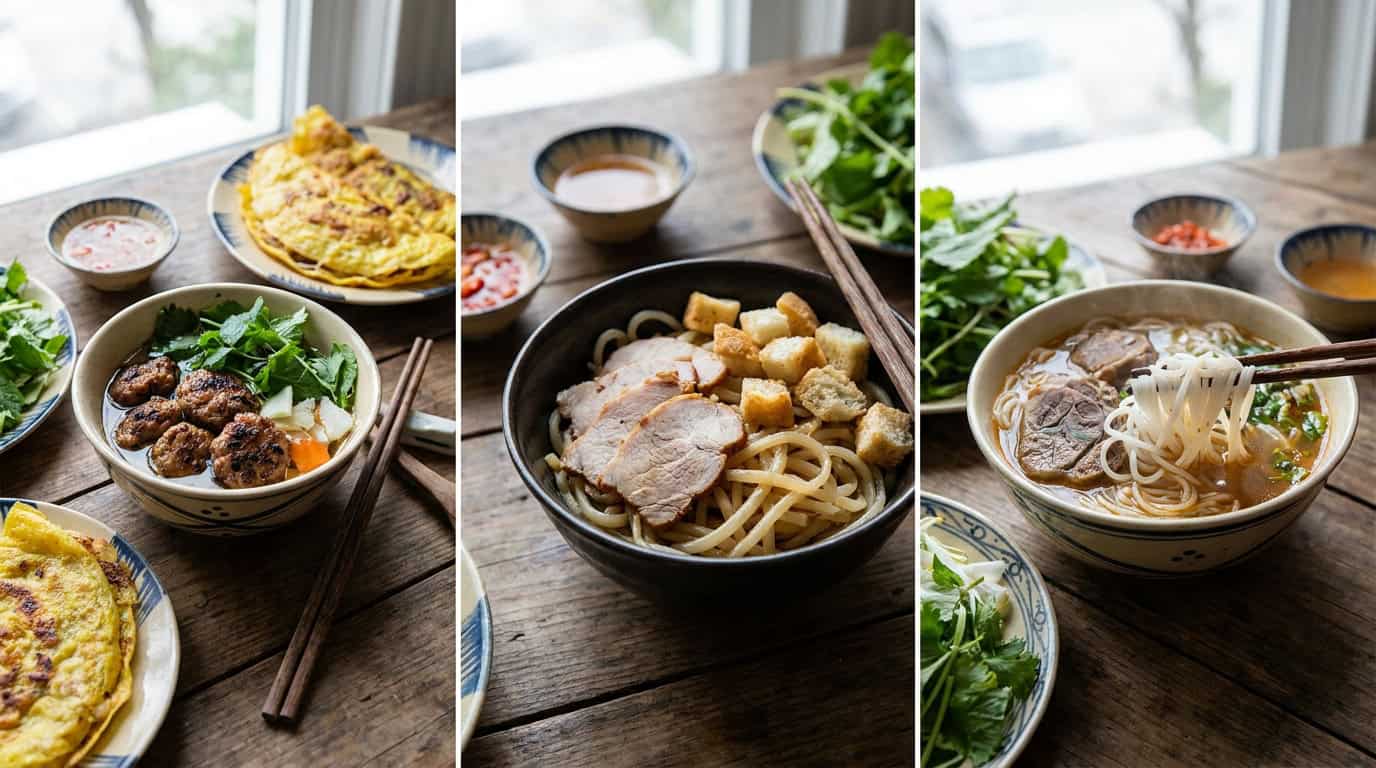
Most visitors who order bun bo Hue once immediately understand why locals consider it superior to pho for pure depth of flavor. This beef and pork noodle soup from the former imperial capital of Hue uses lemongrass, shrimp paste, and dried chilies to build a broth that is simultaneously funkier, spicier, and more complex than pho. The noodles are thick and round rather than flat. Toppings include sliced beef shank, pork knuckle, and cubes of congealed pork blood for those willing to go fully local. Look for it at street stalls opening around 6am in Districts 1, 3, and 10.
Banh Mi: More Than a Sandwich
International food media has done banh mi justice in recent years, but visitors still underestimate how much variation exists within the category. The baguette is a French colonial legacy adapted by Vietnamese bakers who changed the flour ratio to produce a lighter, crispier shell. Standard fillings include pate, cold cuts, pickled daikon and carrot, cilantro, and chili. But regional variations add fried eggs, grilled pork, sardines in tomato sauce, or nothing but butter and sugar for a sweet breakfast version. Banh mi is one of the most versatile vietnamese cuisine dishes in the country and costs between 15,000 and 40,000 VND depending on fillings.

Goi Cuon and Bi Cuon: The Raw and the Cured
Goi cuon (fresh spring rolls) appear on many tourist menus but are frequently made poorly outside of Vietnamese homes and dedicated stalls. Properly made, the rice paper should be just soft enough to bite through cleanly while holding shrimp, pork, vermicelli, herbs, and lettuce in a tight cylinder. The dipping sauce is hoisin thinned with water and topped with crushed peanuts — not the generic sweet chili sauce served in most tourist restaurants. Bi cuon swaps the shrimp and pork for shredded pork skin mixed with toasted rice powder, giving a chewier, more textured filling that is entirely its own experience.
Com Tam: Saigon’s True Signature Dish
If any single dish defines everyday eating in Ho Chi Minh City, it is com tam — broken rice served with grilled pork ribs (suon nuong), shredded pork skin (bi), a steamed egg and pork cake (cha trung), and a fried egg, all topped with scallion oil and served alongside a bowl of light fish sauce broth. Com tam stalls open before dawn and often sell out by mid-morning. The name refers to the broken or “fractured” rice grains originally considered lower quality but now preferred for their ability to absorb the accompanying sauces. Any honest ranking of vietnamese cuisine dishes by cultural importance in Saigon places com tam at or near the top.
Banh Xeo: The Sizzling Rice Crepe
The name translates literally as “sizzling cake,” named for the sound the batter makes when it hits the hot pan. A proper banh xeo is a thin, crispy rice flour crepe colored yellow with turmeric and folded over a filling of pork belly, shrimp, bean sprouts, and green onion. The correct way to eat it is to tear off a piece, wrap it in mustard leaf or lettuce with fresh herbs, and dip the whole parcel in nuoc cham. The contrast of the hot, crispy crepe against the cold raw herbs is one of the most satisfying textural combinations in all of Vietnamese cooking. Pho is the gateway. These 15 dishes are the destination. Discover all of them within walking distance of our D1 apartments.
Bun Rieu: Crab and Tomato Noodle Soup
Bun rieu is among the most underrated vietnamese cuisine dishes served in Saigon. The broth is built on minced freshwater crab paste (rieu) cooked with tomatoes, giving it a distinctive orange-red color and a sweet-sour-savory flavor profile that bears no resemblance to pho or bun bo Hue. Toppings include fried tofu cubes that soak up the broth, congealed pork blood, fresh tomato wedges, and a squeeze of tamarind paste. The vermicelli noodles are thin and soft. Many stalls add a spoonful of mam tom (fermented shrimp paste) on the side — accept it.
Cao Lau: Hoi An’s Regional Treasure Found in Saigon
Cao lau is technically a Hoi An dish, made properly only with water drawn from specific local wells and ash-treated noodles. Saigon versions are close approximations but still worth seeking out. The dish combines thick, chewy noodles with sliced char-siu-style pork, crispy fried croutons made from the same noodle dough, bean sprouts, fresh herbs, and just a small amount of rich broth. It is drier than most Vietnamese noodle dishes — more of an assembled plate than a soup. It represents the Chinese-Vietnamese fusion cooking tradition that defines coastal central Vietnam and distinguishes it from both northern and southern vietnamese cuisine dishes.
Chao Long: Offal Rice Porridge for Breakfast
Chao (rice porridge, or congee) is eaten across Southeast Asia but the Vietnamese version served with offal — pork intestines, liver, kidney, and heart — occupies a specific early-morning ritual in Saigon. Chao long stalls typically open at 5am and close by 9am. The porridge itself is silky and mild; the offal adds richness and texture. Accompaniments include fresh ginger, fried shallots, chopped cilantro, and a drizzle of sesame oil. For visitors willing to eat adventurously before most of the city is awake, chao long provides an unfiltered window into how Saigonese workers start their day.
Mi Quang: Turmeric Noodles from Da Nang
Mi quang is another central Vietnamese dish with a strong presence in Saigon’s restaurant scene. Wide, flat turmeric-yellow rice noodles sit in a small amount of concentrated broth — just enough to coat the noodles rather than submerge them. Toppings vary but typically include shrimp, pork, hard-boiled quail eggs, peanuts, sesame rice crackers, and a generous pile of fresh herbs including banana blossom, perilla, and saw-tooth coriander. The rice cracker is not decorative — it softens slightly in the broth and should be eaten as part of each bite. Mi quang is one of the few vietnamese cuisine dishes where the ratio of toppings to liquid intentionally inverts the usual soup logic.
Nem Nuong and Thit Nuong: The Grilled Meat Tradition
Vietnamese grilled meats deserve their own category. Nem nuong are grilled pork sausages made from seasoned ground pork formed around a skewer or bamboo stick and cooked over charcoal. Thit nuong refers more broadly to marinated grilled pork — usually thin slices of shoulder or belly lacquered with lemongrass, fish sauce, garlic, and sugar. Both are served as part of larger assemblies that require diners to build their own wraps using rice paper, lettuce, herbs, green mango or starfruit slices, and a fermented peanut dipping sauce. The interactive, build-your-own format is common across many authentic vietnamese cuisine dishes and is part of what makes Vietnamese eating social by design.
Che: Vietnamese Sweet Soups and Desserts
Western visitors often skip dessert entirely in Vietnam because che looks unfamiliar — layered glasses or bowls containing combinations of mung beans, black-eyed peas, jelly cubes, lotus seeds, taro, coconut milk, and crushed ice. Each combination has a different name and regional origin. Che ba mau (three-color dessert) is the most photogenic, with layers of green pandan jelly, yellow mung bean paste, and red kidney beans under coconut cream and ice. Che is inexpensive, widely available, and represents a category of vietnamese cuisine dishes that most food guides fail to cover adequately.
Banh Canh Cua: Thick Noodle Crab Soup
Banh canh noodles are thick, chewy, and made from either tapioca starch, rice flour, or a combination of both. The cua (crab) version builds its broth from whole crab shells simmered for hours with pork bones, producing a deeply sweet, oceanic soup. Whole crab claws, crab roe, fish cakes, and quail eggs typically complete the bowl. The noodles have a slippery, almost gelatinous texture that takes getting used to but becomes addictive quickly. Banh canh cua is a weekend morning staple in Saigon households and a reliable marker of quality at any stall willing to make it properly.
How to Eat Your Way Through These Vietnamese Cuisine Dishes in District 1
The most practical approach is to eat by meal type rather than trying to sample everything in a single day. Start with a 6am breakfast of chao long or bun bo Hue near Ben Thanh Market. Mid-morning, grab a banh mi from any street cart. Lunch is the best time for com tam, with dozens of stalls setting up along Nguyen Trai and Co Giang streets by 10:30am. Afternoon snacking means banh xeo or goi cuon from the alley restaurants clustered behind the Reunification Palace. Evening brings nem nuong and thit nuong to outdoor tables throughout the district, best eaten with a cold Saigon beer.
The full range of vietnamese cuisine dishes described in this guide requires nothing more than a willingness to eat at ground level, at street-side plastic tables, with chopsticks and a spoon. Every single dish on this list is available within fifteen minutes on foot of the central backpacker and serviced apartment district.
You May Also Find Useful
Frequently Asked Questions
What are the most important vietnamese cuisine dishes to try beyond pho?
The highest-priority dishes for any serious food visitor are com tam (broken rice with grilled pork), bun bo Hue (spicy beef and lemongrass noodle soup), banh xeo (crispy turmeric crepe), mi quang (turmeric noodles with peanuts and rice crackers), and bun rieu (crab and tomato noodle soup). These five dishes collectively represent the range of techniques, flavor profiles, and regional origins that define Vietnamese cooking as a whole.
Is Vietnamese food in Ho Chi Minh City different from Hanoi?
Yes, significantly. Southern Vietnamese cuisine tends to be sweeter and uses more fresh herbs, bean sprouts, and coconut-based flavors. Northern cuisine centered on Hanoi is generally more restrained, less sweet, and relies more heavily on fermented and preserved ingredients. HCMC has the advantage of being a culinary melting pot where northern and central Vietnamese dishes are available alongside southern specialties, making it the single best city to survey the full range of vietnamese cuisine dishes.
Where is the best area in Ho Chi Minh City to try authentic vietnamese cuisine dishes?
District 1 is the most accessible starting point, with high concentrations of street food stalls along Bui Vien, Nguyen Trai, and the back alleys of the Ben Thanh Market area. For deeper exploration, Districts 3, 4, and 10 have neighborhood stalls with fewer tourists and often better quality. The key is eating where Vietnamese families eat, which usually means arriving before 8am for breakfast dishes and between 11am and 1pm for lunch specials.
Are vietnamese cuisine dishes from street stalls generally safe to eat?
The vast majority of street food stalls in Ho Chi Minh City are safe when basic precautions are followed. Choose stalls with high customer turnover, where food is cooked to order or kept at temperature in visible containers. Avoid pre-cut fruit left in the sun and raw shellfish from vendors without refrigeration. Properly cooked Vietnamese street food — soups, grilled meats, fresh rice paper rolls assembled on the spot — carries very low risk and is eaten safely by millions of locals daily.
What is the price range for vietnamese cuisine dishes at street stalls in HCMC?
Most noodle soups and rice dishes at local stalls cost between 30,000 and 80,000 VND (approximately USD 1.20 to 3.20). Banh mi sandwiches range from 15,000 to 40,000 VND. Fresh spring rolls are typically sold in pairs for 20,000 to 35,000 VND. Even at sit-down local restaurants, a full meal with drinks rarely exceeds 150,000 VND per person. This makes systematic food exploration in HCMC one of the most cost-effective culinary experiences available anywhere in the world.
Official Resources
For the most up-to-date information on vietnamese cuisine dishes, visit the Vietnam Tourism Official Guide.