
War Remnants Museum Saigon: What to Expect, Tips, and How to Prepare
Roughly 85% of visitors to the War Remnants Museum in Saigon describe it as “emotionally overwhelming” or “deeply affecting” in post-visit survey data (TripAdvisor Travellers’ Reviews, 2024). That response is not a warning — it’s the measure of how effectively the museum does its job. Understanding what you’re about to experience, and how to approach it, makes the difference between a rushed and uncomfortable visit and one that stays with you for years.
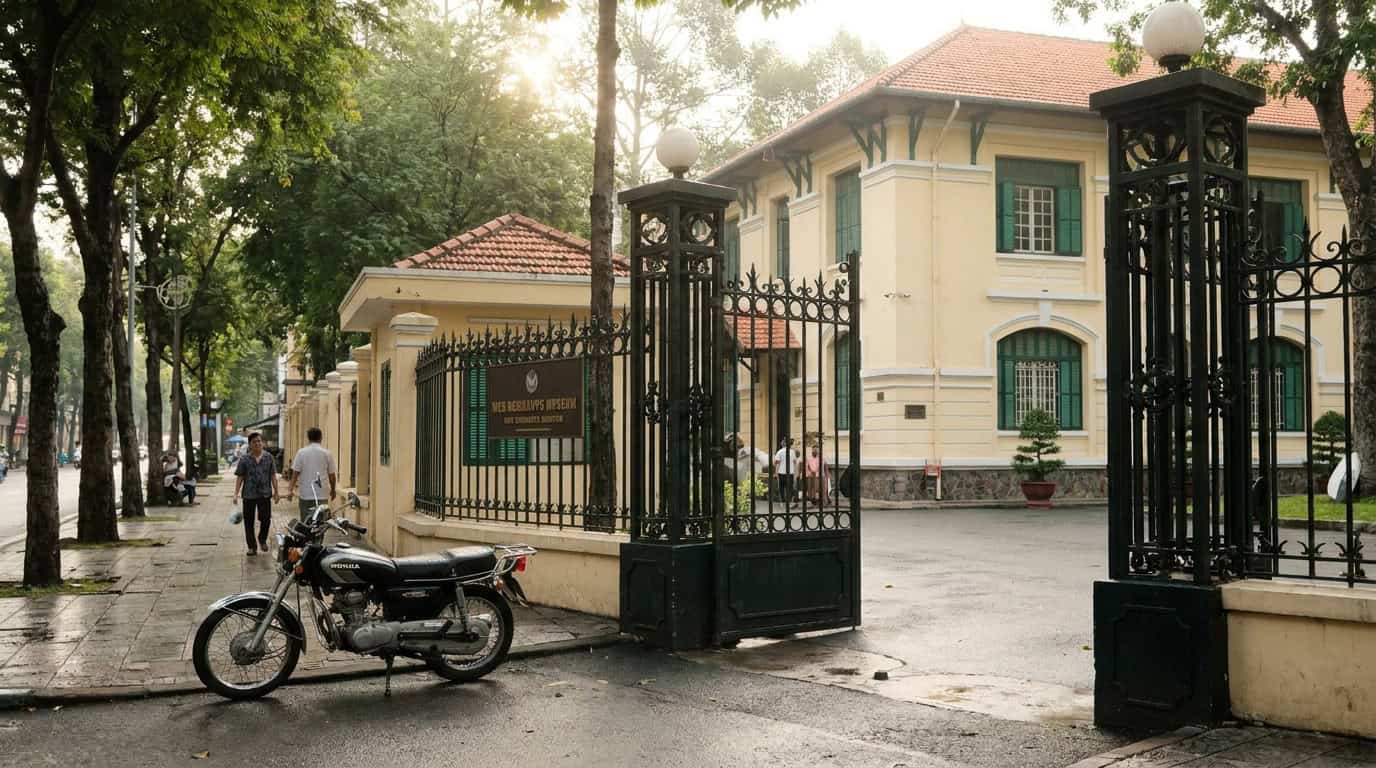
Key Takeaways
- The museum’s content is intense by design — emotional preparation beforehand makes the experience more meaningful, not easier.
- The Requiem floor (Floor 3) is consistently identified by reviewers as the most affecting, featuring work from 134 photographers killed in the war (War Remnants Museum, 2023).
- Don’t rush: most visitors need 2-3 hours minimum. Spending less than 90 minutes means missing critical context.
- After your visit, the Jade Emperor Pagoda or a quiet cafe on Vo Van Tan Street are ideal for decompression.
- Photography is permitted throughout. Respectful silence near graphic exhibits is expected by other visitors.
Why Is the War Remnants Museum So Emotionally Intense?
Most war museums present history at a distance — through maps, weapons, and uniforms. The War Remnants Museum presents it through faces. Its photographic collection includes approximately 1,500 documentary images, many taken by journalists who died in the conflict (War Remnants Museum, 2023). The visual proximity to human suffering — unmediated by curatorial distance — is what separates this museum from any other war memorial most Western visitors have encountered.
The museum is frank about its perspective. It was founded in 1975 as an exhibition of “US and Puppet Crimes” and renamed in 1995 following U.S.-Vietnam normalisation. It does not aim for geopolitical balance. It aims to document. Visitors from countries that participated in the conflict — Americans, Australians, South Koreans — often report the most complex emotional responses. But visitors of every nationality consistently rate it among the most important experiences of their time in Vietnam.
That context matters before you walk in. Going in knowing the museum’s perspective is not propaganda-neutral helps you engage more honestly with what you’re seeing rather than reacting defensively to the framing.
What Shocked People Most: Real Visitor Accounts
Based on aggregated TripAdvisor and Google Maps reviews, three exhibits consistently appear in first-person “most shocking” accounts. They’re worth knowing about in advance not to brace yourself, but because they repay slow, attentive looking rather than a flinching glance.
The Agent Orange Section
Floor 1’s “Ongoing Atrocities” section documents multi-generational health consequences from U.S. herbicide spraying between 1961 and 1971. Approximately 4.8 million Vietnamese people were directly exposed to Agent Orange during this period (International Red Cross, 2013). The photographs show affected adults and children across decades. Many visitors report this as the section that lingers longest — partly because it documents ongoing harm, not historical harm.
The My Lai Photographs
The second floor contains Ronald Haeberle’s photographs of the My Lai massacre (March 1968), in which U.S. forces killed between 347 and 504 unarmed Vietnamese civilians. These are among the most studied photographs in the history of conflict documentation. Seeing them at large format, on a wall in the country where the events took place, is a fundamentally different experience from viewing them in a history textbook. Don’t rush past them.
The Tiger Cage Replicas

In the outdoor courtyard, the tiger cage replicas are built to original dimensions — roughly 2 metres by 3 metres, with iron bar ceilings. They were used at Con Son Island prison to hold political prisoners in conditions that prevented standing upright. U.S. Congressman Tom Harkin documented and photographed them in 1970 for Life Magazine (Time Magazine Archive, 1970). Standing inside one — even briefly — communicates something that no photograph can.
The Four Outdoor Areas: What to Spend Time On
The outdoor courtyard covers four distinct display areas, and most visitors move through them too quickly. The military aircraft — including an F-5A jet fighter, A-37 Dragonfly, and UH-1 Huey helicopter — are displayed without barriers and can be walked around and photographed from every angle. This is unusual access. Give yourself at least 30 minutes outside before entering the main building.
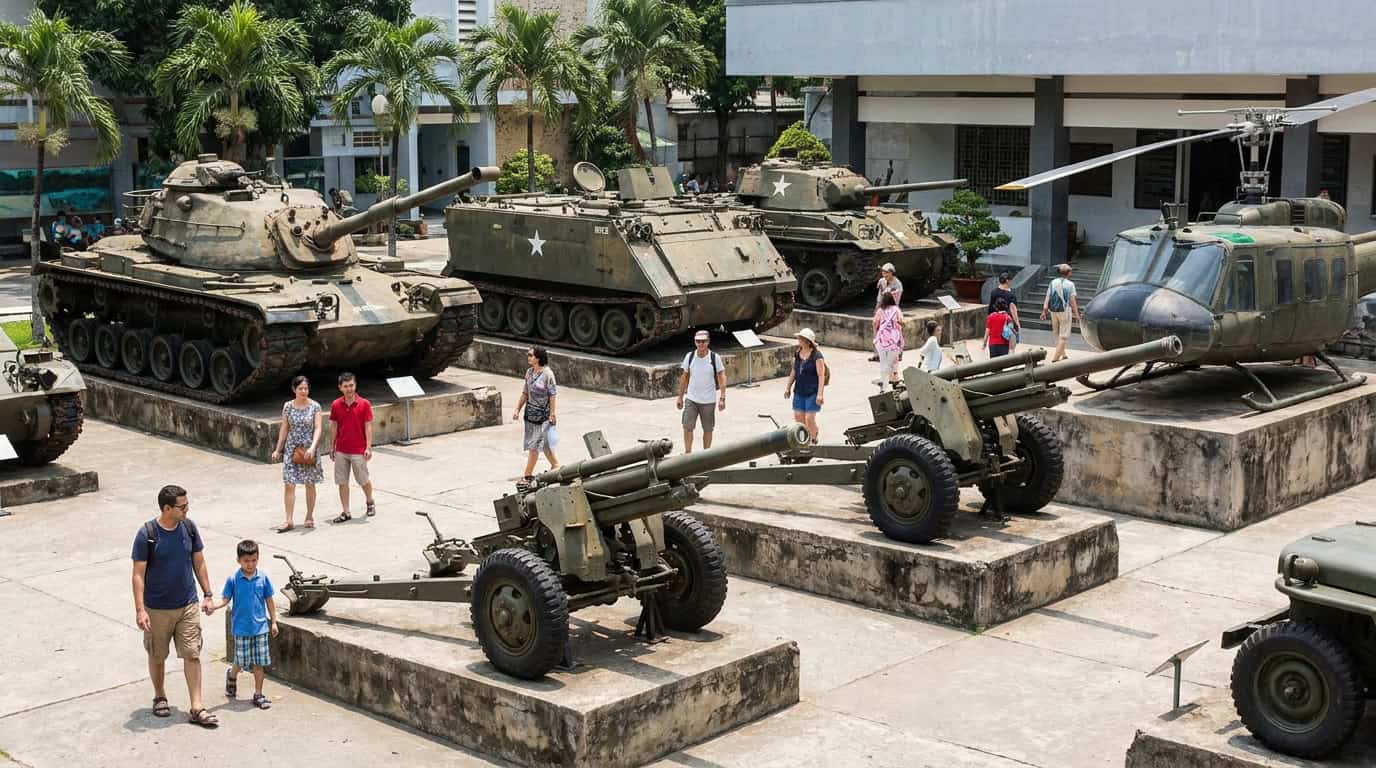
The armoured vehicle section includes an M48 Patton tank, M132 armoured flamethrower, and several artillery pieces. Each has a placard detailing its use and origin. The guillotine on display was used by French colonial authorities for public executions and is one of the few exhibits that pre-dates U.S. involvement — a reminder that the museum covers a longer arc of colonial violence.
The ordnance display — rows of cluster bomb casings, rockets, and aerial bombs — is the most abstract area, but the scale matters. The United States dropped more ordnance on Vietnam, Laos, and Cambodia between 1964 and 1973 than was dropped by all sides in World War II combined (PBS Frontline, 2003). The physical volume on display makes that figure comprehensible in a way that statistics alone do not.
The Photographic Exhibits That Hit Hardest
The Requiem exhibition on Floor 3 is curated around a single fact: 134 photographers from 11 nationalities were killed covering this war (War Remnants Museum, 2023). The work on these walls is their final testimony. Curator Tim Page, an Australian photojournalist who survived the war, spent years gathering the images from families and archives worldwide. The result is an exhibition that honours craft while confronting mortality.
What makes this floor different from Floor 2 is the lens through which violence is shown. Floor 2 documents atrocity. Floor 3 documents the act of witnessing. You’re looking at the last rolls of film some of these people ever shot. Nick Ut’s “Napalm Girl” photograph was taken just before several of his colleagues were killed. The girl in that photograph, Kim Phuc, was found and treated. Not everyone in the frame survived.
The most common piece of advice from repeat visitors: go through floors 1 and 2 first, then give yourself a full 30-45 minutes on Floor 3 without time pressure. It’s the floor that most often prompts visitors to sit down, not because they’re tired, but because they need to.
What NOT to Do at the War Remnants Museum
Don’t rush. This is the single most consistent piece of advice from experienced visitors. The museum is not designed for a 45-minute run-through, and treating it as one of many D1 checkbox attractions misses its purpose entirely.
Don’t skip the Requiem floor. Many visitors who’ve already been through the intense content of Floor 2 feel emotionally saturated and skip Floor 3. This is the most commonly expressed regret in visitor reviews. The Requiem floor is difficult in a different way — quieter, more contemplative — and it provides a kind of resolution that the lower floors don’t.
Don’t photograph other visitors during moments of visible distress. It happens. It’s intrusive. The museum atmosphere warrants the same basic courtesy as a place of worship.
Photography Etiquette Inside the Museum
Personal photography is permitted throughout all areas, including the outdoor courtyard and all three floors. No flash near sensitive exhibits. Commercial or press photography requires advance permission from museum administration. The common-sense rule that applies everywhere else applies here: photograph exhibits, not other visitors’ grief.
The outdoor military hardware is particularly photogenic, and visiting photographers often spend significant time on angles and lighting of the aircraft. The interior floors are low-light in places — a wide-aperture lens or phone with a good low-light mode helps. The Requiem floor has the best natural light via large windows on the east side, best in mid-morning.
Where to Go After Your Visit to Decompress
Most visitors benefit from a quiet transition space after 2-3 hours in the museum. The Jade Emperor Pagoda (Phuoc Hai Tu) in District 3 is the most recommended option — a 15-minute walk or 5-minute Grab ride from the museum. It’s fragrant with incense, visually rich without being emotionally demanding, and tends toward a meditative atmosphere that provides genuine contrast.
Alternatively, the cafe strip on Vo Van Tan Street, directly adjacent to the museum exit, has several quiet coffee shops with outdoor seating. Vietnamese iced coffee — ca phe sua da — is what most visitors drink when they sit down to decompress. Tao Dan Park, 10 minutes by foot in District 1, is another solid option, especially if you want to simply sit under trees.
Stay nearby in D1 and visit first thing when it opens. Ask about our early check-in options for arriving guests.
If you are doing this as a day out from elsewhere, Booking.com and Agoda show what is available to stay in Ho Chi Minh City on the nights around it.
Frequently Asked Questions
Is the War Remnants Museum one-sided?
Yes, deliberately so. The museum was established by the Vietnamese government to document war crimes and human suffering from a Vietnamese perspective. It does not aim for political neutrality. Most visitors from participating nations find this framing confrontational but ultimately consider the experience essential. Vietnam attracted 3.5 million international visitors in the first half of 2024 alone (Vietnam National Administration of Tourism, 2024), and the museum remains one of the most visited sites in the country.
How does the War Remnants Museum compare to other war museums?
Most war museums present military history through hardware and strategy. This museum presents it through documented human cost. The comparison most often made by visitors is to the Holocaust Museum in Washington D.C. — same insistence on photographic evidence of suffering, same refusal to aestheticise violence. The primary difference is that the events documented here are within living memory for many Vietnamese visitors and some international ones.
Can you buy anything at the War Remnants Museum?
The museum has a bookshop near the entrance selling exhibition catalogues, photography books, postcards, and war-era memorabilia reproductions. Books are primarily in Vietnamese and English. Postcards feature both exhibition photographs and general HCMC imagery. The bookshop is open during museum hours (07:30-12:00 and 13:30-17:00). Payment in Vietnamese Dong (VND) only — no card payment available at the shop.
What should I wear to the War Remnants Museum?
There is no dress code, but modest dress (shoulders and knees covered) is considerate given the solemn nature of the exhibits and the Vietnamese cultural context. Comfortable walking shoes are essential — the outdoor courtyard has uneven paving, and you’ll be on your feet for 2-3 hours. Bring water, as the courtyard has no shade and HCMC humidity averages 75-80% year-round (World Weather Online, 2024).
Is the War Remnants Museum in the same area as other Saigon tourist sites?
The museum is at 28 Vo Van Tan Street, District 3 — about 1.5 km from Ben Thanh Market and 1.2 km from Reunification Palace. Jade Emperor Pagoda is roughly 2 km northeast. Most visitors pair the museum with Reunification Palace in a half-day itinerary, since both sites address the same historical period. A Grab car between any two of these sites costs approximately 25,000-40,000 VND (under USD 2).
Planning to make Saigon your base?
For more Saigon guides, check out: War Remnants Museum Ho Chi Minh City: Complete Visitor Guide 2026, Fine Arts Museum Saigon: Collections, Hours, and What to Expect.