
Wi-Fi speed in Saigon in 2026 is genuinely good — most residential neighborhoods and co-working spaces deliver 50–200 Mbps on fiber connections, and 4G/5G backup is fast enough for video calls when needed. But averages mask a wide range: a $400/month serviced apartment in District 1 running shared building Wi-Fi can drop to 5 Mbps at 7 p.m., while a purpose-built remote-work apartment two blocks away holds 100 Mbps around the clock. This guide breaks down what wifi speed saigon actually looks like by district, building type, and provider — so you can stop guessing before you sign a lease.
Key Takeaways
- Vietnam’s average fixed broadband speed reached 95 Mbps in early 2026, placing it in the top tier of Southeast Asia for wired connections.
- Ho Chi Minh City consistently outperforms the national average, with fiber-heavy districts (D1, D2/Thu Duc, D7, Binh Thanh) regularly hitting 100–300 Mbps on speed tests.
- Shared building connections are the biggest risk factor — a single ISP line split across 50 units collapses under evening load.
- Dedicated fiber per unit, or at minimum a dedicated port on a building switch, is the only reliable setup for full-time remote work.
- 5G coverage now blankets most of inner HCMC and provides a solid 80–150 Mbps backup for nomads moving between locations.
Wi-fi Speed in Saigon: Vietnam’s Broadband Landscape in 2026 — The Numbers That Matter
Context first. According to Ookla’s Speedtest Global Index (Q1 2026), Vietnam’s median fixed broadband download speed is 95.4 Mbps, up from 74 Mbps in 2024 — a jump driven largely by aggressive fiber rollout by VNPT, Viettel, and FPT in urban centers. Ho Chi Minh City accounts for a disproportionate share of those fast connections.

According to GSMA Intelligence (2025 Mobile Connectivity Report), Vietnam’s 5G penetration in major cities crossed 28% of mobile subscribers by end-2025, with HCMC and Hanoi as the lead markets. That matters for remote workers who rely on mobile data as a backup or primary connection while apartment-hunting.
What these macro numbers do not capture is the in-building story — which is where most remote workers actually suffer.
Wifi Speed Saigon: District-by-District Reality Check
Geography shapes your connectivity options before your ISP even enters the picture. Here is how the main expat and digital-nomad zones break down:
District 1 — CBD Core
Fiber infrastructure is dense, but older serviced apartment blocks often share a single 100 Mbps line across many units. Purpose-built buildings and newer condos (post-2020) typically have proper cabling. Expect 60–180 Mbps in good buildings, 5–30 Mbps in bad ones. The variance is enormous.
District 2 / Thu Duc (The Expat Belt)
The Thao Dien and An Phu corridors have some of the most reliable residential internet in the city. Newer condo towers here were built with structured cabling. Most units get a dedicated fiber drop or at worst a high-capacity shared port. Typical speeds: 80–250 Mbps. This is where many long-stay remote workers land.
District 7 — Phu My Hung
Planned satellite city infrastructure means better baseline cabling than older districts. Speeds mirror D2 — strong in modern towers, weaker in the handful of older villas converted to short-stay rentals.
Binh Thanh — The Value Zone
A mix of old and new stock. Streets like Xo Viet Nghe Tinh have buildings from every era. Newer buildings (2018 onward) are largely fiber-ready. Older ones — particularly walk-up apartment blocks — often run Cat5 cabling that physically cannot carry gigabit speeds regardless of the plan purchased.
District 3 and District 10 — Central but Older Stock
Charming neighborhoods with real connectivity risk. Many buildings predate structured cabling norms. Short-stay platforms frequently list apartments here without mentioning that the Wi-Fi runs on a shared DSL or an oversubscribed FTTN connection. Always speed-test before committing.
The Three ISPs Powering Saigon’s Fiber Grid
Most apartments connect through one of three providers. The ISP matters less than the in-building setup, but provider quality is not irrelevant:
- Viettel — largest coverage footprint, strong in residential areas, fiber plans from 100 Mbps to 1 Gbps. Generally reliable uptime. Customer service is improving but still slow for English speakers.
- FPT Telecom — preferred by many expats for its reasonably English-capable support line and consistent speeds. Strong in D1, D2, D7. Fiber plans widely available.
- VNPT VinaPhone — state-owned, ubiquitous infrastructure, sometimes slightly slower peak-hour performance than Viettel/FPT in dense residential areas, but competitive on price.
All three offer symmetric fiber plans (same upload and download speed) which matters enormously for video calls and uploading large files — a detail many apartment listings skip entirely.
Shared vs. Dedicated: Why This Single Factor Defines Your Wifi Speed in Saigon
This is the most important section in this guide. The ISP plan advertised in a listing means almost nothing if the connection is shared.
Here is the math: a building purchases a 200 Mbps fiber line, splits it over 60 units, and advertises “200 Mbps fiber Wi-Fi included.” At 9 a.m. on a Tuesday when five people are working, you might see 80 Mbps. At 7 p.m. when 40 units are streaming, you see 4 Mbps. This is not an edge case — it is the standard model for most serviced apartments and guesthouses in HCMC that bundle Wi-Fi into the rent.
A dedicated connection means one of the following: (1) a fiber line that terminates exclusively in your unit, (2) a dedicated port on a managed building switch with a guaranteed bandwidth allocation, or (3) a VLAN-separated connection with a committed information rate. Ask for specifics. Vague answers (“we have good internet”) mean shared.
A well-run serviced building runs dedicated fiber with consistent speeds tested at 80–120 Mbps. No shared building connection. No peak-hour dropouts. Remote work requires it — we built for it.
Co-Working Spaces vs. Apartment Internet: Which Should You Rely On?
Saigon’s co-working scene is mature and well-connected. Spaces like Toong, Dreamplex, Circo, and Base Camp typically run 200–500 Mbps symmetric fiber with redundant connections. If you work from a co-working space daily, your wifi speed saigon experience will be excellent regardless of where you sleep.
The problem is cost and logistics. A hot-desk membership runs $80–$200/month on top of rent. Commuting adds 20–40 minutes in Saigon traffic. And if you take calls from home early morning (for European or US time zones), your apartment connection is the one that matters at 6 a.m.
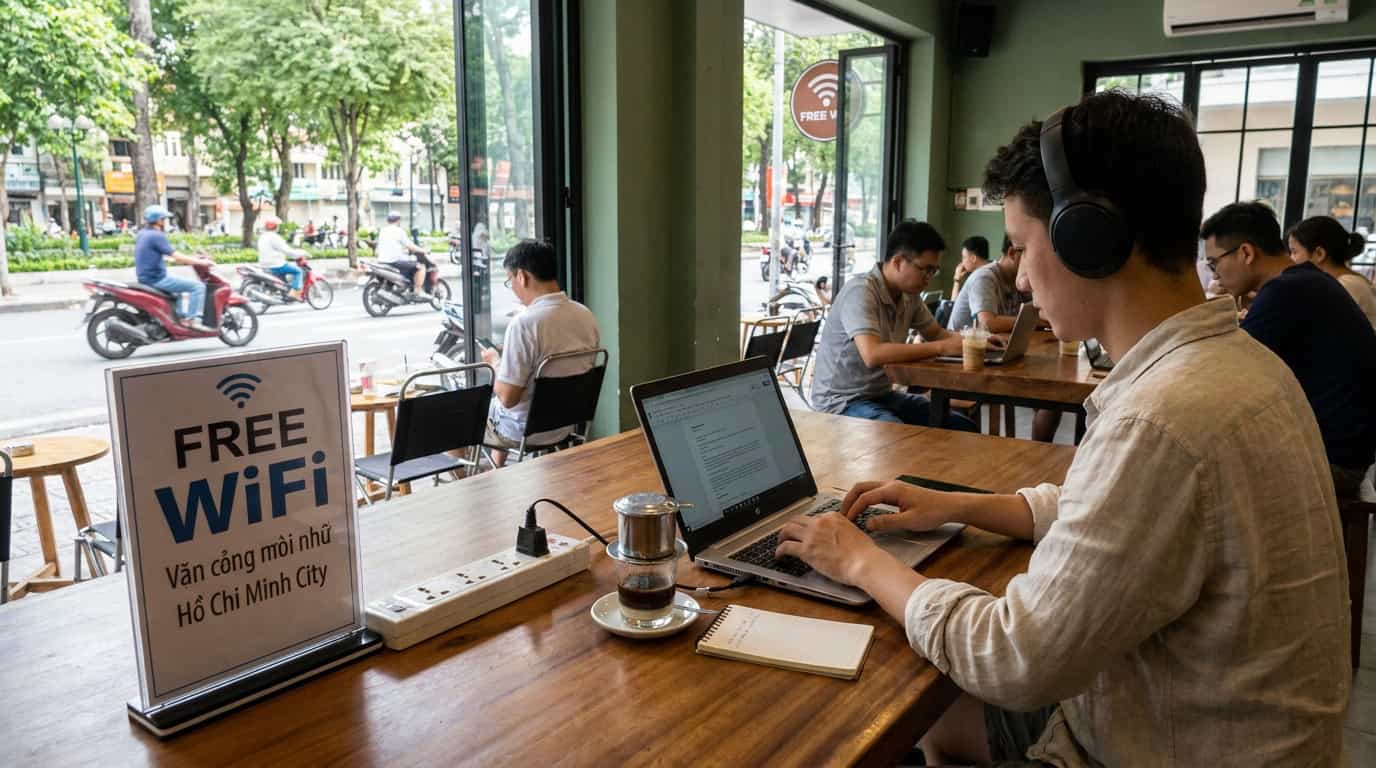
The practical answer for most remote workers: vet your apartment internet first, use co-working spaces as a supplement for focused work, and treat cafes as a last resort (cafe Wi-Fi in HCMC is genuinely variable — some BanhMi&Co-style chains run solid fiber, many independent cafes share a home-plan connection).
Mobile Data as a Backup: 4G and 5G Coverage in HCMC 2026
Vietnam’s mobile data pricing is among the lowest in Southeast Asia. Viettel, Vinaphone, and Mobifone all offer unlimited 4G plans starting around 100,000–150,000 VND/month (roughly $4–$6). 5G coverage on Viettel and Vinaphone now covers central HCMC districts reliably.
Real-world 5G speeds in District 1, Binh Thanh, and D2 average 80–150 Mbps download, 30–60 Mbps upload — more than sufficient for video conferencing and cloud work. A Vietnamese SIM card with a data plan is a mandatory purchase for any remote worker arriving in Saigon, both as a backup and for getting online during the first days before apartment internet is sorted.
Latency on 5G (30–50ms to regional servers) is generally acceptable for VoIP and video. Fiber fixed lines will typically be 10–20ms to Singapore, which is noticeably smoother for tools like Figma or any latency-sensitive application.
How to Actually Test Wifi Speed in Saigon Before Signing a Lease
Never rely on a landlord’s claim. Here is the standard verification process used by experienced Saigon remote workers:
- Visit during peak hours — arrive between 7 p.m. and 9 p.m. on a weekday. This is when shared connections reveal their true performance ceiling.
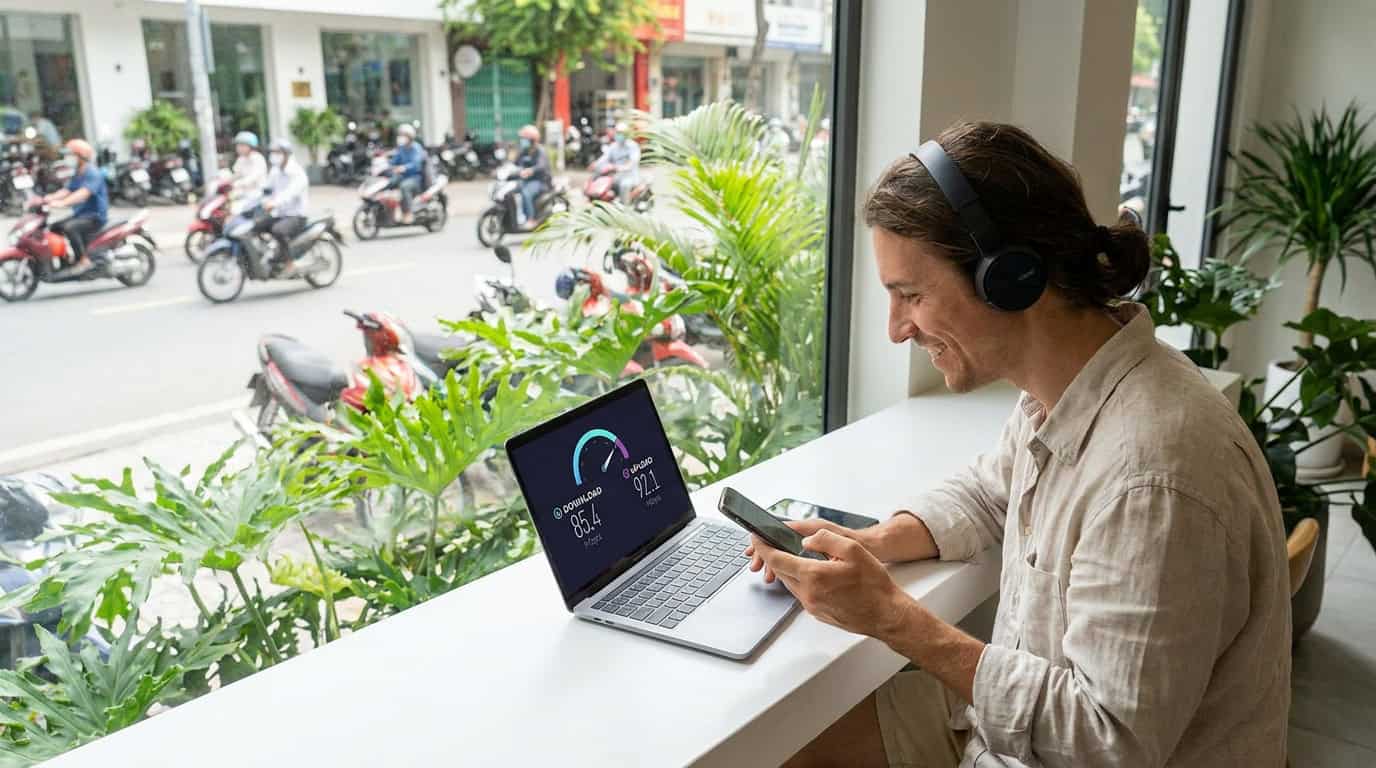
- Run fast.com and Speedtest.net — use both, as they route to different servers. Note download speed, upload speed, and ping to Singapore (should be under 30ms on fiber).
- Run a 30-minute consistency test — tools like Waveform’s Bufferbloat Test or a sustained iPerf session reveal whether speed drops over time, which single-point tests miss.
- Ask for the router login or ISP bill — a dedicated line will show a single-unit subscriber account. A shared line may be on a commercial plan registered to the building management company.
- Test video call quality — a 10-minute Zoom or Google Meet call is the most practical proxy for remote work usability.
What Upload Speed Matters: The Metric Most Listings Ignore
Download speed dominates listings and marketing materials, but remote workers care deeply about upload speed. Video calls, screen sharing, uploading deliverables, and pushing to cloud storage are all upload-limited operations.
Symmetric fiber plans (same up and down) are the norm from Viettel, FPT, and VNPT in 2026. A 100 Mbps plan should deliver ~100 Mbps up as well as down. Where this breaks down is on shared FTTN or cable connections that are structurally asymmetric (20 Mbps up on a 100 Mbps down plan) — these exist in older buildings that have not been upgraded to FTTH.
When evaluating wifi speed saigon for remote work, always ask specifically about upload speed. Anything below 20 Mbps upload will create friction on a daily basis for anyone doing video-heavy work.
VPN Performance: An Underrated Consideration for Remote Workers
Many remote workers route through a corporate VPN or use personal VPNs for privacy. VPN performance over Vietnamese ISPs is relevant because: (1) some enterprise VPNs route through US or EU servers, adding 200–300ms latency on top of the base 30ms to Singapore, and (2) certain protocols are occasionally throttled on consumer plans.
In practice, WireGuard-based VPNs with Singapore or Hong Kong endpoints perform well on Saigon fiber — adding 20–40ms latency on top of a clean base connection. OpenVPN over UDP is also reliable. If your employer requires a specific VPN endpoint, test it during your initial apartment visit. A connection that looks fine without VPN can become unusable if the VPN route adds 250ms of latency.
Red Flags to Watch for When Renting in Saigon
After years of remote workers reporting their experiences, patterns emerge in the listings that should trigger skepticism:
- “High-speed Wi-Fi included” with no Mbps figure — almost always shared and often under 20 Mbps at peak.
- Router in a common hallway or lobby — physical evidence of a shared building connection with Wi-Fi extenders rather than per-unit ports.
- ISP router in your unit but labeled with building management’s branding — may indicate a resold shared plan rather than a direct subscriber connection.
- No ethernet port in the unit — buildings serious about connectivity provide wired options. Wi-Fi-only setups are a risk signal.
- Landlord cannot name the ISP — a direct fiber subscriber always knows their provider.
Frequently Asked Questions
You May Also Find Useful
- Coworking Spaces with Best Internet in Saigon: Where Remote Workers Get Fast Wi-Fi
- Wi-Fi Included Apartments in Saigon 2025: What Speed and Reliability Actually Look Like in D1
- Coworking Spaces Saigon 2026: The Complete District-by-District Guide for Remote Workers
- Saigon Internet and Coworking: Guide for Digital Nomads and Remote Workers
Frequently Asked Questions
Is wifi speed in Saigon fast enough for remote work in 2026?
Yes, in the right accommodation. Saigon has excellent fiber infrastructure in modern buildings, with dedicated connections delivering 80–200 Mbps. The risk is shared building connections that collapse under evening load. Vet your specific building rather than relying on city-wide averages.
Which district in Ho Chi Minh City has the best internet for remote workers?
District 2 (Thao Dien, An Phu) and District 7 (Phu My Hung) are the most reliable for consistent wifi speed in Saigon due to newer building stock with proper fiber cabling. District 1 has excellent infrastructure but older serviced apartments are hit or miss. Binh Thanh is a solid budget option if you choose a post-2018 building.
What is a realistic monthly cost for good internet in a Saigon apartment?
Dedicated fiber plans cost 200,000–500,000 VND/month ($8–$20) directly from the ISP. Many modern apartments include this in rent. The question is whether “included internet” means a dedicated drop or a shared building connection — the price difference to you is zero but the performance difference is enormous.
How does wifi speed in Saigon compare to other Southeast Asian cities?
HCMC is competitive with Bangkok and Kuala Lumpur, and generally faster than Bali (Canggu), Chiang Mai, and Manila for fixed broadband. Singapore and Tokyo remain faster, but for remote work purposes Saigon’s fiber speeds are more than adequate. According to Ookla’s Q1 2026 data, Vietnam ranks in the top 5 in Southeast Asia for median fixed broadband speed.
Do I need a VPN to use the internet normally in Vietnam?
Most major services — Google, Zoom, Slack, GitHub, Notion, Figma — work without a VPN from Vietnamese ISPs. Some Western news sites and social platforms load slowly or intermittently without one. A VPN with a Singapore endpoint is worth having but is not required for standard remote work tools.
Official Resources
For the most up-to-date information on wifi speed saigon, visit the Vietnam Telecommunications Authority.