
Best Apps and Resources for Expats Living in Saigon
Ho Chi Minh City’s Apps for expats saigon is a topic every expat and long-stay visitor needs to understand before settling in Saigon. Published: June 2, 2026 | Reading time: 11 minutes
Apps for Expats Saigon: Key Takeaways
- Grab and Be dominate ride-hailing and food delivery in Ho Chi Minh City, with Grab holding roughly 60% of Southeast Asia’s ride-hailing market share as of 2025 (Momentum Works).
- Zalo is Vietnam’s default messaging app, used by over 78 million monthly active users — roughly 78% of the population (Decision Lab, 2025).
- MoMo, ZaloPay, and VietQR have made cashless payments mainstream, with the State Bank of Vietnam reporting cashless transaction volume up 57.1% year-on-year in 2024.
- Essential expat toolkit covers six categories: transport, food delivery, payments, communication, language, and healthcare.
- District 1 remains the top expat residential choice thanks to walkability, English signage, and proximity to all major service apps’ coverage zones.
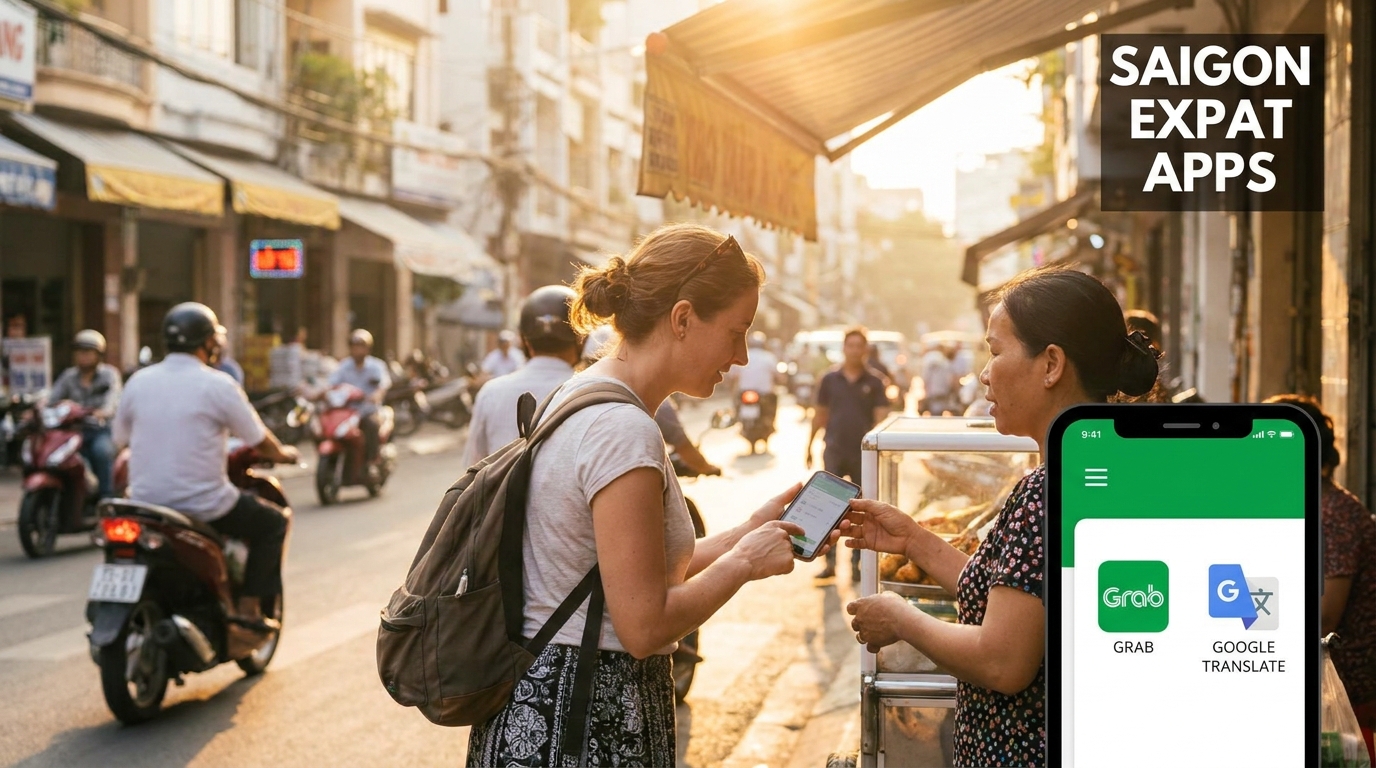
Why Your Phone Is Your Most Important Tool in Saigon
Moving to Ho Chi Minh City — Saigon, as residents still call it — used to mean carrying a phrasebook, a paper map, and a wad of small-denomination dong. In 2026, it means downloading roughly a dozen apps before your plane lands at Tan Son Nhat.
Saigon’s smartphone penetration is one of the highest in Southeast Asia. According to DataReportal’s Digital 2025: Vietnam report, 79.8 million Vietnamese internet users (78.8% of the population) are online, and 168.5 million mobile connections are active nationwide. That density has produced a hyper-local app ecosystem where almost every daily task — from booking a motorbike to paying your electric bill — happens through a Vietnamese-built platform.
The good news for new arrivals: most of these apps offer English interfaces. The catch: knowing which ones the locals actually use, and which Western alternatives simply don’t work here, can save you weeks of frustration.
Transport Apps: Getting Around Without a Car
Grab
Grab is the non-negotiable. Originally a Malaysian ride-hailing startup, Grab acquired Uber’s Southeast Asia operations in 2018 and has held roughly 60% regional market share ever since (Momentum Works, Who’s Who in Southeast Asia Ride-Hailing 2025).
In Saigon, Grab gives you four main options:
– GrabBike — the cheapest and fastest way through traffic (typical fare: 20,000–40,000 VND for short hops)
– GrabCar — air-conditioned 4-seater for longer trips or airport runs
– GrabFood — restaurant delivery
– GrabExpress — parcel and document courier
Payment can be cash, linked international card, or GrabPay wallet. The app’s English interface is clean, and driver ratings keep service quality reasonable.
Be
Be is the Vietnamese-owned challenger that has carved out a genuine number-two position. Drivers are often cheaper than Grab during off-peak hours, and the app integrates with local banks more smoothly. Most expats install both and check fares side-by-side.
Xanh SM
Launched in 2023 by VinFast, Xanh SM is Vietnam’s all-electric taxi and bike service. By the end of 2024 it had completed over 100 million rides and operates a fleet of more than 30,000 EVs nationwide (VinFast investor communications, 2024). For anyone uncomfortable with the air quality on a GrabBike, Xanh SM’s electric cars are a noticeably cleaner option.
Food Delivery: Eating Like a Local
Saigon’s food delivery scene is fierce. GrabFood and ShopeeFood are the two giants, with Be Food as a competitive third. ShopeeFood (owned by Sea Group) tends to have the deepest catalog of street-food vendors — exactly the small cơm tấm and bún bò shops that don’t appear on Western-facing platforms.
For groceries:
– GrabMart — convenience and supermarket delivery in under an hour
– Bach Hoa Xanh app — Vietnam’s largest grocery chain; great for fresh produce
– Annam Gourmet — Western imports, organic produce, and wine (their app handles delivery for District 1 and District 2 customers)
Banking and Payments: Going Cashless
Vietnam’s leap to a cashless economy has been dramatic. The State Bank of Vietnam reported that non-cash transactions grew 57.1% in volume and 34.5% in value in 2024, with QR-code payments alone up over 100% year-on-year (SBV Annual Report 2024).
The Three You Need
MoMo is the market leader for e-wallets, claiming over 31 million users. It handles bill payments (electricity, water, internet), mobile top-ups, peer-to-peer transfers, and in-store QR payments at virtually every coffee shop and convenience store.
ZaloPay is integrated directly into Zalo (more on that below), which makes it the path of least resistance once you’re using Zalo for messaging anyway.
VietQR is the interbank QR standard. Most local bank apps (Vietcombank, Techcombank, VPBank, MB Bank) support scanning a VietQR code to pay instantly with no fees — including paying small street vendors who print their QR on a laminated card.
For Expats Specifically
- Wise (formerly TransferWise) — by far the cheapest way to transfer money from your home country into a Vietnamese VND account.
- Revolut — works for international card payments and ATM withdrawals, though Vietnam isn’t yet a full Revolut market.
- Timo — a Vietnamese digital bank with an English app, popular with expats who don’t want to navigate a traditional branch.
Communication: Why You’ll Stop Using WhatsApp
This is the single biggest surprise for new arrivals. Vietnam doesn’t run on WhatsApp. It runs on Zalo.
According to Decision Lab’s Connected Consumer Q1 2025 report, Zalo is the most-used messaging app in Vietnam at 87% penetration, ahead of Facebook Messenger (74%) and well ahead of WhatsApp (under 15%). Your landlord, your delivery driver, your dentist, your gym, and your local pho lady will all ask for your Zalo before they ask for your phone number.
Zalo handles:
– Text, voice, and video calls
– Group chats
– Photo and file sharing
– Mini-app payments (via ZaloPay)
– Official business accounts (think utilities, hospitals, government services)
Install it on day one. Use your local Vietnamese SIM number to register — international numbers can hit verification issues.
For business video calls, Zoom and Google Meet work normally. Microsoft Teams is widely used by multinationals.
Language Learning: Beyond Duolingo
Vietnamese is a tonal language, which makes app-based learning genuinely difficult. The most-recommended tools by expats who actually stick with it:
- Drops — visual vocabulary with strong Vietnamese-specific content; five free minutes per day is enough to make steady progress
- Pimsleur Vietnamese — audio-only, focuses on pronunciation and tones; expensive but considered the gold standard for southern dialect
- Anki with a downloaded Vietnamese deck — free, customizable, the long-term winner for serious learners
- Google Translate — the camera-translate feature for menus is invaluable; download the offline Vietnamese pack
Duolingo added Vietnamese in 2023 and the course has improved, but the tone training remains weak compared to Pimsleur.
For finding an in-person tutor, Preply and the Facebook group Vietnamese Language Exchange Saigon both work well.
Healthcare and Insurance
Vietnam’s healthcare system is bifurcated: public hospitals are inexpensive but bureaucratic; private international hospitals are excellent but pricey. According to the WHO Global Health Expenditure Database (2024), Vietnam spends roughly 5.3% of GDP on health, with private out-of-pocket spending making up about 40% of total health expenditure — meaning insurance matters.
Apps worth installing:
- Jio Health — telemedicine and home doctor visits in HCMC, with English-speaking GPs
- eDoctor — appointment booking at major hospitals (FV Hospital, Hanh Phuc, Columbia Asia)
- Pharmacity — pharmacy chain with app-based delivery for OTC medications
- Long Chau — competing pharmacy chain, often better stocked for prescription items
For insurance claim documentation, Pacific Cross Vietnam and Liberty Insurance both run apps that let you submit claims by photo — far faster than the paper process.
Daily Life Utilities
A few smaller apps that punch above their weight:
- VnExpress International — English-language news from Vietnam’s largest digital paper
- TheThao247 / VOV Giao Thông — real-time traffic alerts (useful during monsoon flooding)
- EVN HCMC — official Ho Chi Minh City electricity app; check your bill, report outages
- iSaigon — city information, event listings, and emergency contacts
- Klook and Traveloka — domestic flights, trains, and tour bookings; both cheaper than international OTAs for Vietnam-region travel
- AirVisual (IQAir) — Saigon’s air quality varies significantly by month; this app tells you when to wear a mask
A Realistic First-Week Setup Checklist
| Priority | App | Time to Set Up |
|---|---|---|
| Day 1 | Grab, Zalo, Google Translate | 30 minutes |
| Day 1 | Local SIM (Viettel or Mobifone) | At airport |
| Day 2 | MoMo or ZaloPay | 15 minutes |
| Day 3 | GrabFood, ShopeeFood | 10 minutes |
| Week 1 | Bank app (Timo or Vietcombank) | 1 hour + branch visit |
| Week 1 | Jio Health, AirVisual | 15 minutes |
| Week 2 | Language app of choice | Ongoing |
Frequently Asked Questions
Where do most expats live in Saigon?
The largest expat populations cluster in District 1 (central, walkable, top restaurants and offices), District 2 / Thao Dien (leafy, international schools, popular with families), District 7 / Phu My Hung (modern high-rises, large Korean and Japanese communities), and District 3 (slightly cheaper than D1 with strong café culture). District 1 remains the most popular for short- and medium-stay professionals because it combines walkability, English-language services, and dense Grab/Be driver coverage that keeps wait times under three minutes.
What apps should I have before going to Vietnam?
Install five before you board: Grab (transport and food), Zalo (messaging — locals will ask immediately), Google Translate with the offline Vietnamese pack, XE Currency for VND conversions, and Wise if you’ll need to transfer money from abroad. Everything else — local bank apps, MoMo, ShopeeFood — can wait until you have a Vietnamese SIM and address.
Which app is mostly used in Vietnam?
Zalo is Vietnam’s most-used app overall, with roughly 78 million monthly active users (Decision Lab, 2025). It functions as the country’s combined WhatsApp, WeChat, and Venmo. For ride-hailing and food, Grab leads with about 60% of the Southeast Asian market (Momentum Works, 2025). For mobile payments, MoMo holds the largest e-wallet share at over 31 million users.
What do Vietnamese use instead of WhatsApp?
Zalo. Built by Vietnamese tech company VNG and launched in 2012, Zalo has become so dominant that WhatsApp barely registers in local usage. Zalo handles text, voice calls, video calls, file transfer, payments via ZaloPay, and official business communication. New arrivals are typically asked for their Zalo number within the first hour of meeting anyone — your landlord, your gym, your bank, even your dry cleaner.
The Bottom Line
Saigon rewards the prepared. A phone loaded with the right dozen apps turns a notoriously chaotic city into one of the most convenient places in Asia to live. Transport arrives in two minutes. Food arrives in twenty. Bills get paid with a thumb. The Vietnamese-built ecosystem is genuinely world-class — once you know which apps to trust.
For long-stay residents, the right address makes everything else easier: a central District 1 base puts you inside the highest-density service zone for every major app on this list.
For more Saigon guides, check out: Saigon vs Bangkok for Expats: Which City Is Right for You in 2026?, Saigon 7-Day Itinerary: A Week in Ho Chi Minh City.
For official information and further reading, visit Wikipedia — Ho Chi Minh City Transport.