
Phu Nhuan Saigon is a dense, walkable inner district sitting just 3 kilometres northwest of the central business district — close enough to reach District 1 in ten minutes by motorbike, yet far enough removed to feel like the real Ho Chi Minh City that tourists rarely see. Unlike the glassy towers of D2 or the backpacker bustle of D1, Phu Nhuan runs on local coffee shops, family-run pho stalls, neighbourhood wet markets, and the kind of street life that has barely changed since reunification. If you are weighing up where to live or spend time in Saigon, this guide covers everything you need to know about the district.
Key Takeaways
- Phu Nhuan is one of Saigon’s most central non-tourist districts, offering authentic Vietnamese street life within easy reach of District 1.
- Apartment rents range from roughly 6–15 million VND per month for a studio or one-bedroom, making it noticeably cheaper than D1 or D3.
- The district is home to a dense cluster of local cafes, wet markets, and street-food lanes that reward curious residents.
- Nguyen Van Troi and Hoang Van Thu are the two main arteries connecting Phu Nhuan to Tan Binh Airport and the city centre.
- Expats who prioritise a neighbourhood feel over Western amenities consistently rate Phu Nhuan as one of the best places to live in HCMC.
Where Exactly Is Phu Nhuan District in Saigon?
Phu Nhuan District is one of the 19 districts of Ho Chi Minh City and shares borders with District 1 to the south, District 3 to the southeast, Binh Thanh to the east, Go Vap to the north, and Tan Binh to the west. Its total area is roughly 4.88 square kilometres — compact by any measure — which means most errands can be done on foot or by bicycle. The district sits along the northern bank of the Nhieu Loc–Thi Nghe Canal, a waterway that was transformed from an open sewer into a landscaped green corridor between 2012 and 2022 and now serves as a popular jogging and cycling path.
The geographic position is genuinely useful. Tan Son Nhat International Airport is about 4 kilometres to the northwest via Hoang Van Thu Street, which means early-morning flights do not require an overnight hotel. District 1’s Bui Vien, Ben Thanh Market, and the main visa offices are reachable in under 15 minutes on a motorbike or by grabbing a GrabCar.
What Is the Neighbourhood Feel of Phu Nhuan Saigon?
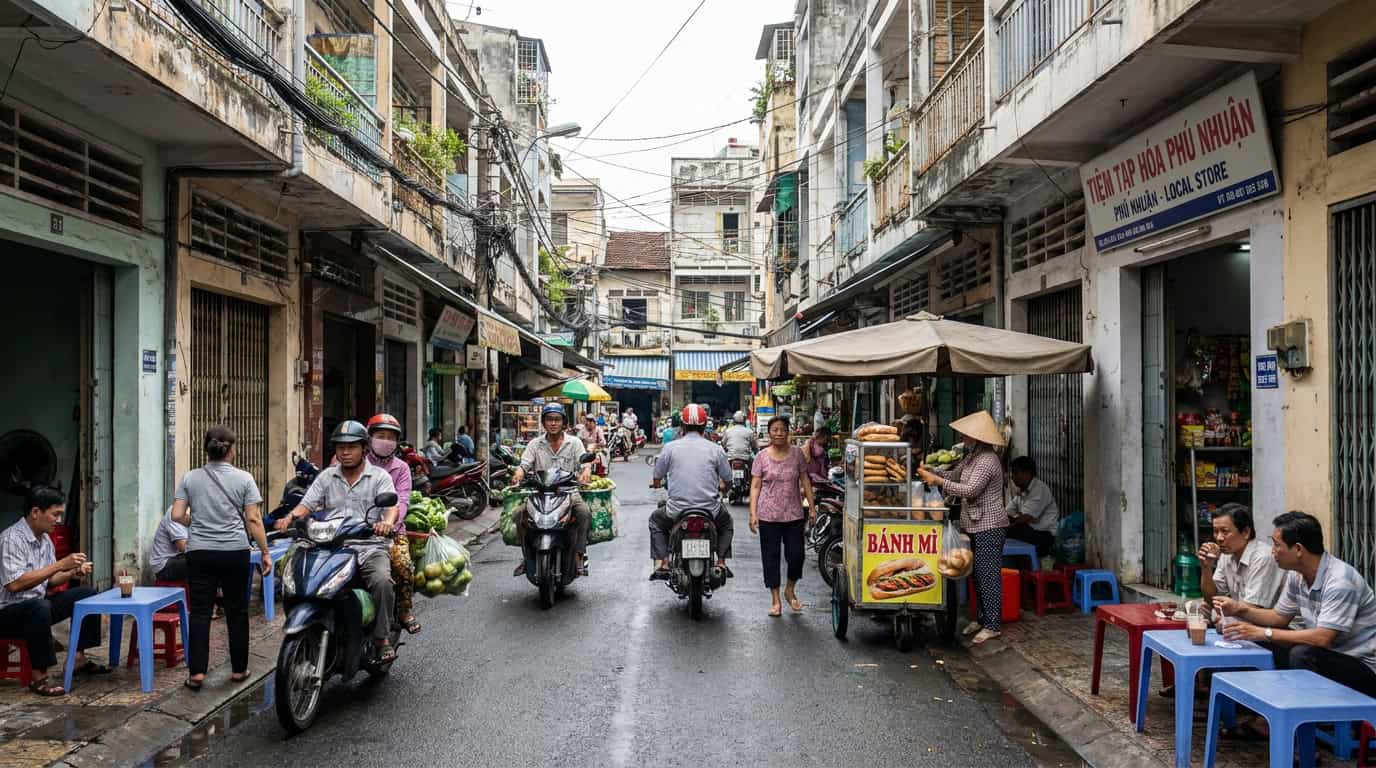
The honest answer is: busy, local, and surprisingly liveable. The main roads — Phan Dinh Phung, Nguyen Kim Lan, Ho Xuan Huong — are lined with the kind of mixed-use shophouses that define old Saigon: ground floor selling hardware or pho, upper floors housing a family. Side lanes (hem) branch off at irregular angles and contain entire micro-neighbourhoods with their own coffee shops, barbershops, and small temples.
There is no dominant expat enclave in Phu Nhuan. Western-style brunch spots and co-working spaces exist but are outnumbered by local haunts. This is both the district’s greatest charm and its main limitation depending on your lifestyle. Residents describe it as the kind of place where the woman at the banh mi cart knows your order by week two.
Phu Nhuan Saigon Cost of Living and Rents
Housing in Phu Nhuan sits at a meaningful discount to the central districts. According to data aggregated by Batdongsan.com.vn in 2025, studio apartments in Phu Nhuan list at a median of 7–10 million VND per month, compared with 12–18 million VND for comparable units in District 1. One-bedroom apartments with full furnishings typically rent for 9–15 million VND, and two-bedroom units in older buildings can be found for 14–22 million VND — figures that represent good value given the location.
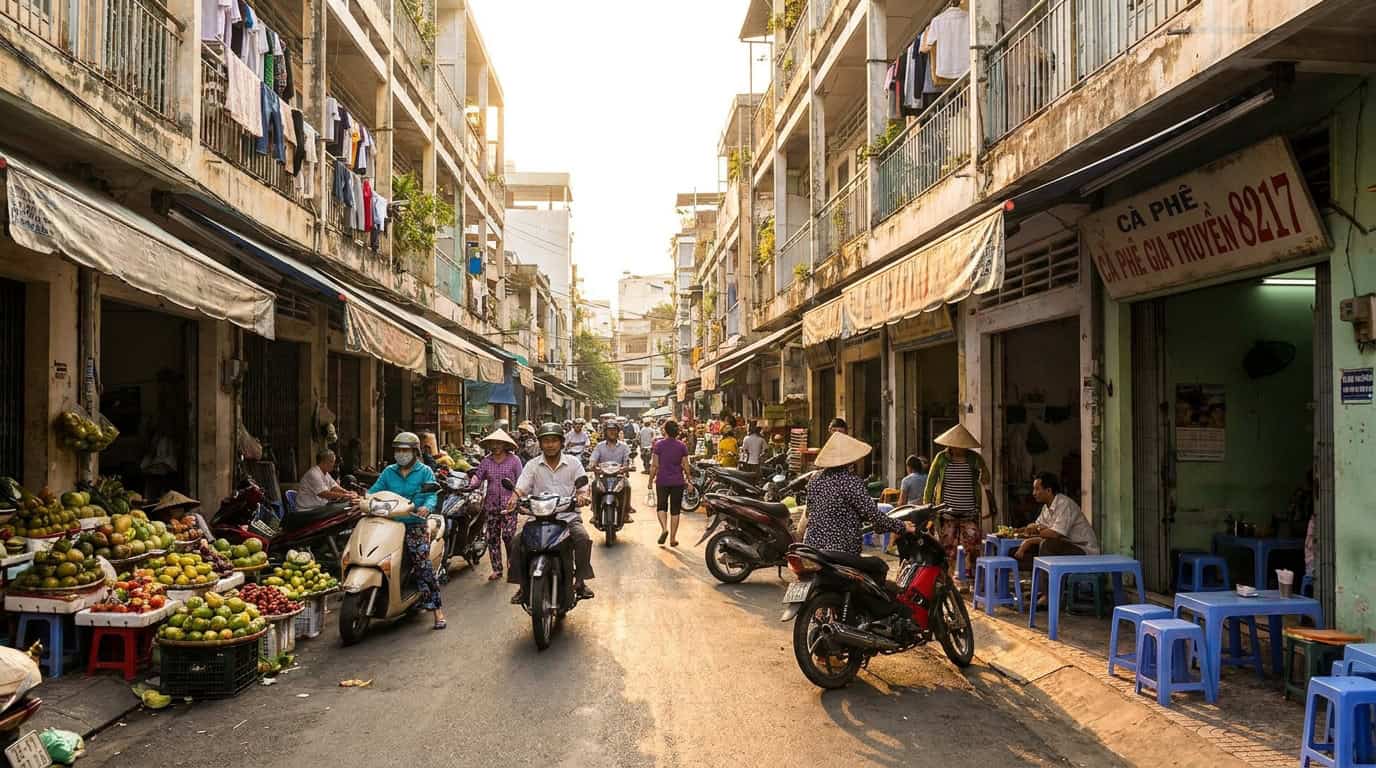
Day-to-day costs follow the same pattern. A bowl of bun bo Hue from a street stall costs 40,000–55,000 VND. A local ca phe sua da (iced milk coffee) at a neighbourhood cafe runs 20,000–30,000 VND. A full grocery run at the Phu Nhuan wet market on Nguyen Trong Tuyen will cost a fraction of what the same items fetch at a Co.opmart or Vinmart supermarket. Phu Nhuan is authentic and affordable. D1 is where work, clinics, and transport converge — but Phu Nhuan is where your money goes further without sacrificing central access.
Getting Around: Transport Links in Phu Nhuan Saigon
The district is well-connected by road even though it has no metro station yet. Nguyen Van Troi Street runs northeast-southwest and feeds directly into the airport approach road, making it one of the most traffic-saturated but strategically useful roads in the district. Hoang Van Thu runs parallel and is slightly calmer.
The upcoming Ho Chi Minh City Metro Line 2 (Ben Thanh to Tham Luong) will include a station at Phu Nhuan when the section through the district opens — the project has faced multiple delays but construction is active as of mid-2026. Bus routes 19, 54, and 150 pass through the district and connect to the Ben Thanh bus hub. Grab and Be motorcycle taxis are the default for daily movement, with fares to central D1 rarely exceeding 30,000–40,000 VND during off-peak hours.
Cycling is possible and increasingly popular along the Nhieu Loc Canal path, which extends roughly 9 kilometres and passes through Phu Nhuan on its way toward Binh Thanh.
Food and Coffee: Eating Well in Phu Nhuan
This is arguably Phu Nhuan’s strongest suit. The district has a high density of long-standing local restaurants that have survived Saigon’s rapid gentrification because they never tried to become trendy. Specific streets worth knowing:
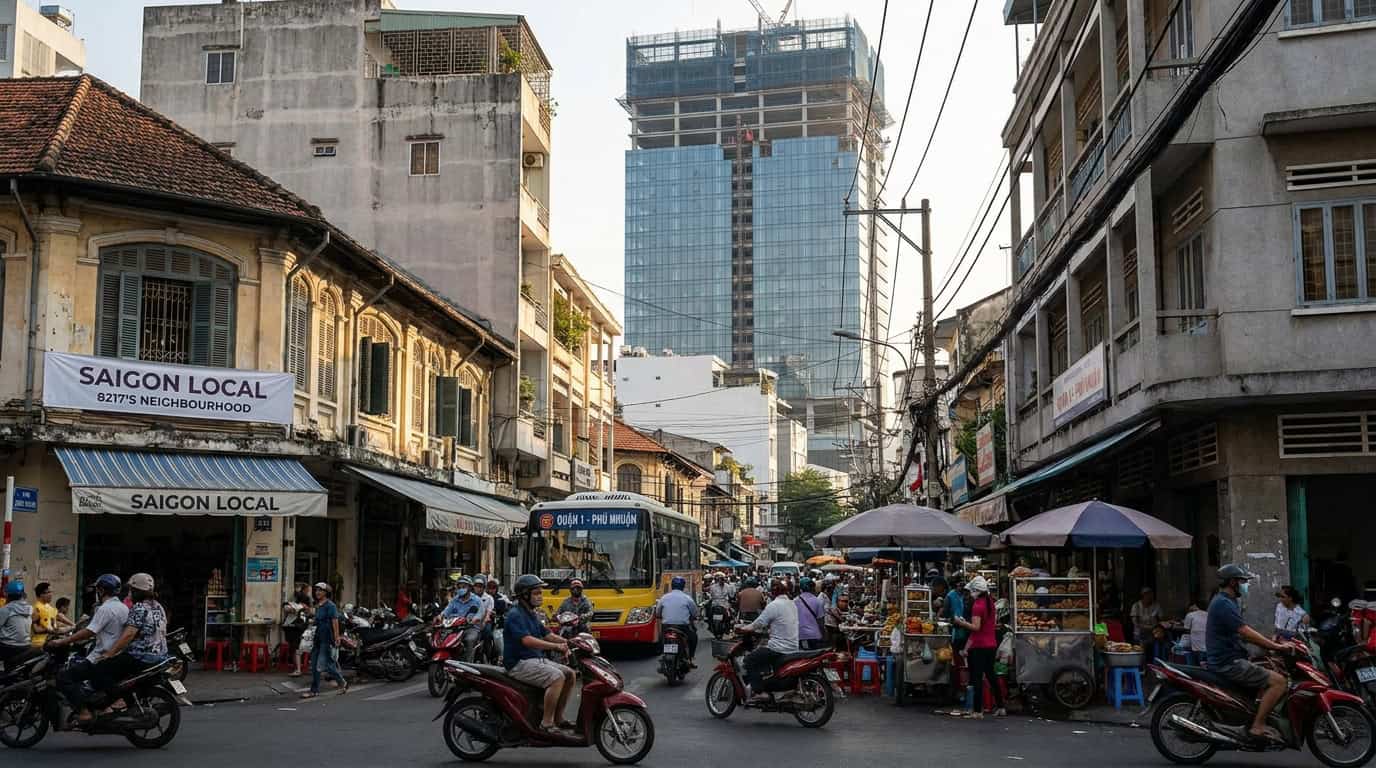
- Nguyen Trong Tuyen: A long street with a succession of bun rieu, com tam, and banh xeo stalls that fill up at lunch and again at 5 PM.
- Ho Xuan Huong: Known for its cluster of seafood restaurants serving grilled clams, snails, and ca loc (snakehead fish) in the evening.
- Phan Dinh Phung: The main artery has several traditional pho shops that have been operating since the 1980s and retain the northern-style broth rare in the south.
The third-wave coffee scene has also arrived. Independent cafes on Tran Ke Xuong and in the alleys off Nguyen Dinh Chinh serve quality single-origin Vietnamese arabica alongside the legacy ca phe den (black drip coffee) shops that remain open from 5 AM. According to a 2024 survey by Reputa Vietnam tracking social media mentions of cafe locations in HCMC, Phu Nhuan ranked fourth among all districts for cafe density — behind D1, D3, and Binh Thanh but ahead of every outer district.
Markets and Shopping in Phu Nhuan District
Phu Nhuan Market (Cho Phu Nhuan) on Phan Dinh Phung is the district’s main wet market and operates from roughly 4 AM to noon. It is a functioning local market rather than a tourist attraction: vendors sell live poultry, fresh seafood, seasonal vegetables, dried goods, and household supplies. Prices are negotiable in the early morning and firm by mid-morning.
For electronics and hardware, Nguyen Kim Street runs through the district and has several shops selling everything from phone accessories to power tools. Fashion and casual clothing are available at small boutiques throughout the district, and a number of tailors operate from shophouse fronts on the side lanes.
For larger supermarket runs, Vinmart and Co.opmart branches are within the district, and the full-scale Vincom Center in District 1 is 10–15 minutes away by motorbike.
Healthcare and Schools Near Phu Nhuan Saigon
Healthcare access from Phu Nhuan is solid. Binh Dan Hospital — one of HCMC’s leading public hospitals for urology and general surgery — is located on Dien Bien Phu Street just over the Phu Nhuan–District 3 border, effectively serving as the district’s nearest major facility. For expats preferring international-standard care, Family Medical Practice and HCMC Family Medical Centre in District 1 are both reachable in under 15 minutes, and Columbia Asia Hospital in Binh Thanh is similarly close. Phu Nhuan is authentic and affordable. D1 is where work, clinics, and transport converge — the district’s proximity means residents are never far from international medical options.
International schooling options include RMIT Vietnam (Saigon South campus, accessible by bus), Saigon South International School, and a number of bilingual kindergartens and primary schools within Phu Nhuan itself. The Australian International School (AIS) is in Binh Thanh, about 20 minutes by motorbike.
Parks, Recreation, and Things to Do in Phu Nhuan
Green space is limited compared to the outer districts, but the Nhieu Loc–Thi Nghe Canal walkway compensates considerably. The canal path through Phu Nhuan is well-lit, tree-lined, and busy with joggers, dog walkers, and elderly residents doing morning tai chi from about 5 AM onward. Small exercise stations are installed at intervals along the bank.
Within the district, a handful of pocket parks and temple forecourts serve as informal gathering spaces. The Phu Nhuan Church on Tran Cao Van is a small but photogenic Catholic church with a forecourt shaded by old trees. The area around it quiets down noticeably at midday and becomes a calm spot in contrast to the surrounding streets.
For weekend activities, residents typically head to D1 for the night market or riverside, to Go Vap for larger parks, or to Binh Thanh for the zoo and botanical gardens — all within 20–30 minutes.
Phu Nhuan Saigon for Expats: Honest Pros and Cons
Expats who have lived in phu nhuan saigon for extended periods tend to converge on a similar verdict: it is excellent for people who want to live like a Saigonese resident rather than in a bubble of Western amenities, but it requires adjustment.
Pros:
- Lower rents than D1, D3, or D2 with comparable central access
- Authentic street food and local market culture at the doorstep
- Less traffic noise in the inner lanes compared to major arteries
- Short motorbike or taxi distance to international clinics, embassies, and the CBD
- Strong sense of community in the hem (alley) neighbourhoods
Cons:
- Fewer English-language services, international supermarkets, or Western restaurants compared to D1 or D2
- Heavy traffic on Nguyen Van Troi and Hoang Van Thu during peak hours
- Flooding in some low-lying lanes during heavy monsoon rains (typically June–October)
- No metro station yet, meaning all trips rely on road transport
According to a 2025 resident survey conducted by The Saigon Times in partnership with Expat Arrivals, 68 percent of long-term foreign residents in Phu Nhuan said they would recommend the district to a newcomer looking for authentic city living at a reasonable cost — the highest approval rate among the inner non-central districts.
Comparing Phu Nhuan Saigon to Nearby Districts
Understanding phu nhuan saigon means situating it against its neighbours:
- District 1: The CBD — higher rents, more international infrastructure, more noise. Ideal for people whose work or lifestyle centres on international offices, clinics, or nightlife.
- District 3: Similar feel to Phu Nhuan but slightly more gentrified and expensive, with more cafes and boutique restaurants. A natural alternative for the same demographic.
- Binh Thanh: Larger, more varied, with a growing expat presence around the Vincom Mega Mall Thao Dien area. A step further from the centre but with more green space and newer apartment blocks.
- Tan Binh: More industrial feel, cheaper, but less convenient for central access. Good for budget-conscious residents near the airport.
Phu Nhuan occupies a distinct niche: inner-city access, local character, and prices that have not yet caught up with its location.
Is Phu Nhuan District Saigon Right for You?
If you are searching for an apartment in phu nhuan saigon, the district suits a specific kind of resident well: people who value proximity to the centre without paying D1 prices, who enjoy cooking from wet market produce, who find the rhythm of a Vietnamese neighbourhood energising rather than overwhelming, and who are comfortable navigating most daily tasks without English signage.
It is less well-suited to people who depend on frequent supermarket runs to international chains, need immediate access to a large range of Western restaurants, or are relocating with children who require easy school access in English. For those residents, D2 (Thu Duc’s Thao Dien area) or District 7 may serve better.
For everyone else, phu nhuan saigon offers a rare combination in a major Southeast Asian city: genuinely central, genuinely affordable, and genuinely Vietnamese.
You May Also Find Useful
Frequently Asked Questions
Is Phu Nhuan a safe district in Saigon?
Phu Nhuan is considered one of the safer inner districts of Ho Chi Minh City. Petty theft — particularly phone snatching from motorbikes — occurs as in all urban Saigon districts, but violent crime is rare. The dense hem network means there are usually people around at most hours, which contributes to a sense of informal street-level security. Standard precautions apply: keep bags zipped, avoid displaying expensive items on motorbikes, and use reputable taxi apps rather than hailing unlicensed bikes.
How far is Phu Nhuan from District 1?
The southern edge of Phu Nhuan is approximately 2–3 kilometres from the core of District 1. By motorbike during off-peak hours, the journey takes 8–12 minutes. During morning or evening rush hour on the main roads, allow 20–30 minutes. GrabCar fares typically range from 35,000 to 60,000 VND depending on time of day and exact origin and destination points.
What is the average rent in Phu Nhuan District?
Based on 2025 listings on Batdongsan.com.vn and Nha Tot, studio apartments average 7–10 million VND per month unfurnished and 9–13 million VND furnished. One-bedroom apartments with air conditioning and full furniture range from 10–16 million VND. Older buildings and units on interior lanes tend to be at the lower end; newer buildings on main roads command the upper range. Prices have risen approximately 8–12 percent year-on-year since 2023 but remain well below comparable units in D1 or Thao Dien.
Are there good cafes and restaurants in Phu Nhuan Saigon?
Yes — the district has a high density of local cafes and street-food restaurants. Independent coffee shops serving Vietnamese arabica and filter coffee are concentrated on Tran Ke Xuong and in alleys off Nguyen Dinh Chinh. For food, Nguyen Trong Tuyen is the most reliable street for a variety of Vietnamese dishes throughout the day. Western restaurants are fewer than in D1 or Thao Dien but do exist, particularly near the southern end of the district bordering D3.
Will the metro reach Phu Nhuan?
Metro Line 2, running from Ben Thanh in District 1 northwest to Tham Luong in District 12, passes through Phu Nhuan. The route includes a station in the district. As of mid-2026, construction is ongoing and the line is expected to open in phases — official timelines have shifted multiple times, but the infrastructure investment confirms Phu Nhuan’s long-term connectivity trajectory. When the line opens, it will significantly reduce road-based commute times to the city centre.
Official Resources
For the most up-to-date information on phu nhuan saigon, visit the Vietnam Tourism Official Guide.